Bhagavad Gita 7.4: meaning and translation
Chapter 7: Jnana Vijnana Yoga. Krishna says
Krishna names the eight parts of his nature (prakṛti): earth, water, fire, air, space (ether), mind (manas), intellect (buddhi) and the sense of "I" (ahaṅkāra).
Click or tap a word for its meaning and its dictionary page.
Text and layers
Text and layers
These choices stay in this browser.
Bhagavad Gita 7.4
भूमिरापोऽनलो वायुः खं मनो बुद्धिरेव च ।अहङ्कार इतीयं मे भिन्ना प्रकृतिरष्टधा ॥
Bhumiraponalo vayuh kham mano buddhireva chaAhankara itiyam me bhinna prakritirashtadha
bhūmirāpo’nalo vāyuḥ khaṃ mano buddhireva ca |ahaṅkāra itīyaṃ me bhinnā prakṛtiraṣṭadhā ||
Our explanation Krishna names the eight parts of his nature (prakṛti): earth, water, fire, air, space (ether), mind (manas), intellect (buddhi) and the sense of "I" (ahaṅkāra). The commentators explain this list in different ways (see the views).
हिंदी अर्थ कृष्ण अपनी प्रकृति के आठ भाग बताते हैं: पृथ्वी, जल, अग्नि, वायु, आकाश, मन, बुद्धि और अहंकार। टीकाकार इस सूची को अलग-अलग ढंग से समझाते हैं।
Word by word
Every word, with its dictionary page
Word by word
- भूमिः bhūmiḥ · earth (noun (feminine), nominative singular) Dictionary: bhūmi, Monier-Williams 1899, p. 763, col. 1 “the earth, soil, ground”
- आपः āpaḥ · water (noun (feminine), nominative plural) Dictionary: 2. ap, Monier-Williams 1899, p. 47, col. 3 “water”
- अनलः analaḥ · fire (noun (masculine), nominative singular) Dictionary: anala, Monier-Williams 1899, p. 26, col. 2 “fire; the god of fire”
- वायुः vāyuḥ · air, wind (noun (masculine), nominative singular) Dictionary: 1. vāyu, Monier-Williams 1899, p. 942, col. 2 “wind, air (as one of the 5 elements; in MBh. 7 winds are reckoned)”
- खम् kham · space, ether (noun (neuter), nominative singular) Dictionary: 3. kha, Monier-Williams 1899, p. 334, col. 2 “vacuity, empty space, air, ether, sky”
- मनः manaḥ · mind (noun (neuter), nominative singular) Dictionary: manas, Monier-Williams 1899, p. 783, col. 3 “mind (in its widest sense as applied to all the mental powers)”
- बुद्धिः buddhiḥ · intellect (noun (feminine), nominative singular) Dictionary: buddhi, Monier-Williams 1899, p. 733, col. 3 “intelligence, reason, intellect, mind, discernment, judgment”
- एव eva · also (indeclinable) Dictionary: 1. eva, Monier-Williams 1899, p. 232, col. 2 “just, exactly, very, same, only, even, alone, merely”
- च ca · and (indeclinable) Dictionary: 2. ca, Monier-Williams 1899, p. 380, col. 1 “and, both, also, moreover, as well as”
- अहङ्कारः ahaṅkāraḥ · the sense of "I" (noun (masculine), nominative singular) Dictionary: ahaṃ-kāra, Monier-Williams 1899, p. 124, col. 2 “conception of one's individuality, self-consciousness”
- इति iti · thus (indeclinable) Dictionary: 2. iti, Monier-Williams 1899, p. 165, col. 1 “in this manner, thus”
- इयम् iyam · this (pronoun (feminine), nominative singular) Dictionary: 1. idam, Monier-Williams 1899, p. 165, col. 2 “this, this here, referring to something near the speaker”
- मे me · "my" (Krishna's) (pronoun, genitive singular) Dictionary: 1. mad, Monier-Williams 1899, p. 777, col. 2 “base of the first pers. pron. in the sg. number (esp. in comp.)”
- भिन्ना bhinnā · divided (past participle (feminine), nominative singular) Dictionary: bhinna, Monier-Williams 1899, p. 757, col. 1 “divided into parts, anything less than a whole”
- प्रकृतिः prakṛtiḥ · nature (prakṛti) (noun (feminine), nominative singular) Dictionary: pra-kṛti, Monier-Williams 1899, p. 654, col. 1 “the original or natural form or condition of anything, original or primary substance”
- अष्टधा aṣṭadhā · eightfold (indeclinable) Dictionary: aṣṭa-dhā, Monier-Williams 1899, p. 116, col. 2 “in eight parts or sections”
Old translations
Kashinath Trimbak Telang, 1882. Public domain. Page 73–74.
Earth, water, fire, air, space, mind, understanding, and egoism1, thus is my nature divided eightfold.
Footnotes (the translator’s own) - This accords with the Sâṅkhya philosophy. See chapter I, sutra 61 of the current aphorisms. ↩
Compare 3 translations
Kashinath Trimbak Telang, 1882. Public domain. Page 73–74.
Earth, water, fire, air, space, mind, understanding, and egoism1, thus is my nature divided eightfold.
Footnotes (the translator’s own) - This accords with the Sâṅkhya philosophy. See chapter I, sutra 61 of the current aphorisms. ↩
You are reading this one
Annie Besant, 1895. Public domain. Page 75.
Earth, water, fire, air, ether, Manas and Buddhi also and Ahankâra—these are the eightfold division of My Prakriti—1
This sentence goes on in 7.5.
Footnotes (the translator’s own) - Prakriti is matter in the widest sense of the term, including all that has extension. ↩
You are reading this one
Swami Swarupananda, 1909 (first printed 1907). Public domain. Page 146.
Bhumi (earth), Apa (water), Anala (fire), Vâyu (air), Kham (ether), mind, intellect, and egoism: thus is My Prakriti divided eightfold.
You are reading this one
Cite this verse
The translation: K. T. Telang, The Bhagavadgîtâ (The Sacred Books of the East, vol. VIII, Oxford: Clarendon Press, 1882), pp. 73–74. Bhagavad Gita 7.4.
The translation: Annie Besant, The Bhagavad Gîtâ, or The Lord's Song (London: Theosophical Publishing Society, 1895), p. 75. Bhagavad Gita 7.4.
The translation: Swami Swarupananda, Srimad-Bhagavad-Gita (Mayavati: Prabuddha Bharata Press, 1909; first printed in Prabuddha Bharata, 1907–1909), p. 146. Bhagavad Gita 7.4.
Our explanation: “Bhagavad Gita 7.4: meaning and translation.” Pujadeep. Updated October 27, 2026. https://pujadeep.com/bhagavad-gita/7/4/
Pujadeep’s explanations are free to quote with credit: name Pujadeep and link to the page. How to credit
Classical readings, by school
Each reading is named by its school. None is presented as the only meaning.
What Advaita, Vishishtadvaita and Dvaita teach, in short
Shankara Advaita
Shankara says the five elements here are their subtle forms (tanmātras); mind stands for its cause, ahaṅkāra; intellect for mahat; and ahaṅkāra for the Unmanifest (avyakta) joined with ignorance (avidyā). This eightfold prakṛti is the Lord's māyā.
Source: The Bhagavad-Gita, with the commentary of Sri Sankaracharya, translated by A. Mahadeva Sastri (2nd ed., Mysore: G. T. A. Printing Works, 1901), commentary on 7.4, pp. 189–190. Summarised in our own words; none of its text is reproduced.
Ramanuja Vishishtadvaita
Ramanuja takes this as primal matter (mūla-prakṛti), the base of the whole universe. It serves conscious beings as the things they enjoy, the means of enjoying and the places of enjoyment, and it belongs to the Lord.
Source: Sri Bhagavad-Gita with Sri Ramanujacharya's Visishtadvaita commentary, translated by A. Govindacharya (Madras, 1898), commentary on 7.4, pp. 232–233. Summarised in our own words; none of its text is reproduced.
Share
Show the ways to share
Send one picture or the text to one chat. The picture names its source and the address of this page.
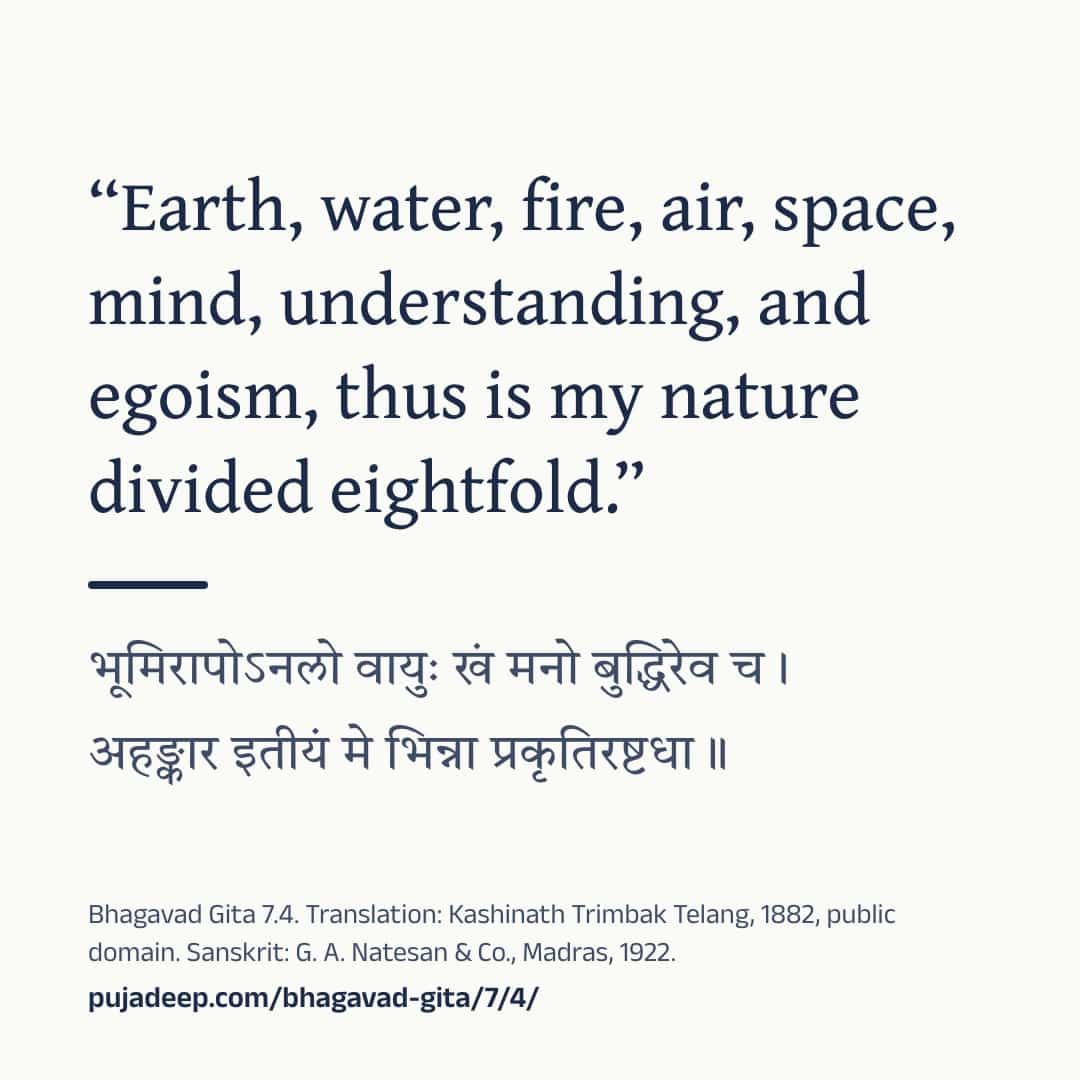
Drawing the picture
See the words
Bhagavad Gita 7.4

भूमिरापोऽनलो वायुः खं मनो बुद्धिरेव च ।
अहङ्कार इतीयं मे भिन्ना प्रकृतिरष्टधा ॥

“Earth, water, fire, air, space, mind, understanding, and egoism, thus is my nature divided eightfold.”
(K. T. Telang, The Bhagavadgîtâ (The Sacred Books of the East, vol. VIII, Oxford: Clarendon Press, 1882), pp. 73–74, public domain)

“Earth, water, fire, air, ether, Manas and Buddhi also and Ahankâra—these are the eightfold division of My Prakriti—”
(Annie Besant, The Bhagavad Gîtâ, or The Lord's Song (London: Theosophical Publishing Society, 1895), p. 75, public domain)
This sentence goes on in 7.5.

“Bhumi (earth), Apa (water), Anala (fire), Vâyu (air), Kham (ether), mind, intellect, and egoism: thus is My Prakriti divided eightfold.”
(Swami Swarupananda, Srimad-Bhagavad-Gita (Mayavati: Prabuddha Bharata Press, 1909; first printed in Prabuddha Bharata, 1907–1909), p. 146, public domain)

Sanskrit: G. A. Natesan & Co., Madras, 1922.
https://pujadeep.com/bhagavad-gita/7/4/ Nothing is sent from this site. Your own app sends it, to the chat you choose. The picture quotes the translation you chose on this page, with its name and year.
Sanskrit text: The Bhagavad-Gita, or The Lord's Song, with the text in Devanagari and an English translation, 1922. Meanings: written for Pujadeep and checked against the cited edition. Source and changes
Questions families ask
Who speaks Bhagavad Gita 7.4?
Krishna speaks this verse, in chapter 7 (Jnana Vijnana Yoga).
Where does the Sanskrit text come from?
Sanskrit text: The Bhagavad-Gita, or The Lord's Song, with the text in Devanagari and an English translation, 1922. Meanings: written for Pujadeep and checked against the cited edition. See the source
Is the meaning on this page a translation?
Explanation written for this site from the sources listed here, and checked against the cited edition. It is not a translation and not the only way to read the text. Free to quote with credit.
Source and licence
- Sanskrit text
- The Bhagavad-Gita, or The Lord's Song, with the text in Devanagari and an English translation (Annie Besant, G. A. Natesan & Co., Madras, 1922). Public domain. The Sanskrit on these pages was read from this printing’s page images.
- Translation
- The Bhagavadgîtâ with the Sanatsugâtîya and the Anugîtâ, translated by Kâshinâth Trimbak Telang (The Sacred Books of the East, vol. VIII, ed. F. Max Müller) (Kashinath Trimbak Telang, F. Max Müller, Clarendon Press, Oxford, 1882). Public domain. Shown verbatim, as printed.
- Translation
- The Bhagavad Gîtâ, or The Lord's Song, translated by Annie Besant (Annie Besant, Theosophical Publishing Society, London, 1895). Public domain. Shown verbatim, as printed.
- Translation
- Srimad-Bhagavad-Gita, with Sanskrit Text; Paraphrase with Word-by-word Literal Translation; English Rendering and Comments, Index, &c., by the Swami Swarupananda (Himalayan Series, No. XX) (Swami Swarupananda, The Editors and Publishers, Advaita Ashrama, Mayavati, Prabuddha Bharata Press, Mayavati, Almora, Himalayas, 1909). Public domain. Shown verbatim, as printed.
- Commentary
- The Bhagavad-Gita, with the commentary of Sri Sankaracharya, translated by A. Mahadeva Sastri (2nd ed., Mysore: G. T. A. Printing Works, 1901) (Public-domain scan, University of California Libraries). Summarised in our own words; none of its text is reproduced.
- Commentary
- Sri Bhagavad-Gita with Sri Ramanujacharya's Visishtadvaita commentary, translated by A. Govindacharya (Madras, 1898) (Scan uploaded to archive.org (folkscanomy collection)). Summarised in our own words; none of its text is reproduced.
- Common wording
- In this text, 32 words follow today's common wording, checked against sanskritdocuments.org; Sanskrit Wikisource; Gita Press, Gorakhpur; GRETIL, Göttingen and Bhaktivedanta Book Trust.
- Our explanation
- Explanation written for this site from the sources listed here, and checked against the cited edition. It is not a translation and not the only way to read the text. Free to quote with credit.
- Checked
- Checked against the cited edition, October 15, 2026.
- Updated
- October 27, 2026