Bhagavad Gita 6.9: meaning and translation
Chapter 6: Dhyana Yoga. Krishna says
The one who has the same understanding towards well-wishers, friends, enemies, the indifferent, the neutral, the hateful and relatives, and also towards good people and wrongdoers, stands out (viśiṣyate), Krishna says.
Click or tap a word for its meaning and its dictionary page.
Text and layers
Text and layers
These choices stay in this browser.
Bhagavad Gita 6.9
सुहृन्मित्रार्युदासीनमध्यस्थद्वेष्यबन्धुषु ।साधुष्वपि च पापेषु समबुद्धिर्विशिष्यते ॥
SuhrinmitraryudasinamadhyasthadveshyabandhushuSadhushvapi cha papeshu samabuddhirvishishyate
suhṛnmitrāryudāsīnamadhyasthadveṣyabandhuṣu |sādhuṣvapi ca pāpeṣu samabuddhirviśiṣyate ||
Our explanation The one who has the same understanding towards well-wishers, friends, enemies, the indifferent, the neutral, the hateful and relatives, and also towards good people and wrongdoers, stands out (viśiṣyate), Krishna says.
हिंदी अर्थ कृष्ण कहते हैं कि जो सुहृद, मित्र, शत्रु, उदासीन, मध्यस्थ, द्वेष करने वाले और संबंधी—सबके प्रति, और साधुओं तथा पापियों के प्रति भी, समान बुद्धि रखता है, वह श्रेष्ठ है।
Word by word
Every word, with its dictionary page
Word by word
- सुहृन्मित्रार्युदासीनमध्यस्थद्वेष्यबन्धुषु suhṛnmitrāryudāsīnamadhyasthadveṣyabandhuṣu · well-wishers, friends, foes, neutrals, mediators, the hateful, kin (compound (masculine), locative plural) Dictionary: su-hṛd, Monier-Williams 1899, p. 1239, col. 3 “‘good-hearted,’ ‘kind-hearted,’ ‘well-disposed,’ a friend, ally”; 1. mitra, Monier-Williams 1899, p. 816, col. 1 “a friend, companion, associate”; 2. a-ri, Monier-Williams 1899, p. 87, col. 3 “an enemy”; ud-āsīna, Monier-Williams 1899, p. 185, col. 3 “sitting apart, indifferent, free from affection”; madhya-stha, Monier-Williams 1899, p. 782, col. 1 “standing between two persons or parties, mediating, a mediator”; dveṣya, Monier-Williams 1899, p. 507, col. 1 “to be hated or disliked, odious, detestable”; bandhu, Monier-Williams 1899, p. 721, col. 1 “a friend (opp. to ripu)”
- साधुषु sādhuṣu · to the good (noun (masculine), locative plural) Dictionary: sādhu, Monier-Williams 1899, p. 1201, col. 2 “a good or virtuous or honest man”
- अपि api · also (indeclinable) Dictionary: api, Monier-Williams 1899, p. 55, col. 1 “in the sense of even, also, very”
- च ca · and (indeclinable) Dictionary: 2. ca, Monier-Williams 1899, p. 380, col. 1 “ind. and, both, also, moreover, as well as”
- पापेषु pāpeṣu · to wrongdoers (noun (masculine), locative plural) Dictionary: pāpa, Monier-Williams 1899, p. 618, col. 2 “sin, vice, crime, guilt”
- समबुद्धिः samabuddhiḥ · with the same understanding (compound (masculine), nominative singular) Dictionary: sama-buddhi, Monier-Williams 1899, p. 1152, col. 3 “esteeming all things alike, indifferent”
- विशिष्यते viśiṣyate · stands out, excels (present passive, 3rd person singular) Dictionary: vi-śiṣ, Monier-Williams 1899, p. 990, col. 2 “to be pre-eminent, excel, be better than”
Old translations
Kashinath Trimbak Telang, 1882. Public domain. Page 68.
And he is esteemed highest, who thinks alike1 about well-wishers, friends, and enemies, and those who are indifferent, and those who take part with both sides, and those who are objects of hatred, and relatives, as well as about the good and the sinful.
Footnotes (the translator’s own) - I. e. is free from affection or aversion towards them. ↩
Compare 3 translations
Kashinath Trimbak Telang, 1882. Public domain. Page 68.
And he is esteemed highest, who thinks alike1 about well-wishers, friends, and enemies, and those who are indifferent, and those who take part with both sides, and those who are objects of hatred, and relatives, as well as about the good and the sinful.
Footnotes (the translator’s own) - I. e. is free from affection or aversion towards them. ↩
You are reading this one
Annie Besant, 1895. Public domain. Page 67.
He who among lovers, friends, and foes, strangers, neutrals, foreigners and relatives, and also among the righteous and unrighteous, is of balanced Buddhi, is highly esteemed.
You are reading this one
Swami Swarupananda, 1909 (first printed 1907). Public domain. Page 126.
He attains excellence who looks with equal regard upon well-wishers, friends, foes, neutrals, and arbitors, upon the hateful, the relatives, and upon the righteous and unrighteous alike.
You are reading this one
Cite this verse
The translation: K. T. Telang, The Bhagavadgîtâ (The Sacred Books of the East, vol. VIII, Oxford: Clarendon Press, 1882), p. 68. Bhagavad Gita 6.9.
The translation: Annie Besant, The Bhagavad Gîtâ, or The Lord's Song (London: Theosophical Publishing Society, 1895), p. 67. Bhagavad Gita 6.9.
The translation: Swami Swarupananda, Srimad-Bhagavad-Gita (Mayavati: Prabuddha Bharata Press, 1909; first printed in Prabuddha Bharata, 1907–1909), p. 126. Bhagavad Gita 6.9.
Our explanation: “Bhagavad Gita 6.9: meaning and translation.” Pujadeep. Updated October 25, 2026. https://pujadeep.com/bhagavad-gita/6/9/
Pujadeep’s explanations are free to quote with credit: name Pujadeep and link to the page. How to credit
Classical readings, by school
No readings by school on this verse yet.
Share
Show the ways to share
Send one picture or the text to one chat. The picture names its source and the address of this page.
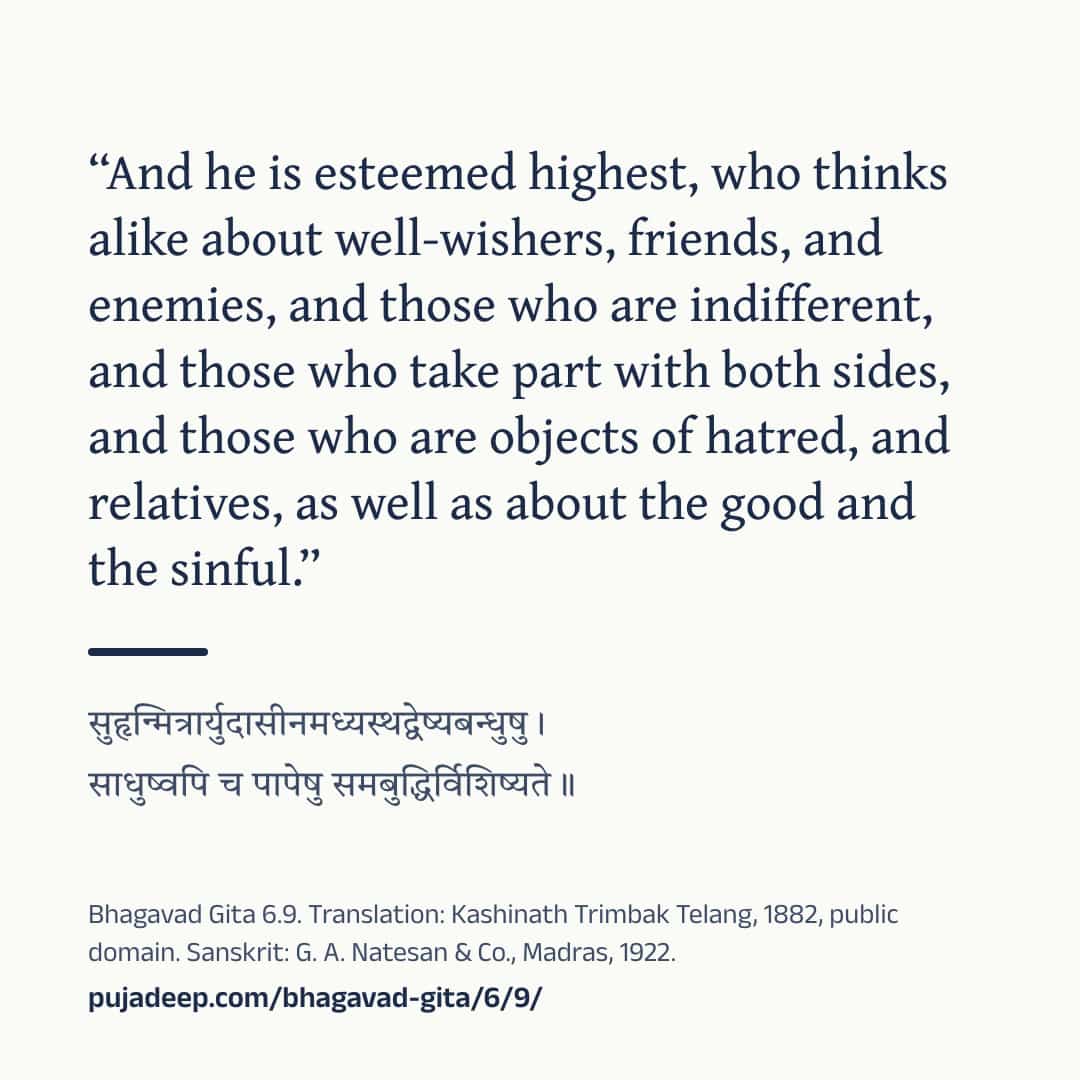
Drawing the picture
See the words
Bhagavad Gita 6.9

सुहृन्मित्रार्युदासीनमध्यस्थद्वेष्यबन्धुषु ।
साधुष्वपि च पापेषु समबुद्धिर्विशिष्यते ॥

“And he is esteemed highest, who thinks alike about well-wishers, friends, and enemies, and those who are indifferent, and those who take part with both sides, and those who are objects of hatred, and relatives, as well as about the good and the sinful.”
(K. T. Telang, The Bhagavadgîtâ (The Sacred Books of the East, vol. VIII, Oxford: Clarendon Press, 1882), p. 68, public domain)

“He who among lovers, friends, and foes, strangers, neutrals, foreigners and relatives, and also among the righteous and unrighteous, is of balanced Buddhi, is highly esteemed.”
(Annie Besant, The Bhagavad Gîtâ, or The Lord's Song (London: Theosophical Publishing Society, 1895), p. 67, public domain)

“He attains excellence who looks with equal regard upon well-wishers, friends, foes, neutrals, and arbitors, upon the hateful, the relatives, and upon the righteous and unrighteous alike.”
(Swami Swarupananda, Srimad-Bhagavad-Gita (Mayavati: Prabuddha Bharata Press, 1909; first printed in Prabuddha Bharata, 1907–1909), p. 126, public domain)

Sanskrit: G. A. Natesan & Co., Madras, 1922.
https://pujadeep.com/bhagavad-gita/6/9/ Nothing is sent from this site. Your own app sends it, to the chat you choose. The picture quotes the translation you chose on this page, with its name and year.
Sanskrit text: The Bhagavad-Gita, or The Lord's Song, with the text in Devanagari and an English translation, 1922. Meanings: written for Pujadeep and checked against the cited edition. Source and changes
Questions families ask
Who speaks Bhagavad Gita 6.9?
Krishna speaks this verse, in chapter 6 (Dhyana Yoga).
Where does the Sanskrit text come from?
Sanskrit text: The Bhagavad-Gita, or The Lord's Song, with the text in Devanagari and an English translation, 1922. Meanings: written for Pujadeep and checked against the cited edition. See the source
Is the meaning on this page a translation?
Explanation written for this site from the sources listed here, and checked against the cited edition. It is not a translation and not the only way to read the text. Free to quote with credit.
Source and licence
- Sanskrit text
- The Bhagavad-Gita, or The Lord's Song, with the text in Devanagari and an English translation (Annie Besant, G. A. Natesan & Co., Madras, 1922). Public domain. The Sanskrit on these pages was read from this printing’s page images.
- Translation
- The Bhagavadgîtâ with the Sanatsugâtîya and the Anugîtâ, translated by Kâshinâth Trimbak Telang (The Sacred Books of the East, vol. VIII, ed. F. Max Müller) (Kashinath Trimbak Telang, F. Max Müller, Clarendon Press, Oxford, 1882). Public domain. Shown verbatim, as printed.
- Translation
- The Bhagavad Gîtâ, or The Lord's Song, translated by Annie Besant (Annie Besant, Theosophical Publishing Society, London, 1895). Public domain. Shown verbatim, as printed.
- Translation
- Srimad-Bhagavad-Gita, with Sanskrit Text; Paraphrase with Word-by-word Literal Translation; English Rendering and Comments, Index, &c., by the Swami Swarupananda (Himalayan Series, No. XX) (Swami Swarupananda, The Editors and Publishers, Advaita Ashrama, Mayavati, Prabuddha Bharata Press, Mayavati, Almora, Himalayas, 1909). Public domain. Shown verbatim, as printed.
- Common wording
- In this text, 32 words follow today's common wording, checked against sanskritdocuments.org; Sanskrit Wikisource; Gita Press, Gorakhpur; GRETIL, Göttingen and Bhaktivedanta Book Trust.
- Our explanation
- Explanation written for this site from the sources listed here, and checked against the cited edition. It is not a translation and not the only way to read the text. Free to quote with credit.
- Checked
- Checked against the cited edition, October 15, 2026.
- Updated
- October 25, 2026