Bhagavad Gita 6.3: meaning and translation
Chapter 6: Dhyana Yoga. Krishna says
Krishna says that for a sage (muni) who is still trying to rise to yoga, the way forward is action.
Click or tap a word for its meaning and its dictionary page.
Text and layers
Text and layers
These choices stay in this browser.
Bhagavad Gita 6.3
आरुरुक्षोर्मुनेर्योगं कर्म कारणमुच्यते ।योगारूढस्य तस्यैव शमः कारणमुच्यते ॥
Arurukshormuneryogam karma karanamuchyateYogarudhasya tasyaiva shamah karanamuchyate
ārurukṣormuneryogaṃ karma kāraṇamucyate |yogārūḍhasya tasyaiva śamaḥ kāraṇamucyate ||
Our explanation Krishna says that for a sage (muni) who is still trying to rise to yoga, the way forward is action. Once that same sage has reached yoga, the way forward is calm (śama). The commentators read this calm in different ways (see the views).
हिंदी अर्थ कृष्ण कहते हैं कि जो मुनि योग पर चढ़ना चाहता है, उसके लिए कर्म को साधन कहा गया है। वही व्यक्ति जब योग पर चढ़ जाता है, तब उसके लिए शम (शांति) को साधन कहा गया है। टीकाकार इस शम को अलग-अलग ढंग से समझते हैं।
Word by word
Every word, with its dictionary page
Word by word
- आरुरुक्षोः ārurukṣoḥ · of one who wants to climb (adjective (masculine), genitive singular) Dictionary: ā-rurukṣu, Monier-Williams 1899, p. 151, col. 1 “desirous to rise or ascend or advance”
- मुनेः muneḥ · of the sage (noun (masculine), genitive singular) Dictionary: muni, Monier-Williams 1899, p. 823, col. 1 “a saint, sage, seer, ascetic, monk, devotee, hermit”
- योगम् yogam · to yoga (noun (masculine), accusative singular) Dictionary: yoga, Monier-Williams 1899, p. 856, col. 2 “the act of yoking, joining, attaching”
- कर्म karma · action (noun (neuter), nominative singular) Dictionary: karman, Monier-Williams 1899, p. 258, col. 2 “act, action, performance, business”
- कारणम् kāraṇam · the means (noun (neuter), nominative singular) Dictionary: kāraṇa, Monier-Williams 1899, p. 274, col. 2 “cause, reason, the cause of anything”
- उच्यते ucyate · is said to be (present passive, 3rd person singular) Dictionary: vac, Monier-Williams 1899, p. 912, col. 1 “to be called or accounted, be regarded as”
- योगारूढस्य yogārūḍhasya · of one who has climbed to yoga (compound (masculine), genitive singular) Dictionary: yogārūḍha, Monier-Williams 1899, p. 857, col. 3 “absorbed in profound or abstract meditation”
- तस्य tasya · of him (pronoun (masculine), genitive singular) Dictionary: tad, Monier-Williams 1899, p. 434, col. 1 “m. he, f. she, n. it, that, this”
- एव eva · the same (indeclinable) Dictionary: 1. eva, Monier-Williams 1899, p. 232, col. 2 “just, exactly, very, same, only, even, alone, merely”
- शमः śamaḥ · calm (noun (masculine), nominative singular) Dictionary: śama, Monier-Williams 1899, p. 1053, col. 3 “tranquillity, calmness, rest, equanimity, quietude or quietism, absence of passion”
- कारणम् kāraṇam · the means (noun (neuter), nominative singular) Dictionary: kāraṇa, Monier-Williams 1899, p. 274, col. 2 “cause, reason, the cause of anything”
- उच्यते ucyate · is said to be (present passive, 3rd person singular) Dictionary: vac, Monier-Williams 1899, p. 912, col. 1 “to be called or accounted, be regarded as”
Old translations
Kashinath Trimbak Telang, 1882. Public domain. Page 67.
To the sage who wishes to rise to devotion, action is said to be a means, and to him, when he has risen to devotion, tranquillity1 is said to be a means.
Footnotes (the translator’s own) - Abandonment of distracting actions; means scil. to perfect knowledge, says Srîdhara. ↩
Compare 3 translations
Kashinath Trimbak Telang, 1882. Public domain. Page 67.
To the sage who wishes to rise to devotion, action is said to be a means, and to him, when he has risen to devotion, tranquillity1 is said to be a means.
Footnotes (the translator’s own) - Abandonment of distracting actions; means scil. to perfect knowledge, says Srîdhara. ↩
You are reading this one
Annie Besant, 1895. Public domain. Page 65.
For a Muni who is seeking Yoga, action is called the method; for him who enjoyeth it, serenity is called the method.
You are reading this one
Swami Swarupananda, 1909 (first printed 1907). Public domain. Page 122–123.
For the man of meditation wishing to attain purification of heart leading to concentration, work is said to be the way: For him, when he has attained such (concentration), inaction is said to be the way.
You are reading this one
Cite this verse
The translation: K. T. Telang, The Bhagavadgîtâ (The Sacred Books of the East, vol. VIII, Oxford: Clarendon Press, 1882), p. 67. Bhagavad Gita 6.3.
The translation: Annie Besant, The Bhagavad Gîtâ, or The Lord's Song (London: Theosophical Publishing Society, 1895), p. 65. Bhagavad Gita 6.3.
The translation: Swami Swarupananda, Srimad-Bhagavad-Gita (Mayavati: Prabuddha Bharata Press, 1909; first printed in Prabuddha Bharata, 1907–1909), pp. 122–123. Bhagavad Gita 6.3.
Our explanation: “Bhagavad Gita 6.3: meaning and translation.” Pujadeep. Updated October 25, 2026. https://pujadeep.com/bhagavad-gita/6/3/
Pujadeep’s explanations are free to quote with credit: name Pujadeep and link to the page. How to credit
Classical readings, by school
Each reading is named by its school. None is presented as the only meaning.
What Advaita, Vishishtadvaita and Dvaita teach, in short
Shankara Advaita
Shankara takes the calm (śama) of the one who has risen to yoga to be the giving up of all action: the more fully he stops acting, the steadier his mind becomes.
Source: The Bhagavad-Gita, with the commentary of Sri Sankaracharya, translated by A. Mahadeva Sastri (2nd ed., Mysore: G. T. A. Printing Works, 1901), commentary on 6.3, p. 169. Summarised in our own words; none of its text is reproduced.
Ramanuja Vishishtadvaita
Ramanuja says work is the means for the beginner, and for the one settled in meditation calm means a pause from work during meditation. He concludes that work stays a duty until the self is seen.
Source: Sri Bhagavad-Gita with Sri Ramanujacharya's Visishtadvaita commentary, translated by A. Govindacharya (Madras, 1898), commentary on 6.3, p. 195. Summarised in our own words; none of its text is reproduced.
Share
Show the ways to share
Send one picture or the text to one chat. The picture names its source and the address of this page.
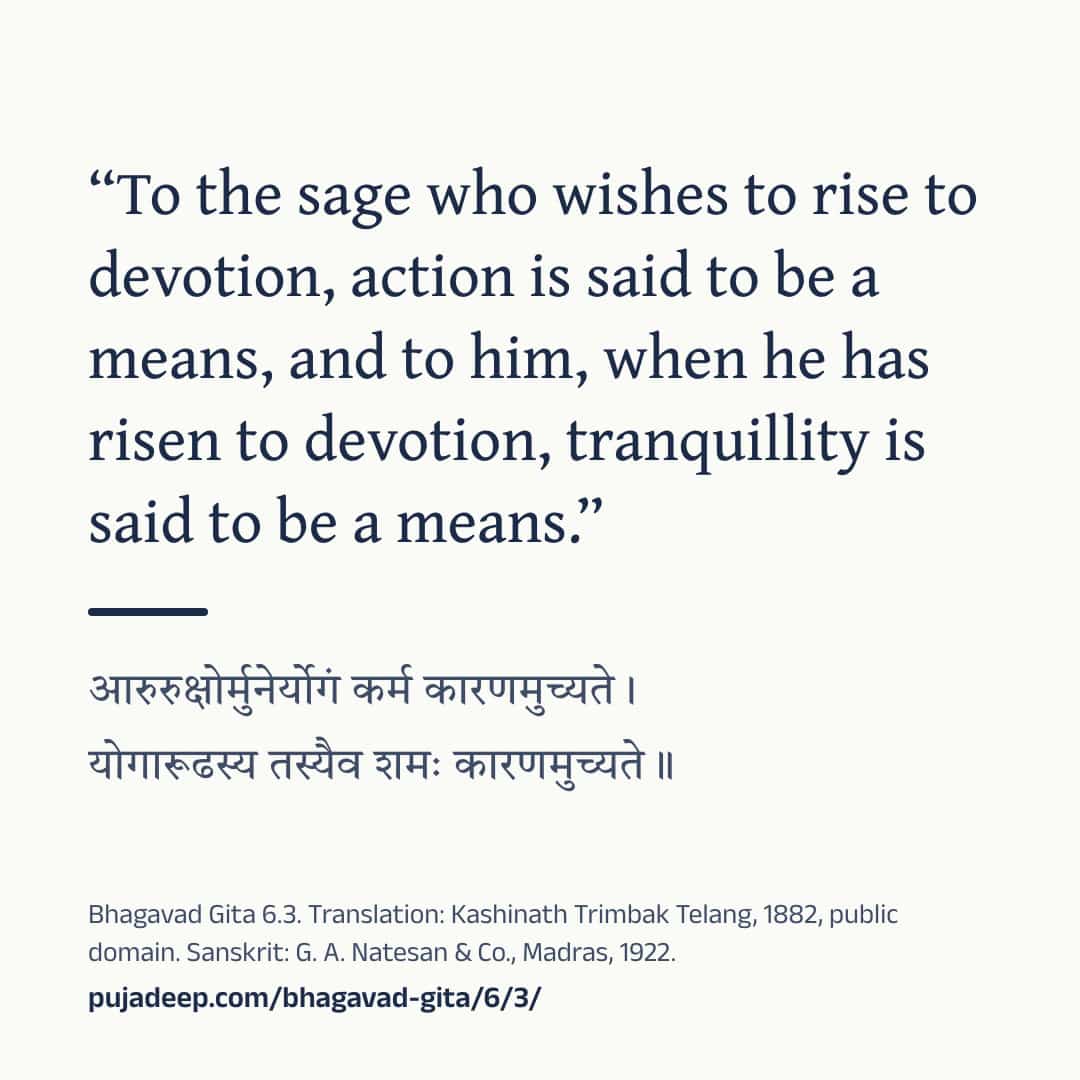
Drawing the picture
See the words
Bhagavad Gita 6.3

आरुरुक्षोर्मुनेर्योगं कर्म कारणमुच्यते ।
योगारूढस्य तस्यैव शमः कारणमुच्यते ॥

“To the sage who wishes to rise to devotion, action is said to be a means, and to him, when he has risen to devotion, tranquillity is said to be a means.”
(K. T. Telang, The Bhagavadgîtâ (The Sacred Books of the East, vol. VIII, Oxford: Clarendon Press, 1882), p. 67, public domain)

“For a Muni who is seeking Yoga, action is called the method; for him who enjoyeth it, serenity is called the method.”
(Annie Besant, The Bhagavad Gîtâ, or The Lord's Song (London: Theosophical Publishing Society, 1895), p. 65, public domain)

“For the man of meditation wishing to attain purification of heart leading to concentration, work is said to be the way: For him, when he has attained such (concentration), inaction is said to be the way.”
(Swami Swarupananda, Srimad-Bhagavad-Gita (Mayavati: Prabuddha Bharata Press, 1909; first printed in Prabuddha Bharata, 1907–1909), pp. 122–123, public domain)

Sanskrit: G. A. Natesan & Co., Madras, 1922.
https://pujadeep.com/bhagavad-gita/6/3/ Nothing is sent from this site. Your own app sends it, to the chat you choose. The picture quotes the translation you chose on this page, with its name and year.
Sanskrit text: The Bhagavad-Gita, or The Lord's Song, with the text in Devanagari and an English translation, 1922. Meanings: written for Pujadeep and checked against the cited edition. Source and changes
Questions families ask
Who speaks Bhagavad Gita 6.3?
Krishna speaks this verse, in chapter 6 (Dhyana Yoga).
Where does the Sanskrit text come from?
Sanskrit text: The Bhagavad-Gita, or The Lord's Song, with the text in Devanagari and an English translation, 1922. Meanings: written for Pujadeep and checked against the cited edition. See the source
Is the meaning on this page a translation?
Explanation written for this site from the sources listed here, and checked against the cited edition. It is not a translation and not the only way to read the text. Free to quote with credit.
Source and licence
- Sanskrit text
- The Bhagavad-Gita, or The Lord's Song, with the text in Devanagari and an English translation (Annie Besant, G. A. Natesan & Co., Madras, 1922). Public domain. The Sanskrit on these pages was read from this printing’s page images.
- Translation
- The Bhagavadgîtâ with the Sanatsugâtîya and the Anugîtâ, translated by Kâshinâth Trimbak Telang (The Sacred Books of the East, vol. VIII, ed. F. Max Müller) (Kashinath Trimbak Telang, F. Max Müller, Clarendon Press, Oxford, 1882). Public domain. Shown verbatim, as printed.
- Translation
- The Bhagavad Gîtâ, or The Lord's Song, translated by Annie Besant (Annie Besant, Theosophical Publishing Society, London, 1895). Public domain. Shown verbatim, as printed.
- Translation
- Srimad-Bhagavad-Gita, with Sanskrit Text; Paraphrase with Word-by-word Literal Translation; English Rendering and Comments, Index, &c., by the Swami Swarupananda (Himalayan Series, No. XX) (Swami Swarupananda, The Editors and Publishers, Advaita Ashrama, Mayavati, Prabuddha Bharata Press, Mayavati, Almora, Himalayas, 1909). Public domain. Shown verbatim, as printed.
- Commentary
- The Bhagavad-Gita, with the commentary of Sri Sankaracharya, translated by A. Mahadeva Sastri (2nd ed., Mysore: G. T. A. Printing Works, 1901) (Public-domain scan, University of California Libraries). Summarised in our own words; none of its text is reproduced.
- Commentary
- Sri Bhagavad-Gita with Sri Ramanujacharya's Visishtadvaita commentary, translated by A. Govindacharya (Madras, 1898) (Scan uploaded to archive.org (folkscanomy collection)). Summarised in our own words; none of its text is reproduced.
- Common wording
- In this text, 32 words follow today's common wording, checked against sanskritdocuments.org; Sanskrit Wikisource; Gita Press, Gorakhpur; GRETIL, Göttingen and Bhaktivedanta Book Trust.
- Our explanation
- Explanation written for this site from the sources listed here, and checked against the cited edition. It is not a translation and not the only way to read the text. Free to quote with credit.
- Checked
- Checked against the cited edition, October 15, 2026.
- Updated
- October 25, 2026