Bhagavad Gita 6.4: meaning and translation
Chapter 6: Dhyana Yoga. Krishna says
A person is said to have climbed to yoga (yogārūḍha), Krishna says, when he is no longer attached to the objects of the senses or to actions, and has given up every saṅkalpa.
Click or tap a word for its meaning and its dictionary page.
Text and layers
Text and layers
These choices stay in this browser.
Bhagavad Gita 6.4
यदा हि नेन्द्रियार्थेषु न कर्मस्वनुषज्जते ।सर्वसङ्कल्पसंन्यासी योगारूढस्तदोच्यते ॥
Yada hi nendriyartheshu na karmasvanushajjateSarvasankalpasannyasi yogarudhastadochyate
yadā hi nendriyārtheṣu na karmasvanuṣajjate |sarvasaṅkalpasaṃnyāsī yogārūḍhastadocyate ||
Our explanation A person is said to have climbed to yoga (yogārūḍha), Krishna says, when he is no longer attached to the objects of the senses or to actions, and has given up every saṅkalpa.
हिंदी अर्थ कृष्ण कहते हैं कि जब व्यक्ति न इंद्रियों के विषयों में आसक्त होता है, न कर्मों में, और सब संकल्पों को छोड़ देता है, तब उसे योगारूढ़ (योग पर चढ़ा हुआ) कहा जाता है।
Word by word
Every word, with its dictionary page
Word by word
- यदा yadā · when (indeclinable) Dictionary: yadā, Monier-Williams 1899, p. 844, col. 1 “when, at what time, whenever”
- हि hi · indeed (indeclinable) Dictionary: 2. hi, Monier-Williams 1899, p. 1297, col. 3 “for, because, on account of”
- न na · not (indeclinable) Dictionary: 2. na, Monier-Williams 1899, p. 523, col. 1 “ind. not, no, nor, neither”
- इन्द्रियार्थेषु indriyārtheṣu · to the objects of the senses (compound (masculine), locative plural) Dictionary: indriyārtha, Monier-Williams 1899, p. 167, col. 2 “an object of sense (as sound, smell, &c.)”
- न na · nor (indeclinable) Dictionary: 2. na, Monier-Williams 1899, p. 523, col. 1 “ind. not, no, nor, neither”
- कर्मसु karmasu · to actions (noun (neuter), locative plural) Dictionary: karman, Monier-Williams 1899, p. 258, col. 2 “act, action, performance, business”
- अनुषज्जते anuṣajjate · is attached (present, 3rd person singular) Dictionary: anu-ṣañj, Monier-Williams 1899, p. 39, col. 3 “to cling to, adhere, be attached to”
- सर्वसङ्कल्पसंन्यासी sarvasaṅkalpasaṃnyāsī · who has given up every saṅkalpa (compound (masculine), nominative singular) Dictionary: sarva, Monier-Williams 1899, p. 1184, col. 3 “whole, entire, all, every”; saṃ-kalpa, Monier-Williams 1899, p. 1126, col. 3 “conception or idea or notion formed in the mind or heart, (esp.) will, volition, desire, purpose”; saṃ-nyāsin, Monier-Williams 1899, p. 1148, col. 1 “one who abandons or resigns worldly affairs, an ascetic”
- योगारूढः yogārūḍhaḥ · climbed to yoga (compound (masculine), nominative singular) Dictionary: yogārūḍha, Monier-Williams 1899, p. 857, col. 3 “absorbed in profound or abstract meditation”
- तदा tadā · then (indeclinable) Dictionary: tadā, Monier-Williams 1899, p. 434, col. 3 “at that time, then, in that case”
- उच्यते ucyate · is said to be (present passive, 3rd person singular) Dictionary: vac, Monier-Williams 1899, p. 912, col. 1 “to be called or accounted, be regarded as”
Old translations
Kashinath Trimbak Telang, 1882. Public domain. Page 67.
When one does not attach oneself to objects of sense, nor to action, renouncing all fancies, then is one said to have risen to devotion.
Compare 3 translations
Kashinath Trimbak Telang, 1882. Public domain. Page 67.
When one does not attach oneself to objects of sense, nor to action, renouncing all fancies, then is one said to have risen to devotion.
You are reading this one
Annie Besant, 1895. Public domain. Page 66.
When among the objects of sense and among actions he feeleth no longings, nor any formative willings, then, successful in Yoga, he is called a Sannyâsî.
You are reading this one
Swami Swarupananda, 1909 (first printed 1907). Public domain. Page 123.
Verily, when there is no attachment, either to sense objects, or to actions, then is one said to have renounced all Sankalpas, and attained concentration.
You are reading this one
Cite this verse
The translation: K. T. Telang, The Bhagavadgîtâ (The Sacred Books of the East, vol. VIII, Oxford: Clarendon Press, 1882), p. 67. Bhagavad Gita 6.4.
The translation: Annie Besant, The Bhagavad Gîtâ, or The Lord's Song (London: Theosophical Publishing Society, 1895), p. 66. Bhagavad Gita 6.4.
The translation: Swami Swarupananda, Srimad-Bhagavad-Gita (Mayavati: Prabuddha Bharata Press, 1909; first printed in Prabuddha Bharata, 1907–1909), p. 123. Bhagavad Gita 6.4.
Our explanation: “Bhagavad Gita 6.4: meaning and translation.” Pujadeep. Updated October 25, 2026. https://pujadeep.com/bhagavad-gita/6/4/
Pujadeep’s explanations are free to quote with credit: name Pujadeep and link to the page. How to credit
Classical readings, by school
No readings by school on this verse yet.
Share
Show the ways to share
Send one picture or the text to one chat. The picture names its source and the address of this page.
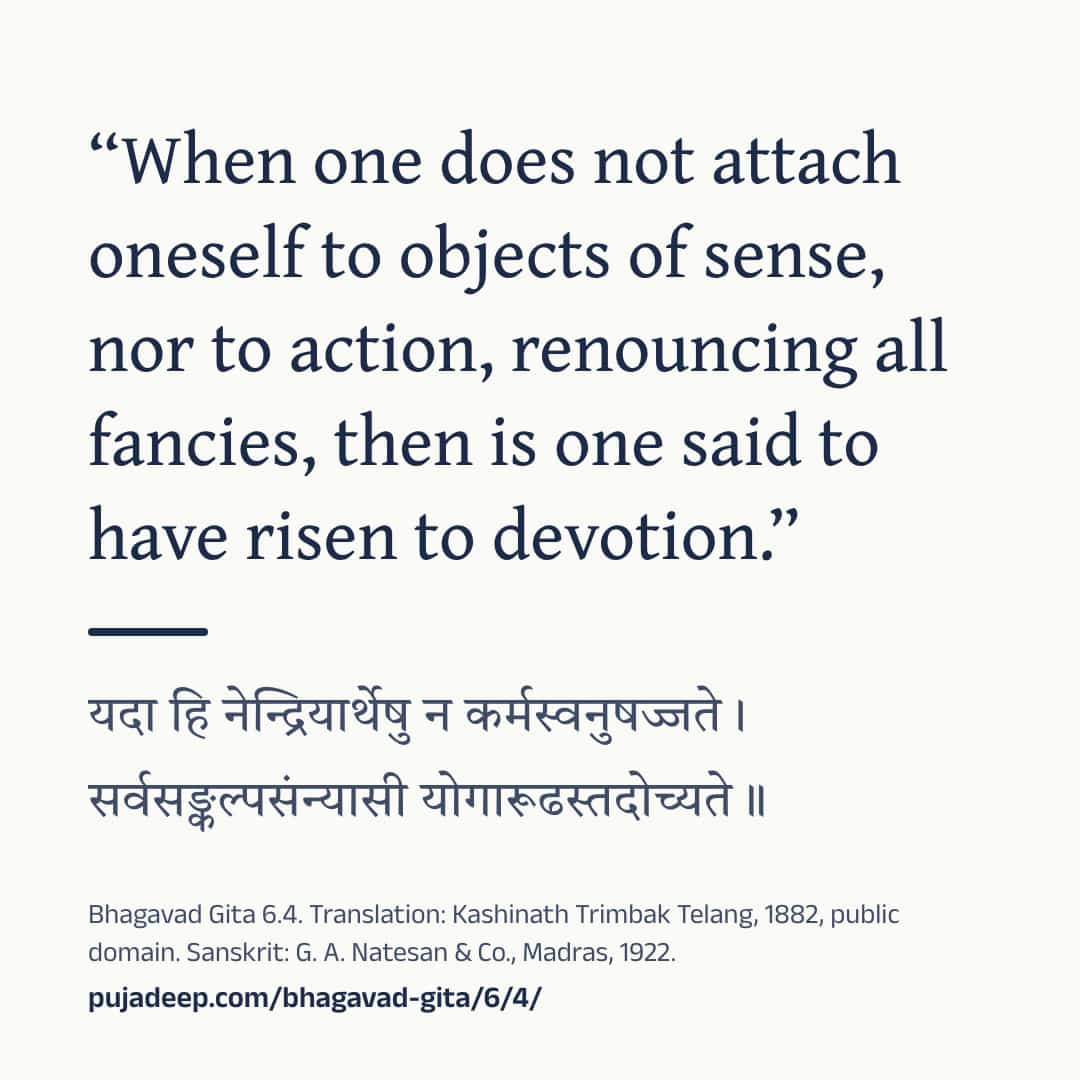
Drawing the picture
See the words
Bhagavad Gita 6.4

यदा हि नेन्द्रियार्थेषु न कर्मस्वनुषज्जते ।
सर्वसङ्कल्पसंन्यासी योगारूढस्तदोच्यते ॥

“When one does not attach oneself to objects of sense, nor to action, renouncing all fancies, then is one said to have risen to devotion.”
(K. T. Telang, The Bhagavadgîtâ (The Sacred Books of the East, vol. VIII, Oxford: Clarendon Press, 1882), p. 67, public domain)

“When among the objects of sense and among actions he feeleth no longings, nor any formative willings, then, successful in Yoga, he is called a Sannyâsî.”
(Annie Besant, The Bhagavad Gîtâ, or The Lord's Song (London: Theosophical Publishing Society, 1895), p. 66, public domain)

“Verily, when there is no attachment, either to sense objects, or to actions, then is one said to have renounced all Sankalpas, and attained concentration.”
(Swami Swarupananda, Srimad-Bhagavad-Gita (Mayavati: Prabuddha Bharata Press, 1909; first printed in Prabuddha Bharata, 1907–1909), p. 123, public domain)

Sanskrit: G. A. Natesan & Co., Madras, 1922.
https://pujadeep.com/bhagavad-gita/6/4/ Nothing is sent from this site. Your own app sends it, to the chat you choose. The picture quotes the translation you chose on this page, with its name and year.
Sanskrit text: The Bhagavad-Gita, or The Lord's Song, with the text in Devanagari and an English translation, 1922. Meanings: written for Pujadeep and checked against the cited edition. Source and changes
Questions families ask
Who speaks Bhagavad Gita 6.4?
Krishna speaks this verse, in chapter 6 (Dhyana Yoga).
Where does the Sanskrit text come from?
Sanskrit text: The Bhagavad-Gita, or The Lord's Song, with the text in Devanagari and an English translation, 1922. Meanings: written for Pujadeep and checked against the cited edition. See the source
Is the meaning on this page a translation?
Explanation written for this site from the sources listed here, and checked against the cited edition. It is not a translation and not the only way to read the text. Free to quote with credit.
Source and licence
- Sanskrit text
- The Bhagavad-Gita, or The Lord's Song, with the text in Devanagari and an English translation (Annie Besant, G. A. Natesan & Co., Madras, 1922). Public domain. The Sanskrit on these pages was read from this printing’s page images.
- Translation
- The Bhagavadgîtâ with the Sanatsugâtîya and the Anugîtâ, translated by Kâshinâth Trimbak Telang (The Sacred Books of the East, vol. VIII, ed. F. Max Müller) (Kashinath Trimbak Telang, F. Max Müller, Clarendon Press, Oxford, 1882). Public domain. Shown verbatim, as printed.
- Translation
- The Bhagavad Gîtâ, or The Lord's Song, translated by Annie Besant (Annie Besant, Theosophical Publishing Society, London, 1895). Public domain. Shown verbatim, as printed.
- Translation
- Srimad-Bhagavad-Gita, with Sanskrit Text; Paraphrase with Word-by-word Literal Translation; English Rendering and Comments, Index, &c., by the Swami Swarupananda (Himalayan Series, No. XX) (Swami Swarupananda, The Editors and Publishers, Advaita Ashrama, Mayavati, Prabuddha Bharata Press, Mayavati, Almora, Himalayas, 1909). Public domain. Shown verbatim, as printed.
- Common wording
- In this text, 32 words follow today's common wording, checked against sanskritdocuments.org; Sanskrit Wikisource; Gita Press, Gorakhpur; GRETIL, Göttingen and Bhaktivedanta Book Trust.
- Our explanation
- Explanation written for this site from the sources listed here, and checked against the cited edition. It is not a translation and not the only way to read the text. Free to quote with credit.
- Checked
- Checked against the cited edition, October 15, 2026.
- Updated
- October 25, 2026