Bhagavad Gita 6.5: meaning and translation
Chapter 6: Dhyana Yoga. Krishna says
Krishna says that one should lift oneself up by oneself, and not let oneself sink down, for the self alone is one's friend and the self alone is one's enemy.
Click or tap a word for its meaning and its dictionary page.
Text and layers
Text and layers
These choices stay in this browser.
Bhagavad Gita 6.5
उद्धरेदात्मनाऽऽत्मानं नात्मानमवसादयेत् ।आत्मैव ह्यात्मनो बन्धुरात्मैव रिपुरात्मनः ॥
Uddharedatmanatmanam natmanamavasadayetAtmaiva hyatmano bandhuratmaiva ripuratmanah
uddharedātmanā’’tmānaṃ nātmānamavasādayet |ātmaiva hyātmano bandhurātmaiva ripurātmanaḥ ||
Our explanation Krishna says that one should lift oneself up by oneself, and not let oneself sink down, for the self alone is one's friend and the self alone is one's enemy. The Sanskrit uses one word, ātman, for both sides, so the verse can be read in more than one way. The translators show this: Telang writes 'self' throughout, Besant contrasts 'the self' with 'the SELF'. The commentators differ too (see the views).
हिंदी अर्थ कृष्ण कहते हैं कि मनुष्य स्वयं अपना उद्धार करे, स्वयं को नीचे न गिरने दे; क्योंकि आत्मा ही आत्मा का मित्र है और आत्मा ही आत्मा का शत्रु। संस्कृत दोनों ओर एक ही शब्द “आत्मा” रखती है, इसलिए इस श्लोक को एक से अधिक ढंग से पढ़ा जाता है। अनुवाद भी यह दिखाते हैं: तेलंग हर जगह 'self' लिखते हैं, बेसेंट 'self' और 'SELF' (छोटा और बड़ा आत्मा) में भेद करती हैं। टीकाकारों के मत भी अलग हैं।
Word by word
Every word, with its dictionary page
Word by word
- उद्धरेत् uddharet · should lift up (optative, 3rd person singular) Dictionary: 2. ud-dhṛ, Monier-Williams 1899, p. 189, col. 2 “to raise, lift up”
- आत्मना ātmanā · by oneself (noun (masculine), instrumental singular) Dictionary: ātman, Monier-Williams 1899, p. 135, col. 1 “the individual soul, self”
- आत्मानम् ātmānam · oneself (noun (masculine), accusative singular) Dictionary: ātman, Monier-Williams 1899, p. 135, col. 1 “the individual soul, self”
- न na · not (indeclinable) Dictionary: 2. na, Monier-Williams 1899, p. 523, col. 1 “ind. not, no, nor, neither”
- आत्मानम् ātmānam · oneself (noun (masculine), accusative singular) Dictionary: ātman, Monier-Williams 1899, p. 135, col. 1 “the individual soul, self”
- अवसादयेत् avasādayet · should let sink (optative of the causative, 3rd person singular) Dictionary: ava-sad, Monier-Williams 1899, p. 104, col. 3 “to sink down, faint, grow lean”
- आत्मा ātmā · the self (noun (masculine), nominative singular) Dictionary: ātman, Monier-Williams 1899, p. 135, col. 1 “the individual soul, self”
- एव eva · alone (indeclinable) Dictionary: 1. eva, Monier-Williams 1899, p. 232, col. 2 “just, exactly, very, same, only, even, alone, merely”
- हि hi · for (indeclinable) Dictionary: 2. hi, Monier-Williams 1899, p. 1297, col. 3 “for, because, on account of”
- आत्मनः ātmanaḥ · of oneself (noun (masculine), genitive singular) Dictionary: ātman, Monier-Williams 1899, p. 135, col. 1 “the individual soul, self”
- बन्धुः bandhuḥ · friend (noun (masculine), nominative singular) Dictionary: bandhu, Monier-Williams 1899, p. 721, col. 1 “a friend (opp. to ripu)”
- आत्मा ātmā · the self (noun (masculine), nominative singular) Dictionary: ātman, Monier-Williams 1899, p. 135, col. 1 “the individual soul, self”
- एव eva · alone (indeclinable) Dictionary: 1. eva, Monier-Williams 1899, p. 232, col. 2 “just, exactly, very, same, only, even, alone, merely”
- रिपुः ripuḥ · enemy (noun (masculine), nominative singular) Dictionary: ripu, Monier-Williams 1899, p. 880, col. 3 “an enemy, adversary, foe”
- आत्मनः ātmanaḥ · of oneself (noun (masculine), genitive singular) Dictionary: ātman, Monier-Williams 1899, p. 135, col. 1 “the individual soul, self”
1 printing differs
Edition differences. Another printing or text reads this place differently.
- Spelling A digital text reads Same words. The 1922 edition marks the merged vowel with an avagraha (आत्मनाऽऽत्मानं); this e-text does not.
Old translations
Kashinath Trimbak Telang, 1882. Public domain. Page 67–68.
(A man) should elevate his self by his self1; he should not debase his self, for even (a man's) own self is his friend, (a man's) own self is also his enemy2.
Footnotes (the translator’s own) Compare 3 translations
Kashinath Trimbak Telang, 1882. Public domain. Page 67–68.
(A man) should elevate his self by his self1; he should not debase his self, for even (a man's) own self is his friend, (a man's) own self is also his enemy2.
Footnotes (the translator’s own) You are reading this one
Annie Besant, 1895. Public domain. Page 66.
Let him raise the self by the SELF, nor let the self become disheartened; verily the SELF is the friend of the self, and also the SELF is the self's enemy;
This sentence goes on in 6.6.
You are reading this one
Swami Swarupananda, 1909 (first printed 1907). Public domain. Page 124.
Let a man uplift himself by the Self. Let him not drag himself down. For the Self alone is the friend of the self. And the self alone is the enemy of the Self.
You are reading this one
Cite this verse
The translation: K. T. Telang, The Bhagavadgîtâ (The Sacred Books of the East, vol. VIII, Oxford: Clarendon Press, 1882), pp. 67–68. Bhagavad Gita 6.5.
The translation: Annie Besant, The Bhagavad Gîtâ, or The Lord's Song (London: Theosophical Publishing Society, 1895), p. 66. Bhagavad Gita 6.5.
The translation: Swami Swarupananda, Srimad-Bhagavad-Gita (Mayavati: Prabuddha Bharata Press, 1909; first printed in Prabuddha Bharata, 1907–1909), p. 124. Bhagavad Gita 6.5.
Our explanation: “Bhagavad Gita 6.5: meaning and translation.” Pujadeep. Updated October 25, 2026. https://pujadeep.com/bhagavad-gita/6/5/
Pujadeep’s explanations are free to quote with credit: name Pujadeep and link to the page. How to credit
Classical readings, by school
Each reading is named by its school. None is presented as the only meaning.
What Advaita, Vishishtadvaita and Dvaita teach, in short
Shankara Advaita
Shankara reads the verse as a call to self-reliance: a person sunk in the ocean of saṃsāra must lift himself by practising yoga. No other friend can free him, and even an outside enemy becomes an enemy only through himself. So he alone is his own friend and his own enemy.
Source: The Bhagavad-Gita, with the commentary of Sri Sankaracharya, translated by A. Mahadeva Sastri (2nd ed., Mysore: G. T. A. Printing Works, 1901), commentary on 6.5, pp. 171–172. Summarised in our own words; none of its text is reproduced.
Ramanuja Vishishtadvaita
Ramanuja takes ātmanā here to mean 'by the mind'. The self is lifted by a mind turned away from sense pleasures, and harmed by a mind attached to them. So the mind is the self's friend or foe, depending on how it is used.
Source: Sri Bhagavad-Gita with Sri Ramanujacharya's Visishtadvaita commentary, translated by A. Govindacharya (Madras, 1898), commentary on 6.5, p. 196. Summarised in our own words; none of its text is reproduced.
This verse is on our page of well-known Gita verses, by theme
Share
Show the ways to share
Send one picture or the text to one chat. The picture names its source and the address of this page.
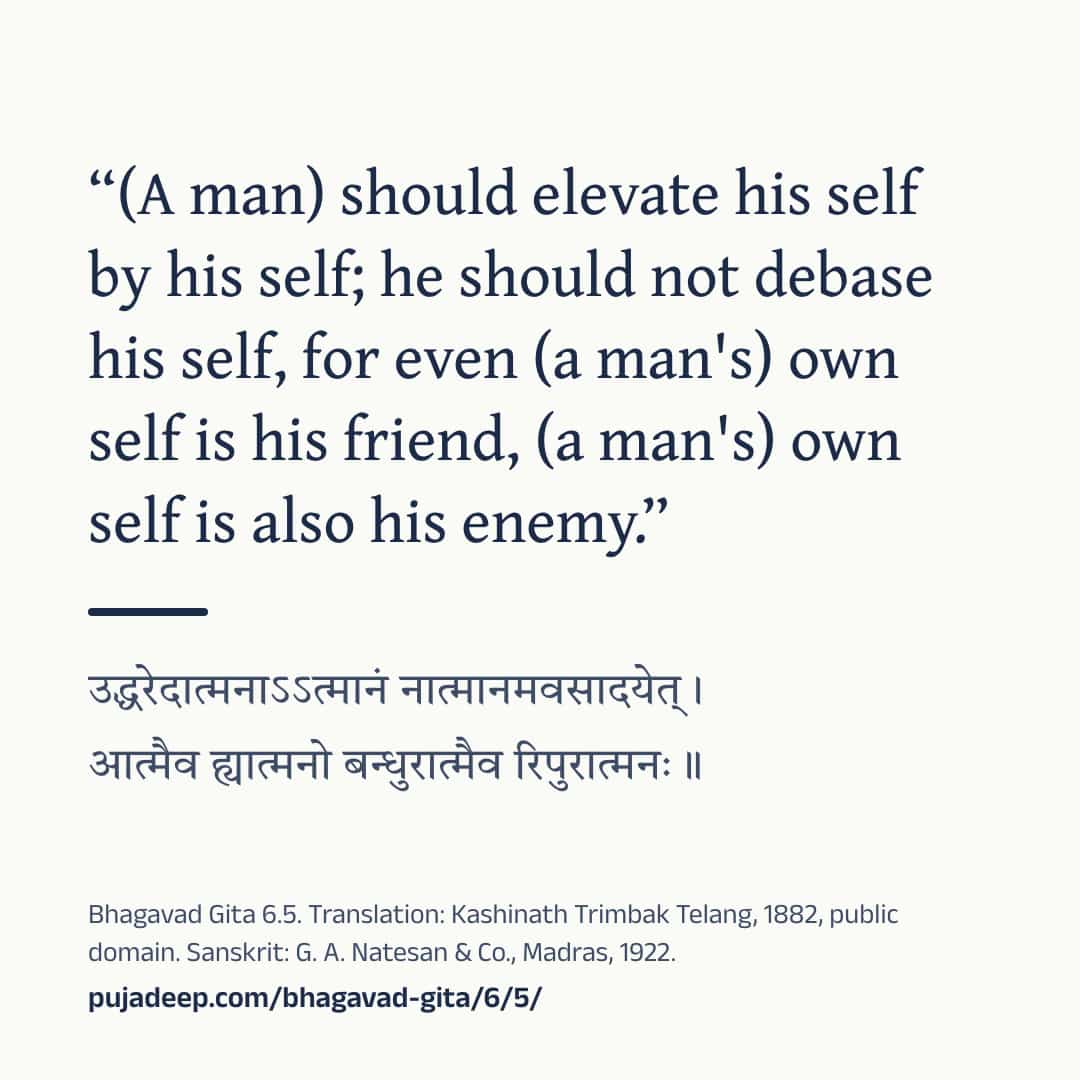
Drawing the picture
See the words
Bhagavad Gita 6.5

उद्धरेदात्मनाऽऽत्मानं नात्मानमवसादयेत् ।
आत्मैव ह्यात्मनो बन्धुरात्मैव रिपुरात्मनः ॥

“(A man) should elevate his self by his self; he should not debase his self, for even (a man's) own self is his friend, (a man's) own self is also his enemy.”
(K. T. Telang, The Bhagavadgîtâ (The Sacred Books of the East, vol. VIII, Oxford: Clarendon Press, 1882), pp. 67–68, public domain)

“Let him raise the self by the SELF, nor let the self become disheartened; verily the SELF is the friend of the self, and also the SELF is the self's enemy;”
(Annie Besant, The Bhagavad Gîtâ, or The Lord's Song (London: Theosophical Publishing Society, 1895), p. 66, public domain)
This sentence goes on in 6.6.

“Let a man uplift himself by the Self. Let him not drag himself down. For the Self alone is the friend of the self. And the self alone is the enemy of the Self.”
(Swami Swarupananda, Srimad-Bhagavad-Gita (Mayavati: Prabuddha Bharata Press, 1909; first printed in Prabuddha Bharata, 1907–1909), p. 124, public domain)

Sanskrit: G. A. Natesan & Co., Madras, 1922.
https://pujadeep.com/bhagavad-gita/6/5/ Nothing is sent from this site. Your own app sends it, to the chat you choose. The picture quotes the translation you chose on this page, with its name and year.
Sanskrit text: The Bhagavad-Gita, or The Lord's Song, with the text in Devanagari and an English translation, 1922. Meanings: written for Pujadeep and checked against the cited edition. Source and changes
Questions families ask
Who speaks Bhagavad Gita 6.5?
Krishna speaks this verse, in chapter 6 (Dhyana Yoga).
Where does the Sanskrit text come from?
Sanskrit text: The Bhagavad-Gita, or The Lord's Song, with the text in Devanagari and an English translation, 1922. Meanings: written for Pujadeep and checked against the cited edition. See the source
Is the meaning on this page a translation?
Explanation written for this site from the sources listed here, and checked against the cited edition. It is not a translation and not the only way to read the text. Free to quote with credit.
Source and licence
- Sanskrit text
- The Bhagavad-Gita, or The Lord's Song, with the text in Devanagari and an English translation (Annie Besant, G. A. Natesan & Co., Madras, 1922). Public domain. The Sanskrit on these pages was read from this printing’s page images.
- Translation
- The Bhagavadgîtâ with the Sanatsugâtîya and the Anugîtâ, translated by Kâshinâth Trimbak Telang (The Sacred Books of the East, vol. VIII, ed. F. Max Müller) (Kashinath Trimbak Telang, F. Max Müller, Clarendon Press, Oxford, 1882). Public domain. Shown verbatim, as printed.
- Translation
- The Bhagavad Gîtâ, or The Lord's Song, translated by Annie Besant (Annie Besant, Theosophical Publishing Society, London, 1895). Public domain. Shown verbatim, as printed.
- Translation
- Srimad-Bhagavad-Gita, with Sanskrit Text; Paraphrase with Word-by-word Literal Translation; English Rendering and Comments, Index, &c., by the Swami Swarupananda (Himalayan Series, No. XX) (Swami Swarupananda, The Editors and Publishers, Advaita Ashrama, Mayavati, Prabuddha Bharata Press, Mayavati, Almora, Himalayas, 1909). Public domain. Shown verbatim, as printed.
- Commentary
- The Bhagavad-Gita, with the commentary of Sri Sankaracharya, translated by A. Mahadeva Sastri (2nd ed., Mysore: G. T. A. Printing Works, 1901) (Public-domain scan, University of California Libraries). Summarised in our own words; none of its text is reproduced.
- Commentary
- Sri Bhagavad-Gita with Sri Ramanujacharya's Visishtadvaita commentary, translated by A. Govindacharya (Madras, 1898) (Scan uploaded to archive.org (folkscanomy collection)). Summarised in our own words; none of its text is reproduced.
- Common wording
- In this text, 32 words follow today's common wording, checked against sanskritdocuments.org; Sanskrit Wikisource; Gita Press, Gorakhpur; GRETIL, Göttingen and Bhaktivedanta Book Trust.
- Our explanation
- Explanation written for this site from the sources listed here, and checked against the cited edition. It is not a translation and not the only way to read the text. Free to quote with credit.
- Checked
- Checked against the cited edition, October 15, 2026.
- Updated
- October 25, 2026