Bhagavad Gita 6.7: meaning and translation
Chapter 6: Dhyana Yoga. Krishna says
Krishna says that for the one who has mastered himself and is at peace, the highest self (paramātmā) is steady (samāhita) in cold and heat, in pleasure and pain, and in honour and dishonour.
Click or tap a word for its meaning and its dictionary page.
Text and layers
Text and layers
These choices stay in this browser.
Bhagavad Gita 6.7
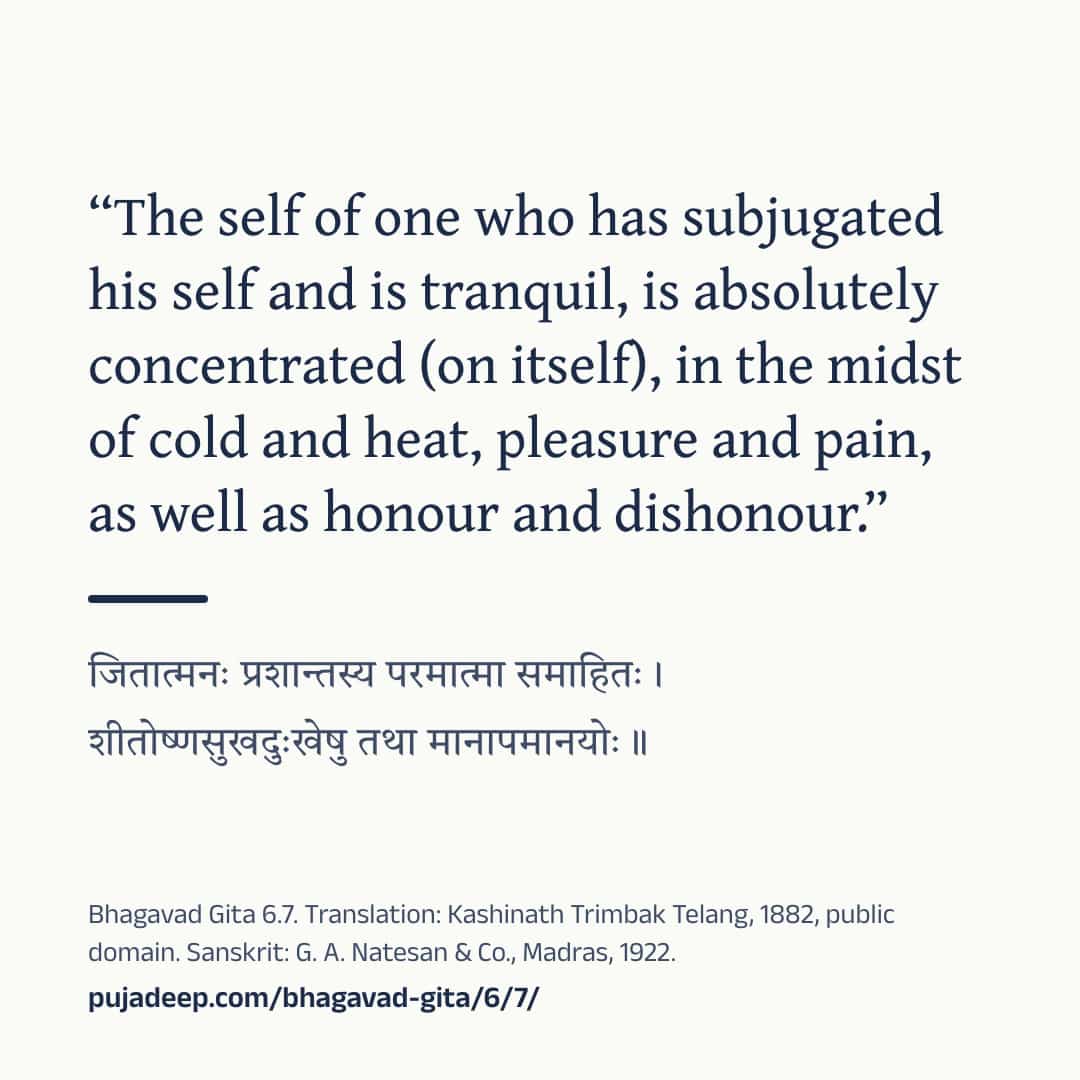
जितात्मनः प्रशान्तस्य परमात्मा समाहितः ।शीतोष्णसुखदुःखेषु तथा मानापमानयोः ॥
Jitatmanah prashantasya paramatma samahitahShitoshnasukhaduhkheshu tatha manapamanayoh
jitātmanaḥ praśāntasya paramātmā samāhitaḥ |śītoṣṇasukhaduḥkheṣu tathā mānāpamānayoḥ ||
Our explanation Krishna says that for the one who has mastered himself and is at peace, the highest self (paramātmā) is steady (samāhita) in cold and heat, in pleasure and pain, and in honour and dishonour. The schools read 'highest self' differently (see the views).
हिंदी अर्थ कृष्ण कहते हैं कि जिसने स्वयं को जीत लिया है और जो शांत है, उसका परमात्मा (परम आत्मा) सर्दी-गर्मी, सुख-दुःख और मान-अपमान में समाहित (स्थिर) रहता है। “परमात्मा” के अर्थ पर परंपराओं के मत अलग हैं।
Word by word
Every word, with its dictionary page
Word by word
- जितात्मनः jitātmanaḥ · of one who has mastered himself (compound (masculine), genitive singular) Dictionary: jitātman, Monier-Williams 1899, p. 420, col. 3 “self-subdued”
- प्रशान्तस्य praśāntasya · of one at peace (past participle (masculine), genitive singular) Dictionary: pra-śānta, Monier-Williams 1899, p. 695, col. 1 “tranquillized, calm, quiet, composed”
- परमात्मा paramātmā · the highest self (compound (masculine), nominative singular) Dictionary: paramātman, Monier-Williams 1899, p. 588, col. 2 “the Supreme Spirit”
- समाहितः samāhitaḥ · steady, collected (past participle (masculine), nominative singular) Dictionary: sam-āhita, Monier-Williams 1899, p. 1160, col. 1 “composed, collected, concentrated”
- शीतोष्णसुखदुःखेषु śītoṣṇasukhaduḥkheṣu · in cold and heat, pleasure and pain (compound (neuter), locative plural) Dictionary: śītoṣṇa, Monier-Williams 1899, p. 1078, col. 1 “cold and heat”; sukha, Monier-Williams 1899, p. 1221, col. 1 “ease, easiness, comfort, prosperity, pleasure, happiness”; 1. duḥkha, Monier-Williams 1899, p. 483, col. 2 “uneasiness, pain, sorrow, trouble, difficulty”
- तथा tathā · so also (indeclinable) Dictionary: tathā, Monier-Williams 1899, p. 433, col. 3 “in that manner, so, thus”
- मानापमानयोः mānāpamānayoḥ · in honour and dishonour (compound (masculine), locative dual) Dictionary: mānāpamāna, Monier-Williams 1899, p. 809, col. 2 “honour and dishonour”
Old translations
Kashinath Trimbak Telang, 1882. Public domain. Page 68.
The self of one who has subjugated his self and is tranquil, is absolutely concentrated (on itself), in the midst of cold and heat, pleasure and pain, as well as honour and dishonour.
Compare 3 translations
Kashinath Trimbak Telang, 1882. Public domain. Page 68.
The self of one who has subjugated his self and is tranquil, is absolutely concentrated (on itself), in the midst of cold and heat, pleasure and pain, as well as honour and dishonour.
You are reading this one
Annie Besant, 1895. Public domain. Page 66.
The higher Self of him who is SELF-vanquished and peaceful, is calm in cold and heat, pleasure and pain, and also in honour and dishonour.
You are reading this one
Swami Swarupananda, 1909 (first printed 1907). Public domain. Page 125.
To the self-controlled and serene, the Supreme Self is the object of constant realisation, in cold and heat, pleasure and pain, as well as in honour and dishonour.
You are reading this one
Cite this verse
The translation: K. T. Telang, The Bhagavadgîtâ (The Sacred Books of the East, vol. VIII, Oxford: Clarendon Press, 1882), p. 68. Bhagavad Gita 6.7.
The translation: Annie Besant, The Bhagavad Gîtâ, or The Lord's Song (London: Theosophical Publishing Society, 1895), p. 66. Bhagavad Gita 6.7.
The translation: Swami Swarupananda, Srimad-Bhagavad-Gita (Mayavati: Prabuddha Bharata Press, 1909; first printed in Prabuddha Bharata, 1907–1909), p. 125. Bhagavad Gita 6.7.
Our explanation: “Bhagavad Gita 6.7: meaning and translation.” Pujadeep. Updated October 25, 2026. https://pujadeep.com/bhagavad-gita/6/7/
Pujadeep’s explanations are free to quote with credit: name Pujadeep and link to the page. How to credit
Classical readings, by school
Each reading is named by its school. None is presented as the only meaning.
What Advaita, Vishishtadvaita and Dvaita teach, in short
Shankara Advaita
Shankara says that when such a person has subdued body and senses and renounced all action, the Supreme Self becomes, in actual experience, his own Self.
Source: The Bhagavad-Gita, with the commentary of Sri Sankaracharya, translated by A. Mahadeva Sastri (2nd ed., Mysore: G. T. A. Printing Works, 1901), commentary on 6.7, p. 172. Summarised in our own words; none of its text is reproduced.
Ramanuja Vishishtadvaita
Ramanuja takes 'highest self' here to mean the individual self, which this chapter is about. It is called highest because each stage of its realisation feels higher than the last. When the mind is calm, the self is seen in its true nature.
Source: Sri Bhagavad-Gita with Sri Ramanujacharya's Visishtadvaita commentary, translated by A. Govindacharya (Madras, 1898), commentary on 6.7, p. 197. Summarised in our own words; none of its text is reproduced.
Share
Show the ways to share
Send one picture or the text to one chat. The picture names its source and the address of this page.
Drawing the picture
See the words
Bhagavad Gita 6.7

जितात्मनः प्रशान्तस्य परमात्मा समाहितः ।
शीतोष्णसुखदुःखेषु तथा मानापमानयोः ॥

“The self of one who has subjugated his self and is tranquil, is absolutely concentrated (on itself), in the midst of cold and heat, pleasure and pain, as well as honour and dishonour.”
(K. T. Telang, The Bhagavadgîtâ (The Sacred Books of the East, vol. VIII, Oxford: Clarendon Press, 1882), p. 68, public domain)

“The higher Self of him who is SELF-vanquished and peaceful, is calm in cold and heat, pleasure and pain, and also in honour and dishonour.”
(Annie Besant, The Bhagavad Gîtâ, or The Lord's Song (London: Theosophical Publishing Society, 1895), p. 66, public domain)

“To the self-controlled and serene, the Supreme Self is the object of constant realisation, in cold and heat, pleasure and pain, as well as in honour and dishonour.”
(Swami Swarupananda, Srimad-Bhagavad-Gita (Mayavati: Prabuddha Bharata Press, 1909; first printed in Prabuddha Bharata, 1907–1909), p. 125, public domain)

Sanskrit: G. A. Natesan & Co., Madras, 1922.
https://pujadeep.com/bhagavad-gita/6/7/ Nothing is sent from this site. Your own app sends it, to the chat you choose. The picture quotes the translation you chose on this page, with its name and year.
Sanskrit text: The Bhagavad-Gita, or The Lord's Song, with the text in Devanagari and an English translation, 1922. Meanings: written for Pujadeep and checked against the cited edition. Source and changes
Questions families ask
Who speaks Bhagavad Gita 6.7?
Krishna speaks this verse, in chapter 6 (Dhyana Yoga).
Where does the Sanskrit text come from?
Sanskrit text: The Bhagavad-Gita, or The Lord's Song, with the text in Devanagari and an English translation, 1922. Meanings: written for Pujadeep and checked against the cited edition. See the source
Is the meaning on this page a translation?
Explanation written for this site from the sources listed here, and checked against the cited edition. It is not a translation and not the only way to read the text. Free to quote with credit.
Source and licence
- Sanskrit text
- The Bhagavad-Gita, or The Lord's Song, with the text in Devanagari and an English translation (Annie Besant, G. A. Natesan & Co., Madras, 1922). Public domain. The Sanskrit on these pages was read from this printing’s page images.
- Translation
- The Bhagavadgîtâ with the Sanatsugâtîya and the Anugîtâ, translated by Kâshinâth Trimbak Telang (The Sacred Books of the East, vol. VIII, ed. F. Max Müller) (Kashinath Trimbak Telang, F. Max Müller, Clarendon Press, Oxford, 1882). Public domain. Shown verbatim, as printed.
- Translation
- The Bhagavad Gîtâ, or The Lord's Song, translated by Annie Besant (Annie Besant, Theosophical Publishing Society, London, 1895). Public domain. Shown verbatim, as printed.
- Translation
- Srimad-Bhagavad-Gita, with Sanskrit Text; Paraphrase with Word-by-word Literal Translation; English Rendering and Comments, Index, &c., by the Swami Swarupananda (Himalayan Series, No. XX) (Swami Swarupananda, The Editors and Publishers, Advaita Ashrama, Mayavati, Prabuddha Bharata Press, Mayavati, Almora, Himalayas, 1909). Public domain. Shown verbatim, as printed.
- Commentary
- The Bhagavad-Gita, with the commentary of Sri Sankaracharya, translated by A. Mahadeva Sastri (2nd ed., Mysore: G. T. A. Printing Works, 1901) (Public-domain scan, University of California Libraries). Summarised in our own words; none of its text is reproduced.
- Commentary
- Sri Bhagavad-Gita with Sri Ramanujacharya's Visishtadvaita commentary, translated by A. Govindacharya (Madras, 1898) (Scan uploaded to archive.org (folkscanomy collection)). Summarised in our own words; none of its text is reproduced.
- Common wording
- In this text, 32 words follow today's common wording, checked against sanskritdocuments.org; Sanskrit Wikisource; Gita Press, Gorakhpur; GRETIL, Göttingen and Bhaktivedanta Book Trust.
- Our explanation
- Explanation written for this site from the sources listed here, and checked against the cited edition. It is not a translation and not the only way to read the text. Free to quote with credit.
- Checked
- Checked against the cited edition, October 15, 2026.
- Updated
- October 25, 2026