Bhagavad Gita 6.2: meaning and translation
Chapter 6: Dhyana Yoga. Krishna says
What people call renunciation (saṃnyāsa), Krishna tells Arjuna, son of Pandu, is yoga.
Click or tap a word for its meaning and its dictionary page.
Text and layers
Text and layers
These choices stay in this browser.
Bhagavad Gita 6.2
यं संन्यासमिति प्राहुर्योगं तं विद्धि पाण्डव ।न ह्यसंन्यस्तसङ्कल्पो योगी भवति कश्चन ॥
Yam sannyasamiti prahuryogam tam viddhi pandavaNa hyasannyastasankalpo yogi bhavati kashchana
yaṃ saṃnyāsamiti prāhuryogaṃ taṃ viddhi pāṇḍava |na hyasaṃnyastasaṅkalpo yogī bhavati kaścana ||
Our explanation What people call renunciation (saṃnyāsa), Krishna tells Arjuna, son of Pandu, is yoga. For no one becomes a yogī without giving up saṅkalpa, the planning will that makes plans and wants their results.
हिंदी अर्थ कृष्ण अर्जुन (पांडव) से कहते हैं कि जिसे लोग संन्यास कहते हैं, उसे ही योग जानो; क्योंकि संकल्प (योजनाएँ बनाने और उनके फल चाहने वाली इच्छा) छोड़े बिना कोई योगी नहीं बनता।
Word by word
Every word, with its dictionary page
Word by word
- यम् yam · what (pronoun (masculine), accusative singular) Dictionary: yad, Monier-Williams 1899, p. 844, col. 2 “who, which, what, whichever, whatever, that”
- संन्यासम् saṃnyāsam · renunciation (noun (masculine), accusative singular) Dictionary: saṃ-nyāsa, Monier-Williams 1899, p. 1148, col. 1 “renunciation of the world, profession of asceticism”
- इति iti · thus (as a name) (indeclinable) Dictionary: 2. iti, Monier-Williams 1899, p. 165, col. 1 “in this manner, thus”
- प्राहुः prāhuḥ · they call (perfect form, present sense, 3rd person plural) Dictionary: 1. ah, Monier-Williams 1899, p. 124, col. 1 “to say, speak”
- योगम् yogam · yoga (noun (masculine), accusative singular) Dictionary: yoga, Monier-Williams 1899, p. 856, col. 2 “the act of yoking, joining, attaching”
- तम् tam · that (pronoun (masculine), accusative singular) Dictionary: tad, Monier-Williams 1899, p. 434, col. 1 “m. he, f. she, n. it, that, this”
- विद्धि viddhi · know (imperative, 2nd person singular) Dictionary: 1. vid, Monier-Williams 1899, p. 963, col. 2 “to know, understand, perceive, learn”
- पाण्डव pāṇḍava · O son of Pandu (Arjuna) (noun (masculine), vocative singular) Dictionary: pāṇḍava, Monier-Williams 1899, p. 616, col. 2 “a son or descendant of Pāṇḍu”
- न na · not (indeclinable) Dictionary: 2. na, Monier-Williams 1899, p. 523, col. 1 “ind. not, no, nor, neither”
- हि hi · for (indeclinable) Dictionary: 2. hi, Monier-Williams 1899, p. 1297, col. 3 “for, because, on account of”
- असंन्यस्तसङ्कल्पः asaṃnyastasaṅkalpaḥ · who has not given up saṅkalpa (compound (masculine), nominative singular) Dictionary: saṃ-nyasta, Monier-Williams 1899, p. 1148, col. 1 “thrown down, laid aside, relinquished, abandoned”; saṃ-kalpa, Monier-Williams 1899, p. 1126, col. 3 “conception or idea or notion formed in the mind or heart, (esp.) will, volition, desire, purpose”
- योगी yogī · a yogī (noun (masculine), nominative singular) Dictionary: yogin, Monier-Williams 1899, p. 857, col. 3 “a follower of the Yoga system, a Yogin (usually called Yogī) or contemplative saint”
- भवति bhavati · becomes (present, 3rd person singular) Dictionary: 1. bhū, Monier-Williams 1899, p. 760, col. 2 “arise, come into being, exist”
- कश्चन kaścana · anyone (pronoun (masculine), nominative singular) Dictionary: kim, Monier-Williams 1899, p. 282, col. 2 “what? how? whence? wherefore? why?”
Old translations
Kashinath Trimbak Telang, 1882. Public domain. Page 67.
Know, O son of Pându! that what is called renunciation is devotion; for nobody becomes a devotee who has not renounced (all) fancies1.
Footnotes (the translator’s own) - Which are the cause of desires; see supra, p. 50. ↩
Compare 3 translations
Kashinath Trimbak Telang, 1882. Public domain. Page 67.
Know, O son of Pându! that what is called renunciation is devotion; for nobody becomes a devotee who has not renounced (all) fancies1.
Footnotes (the translator’s own) - Which are the cause of desires; see supra, p. 50. ↩
You are reading this one
Annie Besant, 1895. Public domain. Page 65.
That which is called renunciation know thou that as Yoga, O Pândava; nor doth any one become a Yogî with the formative will1 unrenounced.
Footnotes (the translator’s own) - The imaginative faculty, that makes plans for the future. ↩
You are reading this one
Swami Swarupananda, 1909 (first printed 1907). Public domain. Page 122.
Know that to be devotion to action, which is called renunciation, O Pândava, for none becomes a devotee to action without forsaking Sankalpa.
You are reading this one
Cite this verse
The translation: K. T. Telang, The Bhagavadgîtâ (The Sacred Books of the East, vol. VIII, Oxford: Clarendon Press, 1882), p. 67. Bhagavad Gita 6.2.
The translation: Annie Besant, The Bhagavad Gîtâ, or The Lord's Song (London: Theosophical Publishing Society, 1895), p. 65. Bhagavad Gita 6.2.
The translation: Swami Swarupananda, Srimad-Bhagavad-Gita (Mayavati: Prabuddha Bharata Press, 1909; first printed in Prabuddha Bharata, 1907–1909), p. 122. Bhagavad Gita 6.2.
Our explanation: “Bhagavad Gita 6.2: meaning and translation.” Pujadeep. Updated October 25, 2026. https://pujadeep.com/bhagavad-gita/6/2/
Pujadeep’s explanations are free to quote with credit: name Pujadeep and link to the page. How to credit
Classical readings, by school
No readings by school on this verse yet.
Share
Show the ways to share
Send one picture or the text to one chat. The picture names its source and the address of this page.
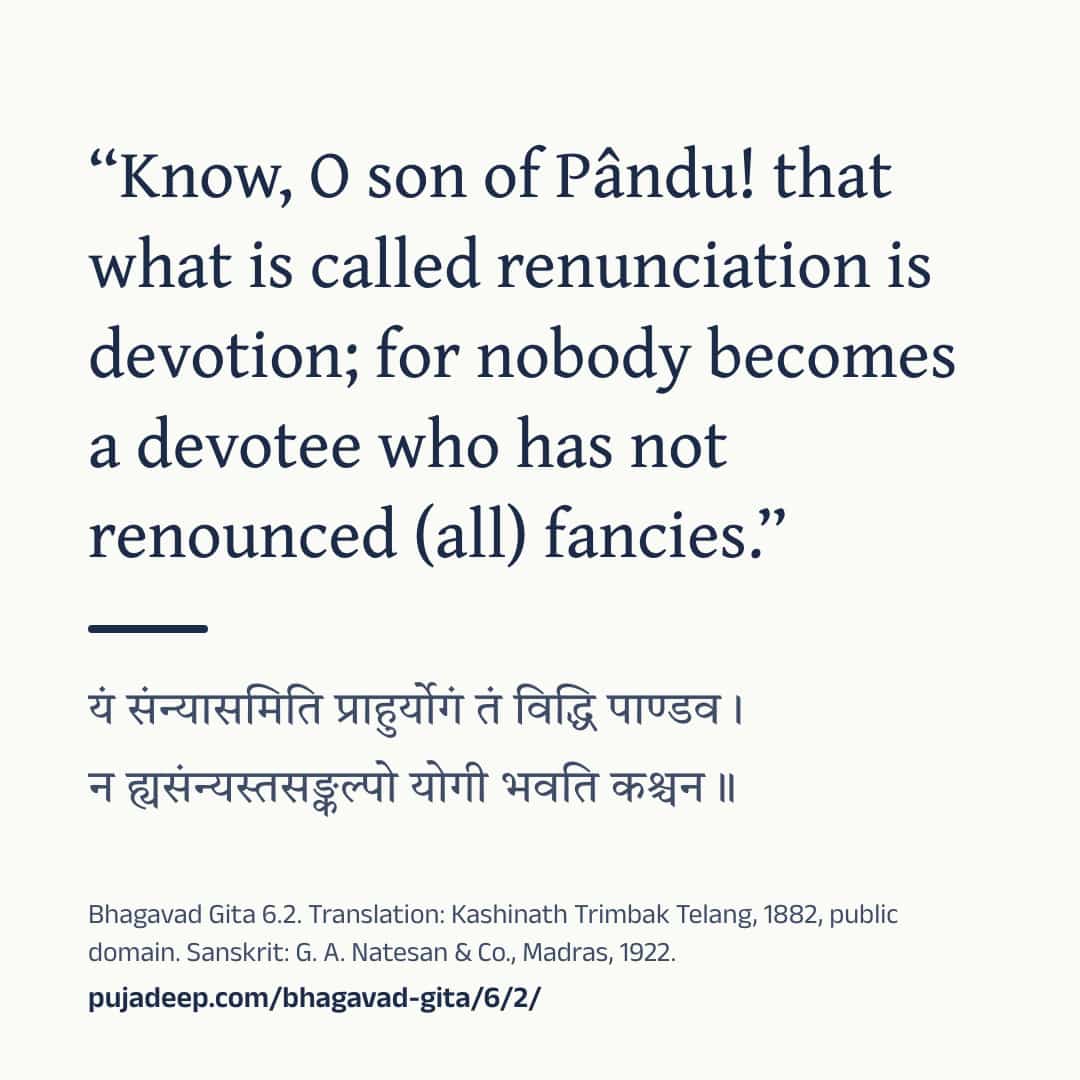
Drawing the picture
See the words
Bhagavad Gita 6.2

यं संन्यासमिति प्राहुर्योगं तं विद्धि पाण्डव ।
न ह्यसंन्यस्तसङ्कल्पो योगी भवति कश्चन ॥

“Know, O son of Pându! that what is called renunciation is devotion; for nobody becomes a devotee who has not renounced (all) fancies.”
(K. T. Telang, The Bhagavadgîtâ (The Sacred Books of the East, vol. VIII, Oxford: Clarendon Press, 1882), p. 67, public domain)

“That which is called renunciation know thou that as Yoga, O Pândava; nor doth any one become a Yogî with the formative will unrenounced.”
(Annie Besant, The Bhagavad Gîtâ, or The Lord's Song (London: Theosophical Publishing Society, 1895), p. 65, public domain)

“Know that to be devotion to action, which is called renunciation, O Pândava, for none becomes a devotee to action without forsaking Sankalpa.”
(Swami Swarupananda, Srimad-Bhagavad-Gita (Mayavati: Prabuddha Bharata Press, 1909; first printed in Prabuddha Bharata, 1907–1909), p. 122, public domain)

Sanskrit: G. A. Natesan & Co., Madras, 1922.
https://pujadeep.com/bhagavad-gita/6/2/ Nothing is sent from this site. Your own app sends it, to the chat you choose. The picture quotes the translation you chose on this page, with its name and year.
Sanskrit text: The Bhagavad-Gita, or The Lord's Song, with the text in Devanagari and an English translation, 1922. Meanings: written for Pujadeep and checked against the cited edition. Source and changes
Questions families ask
Who speaks Bhagavad Gita 6.2?
Krishna speaks this verse, in chapter 6 (Dhyana Yoga).
Where does the Sanskrit text come from?
Sanskrit text: The Bhagavad-Gita, or The Lord's Song, with the text in Devanagari and an English translation, 1922. Meanings: written for Pujadeep and checked against the cited edition. See the source
Is the meaning on this page a translation?
Explanation written for this site from the sources listed here, and checked against the cited edition. It is not a translation and not the only way to read the text. Free to quote with credit.
Source and licence
- Sanskrit text
- The Bhagavad-Gita, or The Lord's Song, with the text in Devanagari and an English translation (Annie Besant, G. A. Natesan & Co., Madras, 1922). Public domain. The Sanskrit on these pages was read from this printing’s page images.
- Translation
- The Bhagavadgîtâ with the Sanatsugâtîya and the Anugîtâ, translated by Kâshinâth Trimbak Telang (The Sacred Books of the East, vol. VIII, ed. F. Max Müller) (Kashinath Trimbak Telang, F. Max Müller, Clarendon Press, Oxford, 1882). Public domain. Shown verbatim, as printed.
- Translation
- The Bhagavad Gîtâ, or The Lord's Song, translated by Annie Besant (Annie Besant, Theosophical Publishing Society, London, 1895). Public domain. Shown verbatim, as printed.
- Translation
- Srimad-Bhagavad-Gita, with Sanskrit Text; Paraphrase with Word-by-word Literal Translation; English Rendering and Comments, Index, &c., by the Swami Swarupananda (Himalayan Series, No. XX) (Swami Swarupananda, The Editors and Publishers, Advaita Ashrama, Mayavati, Prabuddha Bharata Press, Mayavati, Almora, Himalayas, 1909). Public domain. Shown verbatim, as printed.
- Common wording
- In this text, 32 words follow today's common wording, checked against sanskritdocuments.org; Sanskrit Wikisource; Gita Press, Gorakhpur; GRETIL, Göttingen and Bhaktivedanta Book Trust.
- Our explanation
- Explanation written for this site from the sources listed here, and checked against the cited edition. It is not a translation and not the only way to read the text. Free to quote with credit.
- Checked
- Checked against the cited edition, October 15, 2026.
- Updated
- October 25, 2026