भगवद्गीता 17.28: अर्थ और अनुवाद
अध्याय 17: श्रद्धात्रयविभागयोग। कृष्ण कहते हैं
श्रीमद्भगवद्गीता (Bhagavad Gita) 17.28: कृष्ण अध्याय पूरा करते हैं।
किसी शब्द पर क्लिक करें या उसे छुएँ, उसका अर्थ और कोश का पृष्ठ देखें।
दिखावट
दिखावट
ये चुनाव इसी ब्राउज़र में रहते हैं।
श्रीमद्भगवद्गीता 17.28
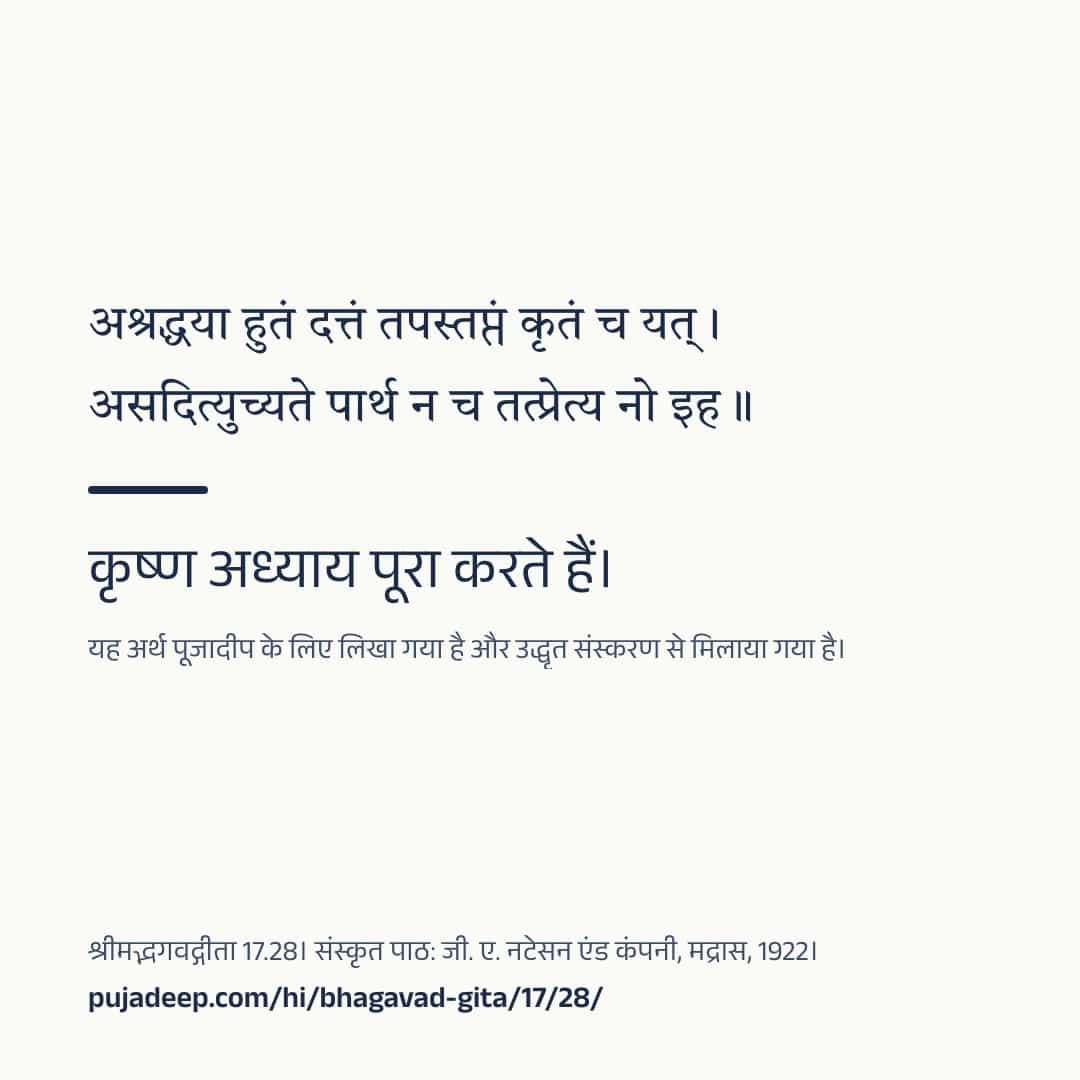
अश्रद्धया हुतं दत्तं तपस्तप्तं कृतं च यत् ।असदित्युच्यते पार्थ न च तत्प्रेत्य नो इह ॥
Ashraddhaya hutam dattam tapastaptam kritam cha yatAsadityuchyate partha na cha tatpretya no iha
aśraddhayā hutaṃ dattaṃ tapastaptaṃ kṛtaṃ ca yat |asadityucyate pārtha na ca tatpretya no iha ||
भावार्थ कृष्ण अध्याय पूरा करते हैं। हे पार्थ, बिना श्रद्धा के जो हवन किया जाए, जो दिया जाए, जो तप किया जाए, और जो भी कर्म किया जाए, वह “असत्” कहलाता है; वे कहते हैं कि वह न मरने के बाद किसी काम का है, न यहाँ। तेलंग की टिप्पणी श्लोक 23 से 28 को ऐसे पढ़ती है कि तीनों शब्दों का अपना-अपना उपयोग बताया गया है।
English meaning Krishna closes the chapter. Whatever is offered in the fire (huta), given or done as austerity, and any act done without faith, Partha, is called 'asat'; he says it counts for nothing, either after death or here. Telang's note reads verses 23 to 28 as giving each of the three words its own use.
शब्दार्थ
हर शब्द, शब्दकोश के पृष्ठ के साथ
शब्दार्थ
- अश्रद्धया aśraddhayā · बिना श्रद्धा के (संज्ञा (स्त्रीलिंग), तृतीया एकवचन) शब्दकोश: a-śraddhā, मोनियर-विलियम्स 1899, पृ. 114, स्तंभ 2
want of trust, unbelief
- हुतम् hutam · हवन किया हुआ (भूतकालिक कृदन्त (नपुंसकलिंग), प्रथमा एकवचन) शब्दकोश: huta, मोनियर-विलियम्स 1899, पृ. 1301, स्तंभ 1
offered in fire, poured out (as clarified butter)
- दत्तम् dattam · दिया हुआ (भूतकालिक कृदन्त (नपुंसकलिंग), प्रथमा एकवचन) शब्दकोश: 2. datta, मोनियर-विलियम्स 1899, पृ. 467, स्तंभ 2
given, granted, presented
- तपः tapaḥ · तप (संज्ञा (नपुंसकलिंग), प्रथमा एकवचन) शब्दकोश: tapas, मोनियर-विलियम्स 1899, पृ. 437, स्तंभ 1
religious austerity, bodily mortification, penance, severe meditation
- तप्तम् taptam · किया हुआ (भूतकालिक कृदन्त (नपुंसकलिंग), प्रथमा एकवचन) शब्दकोश: tapta, मोनियर-विलियम्स 1899, पृ. 437, स्तंभ 3
practised (as austerities)
- कृतम् kṛtam · किया हुआ (भूतकालिक कृदन्त (नपुंसकलिंग), प्रथमा एकवचन) शब्दकोश: 1. kṛta, मोनियर-विलियम्स 1899, पृ. 301, स्तंभ 3
done, made, accomplished, performed
- च ca · और (अव्यय) शब्दकोश: 2. ca, मोनियर-विलियम्स 1899, पृ. 380, स्तंभ 1
and, both, also, moreover, as well as
- यत् yat · जो (सर्वनाम (नपुंसकलिंग), प्रथमा एकवचन) शब्दकोश: yad, मोनियर-विलियम्स 1899, पृ. 844, स्तंभ 2
who, which, what, whichever, whatever, that
- असत् asat · असत् (संज्ञा (नपुंसकलिंग), प्रथमा एकवचन) शब्दकोश: a-sat, मोनियर-विलियम्स 1899, पृ. 118, स्तंभ 2
not being, not existing, unreal
- इति iti · ऐसा (अव्यय) शब्दकोश: 2. iti, मोनियर-विलियम्स 1899, पृ. 165, स्तंभ 1
in this manner, thus
- उच्यते ucyate · कहा जाता है (कर्मवाच्य, वर्तमान काल (लट्), प्रथम पुरुष एकवचन) शब्दकोश: vac, मोनियर-विलियम्स 1899, पृ. 912, स्तंभ 1
to be called or accounted, be regarded as
- पार्थ pārtha · हे पार्थ (अर्जुन) (संज्ञा (पुंलिंग), संबोधन एकवचन) शब्दकोश: 2. pārtha, मोनियर-विलियम्स 1899, पृ. 621, स्तंभ 3
metron. of Yudhi-shṭhira or Bhīma-sena or Arjuna
- न na · नहीं (अव्यय) शब्दकोश: 2. na, मोनियर-विलियम्स 1899, पृ. 523, स्तंभ 1
not, no, nor, neither
- च ca · और (अव्यय) शब्दकोश: 2. ca, मोनियर-विलियम्स 1899, पृ. 380, स्तंभ 1
and, both, also, moreover, as well as
- तत् tat · वह (सर्वनाम (नपुंसकलिंग), प्रथमा एकवचन) शब्दकोश: tad, मोनियर-विलियम्स 1899, पृ. 434, स्तंभ 1
m. he, f. she, n. it, that, this
- प्रेत्य pretya · मरने के बाद (पूर्वकालिक कृदन्त (करके)) शब्दकोश: pretya, मोनियर-विलियम्स 1899, पृ. 712, स्तंभ 1
having died, after death, in the next world
- नो no · न ही (अव्यय) शब्दकोश: no, मोनियर-विलियम्स 1899, पृ. 571, स्तंभ 1
and not
- इह iha · यहाँ (अव्यय) शब्दकोश: iha, मोनियर-विलियम्स 1899, पृ. 169, स्तंभ 3
in this place, here
पुराने अंग्रेज़ी अनुवाद
Kashinath Trimbak Telang, 1882। सार्वजनिक डोमेन (कॉपीराइट-मुक्त)। पृष्ठ 121।
Whatever oblation is offered, whatever is given, whatever penance is performed, and whatever is done, without faith1, that, O son of Prithâ! is called 'Asat,' and that is nought, both after death and here2.
पाद-टिप्पणियाँ (अनुवादक की अपनी) - Cf. Sutta Nipâta, p. 69. ↩
- The meaning of this whole passage seems to be that these three words, which designate the Brahman, have distinct uses, as specified. 'Om,' says Nîlakantha, is employed whether the action is done with any special desire or not. Those who study the Brahman there means 'study the Vedas.' 'Tad' is employed in case of actions without desires only. 'Sat' is employed, according to Saṅkara, in case of existence, such as the birth of a first son; 'goodness,' the reclamation of a bad man; 'auspicious acts,' marriage, &c. The intelligent use of these terms as here specified is said to cure any defects in the actions, the various classes of which are mentioned before. ↩
3 अनुवादों की तुलना करें
Kashinath Trimbak Telang, 1882। सार्वजनिक डोमेन (कॉपीराइट-मुक्त)। पृष्ठ 121।
Whatever oblation is offered, whatever is given, whatever penance is performed, and whatever is done, without faith1, that, O son of Prithâ! is called 'Asat,' and that is nought, both after death and here2.
पाद-टिप्पणियाँ (अनुवादक की अपनी) - Cf. Sutta Nipâta, p. 69. ↩
- The meaning of this whole passage seems to be that these three words, which designate the Brahman, have distinct uses, as specified. 'Om,' says Nîlakantha, is employed whether the action is done with any special desire or not. Those who study the Brahman there means 'study the Vedas.' 'Tad' is employed in case of actions without desires only. 'Sat' is employed, according to Saṅkara, in case of existence, such as the birth of a first son; 'goodness,' the reclamation of a bad man; 'auspicious acts,' marriage, &c. The intelligent use of these terms as here specified is said to cure any defects in the actions, the various classes of which are mentioned before. ↩
आप यही पढ़ रहे हैं
Annie Besant, 1895। सार्वजनिक डोमेन (कॉपीराइट-मुक्त)। पृष्ठ 151।
Whatsoever oblation, gift, austerity, deed, is wrought without faith, "Asat" it is called, O Pârtha; it is nought, here or hereafter.
आप यही पढ़ रहे हैं
Swami Swarupananda, 1909 (पहली बार 1907 में छपा)। सार्वजनिक डोमेन (कॉपीराइट-मुक्त)। पृष्ठ 100।
Whatever is sacrificed, given or performed, and whatever austerity is practised without Shraddhâ, it is called Asat, O Pârtha; it is naught here or hereafter.
आप यही पढ़ रहे हैं
इस श्लोक का हवाला दें
अनुवाद: K. T. Telang, The Bhagavadgîtâ (The Sacred Books of the East, vol. VIII, Oxford: Clarendon Press, 1882), पृष्ठ 121। भगवद्गीता 17.28।
अनुवाद: Annie Besant, The Bhagavad Gîtâ, or The Lord's Song (London: Theosophical Publishing Society, 1895), पृष्ठ 151। भगवद्गीता 17.28।
अनुवाद: Swami Swarupananda, Srimad-Bhagavad-Gita (Mayavati: Prabuddha Bharata Press, 1909; first printed in Prabuddha Bharata, 1907–1909), पृष्ठ 100। भगवद्गीता 17.28।
हमारी व्याख्या: “भगवद्गीता 17.28: अर्थ और अनुवाद”। पूजादीप। अद्यतन 25 अक्टूबर 2026। https://pujadeep.com/hi/bhagavad-gita/17/28/
पूजादीप की व्याख्याएँ श्रेय देकर उद्धृत की जा सकती हैं: पूजादीप का नाम और पृष्ठ का लिंक दें। श्रेय कैसे दें
शास्त्रीय व्याख्याएँ, संप्रदाय के अनुसार
हर व्याख्या अपने संप्रदाय के नाम से दी गई है। कोई भी एकमात्र अर्थ के रूप में प्रस्तुत नहीं है।
अद्वैत, विशिष्टाद्वैत और द्वैत क्या सिखाते हैं, संक्षेप में
शंकराचार्य अद्वैत
शंकराचार्य कहते हैं कि ऐसे कर्म “असत्” इसलिए कहलाते हैं कि वे उस मार्ग से बाहर हैं जिससे भगवान तक पहुँचा जाता है। बहुत परिश्रम लगने पर भी वे यहाँ किसी काम के नहीं, क्योंकि ज्ञानी उन्हें महत्त्व नहीं देते, और परलोक में भी उनसे कुछ नहीं मिलता।
स्रोत: The Bhagavad-Gita, with the commentary of Sri Sankaracharya, translated by A. Mahadeva Sastri (2nd ed., Mysore: G. T. A. Printing Works, 1901), commentary on 17.28, p. 395. हमारे अपने शब्दों में सार; इसका कोई पाठ उद्धृत नहीं किया गया।
रामानुजाचार्य विशिष्टाद्वैत
रामानुजाचार्य कहते हैं कि बिना श्रद्धा के किया गया कर्म, शास्त्र की विधि के अनुसार होने पर भी, असत् है। उससे न इस लोक (इह) में कोई फल मिलता है, न मोक्ष (प्रेत्य)।
स्रोत: Sri Bhagavad-Gita with Sri Ramanujacharya's Visishtadvaita commentary, translated by A. Govindacharya (Madras, 1898), commentary on 17.28, p. 515. हमारे अपने शब्दों में सार; इसका कोई पाठ उद्धृत नहीं किया गया।
भेजें
साझा करने के तरीके दिखाएँ
एक तस्वीर या पाठ एक चैट में भेजें। तस्वीर पर उसका स्रोत और इस पृष्ठ का पता लिखा है।
तस्वीर बन रही है
शब्द देखें
श्रीमद्भगवद्गीता 17.28

अश्रद्धया हुतं दत्तं तपस्तप्तं कृतं च यत् ।
असदित्युच्यते पार्थ न च तत्प्रेत्य नो इह ॥

“Whatever oblation is offered, whatever is given, whatever penance is performed, and whatever is done, without faith, that, O son of Prithâ! is called 'Asat,' and that is nought, both after death and here.”
(K. T. Telang, The Bhagavadgîtâ (The Sacred Books of the East, vol. VIII, Oxford: Clarendon Press, 1882), p. 121, public domain)

“Whatsoever oblation, gift, austerity, deed, is wrought without faith, "Asat" it is called, O Pârtha; it is nought, here or hereafter.”
(Annie Besant, The Bhagavad Gîtâ, or The Lord's Song (London: Theosophical Publishing Society, 1895), p. 151, public domain)

“Whatever is sacrificed, given or performed, and whatever austerity is practised without Shraddhâ, it is called Asat, O Pârtha; it is naught here or hereafter.”
(Swami Swarupananda, Srimad-Bhagavad-Gita (Mayavati: Prabuddha Bharata Press, 1909; first printed in Prabuddha Bharata, 1907–1909), p. 100, public domain)

संस्कृत पाठ: जी. ए. नटेसन एंड कंपनी, मद्रास, 1922।
https://pujadeep.com/hi/bhagavad-gita/17/28/
इस साइट से कुछ नहीं भेजा जाता। आपका अपना ऐप उसे आपकी चुनी हुई चैट में भेजता है। तस्वीर में वही अनुवाद है जो आपने इस पृष्ठ पर चुना है, उसके नाम और वर्ष के साथ।
संस्कृत पाठ: 1922 का मद्रास मुद्रण। अर्थ: पूजादीप के लिए लिखे और जाँचे गए। स्रोत और बदलाव
परिवारों के प्रश्न
गीता 17.28 कौन कहता है?
यह श्लोक कृष्ण कहते हैं, अध्याय 17 (श्रद्धात्रयविभागयोग) में।
संस्कृत पाठ कहाँ से लिया गया है?
संस्कृत पाठ: 1922 का मद्रास मुद्रण। अर्थ: पूजादीप के लिए लिखे और जाँचे गए। स्रोत देखें
क्या इस पृष्ठ का अर्थ अनुवाद है?
इस साइट के लिए यहाँ दिए स्रोतों के आधार पर लिखी और उद्धृत संस्करण से मिलाई गई व्याख्या। यह अनुवाद नहीं है, और पाठ को पढ़ने का एकमात्र तरीका भी नहीं है। श्रेय देकर आप इसे उद्धृत कर सकते हैं।
स्रोत और लाइसेंस
- संस्कृत पाठ
- The Bhagavad-Gita, or The Lord's Song, with the text in Devanagari and an English translation (Annie Besant, G. A. Natesan & Co., Madras, 1922). सार्वजनिक डोमेन (कॉपीराइट-मुक्त)। इन पृष्ठों का संस्कृत पाठ इसी मुद्रण के पृष्ठ-चित्रों से पढ़ा गया है।
- अनुवाद
- The Bhagavadgîtâ with the Sanatsugâtîya and the Anugîtâ, translated by Kâshinâth Trimbak Telang (The Sacred Books of the East, vol. VIII, ed. F. Max Müller) (Kashinath Trimbak Telang, F. Max Müller, Clarendon Press, Oxford, 1882). सार्वजनिक डोमेन (कॉपीराइट-मुक्त)। जैसा छपा है, वैसा ही दिखाया गया।
- अनुवाद
- The Bhagavad Gîtâ, or The Lord's Song, translated by Annie Besant (Annie Besant, Theosophical Publishing Society, London, 1895). सार्वजनिक डोमेन (कॉपीराइट-मुक्त)। जैसा छपा है, वैसा ही दिखाया गया।
- अनुवाद
- Srimad-Bhagavad-Gita, with Sanskrit Text; Paraphrase with Word-by-word Literal Translation; English Rendering and Comments, Index, &c., by the Swami Swarupananda (Himalayan Series, No. XX) (Swami Swarupananda, The Editors and Publishers, Advaita Ashrama, Mayavati, Prabuddha Bharata Press, Mayavati, Almora, Himalayas, 1909). सार्वजनिक डोमेन (कॉपीराइट-मुक्त)। जैसा छपा है, वैसा ही दिखाया गया।
- भाष्य
- The Bhagavad-Gita, with the commentary of Sri Sankaracharya, translated by A. Mahadeva Sastri (2nd ed., Mysore: G. T. A. Printing Works, 1901) (Public-domain scan, University of California Libraries). हमारे अपने शब्दों में सार; इसका कोई पाठ उद्धृत नहीं किया गया।
- भाष्य
- Sri Bhagavad-Gita with Sri Ramanujacharya's Visishtadvaita commentary, translated by A. Govindacharya (Madras, 1898) (Scan uploaded to archive.org (folkscanomy collection)). हमारे अपने शब्दों में सार; इसका कोई पाठ उद्धृत नहीं किया गया।
- प्रचलित पाठ
- इस पाठ में 32 शब्द आज के प्रचलित रूप में हैं; इन्हें sanskritdocuments.org; संस्कृत विकिस्रोत; गीता प्रेस, गोरखपुर; ग्रेटिल, गॉटिंगेन और भक्तिवेदांत बुक ट्रस्ट के पाठ से मिलाकर जाँचा गया।
- हमारी व्याख्या
- इस साइट के लिए यहाँ दिए स्रोतों के आधार पर लिखी और उद्धृत संस्करण से मिलाई गई व्याख्या। यह अनुवाद नहीं है, और पाठ को पढ़ने का एकमात्र तरीका भी नहीं है। श्रेय देकर आप इसे उद्धृत कर सकते हैं।
- जाँच
- उद्धृत संस्करण से मिलाया गया, 15 अक्टूबर 2026।
- अद्यतन
- 25 अक्टूबर 2026