Bhagavad Gita 17.28: meaning and translation
Chapter 17: Shraddhatraya Vibhaga Yoga. Krishna says
Krishna closes the chapter.
Click or tap a word for its meaning and its dictionary page.
Text and layers
Text and layers
These choices stay in this browser.
Bhagavad Gita 17.28
अश्रद्धया हुतं दत्तं तपस्तप्तं कृतं च यत् ।असदित्युच्यते पार्थ न च तत्प्रेत्य नो इह ॥
Ashraddhaya hutam dattam tapastaptam kritam cha yatAsadityuchyate partha na cha tatpretya no iha
aśraddhayā hutaṃ dattaṃ tapastaptaṃ kṛtaṃ ca yat |asadityucyate pārtha na ca tatpretya no iha ||
Our explanation Krishna closes the chapter. Whatever is offered in the fire (huta), given or done as austerity, and any act done without faith, Partha, is called 'asat'; he says it counts for nothing, either after death or here. Telang's note reads verses 23 to 28 as giving each of the three words its own use.
हिंदी अर्थ कृष्ण अध्याय पूरा करते हैं। हे पार्थ, बिना श्रद्धा के जो हवन किया जाए, जो दिया जाए, जो तप किया जाए, और जो भी कर्म किया जाए, वह “असत्” कहलाता है; वे कहते हैं कि वह न मरने के बाद किसी काम का है, न यहाँ। तेलंग की टिप्पणी श्लोक 23 से 28 को ऐसे पढ़ती है कि तीनों शब्दों का अपना-अपना उपयोग बताया गया है।
Word by word
Every word, with its dictionary page
Word by word
- अश्रद्धया aśraddhayā · without faith (noun (feminine), instrumental singular) Dictionary: a-śraddhā, Monier-Williams 1899, p. 114, col. 2 “want of trust, unbelief”
- हुतम् hutam · offered in the fire (past participle (neuter), nominative singular) Dictionary: huta, Monier-Williams 1899, p. 1301, col. 1 “offered in fire, poured out (as clarified butter)”
- दत्तम् dattam · given (past participle (neuter), nominative singular) Dictionary: 2. datta, Monier-Williams 1899, p. 467, col. 2 “given, granted, presented”
- तपः tapaḥ · austerity (noun (neuter), nominative singular) Dictionary: tapas, Monier-Williams 1899, p. 437, col. 1 “religious austerity, bodily mortification, penance, severe meditation”
- तप्तम् taptam · practised (past participle (neuter), nominative singular) Dictionary: tapta, Monier-Williams 1899, p. 437, col. 3 “practised (as austerities)”
- कृतम् kṛtam · done (past participle (neuter), nominative singular) Dictionary: 1. kṛta, Monier-Williams 1899, p. 301, col. 3 “done, made, accomplished, performed”
- च ca · and (indeclinable) Dictionary: 2. ca, Monier-Williams 1899, p. 380, col. 1 “and, both, also, moreover, as well as”
- यत् yat · which (pronoun (neuter), nominative singular) Dictionary: yad, Monier-Williams 1899, p. 844, col. 2 “who, which, what, whichever, whatever, that”
- असत् asat · asat ('not Sat') (noun (neuter), nominative singular) Dictionary: a-sat, Monier-Williams 1899, p. 118, col. 2 “not being, not existing, unreal”
- इति iti · thus (indeclinable) Dictionary: 2. iti, Monier-Williams 1899, p. 165, col. 1 “in this manner, thus”
- उच्यते ucyate · is called (present passive, 3rd person singular) Dictionary: vac, Monier-Williams 1899, p. 912, col. 1 “to be called or accounted, be regarded as”
- पार्थ pārtha · O Partha (Arjuna) (noun (masculine), vocative singular) Dictionary: 2. pārtha, Monier-Williams 1899, p. 621, col. 3 “metron. of Yudhi-shṭhira or Bhīma-sena or Arjuna”
- न na · not (indeclinable) Dictionary: 2. na, Monier-Williams 1899, p. 523, col. 1 “not, no, nor, neither”
- च ca · and (indeclinable) Dictionary: 2. ca, Monier-Williams 1899, p. 380, col. 1 “and, both, also, moreover, as well as”
- तत् tat · it (pronoun (neuter), nominative singular) Dictionary: tad, Monier-Williams 1899, p. 434, col. 1 “m. he, f. she, n. it, that, this”
- प्रेत्य pretya · after death (absolutive (having done)) Dictionary: pretya, Monier-Williams 1899, p. 712, col. 1 “having died, after death, in the next world”
- नो no · nor (indeclinable) Dictionary: no, Monier-Williams 1899, p. 571, col. 1 “and not”
- इह iha · here (indeclinable) Dictionary: iha, Monier-Williams 1899, p. 169, col. 3 “in this place, here”
Old translations
Kashinath Trimbak Telang, 1882. Public domain. Page 121.
Whatever oblation is offered, whatever is given, whatever penance is performed, and whatever is done, without faith1, that, O son of Prithâ! is called 'Asat,' and that is nought, both after death and here2.
Footnotes (the translator’s own) - Cf. Sutta Nipâta, p. 69. ↩
- The meaning of this whole passage seems to be that these three words, which designate the Brahman, have distinct uses, as specified. 'Om,' says Nîlakantha, is employed whether the action is done with any special desire or not. Those who study the Brahman there means 'study the Vedas.' 'Tad' is employed in case of actions without desires only. 'Sat' is employed, according to Saṅkara, in case of existence, such as the birth of a first son; 'goodness,' the reclamation of a bad man; 'auspicious acts,' marriage, &c. The intelligent use of these terms as here specified is said to cure any defects in the actions, the various classes of which are mentioned before. ↩
Compare 3 translations
Kashinath Trimbak Telang, 1882. Public domain. Page 121.
Whatever oblation is offered, whatever is given, whatever penance is performed, and whatever is done, without faith1, that, O son of Prithâ! is called 'Asat,' and that is nought, both after death and here2.
Footnotes (the translator’s own) - Cf. Sutta Nipâta, p. 69. ↩
- The meaning of this whole passage seems to be that these three words, which designate the Brahman, have distinct uses, as specified. 'Om,' says Nîlakantha, is employed whether the action is done with any special desire or not. Those who study the Brahman there means 'study the Vedas.' 'Tad' is employed in case of actions without desires only. 'Sat' is employed, according to Saṅkara, in case of existence, such as the birth of a first son; 'goodness,' the reclamation of a bad man; 'auspicious acts,' marriage, &c. The intelligent use of these terms as here specified is said to cure any defects in the actions, the various classes of which are mentioned before. ↩
You are reading this one
Annie Besant, 1895. Public domain. Page 151.
Whatsoever oblation, gift, austerity, deed, is wrought without faith, "Asat" it is called, O Pârtha; it is nought, here or hereafter.
You are reading this one
Swami Swarupananda, 1909 (first printed 1907). Public domain. Page 100.
Whatever is sacrificed, given or performed, and whatever austerity is practised without Shraddhâ, it is called Asat, O Pârtha; it is naught here or hereafter.
You are reading this one
Cite this verse
The translation: K. T. Telang, The Bhagavadgîtâ (The Sacred Books of the East, vol. VIII, Oxford: Clarendon Press, 1882), p. 121. Bhagavad Gita 17.28.
The translation: Annie Besant, The Bhagavad Gîtâ, or The Lord's Song (London: Theosophical Publishing Society, 1895), p. 151. Bhagavad Gita 17.28.
The translation: Swami Swarupananda, Srimad-Bhagavad-Gita (Mayavati: Prabuddha Bharata Press, 1909; first printed in Prabuddha Bharata, 1907–1909), p. 100. Bhagavad Gita 17.28.
Our explanation: “Bhagavad Gita 17.28: meaning and translation.” Pujadeep. Updated October 25, 2026. https://pujadeep.com/bhagavad-gita/17/28/
Pujadeep’s explanations are free to quote with credit: name Pujadeep and link to the page. How to credit
Classical readings, by school
Each reading is named by its school. None is presented as the only meaning.
What Advaita, Vishishtadvaita and Dvaita teach, in short
Shankara Advaita
Shankara says such acts are called asat because they lie outside the path by which the Lord is reached. Though they cost much effort, they are of no use here, since the wise think little of them, and they bring nothing hereafter.
Source: The Bhagavad-Gita, with the commentary of Sri Sankaracharya, translated by A. Mahadeva Sastri (2nd ed., Mysore: G. T. A. Printing Works, 1901), commentary on 17.28, p. 395. Summarised in our own words; none of its text is reproduced.
Ramanuja Vishishtadvaita
Ramanuja says an act done without faith is asat even if it follows the rules of scripture. It brings neither a fruit in this world (iha) nor liberation (pretya).
Source: Sri Bhagavad-Gita with Sri Ramanujacharya's Visishtadvaita commentary, translated by A. Govindacharya (Madras, 1898), commentary on 17.28, p. 515. Summarised in our own words; none of its text is reproduced.
Share
Show the ways to share
Send one picture or the text to one chat. The picture names its source and the address of this page.
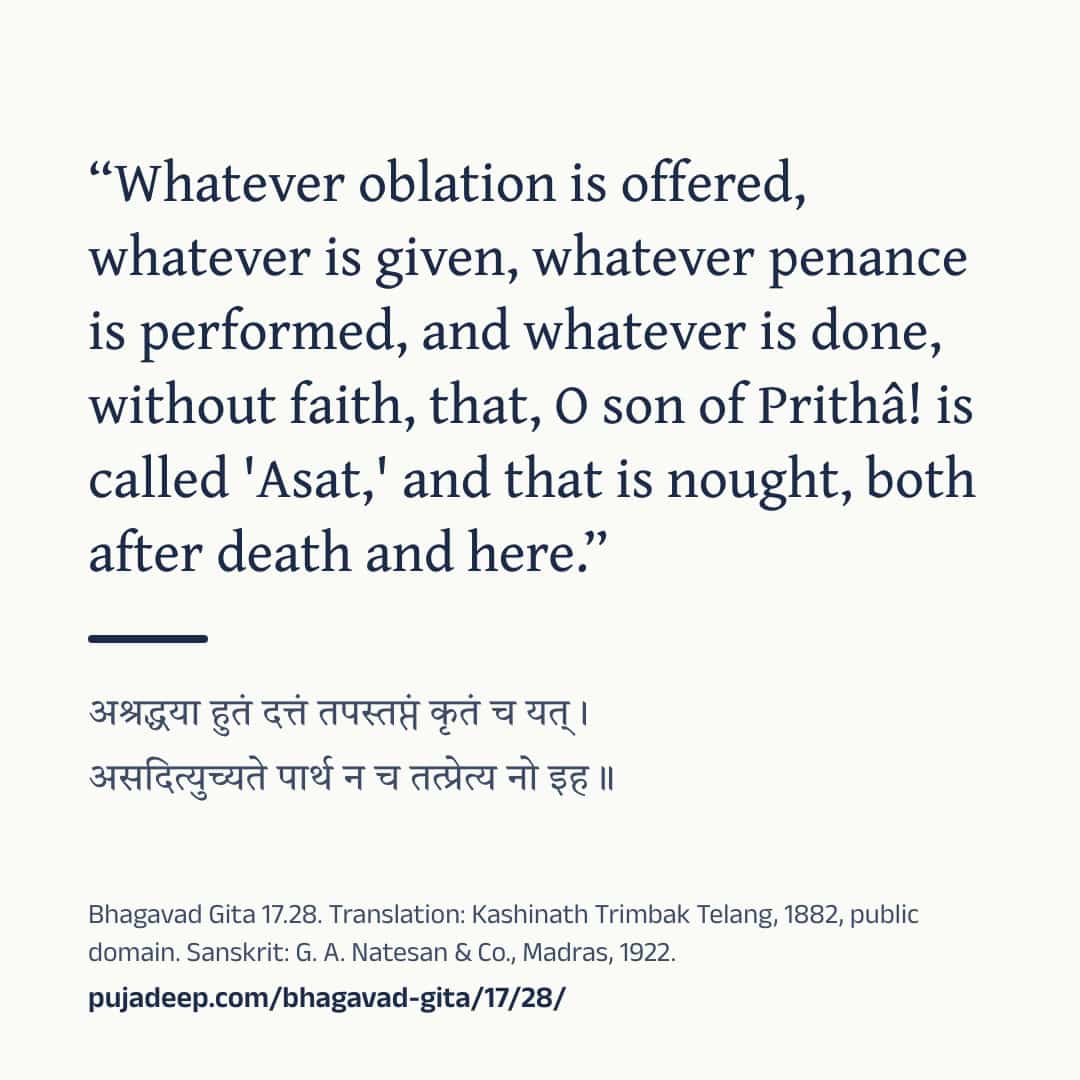
Drawing the picture
See the words
Bhagavad Gita 17.28

अश्रद्धया हुतं दत्तं तपस्तप्तं कृतं च यत् ।
असदित्युच्यते पार्थ न च तत्प्रेत्य नो इह ॥

“Whatever oblation is offered, whatever is given, whatever penance is performed, and whatever is done, without faith, that, O son of Prithâ! is called 'Asat,' and that is nought, both after death and here.”
(K. T. Telang, The Bhagavadgîtâ (The Sacred Books of the East, vol. VIII, Oxford: Clarendon Press, 1882), p. 121, public domain)

“Whatsoever oblation, gift, austerity, deed, is wrought without faith, "Asat" it is called, O Pârtha; it is nought, here or hereafter.”
(Annie Besant, The Bhagavad Gîtâ, or The Lord's Song (London: Theosophical Publishing Society, 1895), p. 151, public domain)

“Whatever is sacrificed, given or performed, and whatever austerity is practised without Shraddhâ, it is called Asat, O Pârtha; it is naught here or hereafter.”
(Swami Swarupananda, Srimad-Bhagavad-Gita (Mayavati: Prabuddha Bharata Press, 1909; first printed in Prabuddha Bharata, 1907–1909), p. 100, public domain)

Sanskrit: G. A. Natesan & Co., Madras, 1922.
https://pujadeep.com/bhagavad-gita/17/28/ Nothing is sent from this site. Your own app sends it, to the chat you choose. The picture quotes the translation you chose on this page, with its name and year.
Sanskrit text: The Bhagavad-Gita, or The Lord's Song, with the text in Devanagari and an English translation, 1922. Meanings: written for Pujadeep and checked against the cited edition. Source and changes
Questions families ask
Who speaks Bhagavad Gita 17.28?
Krishna speaks this verse, in chapter 17 (Shraddhatraya Vibhaga Yoga).
Where does the Sanskrit text come from?
Sanskrit text: The Bhagavad-Gita, or The Lord's Song, with the text in Devanagari and an English translation, 1922. Meanings: written for Pujadeep and checked against the cited edition. See the source
Is the meaning on this page a translation?
Explanation written for this site from the sources listed here, and checked against the cited edition. It is not a translation and not the only way to read the text. Free to quote with credit.
Source and licence
- Sanskrit text
- The Bhagavad-Gita, or The Lord's Song, with the text in Devanagari and an English translation (Annie Besant, G. A. Natesan & Co., Madras, 1922). Public domain. The Sanskrit on these pages was read from this printing’s page images.
- Translation
- The Bhagavadgîtâ with the Sanatsugâtîya and the Anugîtâ, translated by Kâshinâth Trimbak Telang (The Sacred Books of the East, vol. VIII, ed. F. Max Müller) (Kashinath Trimbak Telang, F. Max Müller, Clarendon Press, Oxford, 1882). Public domain. Shown verbatim, as printed.
- Translation
- The Bhagavad Gîtâ, or The Lord's Song, translated by Annie Besant (Annie Besant, Theosophical Publishing Society, London, 1895). Public domain. Shown verbatim, as printed.
- Translation
- Srimad-Bhagavad-Gita, with Sanskrit Text; Paraphrase with Word-by-word Literal Translation; English Rendering and Comments, Index, &c., by the Swami Swarupananda (Himalayan Series, No. XX) (Swami Swarupananda, The Editors and Publishers, Advaita Ashrama, Mayavati, Prabuddha Bharata Press, Mayavati, Almora, Himalayas, 1909). Public domain. Shown verbatim, as printed.
- Commentary
- The Bhagavad-Gita, with the commentary of Sri Sankaracharya, translated by A. Mahadeva Sastri (2nd ed., Mysore: G. T. A. Printing Works, 1901) (Public-domain scan, University of California Libraries). Summarised in our own words; none of its text is reproduced.
- Commentary
- Sri Bhagavad-Gita with Sri Ramanujacharya's Visishtadvaita commentary, translated by A. Govindacharya (Madras, 1898) (Scan uploaded to archive.org (folkscanomy collection)). Summarised in our own words; none of its text is reproduced.
- Common wording
- In this text, 32 words follow today's common wording, checked against sanskritdocuments.org; Sanskrit Wikisource; Gita Press, Gorakhpur; GRETIL, Göttingen and Bhaktivedanta Book Trust.
- Our explanation
- Explanation written for this site from the sources listed here, and checked against the cited edition. It is not a translation and not the only way to read the text. Free to quote with credit.
- Checked
- Checked against the cited edition, October 15, 2026.
- Updated
- October 25, 2026