Bhagavad Gita 17.21: meaning and translation
Chapter 17: Shraddhatraya Vibhaga Yoga. Krishna says
A gift is rājasa, Krishna says, when it is given to get something back, or with an eye on some fruit, or given grudgingly (parikliṣṭa).
Click or tap a word for its meaning and its dictionary page.
Text and layers
Text and layers
These choices stay in this browser.
Bhagavad Gita 17.21
यत्तु प्रत्युपकारार्थं फलमुद्दिश्य वा पुनः ।दीयते च परिक्लिष्टं तद्दानं राजसं स्मृतम् ॥
Yattu pratyupakarartham phalamuddishya va punahDiyate cha pariklishtam taddanam rajasam smritam
yattu pratyupakārārthaṃ phalamuddiśya vā punaḥ |dīyate ca parikliṣṭaṃ taddānaṃ rājasaṃ smṛtam ||
Our explanation A gift is rājasa, Krishna says, when it is given to get something back, or with an eye on some fruit, or given grudgingly (parikliṣṭa). Telang's note names heaven as an example of the fruit hoped for.
हिंदी अर्थ कृष्ण कहते हैं कि वह दान राजस है जो बदले में कुछ पाने के लिए, या किसी फल को ध्यान में रखकर, या मन मारकर (परिक्लिष्ट) दिया जाता है। तेलंग की टिप्पणी ऐसे फल का एक उदाहरण देती है, स्वर्ग।
Word by word
Every word, with its dictionary page
Word by word
- यत् yat · which (pronoun (neuter), nominative singular) Dictionary: yad, Monier-Williams 1899, p. 844, col. 2 “who, which, what, whichever, whatever, that”
- तु tu · but (indeclinable) Dictionary: 2. tu, Monier-Williams 1899, p. 449, col. 3 “but”
- प्रत्युपकारार्थम् pratyupakārārtham · to get something back (compound, accusative used as an adverb (for the sake of)) Dictionary: praty-upakāra, Monier-Williams 1899, p. 678, col. 1 “returning a service or favour, gratitude”; artha, Monier-Williams 1899, p. 90, col. 3 “aim, purpose”
- फलम् phalam · fruit (noun (neuter), accusative singular) Dictionary: phala, Monier-Williams 1899, p. 716, col. 2 “fruit (met.), consequence, effect, result, retribution (good or bad)”
- उद्दिश्य uddiśya · with an eye on (absolutive (having done)) Dictionary: ud-diśya, Monier-Williams 1899, p. 188, col. 1 “aiming at, in the direction of; with reference to”
- वा vā · or (indeclinable) Dictionary: 1. vā, Monier-Williams 1899, p. 934, col. 2 “or”
- पुनः punaḥ · again (indeclinable) Dictionary: punar, Monier-Williams 1899, p. 633, col. 2 “again, once more”
- दीयते dīyate · is given (present passive, 3rd person singular) Dictionary: 1. dā, Monier-Williams 1899, p. 473, col. 3 “to give, bestow, grant”
- च ca · and (indeclinable) Dictionary: 2. ca, Monier-Williams 1899, p. 380, col. 1 “and, both, also, moreover, as well as”
- परिक्लिष्टम् parikliṣṭam · grudgingly (past participle used as an adverb) Dictionary: pari-kliṣṭa, Monier-Williams 1899, p. 592, col. 2 “with uneasiness or reluctance, unwillingly”
- तत् tat · that (pronoun (neuter), nominative singular) Dictionary: tad, Monier-Williams 1899, p. 434, col. 1 “m. he, f. she, n. it, that, this”
- दानम् dānam · gift (noun (neuter), nominative singular) Dictionary: 1. dāna, Monier-Williams 1899, p. 474, col. 1 “the act of giving”
- राजसम् rājasam · rājasa (adjective (neuter), nominative singular) Dictionary: rājasa, Monier-Williams 1899, p. 875, col. 2 “belonging or relating to the quality rajas”
- स्मृतम् smṛtam · is held to be (past participle (neuter), nominative singular) Dictionary: smṛta, Monier-Williams 1899, p. 1272, col. 2 “declared as, passing for (nom., loc., or dat.)”
Old translations
Kashinath Trimbak Telang, 1882. Public domain. Page 120.
But that gift which is given with much difficulty, for a return of services, or even with an expectation of fruit1, is said to be passionate.
Footnotes (the translator’s own) - Heaven &c. as a reward for liberality. ↩
Compare 3 translations
Kashinath Trimbak Telang, 1882. Public domain. Page 120.
But that gift which is given with much difficulty, for a return of services, or even with an expectation of fruit1, is said to be passionate.
Footnotes (the translator’s own) - Heaven &c. as a reward for liberality. ↩
You are reading this one
Annie Besant, 1895. Public domain. Page 150.
That given with a view to receiving in return, or looking for fruit again, or grudgingly, that alms is accounted râjasic.
You are reading this one
Swami Swarupananda, 1909 (first printed 1907). Public domain. Page 315.
And what is given with a view to receiving in return, or looking for the fruit, or reluctantly, that gift is held to be Râjasic.
You are reading this one
Cite this verse
The translation: K. T. Telang, The Bhagavadgîtâ (The Sacred Books of the East, vol. VIII, Oxford: Clarendon Press, 1882), p. 120. Bhagavad Gita 17.21.
The translation: Annie Besant, The Bhagavad Gîtâ, or The Lord's Song (London: Theosophical Publishing Society, 1895), p. 150. Bhagavad Gita 17.21.
The translation: Swami Swarupananda, Srimad-Bhagavad-Gita (Mayavati: Prabuddha Bharata Press, 1909; first printed in Prabuddha Bharata, 1907–1909), p. 315. Bhagavad Gita 17.21.
Our explanation: “Bhagavad Gita 17.21: meaning and translation.” Pujadeep. Updated October 25, 2026. https://pujadeep.com/bhagavad-gita/17/21/
Pujadeep’s explanations are free to quote with credit: name Pujadeep and link to the page. How to credit
Classical readings, by school
No readings by school on this verse yet.
Share
Show the ways to share
Send one picture or the text to one chat. The picture names its source and the address of this page.
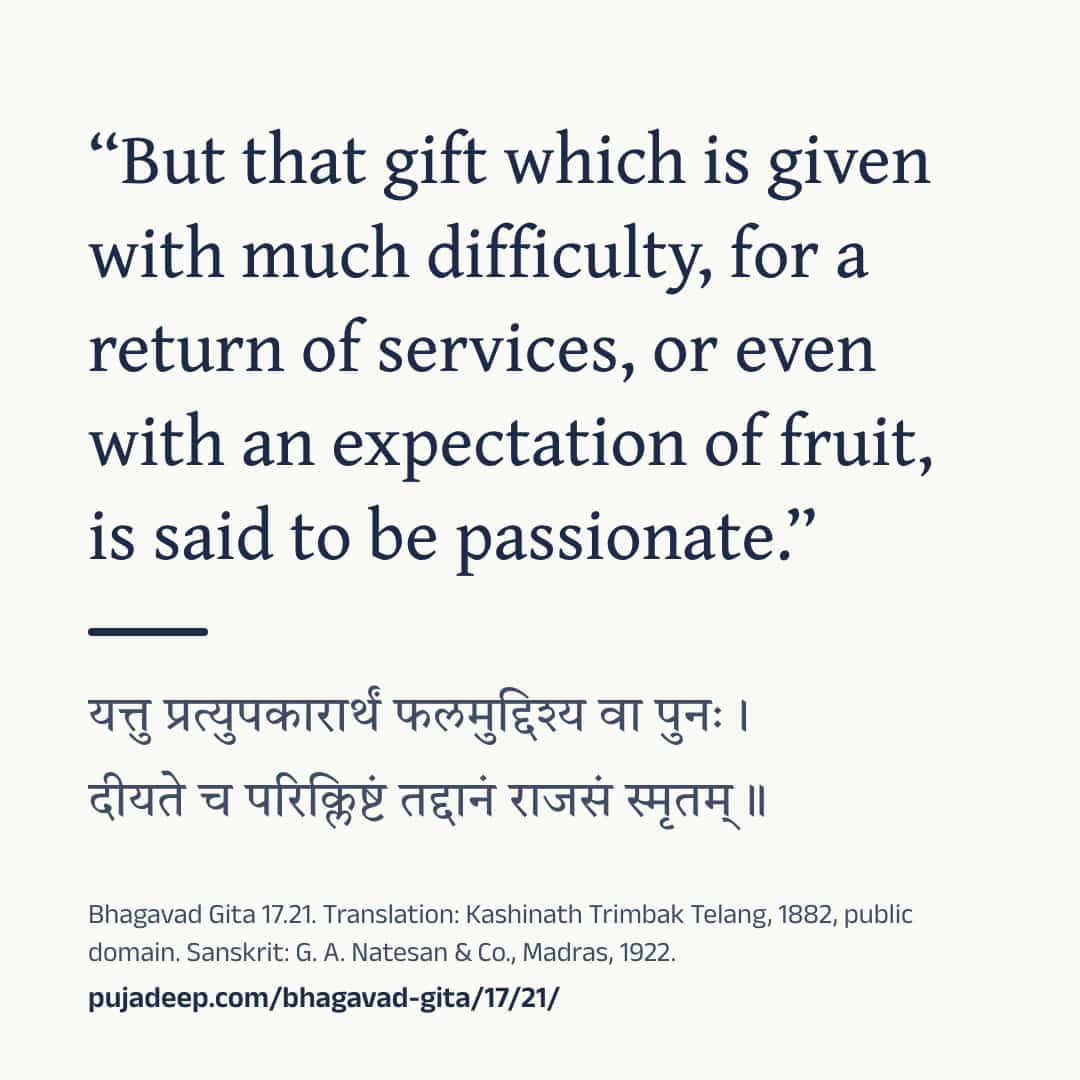
Drawing the picture
See the words
Bhagavad Gita 17.21

यत्तु प्रत्युपकारार्थं फलमुद्दिश्य वा पुनः ।
दीयते च परिक्लिष्टं तद्दानं राजसं स्मृतम् ॥

“But that gift which is given with much difficulty, for a return of services, or even with an expectation of fruit, is said to be passionate.”
(K. T. Telang, The Bhagavadgîtâ (The Sacred Books of the East, vol. VIII, Oxford: Clarendon Press, 1882), p. 120, public domain)

“That given with a view to receiving in return, or looking for fruit again, or grudgingly, that alms is accounted râjasic.”
(Annie Besant, The Bhagavad Gîtâ, or The Lord's Song (London: Theosophical Publishing Society, 1895), p. 150, public domain)

“And what is given with a view to receiving in return, or looking for the fruit, or reluctantly, that gift is held to be Râjasic.”
(Swami Swarupananda, Srimad-Bhagavad-Gita (Mayavati: Prabuddha Bharata Press, 1909; first printed in Prabuddha Bharata, 1907–1909), p. 315, public domain)

Sanskrit: G. A. Natesan & Co., Madras, 1922.
https://pujadeep.com/bhagavad-gita/17/21/ Nothing is sent from this site. Your own app sends it, to the chat you choose. The picture quotes the translation you chose on this page, with its name and year.
Sanskrit text: The Bhagavad-Gita, or The Lord's Song, with the text in Devanagari and an English translation, 1922. Meanings: written for Pujadeep and checked against the cited edition. Source and changes
Questions families ask
Who speaks Bhagavad Gita 17.21?
Krishna speaks this verse, in chapter 17 (Shraddhatraya Vibhaga Yoga).
Where does the Sanskrit text come from?
Sanskrit text: The Bhagavad-Gita, or The Lord's Song, with the text in Devanagari and an English translation, 1922. Meanings: written for Pujadeep and checked against the cited edition. See the source
Is the meaning on this page a translation?
Explanation written for this site from the sources listed here, and checked against the cited edition. It is not a translation and not the only way to read the text. Free to quote with credit.
Source and licence
- Sanskrit text
- The Bhagavad-Gita, or The Lord's Song, with the text in Devanagari and an English translation (Annie Besant, G. A. Natesan & Co., Madras, 1922). Public domain. The Sanskrit on these pages was read from this printing’s page images.
- Translation
- The Bhagavadgîtâ with the Sanatsugâtîya and the Anugîtâ, translated by Kâshinâth Trimbak Telang (The Sacred Books of the East, vol. VIII, ed. F. Max Müller) (Kashinath Trimbak Telang, F. Max Müller, Clarendon Press, Oxford, 1882). Public domain. Shown verbatim, as printed.
- Translation
- The Bhagavad Gîtâ, or The Lord's Song, translated by Annie Besant (Annie Besant, Theosophical Publishing Society, London, 1895). Public domain. Shown verbatim, as printed.
- Translation
- Srimad-Bhagavad-Gita, with Sanskrit Text; Paraphrase with Word-by-word Literal Translation; English Rendering and Comments, Index, &c., by the Swami Swarupananda (Himalayan Series, No. XX) (Swami Swarupananda, The Editors and Publishers, Advaita Ashrama, Mayavati, Prabuddha Bharata Press, Mayavati, Almora, Himalayas, 1909). Public domain. Shown verbatim, as printed.
- Common wording
- In this text, 32 words follow today's common wording, checked against sanskritdocuments.org; Sanskrit Wikisource; Gita Press, Gorakhpur; GRETIL, Göttingen and Bhaktivedanta Book Trust.
- Our explanation
- Explanation written for this site from the sources listed here, and checked against the cited edition. It is not a translation and not the only way to read the text. Free to quote with credit.
- Checked
- Checked against the cited edition, October 15, 2026.
- Updated
- October 25, 2026