Bhagavad Gita 17.11: meaning and translation
Chapter 17: Shraddhatraya Vibhaga Yoga. Krishna says
Krishna says that a sacrifice (yajña) is sāttvika when it is offered as the scriptures direct, by people who do not seek its fruit, with the mind settled on one thought: it ought to be offered.
Click or tap a word for its meaning and its dictionary page.
Text and layers
Text and layers
These choices stay in this browser.
Bhagavad Gita 17.11
अफलाकाङ्क्षिभिर्यज्ञो विधिदृष्टो य इज्यते ।यष्टव्यमेवेति मनः समाधाय स सात्त्विकः ॥
Aphalakankshibhiryajno vidhidrishto ya ijyateYashtavyameveti manah samadhaya sa sattvikah
aphalākāṅkṣibhiryajño vidhidṛṣṭo ya ijyate |yaṣṭavyameveti manaḥ samādhāya sa sāttvikaḥ ||
Our explanation Krishna says that a sacrifice (yajña) is sāttvika when it is offered as the scriptures direct, by people who do not seek its fruit, with the mind settled on one thought: it ought to be offered.
हिंदी अर्थ कृष्ण कहते हैं कि वह यज्ञ सात्त्विक है जो शास्त्र की विधि के अनुसार, फल की इच्छा न रखने वाले लोग, मन में यह निश्चय करके करते हैं कि यज्ञ करना ही चाहिए।
Word by word
Every word, with its dictionary page
Word by word
- अफलाकाङ्क्षिभिः aphalākāṅkṣibhiḥ · by those who seek no fruit (compound (masculine), instrumental plural) Dictionary: a-phala-kāṅkṣin, Monier-Williams 1899, p. 59, col. 3 “disinterested, not looking to beneficial consequences”
- यज्ञः yajñaḥ · sacrifice (noun (masculine), nominative singular) Dictionary: yajña, Monier-Williams 1899, p. 839, col. 2 “worship, devotion, prayer, praise; act of worship or devotion, offering, oblation, sacrifice”
- विधिदृष्टः vidhidṛṣṭaḥ · as the rules direct (compound (masculine), nominative singular) Dictionary: 2. vidhi, Monier-Williams 1899, p. 968, col. 1 “a rule, formula, injunction, ordinance, statute, precept, law, direction”; dṛṣṭa, Monier-Williams 1899, p. 491, col. 3 “seen, looked at, beheld, perceived, noticed”
- यः yaḥ · which (pronoun (masculine), nominative singular) Dictionary: yad, Monier-Williams 1899, p. 844, col. 2 “who, which, what, whichever, whatever, that”
- इज्यते ijyate · is offered (present passive, 3rd person singular) Dictionary: 1. yaj, Monier-Williams 1899, p. 838, col. 3 “to worship, adore, honour (esp. with sacrifice or oblations)”
- यष्टव्यम् yaṣṭavyam · it ought to be offered (gerundive (to be done) (neuter), nominative singular) Dictionary: yaṣṭavya, Monier-Williams 1899, p. 840, col. 3 “to be worshipped or adored (n. impers.)”
- एव eva · indeed (indeclinable) Dictionary: 1. eva, Monier-Williams 1899, p. 232, col. 2 “just, exactly, very, same, only, even, alone, merely”
- इति iti · thus (indeclinable) Dictionary: 2. iti, Monier-Williams 1899, p. 165, col. 1 “in this manner, thus”
- मनः manaḥ · mind (noun (neuter), accusative singular) Dictionary: manas, Monier-Williams 1899, p. 783, col. 3 “mind (in its widest sense as applied to all the mental powers)”
- समाधाय samādhāya · settling (absolutive (having done)) Dictionary: sam-ā-dhā, Monier-Williams 1899, p. 1159, col. 3 “to direct or fix the eyes or mind upon”
- सः saḥ · that (pronoun (masculine), nominative singular) Dictionary: tad, Monier-Williams 1899, p. 434, col. 1 “m. he, f. she, n. it, that, this”
- सात्त्विकः sāttvikaḥ · sāttvika (adjective (masculine), nominative singular) Dictionary: sāttvika, Monier-Williams 1899, p. 1200, col. 1 “relating to or endowed with the quality Sattva (i.e. 'purity' or 'goodness')”
1 printing differs
Edition differences. Another printing or text reads this place differently.
- The printed edition reads: अफलाकाङ्क्षिभिर्यज्ञो विधिदृष्टोय इज्यते ।
यष्टव्यमेवेति मनः समाधाय स सात्त्विकः ॥ The print sets विधिदृष्टो and य with no space (विधिदृष्टोय); read as a dropped space and shown as two words, because they are two words (vidhi-dṛṣṭaḥ 'seen in the rules', yaḥ 'which'), the edition elsewhere spaces a final -o before य (पुरुषो यो 17.3, आत्मनो यत् 17.19), and both proofreading references divide them. No letter is changed.
Old translations
Kashinath Trimbak Telang, 1882. Public domain. Page 118–119.
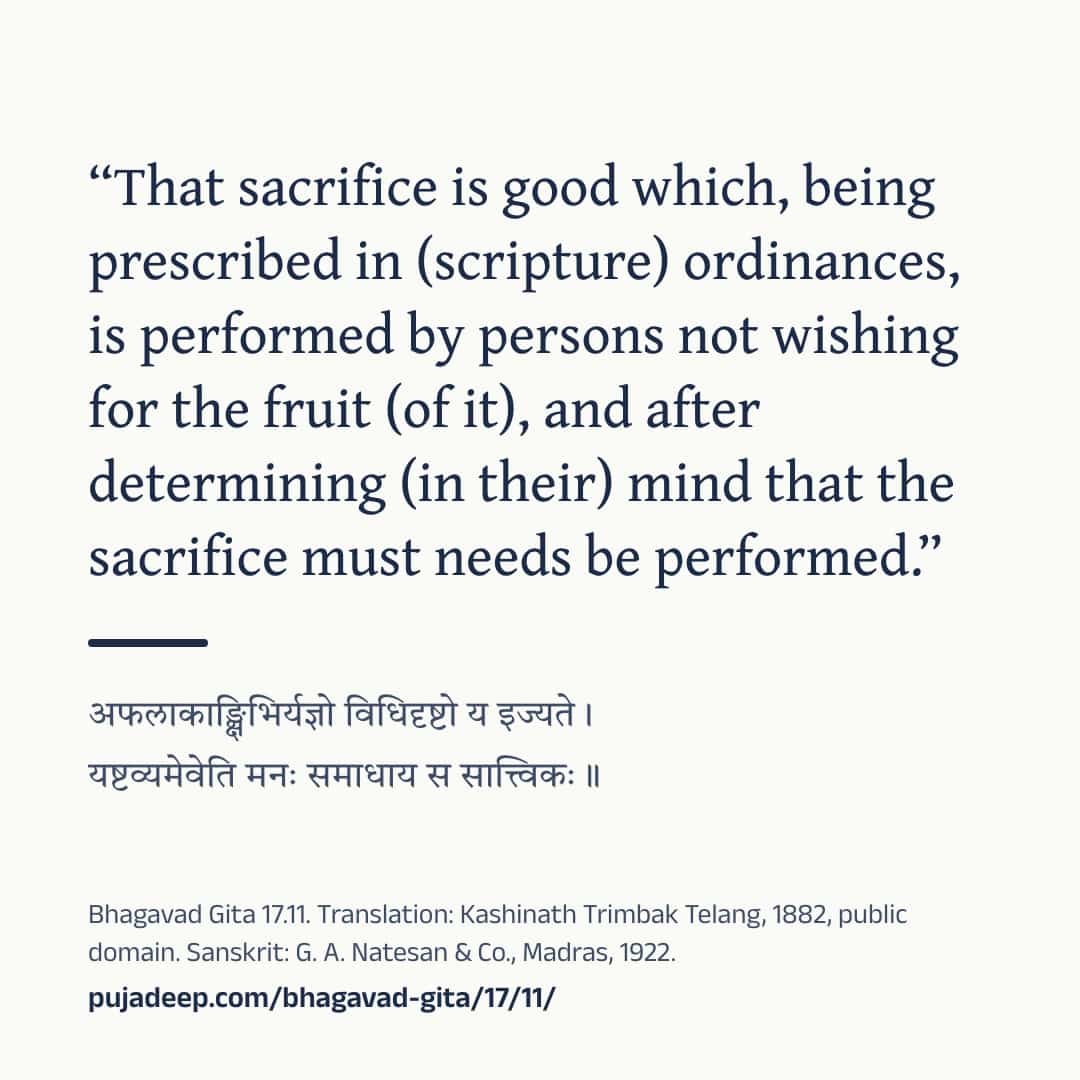
That sacrifice is good which, being prescribed in (scripture) ordinances, is performed by persons not wishing for the fruit (of it), and after determining (in their) mind that the sacrifice must needs be performed.
Compare 3 translations
Kashinath Trimbak Telang, 1882. Public domain. Page 118–119.
That sacrifice is good which, being prescribed in (scripture) ordinances, is performed by persons not wishing for the fruit (of it), and after determining (in their) mind that the sacrifice must needs be performed.
You are reading this one
Annie Besant, 1895. Public domain. Page 148.
A sacrifice which is offered by men without any desire for fruit, as enjoined by the ordinances, under the firm belief that "Sacrifice ought verily to be performed," is sâttvic.
You are reading this one
Swami Swarupananda, 1909 (first printed 1907). Public domain. Page 311.
That Yajna is Sátvic which is performed by men desiring no fruit, as enjoined by ordinance, with their mind fixed on the Yajna only, for its own sake.
You are reading this one
Cite this verse
The translation: K. T. Telang, The Bhagavadgîtâ (The Sacred Books of the East, vol. VIII, Oxford: Clarendon Press, 1882), pp. 118–119. Bhagavad Gita 17.11.
The translation: Annie Besant, The Bhagavad Gîtâ, or The Lord's Song (London: Theosophical Publishing Society, 1895), p. 148. Bhagavad Gita 17.11.
The translation: Swami Swarupananda, Srimad-Bhagavad-Gita (Mayavati: Prabuddha Bharata Press, 1909; first printed in Prabuddha Bharata, 1907–1909), p. 311. Bhagavad Gita 17.11.
Our explanation: “Bhagavad Gita 17.11: meaning and translation.” Pujadeep. Updated October 25, 2026. https://pujadeep.com/bhagavad-gita/17/11/
Pujadeep’s explanations are free to quote with credit: name Pujadeep and link to the page. How to credit
Classical readings, by school
No readings by school on this verse yet.
Share
Show the ways to share
Send one picture or the text to one chat. The picture names its source and the address of this page.
Drawing the picture
See the words
Bhagavad Gita 17.11

अफलाकाङ्क्षिभिर्यज्ञो विधिदृष्टो य इज्यते ।
यष्टव्यमेवेति मनः समाधाय स सात्त्विकः ॥

“That sacrifice is good which, being prescribed in (scripture) ordinances, is performed by persons not wishing for the fruit (of it), and after determining (in their) mind that the sacrifice must needs be performed.”
(K. T. Telang, The Bhagavadgîtâ (The Sacred Books of the East, vol. VIII, Oxford: Clarendon Press, 1882), pp. 118–119, public domain)

“A sacrifice which is offered by men without any desire for fruit, as enjoined by the ordinances, under the firm belief that "Sacrifice ought verily to be performed," is sâttvic.”
(Annie Besant, The Bhagavad Gîtâ, or The Lord's Song (London: Theosophical Publishing Society, 1895), p. 148, public domain)

“That Yajna is Sátvic which is performed by men desiring no fruit, as enjoined by ordinance, with their mind fixed on the Yajna only, for its own sake.”
(Swami Swarupananda, Srimad-Bhagavad-Gita (Mayavati: Prabuddha Bharata Press, 1909; first printed in Prabuddha Bharata, 1907–1909), p. 311, public domain)

Sanskrit: G. A. Natesan & Co., Madras, 1922.
https://pujadeep.com/bhagavad-gita/17/11/ Nothing is sent from this site. Your own app sends it, to the chat you choose. The picture quotes the translation you chose on this page, with its name and year.
Sanskrit text: The Bhagavad-Gita, or The Lord's Song, with the text in Devanagari and an English translation, 1922. Meanings: written for Pujadeep and checked against the cited edition. Source and changes
Questions families ask
Who speaks Bhagavad Gita 17.11?
Krishna speaks this verse, in chapter 17 (Shraddhatraya Vibhaga Yoga).
Where does the Sanskrit text come from?
Sanskrit text: The Bhagavad-Gita, or The Lord's Song, with the text in Devanagari and an English translation, 1922. Meanings: written for Pujadeep and checked against the cited edition. See the source
Is the meaning on this page a translation?
Explanation written for this site from the sources listed here, and checked against the cited edition. It is not a translation and not the only way to read the text. Free to quote with credit.
Source and licence
- Sanskrit text
- The Bhagavad-Gita, or The Lord's Song, with the text in Devanagari and an English translation (Annie Besant, G. A. Natesan & Co., Madras, 1922). Public domain. The Sanskrit on these pages was read from this printing’s page images.
- Translation
- The Bhagavadgîtâ with the Sanatsugâtîya and the Anugîtâ, translated by Kâshinâth Trimbak Telang (The Sacred Books of the East, vol. VIII, ed. F. Max Müller) (Kashinath Trimbak Telang, F. Max Müller, Clarendon Press, Oxford, 1882). Public domain. Shown verbatim, as printed.
- Translation
- The Bhagavad Gîtâ, or The Lord's Song, translated by Annie Besant (Annie Besant, Theosophical Publishing Society, London, 1895). Public domain. Shown verbatim, as printed.
- Translation
- Srimad-Bhagavad-Gita, with Sanskrit Text; Paraphrase with Word-by-word Literal Translation; English Rendering and Comments, Index, &c., by the Swami Swarupananda (Himalayan Series, No. XX) (Swami Swarupananda, The Editors and Publishers, Advaita Ashrama, Mayavati, Prabuddha Bharata Press, Mayavati, Almora, Himalayas, 1909). Public domain. Shown verbatim, as printed.
- Common wording
- In this text, 32 words follow today's common wording, checked against sanskritdocuments.org; Sanskrit Wikisource; Gita Press, Gorakhpur; GRETIL, Göttingen and Bhaktivedanta Book Trust.
- Our explanation
- Explanation written for this site from the sources listed here, and checked against the cited edition. It is not a translation and not the only way to read the text. Free to quote with credit.
- Checked
- Checked against the cited edition, October 15, 2026.
- Updated
- October 25, 2026