Bhagavad Gita 17.6: meaning and translation
Chapter 17: Shraddhatraya Vibhaga Yoga. Krishna says
Such people, Krishna says, lack discernment.
Click or tap a word for its meaning and its dictionary page.
Text and layers
Text and layers
These choices stay in this browser.
Bhagavad Gita 17.6
कर्षयन्तः शरीरस्थं भूतग्राममचेतसः ।मां चैवान्तःशरीरस्थं तान्विद्ध्यासुरनिश्चयान् ॥
Karshayantah sharirastham bhutagramamachetasahMam chaivantahsharirastham tanviddhyasuranishchayan
karṣayantaḥ śarīrasthaṃ bhūtagrāmamacetasaḥ |māṃ caivāntaḥśarīrasthaṃ tānviddhyāsuraniścayān ||
Our explanation Such people, Krishna says, lack discernment. They torment the elements that make up the body, and him too, who dwells within the body. (The 1922 printing reads karśayantaḥ, 'wearing down', which is Shankara's reading.) He tells Arjuna to know them as people of āsura (demonic) resolve, the nature described in chapter 16. The schools explain who dwells within the body here (see the views).
हिंदी अर्थ कृष्ण कहते हैं कि ऐसे लोग अविवेकी हैं। वे शरीर को बनाने वाले भूतों (तत्त्वों) के समूह को पीड़ा देते हैं, और शरीर के भीतर रहने वाले उनको (कृष्ण को) भी। (1922 की छपाई में “कर्शयन्तः”, यानी “क्षीण करते हुए” है, जो शंकराचार्य का पाठ है।) वे अर्जुन से कहते हैं कि ऐसे लोगों को आसुरी निश्चय वाला जानो, जिस स्वभाव का वर्णन अध्याय 16 में है। शरीर के भीतर रहने वाला यहाँ कौन है, इसे परंपराएँ अलग ढंग से समझाती हैं।
Word by word
Every word, with its dictionary page
Word by word
- कर्षयन्तः karṣayantaḥ · tormenting (present participle of the causative (masculine), nominative plural) Dictionary: 1. kṛṣ, Monier-Williams 1899, p. 306, col. 1 “to pull to and fro, cause pain, torture, torment”
- शरीरस्थम् śarīrastham · dwelling in the body (compound (masculine), accusative singular) Dictionary: śarīra-stha, Monier-Williams 1899, p. 1058, col. 1 “existing in the b°”
- भूतग्रामम् bhūtagrāmam · the group of elements (compound (masculine), accusative singular) Dictionary: bhūta-grāma, Monier-Williams 1899, p. 761, col. 3; bhūta, Monier-Williams 1899, p. 761, col. 3 “an element, one of the 5 elements”
- अचेतसः acetasaḥ · lacking discernment (adjective (masculine), nominative plural) Dictionary: a-cetas, Monier-Williams 1899, p. 9, col. 1 “unconscious, insensible”
- माम् mām · "me" (Krishna) (pronoun, accusative singular) Dictionary: 1. mad, Monier-Williams 1899, p. 777, col. 2 “base of the first pers. pron. in the sg. number (esp. in comp.)”
- च ca · and (indeclinable) Dictionary: 2. ca, Monier-Williams 1899, p. 380, col. 1 “and, both, also, moreover, as well as”
- एव eva · also (indeclinable) Dictionary: 1. eva, Monier-Williams 1899, p. 232, col. 2 “just, exactly, very, same, only, even, alone, merely”
- अन्तःशरीरस्थम् antaḥśarīrastham · dwelling within the body (compound (masculine), accusative singular) Dictionary: antar, Monier-Williams 1899, p. 43, col. 2 “meaning interior, internal, intermediate”; śarīra-stha, Monier-Williams 1899, p. 1058, col. 1 “existing in the b°”
- तान् tān · them (pronoun (masculine), accusative plural) Dictionary: tad, Monier-Williams 1899, p. 434, col. 1 “m. he, f. she, n. it, that, this”
- विद्धि viddhi · know (imperative, 2nd person singular) Dictionary: 1. vid, Monier-Williams 1899, p. 963, col. 2 “to know, understand, perceive, learn”
- आसुरनिश्चयान् āsuraniścayān · of demonic resolve (compound (masculine), accusative plural) Dictionary: 1. āsura, Monier-Williams 1899, p. 160, col. 3 “belonging or relating to the Asuras”; niś-caya, Monier-Williams 1899, p. 561, col. 2 “inquiry, ascertainment, fixed opinion, conviction, certainty”
2 printings differ
Edition differences. Another printing or text reads this place differently.
- The printed edition reads: कर्शयन्तः शरीरस्थं भूतग्राममचेतसः ।
मां चैवान्तःशरीरस्थं तान्विद्ध्यासुरनिश्चयान् ॥ - Word The 1922 Madras printing reads: कर्शयन्तः शरीरस्थं भूतग्राममचेतसः The 1922 base printing (leaf n238) reads कर्शयन्तः ('wearing down, making lean', from kṛś), as Gita Press does (p. 178) and as Shankara reads it (Sastri 1901, p. 387: 'Weakening'). Under decision 14 addendum c the display follows कर्षयन्तः ('tormenting', from kṛṣ), printed by sanskritdocuments.org (and GRETIL, its copy), the Gita Supersite text on Sanskrit Wikisource and the Bhaktivedanta Book Trust: three publishers against one. The translations stay as printed: Telang's 'torment' and Besant's 'tormenting' fit कर्षयन्तः.
Old translations
Kashinath Trimbak Telang, 1882. Public domain.
Telang translates verses 5–6 as one sentence; see 17.5. Read it at 17.5
Compare 3 translations
Kashinath Trimbak Telang, 1882. Public domain.
Telang translates verses 5–6 as one sentence; see 17.5. Read it at 17.5
You are reading this one
Annie Besant, 1895. Public domain. Page 147.
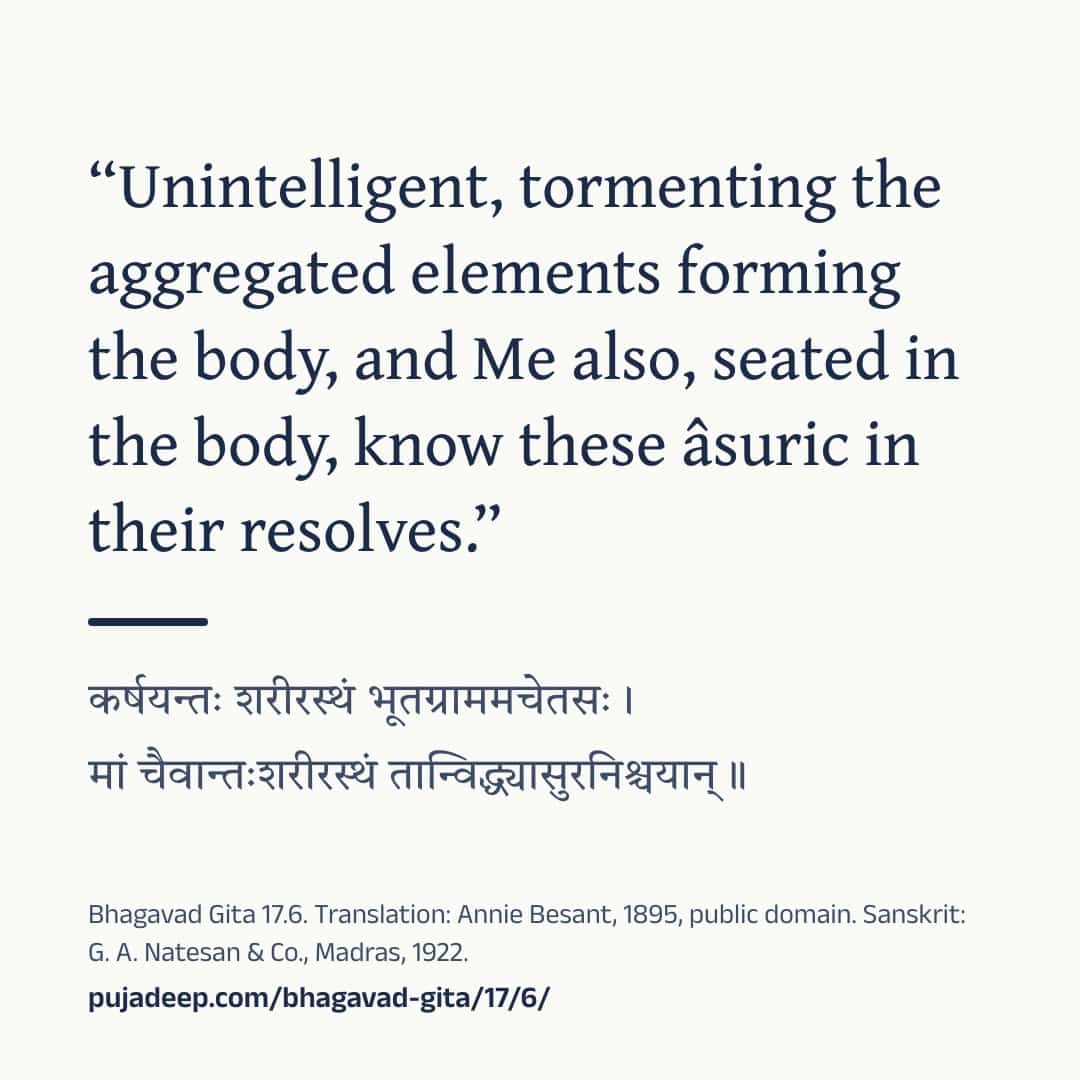
Unintelligent, tormenting the aggregated elements forming the body, and Me also, seated in the body, know these âsuric in their resolves.
This sentence begins in 17.5.
You are reading this one
Swami Swarupananda, 1909 (first printed 1907). Public domain.
Swarupananda renders verses 5–6 together; see 17.5. Read it at 17.5
You are reading this one
Cite this verse
The translation: K. T. Telang, The Bhagavadgîtâ (The Sacred Books of the East, vol. VIII, Oxford: Clarendon Press, 1882), p. 118. Bhagavad Gita 17.5–6.
The translation: Annie Besant, The Bhagavad Gîtâ, or The Lord's Song (London: Theosophical Publishing Society, 1895), p. 147. Bhagavad Gita 17.6.
The translation: Swami Swarupananda, Srimad-Bhagavad-Gita (Mayavati: Prabuddha Bharata Press, 1909; first printed in Prabuddha Bharata, 1907–1909), p. 308. Bhagavad Gita 17.5–6.
Our explanation: “Bhagavad Gita 17.6: meaning and translation.” Pujadeep. Updated October 25, 2026. https://pujadeep.com/bhagavad-gita/17/6/
Pujadeep’s explanations are free to quote with credit: name Pujadeep and link to the page. How to credit
Classical readings, by school
Each reading is named by its school. None is presented as the only meaning.
What Advaita, Vishishtadvaita and Dvaita teach, in short
Shankara Advaita
Shankara reads the verb as 'weakening'. The elements are the organs, and the one within is Nārāyaṇa, the witness of their thoughts and deeds; to weaken him is to neglect his teaching. Their austerity is 'terrific' because it causes pain to themselves and to other beings. Arjuna is told to know them so that he may avoid them.
Source: The Bhagavad-Gita, with the commentary of Sri Sankaracharya, translated by A. Mahadeva Sastri (2nd ed., Mysore: G. T. A. Printing Works, 1901), commentary on 17.5–17.6, pp. 386–387. Summarised in our own words; none of its text is reproduced.
Ramanuja Vishishtadvaita
Ramanuja says the austerity here also stands for sacrifices and other works done against scripture. The one within the body is the individual soul (jīvātman), which is of the Lord's own nature. Such people act against the Lord's commands, and so they gain no happiness from these works.
Source: Sri Bhagavad-Gita with Sri Ramanujacharya's Visishtadvaita commentary, translated by A. Govindacharya (Madras, 1898), commentary on 17.5–17.6, pp. 504–505. Summarised in our own words; none of its text is reproduced.
Share
Show the ways to share
Send one picture or the text to one chat. The picture names its source and the address of this page.
Drawing the picture
See the words
Bhagavad Gita 17.6

कर्षयन्तः शरीरस्थं भूतग्राममचेतसः ।
मां चैवान्तःशरीरस्थं तान्विद्ध्यासुरनिश्चयान् ॥

“Unintelligent, tormenting the aggregated elements forming the body, and Me also, seated in the body, know these âsuric in their resolves.”
(Annie Besant, The Bhagavad Gîtâ, or The Lord's Song (London: Theosophical Publishing Society, 1895), p. 147, public domain)
This sentence begins in 17.5.

Sanskrit: G. A. Natesan & Co., Madras, 1922.
https://pujadeep.com/bhagavad-gita/17/6/ Nothing is sent from this site. Your own app sends it, to the chat you choose. The picture quotes the translation you chose on this page, with its name and year.
Sanskrit text: The Bhagavad-Gita, or The Lord's Song, with the text in Devanagari and an English translation, 1922. Meanings: written for Pujadeep and checked against the cited edition. Source and changes
Questions families ask
Who speaks Bhagavad Gita 17.6?
Krishna speaks this verse, in chapter 17 (Shraddhatraya Vibhaga Yoga).
Where does the Sanskrit text come from?
Sanskrit text: The Bhagavad-Gita, or The Lord's Song, with the text in Devanagari and an English translation, 1922. Meanings: written for Pujadeep and checked against the cited edition. See the source
Is the meaning on this page a translation?
Explanation written for this site from the sources listed here, and checked against the cited edition. It is not a translation and not the only way to read the text. Free to quote with credit.
Source and licence
- Sanskrit text
- The Bhagavad-Gita, or The Lord's Song, with the text in Devanagari and an English translation (Annie Besant, G. A. Natesan & Co., Madras, 1922). Public domain. The Sanskrit on these pages was read from this printing’s page images.
- Translation
- The Bhagavadgîtâ with the Sanatsugâtîya and the Anugîtâ, translated by Kâshinâth Trimbak Telang (The Sacred Books of the East, vol. VIII, ed. F. Max Müller) (Kashinath Trimbak Telang, F. Max Müller, Clarendon Press, Oxford, 1882). Public domain. Shown verbatim, as printed.
- Translation
- The Bhagavad Gîtâ, or The Lord's Song, translated by Annie Besant (Annie Besant, Theosophical Publishing Society, London, 1895). Public domain. Shown verbatim, as printed.
- Translation
- Srimad-Bhagavad-Gita, with Sanskrit Text; Paraphrase with Word-by-word Literal Translation; English Rendering and Comments, Index, &c., by the Swami Swarupananda (Himalayan Series, No. XX) (Swami Swarupananda, The Editors and Publishers, Advaita Ashrama, Mayavati, Prabuddha Bharata Press, Mayavati, Almora, Himalayas, 1909). Public domain. Shown verbatim, as printed.
- Commentary
- The Bhagavad-Gita, with the commentary of Sri Sankaracharya, translated by A. Mahadeva Sastri (2nd ed., Mysore: G. T. A. Printing Works, 1901) (Public-domain scan, University of California Libraries). Summarised in our own words; none of its text is reproduced.
- Commentary
- Sri Bhagavad-Gita with Sri Ramanujacharya's Visishtadvaita commentary, translated by A. Govindacharya (Madras, 1898) (Scan uploaded to archive.org (folkscanomy collection)). Summarised in our own words; none of its text is reproduced.
- Common wording
- In this text, 32 words follow today's common wording, checked against sanskritdocuments.org; Sanskrit Wikisource; Gita Press, Gorakhpur; GRETIL, Göttingen and Bhaktivedanta Book Trust.
- Our explanation
- Explanation written for this site from the sources listed here, and checked against the cited edition. It is not a translation and not the only way to read the text. Free to quote with credit.
- Checked
- Checked against the cited edition, October 15, 2026.
- Updated
- October 25, 2026