Bhagavad Gita 17.4: meaning and translation
Chapter 17: Shraddhatraya Vibhaga Yoga. Krishna says
Krishna says that people of sattva worship the gods (devas); people of rajas worship the yakṣas and rākṣasas; and the others, people of tamas, worship the pretas and the hosts of bhūtas.
Click or tap a word for its meaning and its dictionary page.
Text and layers
Text and layers
These choices stay in this browser.
Bhagavad Gita 17.4
यजन्ते सात्त्विका देवान्यक्षरक्षांसि राजसाः ।प्रेतान्भूतगणांश्चान्ये यजन्ते तामसा जनाः ॥
Yajante sattvika devanyaksharakshansi rajasahPretanbhutagananshchanye yajante tamasa janah
yajante sāttvikā devānyakṣarakṣāṃsi rājasāḥ |pretānbhūtagaṇāṃścānye yajante tāmasā janāḥ ||
Our explanation Krishna says that people of sattva worship the gods (devas); people of rajas worship the yakṣas and rākṣasas; and the others, people of tamas, worship the pretas and the hosts of bhūtas. These are beings of the old stories. Besant's notes call the yakṣas demigods, the pretas the departed, and the bhūtas nature-spirits.
हिंदी अर्थ कृष्ण कहते हैं कि सात्त्विक लोग देवताओं की पूजा करते हैं; राजस लोग यक्षों और राक्षसों की; और बाकी, तामस लोग, प्रेतों और भूतगणों की। ये पुरानी कथाओं के प्राणी हैं। बेसेंट की टिप्पणियाँ यक्षों को उपदेवता, प्रेतों को दिवंगत लोग और भूतों को प्रकृति की आत्माएँ बताती हैं।
Word by word
Every word, with its dictionary page
Word by word
- यजन्ते yajante · worship (present, 3rd person plural) Dictionary: 1. yaj, Monier-Williams 1899, p. 838, col. 3 “to worship, adore, honour (esp. with sacrifice or oblations)”
- सात्त्विकाः sāttvikāḥ · people of sattva (adjective (masculine), nominative plural) Dictionary: sāttvika, Monier-Williams 1899, p. 1200, col. 1 “relating to or endowed with the quality Sattva (i.e. 'purity' or 'goodness')”
- देवान् devān · the gods (noun (masculine), accusative plural) Dictionary: deva, Monier-Williams 1899, p. 492, col. 2 “a deity, god”
- यक्षरक्षांसि yakṣarakṣāṃsi · yakṣas and rākṣasas (compound (neuter), accusative plural) Dictionary: yakṣa, Monier-Williams 1899, p. 838, col. 2 “a living supernatural being, spiritual apparition, ghost, spirit”; rakṣas, Monier-Williams 1899, p. 860, col. 1 “an evil being or demon, a Rākshasa”
- राजसाः rājasāḥ · people of rajas (adjective (masculine), nominative plural) Dictionary: rājasa, Monier-Williams 1899, p. 875, col. 2 “belonging or relating to the quality rajas”
- प्रेतान् pretān · the pretas (the departed) (noun (masculine), accusative plural) Dictionary: preta, Monier-Williams 1899, p. 711, col. 3 “departed, deceased, dead”
- भूतगणान् bhūtagaṇān · the hosts of bhūtas (compound (masculine), accusative plural) Dictionary: bhūta-gaṇa, Monier-Williams 1899, p. 761, col. 3 “the host of living beings”
- च ca · and (indeclinable) Dictionary: 2. ca, Monier-Williams 1899, p. 380, col. 1 “and, both, also, moreover, as well as”
- अन्ये anye · others (pronoun (masculine), nominative plural) Dictionary: 2. anya, Monier-Williams 1899, p. 45, col. 2 “other, different”
- यजन्ते yajante · worship (present, 3rd person plural) Dictionary: 1. yaj, Monier-Williams 1899, p. 838, col. 3 “to worship, adore, honour (esp. with sacrifice or oblations)”
- तामसाः tāmasāḥ · of tamas (adjective (masculine), nominative plural) Dictionary: tāmasa, Monier-Williams 1899, p. 442, col. 3 “appertaining to or affected by the quality tamas”
- जनाः janāḥ · people (noun (masculine), nominative plural) Dictionary: jana, Monier-Williams 1899, p. 410, col. 1 “creature, living being, man, person, race”
Old translations
Kashinath Trimbak Telang, 1882. Public domain. Page 118.
Those of the quality of goodness worship the gods; those of the quality of passion the Yakshas and Rakshases1; and the others, the people of the quality of darkness, worship departed (spirits) and the multitudes of Bhûtas.
Footnotes (the translator’s own) - Goldstücker, Remains, I, 154. ↩
Compare 3 translations
Kashinath Trimbak Telang, 1882. Public domain. Page 118.
Those of the quality of goodness worship the gods; those of the quality of passion the Yakshas and Rakshases1; and the others, the people of the quality of darkness, worship departed (spirits) and the multitudes of Bhûtas.
Footnotes (the translator’s own) - Goldstücker, Remains, I, 154. ↩
You are reading this one
Annie Besant, 1895. Public domain. Page 146–147.
Sâttvic men worship the Gods; râjasic the Yakshas and Râkshasas;1 the others, the tâmasic folk, worships Pretas and troups of Bhûtas.2
Footnotes (the translator’s own) You are reading this one
Swami Swarupananda, 1909 (first printed 1907). Public domain. Page 308.
Sátvic men worship the Devas; Rájasic, the Yakshas and Râkshasas; the others—the Támasic men—the Pretas and the hosts of Bhutas.
You are reading this one
Cite this verse
The translation: K. T. Telang, The Bhagavadgîtâ (The Sacred Books of the East, vol. VIII, Oxford: Clarendon Press, 1882), p. 118. Bhagavad Gita 17.4.
The translation: Annie Besant, The Bhagavad Gîtâ, or The Lord's Song (London: Theosophical Publishing Society, 1895), pp. 146–147. Bhagavad Gita 17.4.
The translation: Swami Swarupananda, Srimad-Bhagavad-Gita (Mayavati: Prabuddha Bharata Press, 1909; first printed in Prabuddha Bharata, 1907–1909), p. 308. Bhagavad Gita 17.4.
Our explanation: “Bhagavad Gita 17.4: meaning and translation.” Pujadeep. Updated October 25, 2026. https://pujadeep.com/bhagavad-gita/17/4/
Pujadeep’s explanations are free to quote with credit: name Pujadeep and link to the page. How to credit
Classical readings, by school
No readings by school on this verse yet.
Share
Show the ways to share
Send one picture or the text to one chat. The picture names its source and the address of this page.
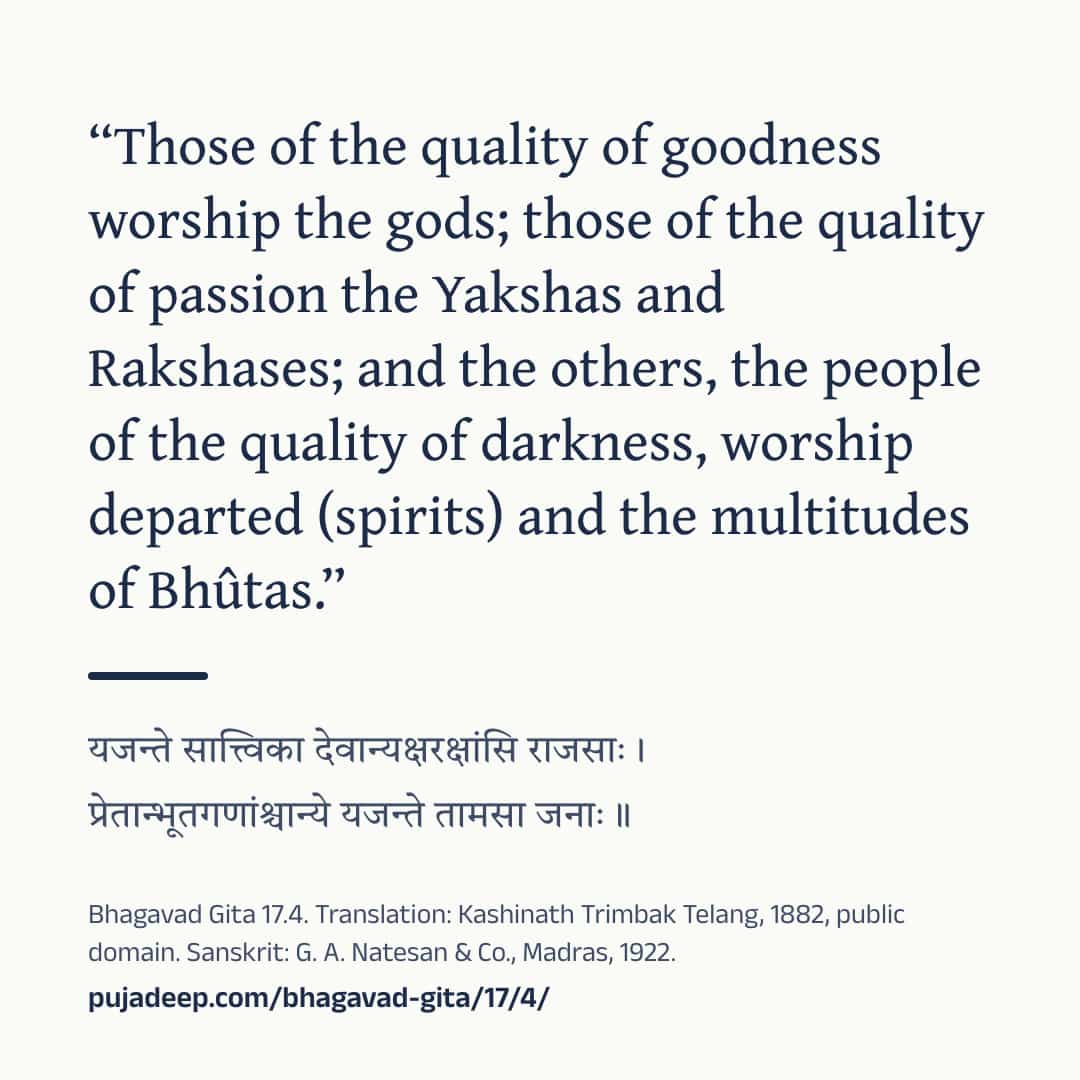
Drawing the picture
See the words
Bhagavad Gita 17.4

यजन्ते सात्त्विका देवान्यक्षरक्षांसि राजसाः ।
प्रेतान्भूतगणांश्चान्ये यजन्ते तामसा जनाः ॥

“Those of the quality of goodness worship the gods; those of the quality of passion the Yakshas and Rakshases; and the others, the people of the quality of darkness, worship departed (spirits) and the multitudes of Bhûtas.”
(K. T. Telang, The Bhagavadgîtâ (The Sacred Books of the East, vol. VIII, Oxford: Clarendon Press, 1882), p. 118, public domain)

“Sâttvic men worship the Gods; râjasic the Yakshas and Râkshasas; the others, the tâmasic folk, worships Pretas and troups of Bhûtas.”
(Annie Besant, The Bhagavad Gîtâ, or The Lord's Song (London: Theosophical Publishing Society, 1895), pp. 146–147, public domain)

“Sátvic men worship the Devas; Rájasic, the Yakshas and Râkshasas; the others—the Támasic men—the Pretas and the hosts of Bhutas.”
(Swami Swarupananda, Srimad-Bhagavad-Gita (Mayavati: Prabuddha Bharata Press, 1909; first printed in Prabuddha Bharata, 1907–1909), p. 308, public domain)

Sanskrit: G. A. Natesan & Co., Madras, 1922.
https://pujadeep.com/bhagavad-gita/17/4/ Nothing is sent from this site. Your own app sends it, to the chat you choose. The picture quotes the translation you chose on this page, with its name and year.
Sanskrit text: The Bhagavad-Gita, or The Lord's Song, with the text in Devanagari and an English translation, 1922. Meanings: written for Pujadeep and checked against the cited edition. Source and changes
Questions families ask
Who speaks Bhagavad Gita 17.4?
Krishna speaks this verse, in chapter 17 (Shraddhatraya Vibhaga Yoga).
Where does the Sanskrit text come from?
Sanskrit text: The Bhagavad-Gita, or The Lord's Song, with the text in Devanagari and an English translation, 1922. Meanings: written for Pujadeep and checked against the cited edition. See the source
Is the meaning on this page a translation?
Explanation written for this site from the sources listed here, and checked against the cited edition. It is not a translation and not the only way to read the text. Free to quote with credit.
Source and licence
- Sanskrit text
- The Bhagavad-Gita, or The Lord's Song, with the text in Devanagari and an English translation (Annie Besant, G. A. Natesan & Co., Madras, 1922). Public domain. The Sanskrit on these pages was read from this printing’s page images.
- Translation
- The Bhagavadgîtâ with the Sanatsugâtîya and the Anugîtâ, translated by Kâshinâth Trimbak Telang (The Sacred Books of the East, vol. VIII, ed. F. Max Müller) (Kashinath Trimbak Telang, F. Max Müller, Clarendon Press, Oxford, 1882). Public domain. Shown verbatim, as printed.
- Translation
- The Bhagavad Gîtâ, or The Lord's Song, translated by Annie Besant (Annie Besant, Theosophical Publishing Society, London, 1895). Public domain. Shown verbatim, as printed.
- Translation
- Srimad-Bhagavad-Gita, with Sanskrit Text; Paraphrase with Word-by-word Literal Translation; English Rendering and Comments, Index, &c., by the Swami Swarupananda (Himalayan Series, No. XX) (Swami Swarupananda, The Editors and Publishers, Advaita Ashrama, Mayavati, Prabuddha Bharata Press, Mayavati, Almora, Himalayas, 1909). Public domain. Shown verbatim, as printed.
- Common wording
- In this text, 32 words follow today's common wording, checked against sanskritdocuments.org; Sanskrit Wikisource; Gita Press, Gorakhpur; GRETIL, Göttingen and Bhaktivedanta Book Trust.
- Our explanation
- Explanation written for this site from the sources listed here, and checked against the cited edition. It is not a translation and not the only way to read the text. Free to quote with credit.
- Checked
- Checked against the cited edition, October 15, 2026.
- Updated
- October 25, 2026