Bhagavad Gita 17.15: meaning and translation
Chapter 17: Shraddhatraya Vibhaga Yoga. Krishna says
The austerity of speech, Krishna says, is speech that upsets no one (anudvega-kara), that is true, pleasant and beneficial, and the steady practice of sacred study and recitation (svādhyāya).
Click or tap a word for its meaning and its dictionary page.
Text and layers
Text and layers
These choices stay in this browser.
Bhagavad Gita 17.15
अनुद्वेगकरं वाक्यं सत्यं प्रियहितं च यत् ।स्वाध्यायाभ्यसनं चैव वाङ्मयं तप उच्यते ॥
Anudvegakaram vakyam satyam priyahitam cha yatSvadhyayabhyasanam chaiva vanmayam tapa uchyate
anudvegakaraṃ vākyaṃ satyaṃ priyahitaṃ ca yat |svādhyāyābhyasanaṃ caiva vāṅmayaṃ tapa ucyate ||
Our explanation The austerity of speech, Krishna says, is speech that upsets no one (anudvega-kara), that is true, pleasant and beneficial, and the steady practice of sacred study and recitation (svādhyāya). Shankara, in Sastri's translation, says all four marks must go together: true speech that hurts, or pleasant speech that is untrue, is not this austerity.
हिंदी अर्थ कृष्ण कहते हैं कि वाणी का तप है ऐसा वचन जो किसी को उद्वेग (बेचैनी) न दे, जो सत्य, प्रिय और हितकारी हो, और स्वाध्याय (वेद आदि के पाठ) का नियमित अभ्यास। शंकराचार्य कहते हैं कि चारों लक्षण साथ होने चाहिए: सत्य पर चुभने वाला वचन, या प्रिय पर असत्य वचन, यह तप नहीं है।
Word by word
Every word, with its dictionary page
Word by word
- अनुद्वेगकरम् anudvegakaram · that upsets no one (compound (neuter), nominative singular) Dictionary: an-udvega-kara, Monier-Williams 1899, p. 33, col. 3 “not causing apprehension, not overawing”
- वाक्यम् vākyam · speech (noun (neuter), nominative singular) Dictionary: vākya, Monier-Williams 1899, p. 936, col. 2 “speech, saying, assertion, statement, command, words”
- सत्यम् satyam · true (adjective (neuter), nominative singular) Dictionary: satya, Monier-Williams 1899, p. 1135, col. 3 “true, real, actual, genuine, sincere, honest, truthful”
- प्रियहितम् priyahitam · pleasant and beneficial (compound (neuter), nominative singular) Dictionary: priya, Monier-Williams 1899, p. 710, col. 1 “beloved, dear to (gen., loc., dat. or comp.), liked, favourite”; 2. hita, Monier-Williams 1899, p. 1298, col. 2 “beneficial, advantageous, salutary, wholesome, suitable”
- च ca · and (indeclinable) Dictionary: 2. ca, Monier-Williams 1899, p. 380, col. 1 “and, both, also, moreover, as well as”
- यत् yat · which (pronoun (neuter), nominative singular) Dictionary: yad, Monier-Williams 1899, p. 844, col. 2 “who, which, what, whichever, whatever, that”
- स्वाध्यायाभ्यसनम् svādhyāyābhyasanam · the practice of sacred study (compound (neuter), nominative singular) Dictionary: 1. svādhyāya, Monier-Williams 1899, p. 1277, col. 2 “repetition or recitation of the Veda in a low voice to o° self”; abhy-asana, Monier-Williams 1899, p. 76, col. 3 “practice, exercise”
- च ca · and (indeclinable) Dictionary: 2. ca, Monier-Williams 1899, p. 380, col. 1 “and, both, also, moreover, as well as”
- एव eva · also (indeclinable) Dictionary: 1. eva, Monier-Williams 1899, p. 232, col. 2 “just, exactly, very, same, only, even, alone, merely”
- वाङ्मयम् vāṅmayam · of speech (adjective (neuter), nominative singular) Dictionary: vāṅ-maya, Monier-Williams 1899, p. 937, col. 2 “consisting of speech, depending on sp°, whose essence is sp°, relating to sp°”
- तपः tapaḥ · austerity (noun (neuter), nominative singular) Dictionary: tapas, Monier-Williams 1899, p. 437, col. 1 “religious austerity, bodily mortification, penance, severe meditation”
- उच्यते ucyate · is called (present passive, 3rd person singular) Dictionary: vac, Monier-Williams 1899, p. 912, col. 1 “to be called or accounted, be regarded as”
Old translations
Kashinath Trimbak Telang, 1882. Public domain. Page 119.
The speech which causes no sorrow, which is true, agreeable, and beneficial, and the study1 of the Vedas, (this) is called the penance vocal.
Footnotes (the translator’s own) - I. e. recitation of the Vedas. ↩
Compare 3 translations
Kashinath Trimbak Telang, 1882. Public domain. Page 119.
The speech which causes no sorrow, which is true, agreeable, and beneficial, and the study1 of the Vedas, (this) is called the penance vocal.
Footnotes (the translator’s own) - I. e. recitation of the Vedas. ↩
You are reading this one
Annie Besant, 1895. Public domain. Page 149.
Speech causing no annoyance, truthful, pleasant and beneficial, the constant practice of the study of the Shâstras, are called the austerity of speech.
You are reading this one
Swami Swarupananda, 1909 (first printed 1907). Public domain. Page 312–313.
Speech which causes no vexation, and is true, as also agreeable and beneficial, and regular study of the Vedas,—these are said to form the austerity of speech.
You are reading this one
Cite this verse
The translation: K. T. Telang, The Bhagavadgîtâ (The Sacred Books of the East, vol. VIII, Oxford: Clarendon Press, 1882), p. 119. Bhagavad Gita 17.15.
The translation: Annie Besant, The Bhagavad Gîtâ, or The Lord's Song (London: Theosophical Publishing Society, 1895), p. 149. Bhagavad Gita 17.15.
The translation: Swami Swarupananda, Srimad-Bhagavad-Gita (Mayavati: Prabuddha Bharata Press, 1909; first printed in Prabuddha Bharata, 1907–1909), pp. 312–313. Bhagavad Gita 17.15.
Our explanation: “Bhagavad Gita 17.15: meaning and translation.” Pujadeep. Updated October 25, 2026. https://pujadeep.com/bhagavad-gita/17/15/
Pujadeep’s explanations are free to quote with credit: name Pujadeep and link to the page. How to credit
Classical readings, by school
No readings by school on this verse yet.
Share
Show the ways to share
Send one picture or the text to one chat. The picture names its source and the address of this page.
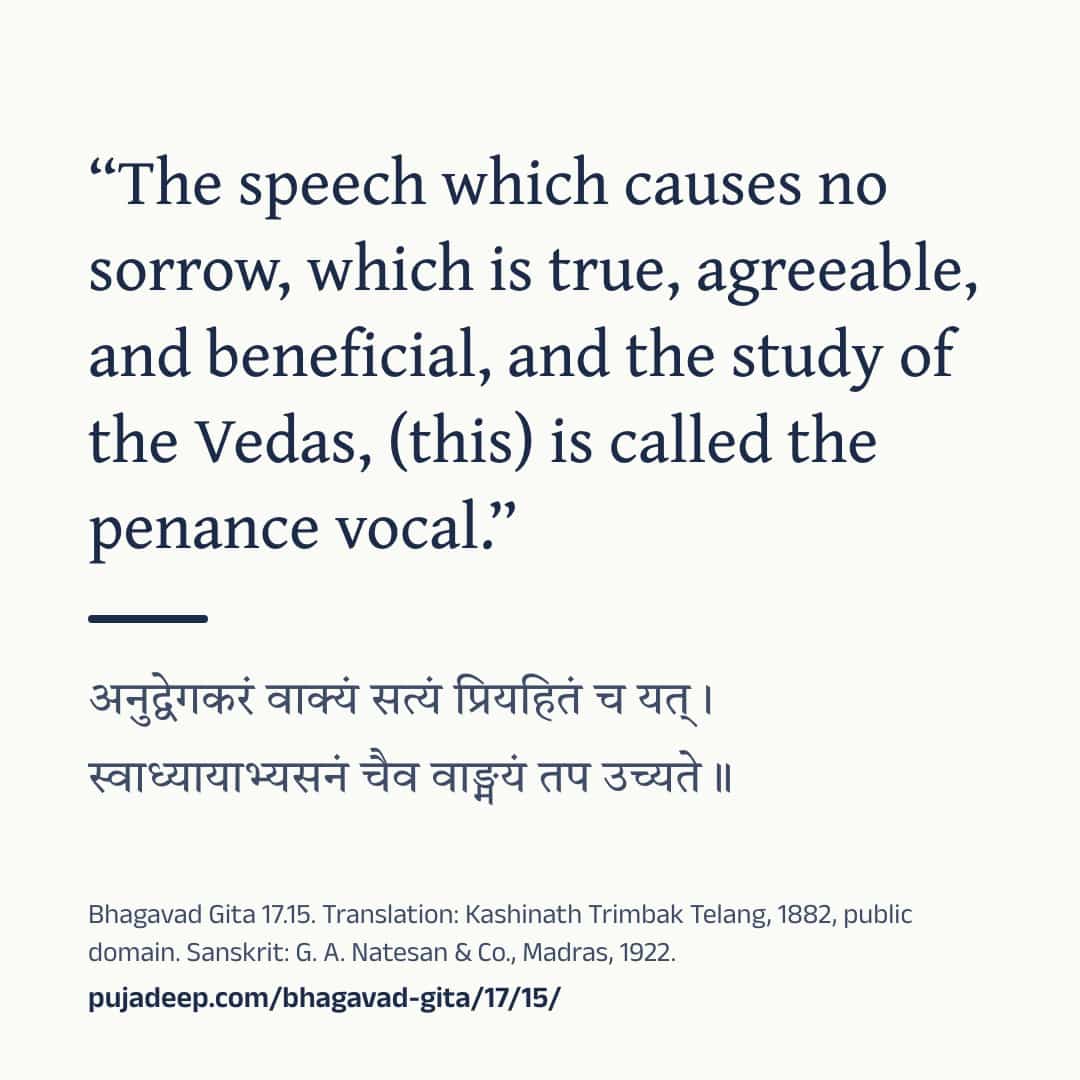
Drawing the picture
See the words
Bhagavad Gita 17.15

अनुद्वेगकरं वाक्यं सत्यं प्रियहितं च यत् ।
स्वाध्यायाभ्यसनं चैव वाङ्मयं तप उच्यते ॥

“The speech which causes no sorrow, which is true, agreeable, and beneficial, and the study of the Vedas, (this) is called the penance vocal.”
(K. T. Telang, The Bhagavadgîtâ (The Sacred Books of the East, vol. VIII, Oxford: Clarendon Press, 1882), p. 119, public domain)

“Speech causing no annoyance, truthful, pleasant and beneficial, the constant practice of the study of the Shâstras, are called the austerity of speech.”
(Annie Besant, The Bhagavad Gîtâ, or The Lord's Song (London: Theosophical Publishing Society, 1895), p. 149, public domain)

“Speech which causes no vexation, and is true, as also agreeable and beneficial, and regular study of the Vedas,—these are said to form the austerity of speech.”
(Swami Swarupananda, Srimad-Bhagavad-Gita (Mayavati: Prabuddha Bharata Press, 1909; first printed in Prabuddha Bharata, 1907–1909), pp. 312–313, public domain)

Sanskrit: G. A. Natesan & Co., Madras, 1922.
https://pujadeep.com/bhagavad-gita/17/15/ Nothing is sent from this site. Your own app sends it, to the chat you choose. The picture quotes the translation you chose on this page, with its name and year.
Sanskrit text: The Bhagavad-Gita, or The Lord's Song, with the text in Devanagari and an English translation, 1922. Meanings: written for Pujadeep and checked against the cited edition. Source and changes
Questions families ask
Who speaks Bhagavad Gita 17.15?
Krishna speaks this verse, in chapter 17 (Shraddhatraya Vibhaga Yoga).
Where does the Sanskrit text come from?
Sanskrit text: The Bhagavad-Gita, or The Lord's Song, with the text in Devanagari and an English translation, 1922. Meanings: written for Pujadeep and checked against the cited edition. See the source
Is the meaning on this page a translation?
Explanation written for this site from the sources listed here, and checked against the cited edition. It is not a translation and not the only way to read the text. Free to quote with credit.
Source and licence
- Sanskrit text
- The Bhagavad-Gita, or The Lord's Song, with the text in Devanagari and an English translation (Annie Besant, G. A. Natesan & Co., Madras, 1922). Public domain. The Sanskrit on these pages was read from this printing’s page images.
- Translation
- The Bhagavadgîtâ with the Sanatsugâtîya and the Anugîtâ, translated by Kâshinâth Trimbak Telang (The Sacred Books of the East, vol. VIII, ed. F. Max Müller) (Kashinath Trimbak Telang, F. Max Müller, Clarendon Press, Oxford, 1882). Public domain. Shown verbatim, as printed.
- Translation
- The Bhagavad Gîtâ, or The Lord's Song, translated by Annie Besant (Annie Besant, Theosophical Publishing Society, London, 1895). Public domain. Shown verbatim, as printed.
- Translation
- Srimad-Bhagavad-Gita, with Sanskrit Text; Paraphrase with Word-by-word Literal Translation; English Rendering and Comments, Index, &c., by the Swami Swarupananda (Himalayan Series, No. XX) (Swami Swarupananda, The Editors and Publishers, Advaita Ashrama, Mayavati, Prabuddha Bharata Press, Mayavati, Almora, Himalayas, 1909). Public domain. Shown verbatim, as printed.
- Common wording
- In this text, 32 words follow today's common wording, checked against sanskritdocuments.org; Sanskrit Wikisource; Gita Press, Gorakhpur; GRETIL, Göttingen and Bhaktivedanta Book Trust.
- Our explanation
- Explanation written for this site from the sources listed here, and checked against the cited edition. It is not a translation and not the only way to read the text. Free to quote with credit.
- Checked
- Checked against the cited edition, October 15, 2026.
- Updated
- October 25, 2026