Bhagavad Gita 17.16: meaning and translation
Chapter 17: Shraddhatraya Vibhaga Yoga. Krishna says
The austerity of the mind, Krishna says, is calmness of mind (manaḥ-prasāda), gentleness (saumyatva), silence (mauna), self-control and purity of heart (bhāva-saṃśuddhi).
Click or tap a word for its meaning and its dictionary page.
Text and layers
Text and layers
These choices stay in this browser.
Bhagavad Gita 17.16
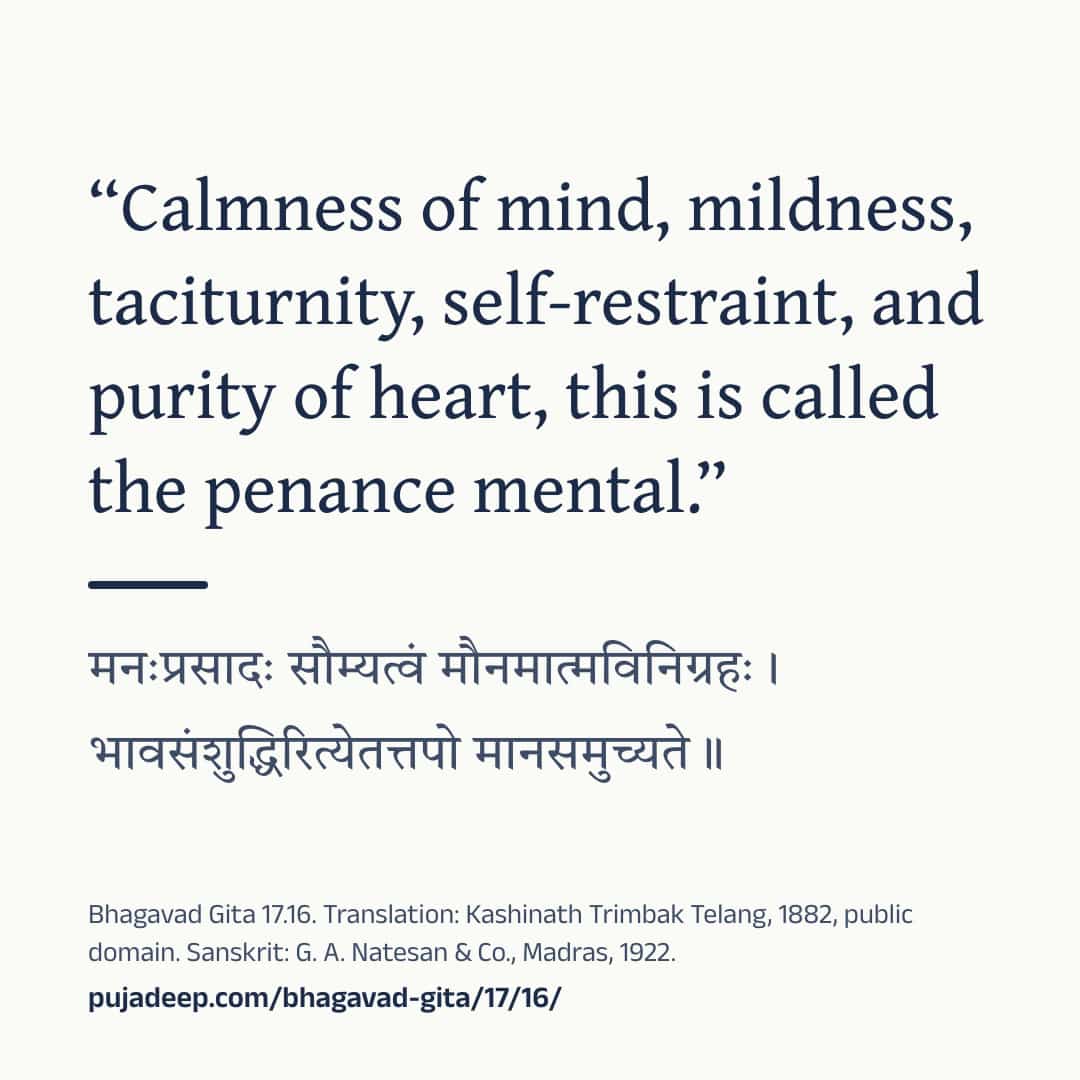
मनःप्रसादः सौम्यत्वं मौनमात्मविनिग्रहः ।भावसंशुद्धिरित्येतत्तपो मानसमुच्यते ॥
Manahprasadah saumyatvam maunamatmavinigrahahBhavasanshuddhirityetattapo manasamuchyate
manaḥprasādaḥ saumyatvaṃ maunamātmavinigrahaḥ |bhāvasaṃśuddhirityetattapo mānasamucyate ||
Our explanation The austerity of the mind, Krishna says, is calmness of mind (manaḥ-prasāda), gentleness (saumyatva), silence (mauna), self-control and purity of heart (bhāva-saṃśuddhi). Telang's note, after Shankara, explains why silence is counted under the mind: control of the tongue follows from control of the mind.
हिंदी अर्थ कृष्ण कहते हैं कि मन का तप है मन की प्रसन्नता (शांति), सौम्यता, मौन, आत्म-संयम और भावों की शुद्धि। तेलंग की टिप्पणी, शंकराचार्य के अनुसार, बताती है कि मौन को मन के तप में क्यों गिना गया: जीभ पर संयम मन के संयम से आता है।
Word by word
Every word, with its dictionary page
Word by word
- मनःप्रसादः manaḥprasādaḥ · calmness of mind (compound (masculine), nominative singular) Dictionary: manas, Monier-Williams 1899, p. 783, col. 3 “mind (in its widest sense as applied to all the mental powers)”; pra-sāda, Monier-Williams 1899, p. 696, col. 3 “clearness, brightness, pellucidness, purity”
- सौम्यत्वम् saumyatvam · gentleness (noun (neuter), nominative singular) Dictionary: saumya-tva, Monier-Williams 1899, p. 1254, col. 1 “gentleness, mildness”
- मौनम् maunam · silence (noun (neuter), nominative singular) Dictionary: mauna, Monier-Williams 1899, p. 837, col. 1 “silence, taciturnity”
- आत्मविनिग्रहः ātmavinigrahaḥ · self-control (compound (masculine), nominative singular) Dictionary: ātman, Monier-Williams 1899, p. 135, col. 1 “the individual soul, self, abstract individual”; vi-nigraha, Monier-Williams 1899, p. 970, col. 1 “restraining, checking, stopping, subduing, controlling”
- भावसंशुद्धिः bhāvasaṃśuddhiḥ · purity of heart (compound (feminine), nominative singular) Dictionary: bhāva, Monier-Williams 1899, p. 754, col. 2 “manner of being, nature, temperament, character”; saṃ-śuddhi, Monier-Williams 1899, p. 1117, col. 3 “perfect purification or purity”
- इति iti · thus (indeclinable) Dictionary: 2. iti, Monier-Williams 1899, p. 165, col. 1 “in this manner, thus”
- एतत् etat · this (pronoun (neuter), nominative singular) Dictionary: etad, Monier-Williams 1899, p. 231, col. 2 “this, this here, here”
- तपः tapaḥ · austerity (noun (neuter), nominative singular) Dictionary: tapas, Monier-Williams 1899, p. 437, col. 1 “religious austerity, bodily mortification, penance, severe meditation”
- मानसम् mānasam · of the mind (adjective (neuter), nominative singular) Dictionary: mānasa, Monier-Williams 1899, p. 810, col. 1 “belonging to the mind or spirit, mental, spiritual”
- उच्यते ucyate · is called (present passive, 3rd person singular) Dictionary: vac, Monier-Williams 1899, p. 912, col. 1 “to be called or accounted, be regarded as”
1 printing differs
Edition differences. Another printing or text reads this place differently.
- Spelling A digital text reads Same letters. The e-text prints मनः प्रसादः as two words; the 1922 edition joins them (मनःप्रसादः), as another digital text does (manaḥprasādaḥ).
Old translations
Kashinath Trimbak Telang, 1882. Public domain. Page 119.
Calmness of mind, mildness, taciturnity1, self-restraint, and purity of heart, this is called the penance mental.
Footnotes (the translator’s own) - This is part of the 'mental penance,' because the government of the tongue is a consequence of mental restraint; the effect being, according to Saṅkara, put here for the cause. ↩
Compare 3 translations
Kashinath Trimbak Telang, 1882. Public domain. Page 119.
Calmness of mind, mildness, taciturnity1, self-restraint, and purity of heart, this is called the penance mental.
Footnotes (the translator’s own) - This is part of the 'mental penance,' because the government of the tongue is a consequence of mental restraint; the effect being, according to Saṅkara, put here for the cause. ↩
You are reading this one
Annie Besant, 1895. Public domain. Page 149.
Mental calmness, equilibrium, silence, self-control, purity of nature—this is called the austerity of the mind.1
Footnotes (the translator’s own) - Manas. ↩
You are reading this one
Swami Swarupananda, 1909 (first printed 1907). Public domain. Page 313.
Serenity of mind, kindliness, silence, self-control, honesty of motive,—this is called the mental austerity.
You are reading this one
Cite this verse
The translation: K. T. Telang, The Bhagavadgîtâ (The Sacred Books of the East, vol. VIII, Oxford: Clarendon Press, 1882), p. 119. Bhagavad Gita 17.16.
The translation: Annie Besant, The Bhagavad Gîtâ, or The Lord's Song (London: Theosophical Publishing Society, 1895), p. 149. Bhagavad Gita 17.16.
The translation: Swami Swarupananda, Srimad-Bhagavad-Gita (Mayavati: Prabuddha Bharata Press, 1909; first printed in Prabuddha Bharata, 1907–1909), p. 313. Bhagavad Gita 17.16.
Our explanation: “Bhagavad Gita 17.16: meaning and translation.” Pujadeep. Updated October 25, 2026. https://pujadeep.com/bhagavad-gita/17/16/
Pujadeep’s explanations are free to quote with credit: name Pujadeep and link to the page. How to credit
Classical readings, by school
No readings by school on this verse yet.
Share
Show the ways to share
Send one picture or the text to one chat. The picture names its source and the address of this page.
Drawing the picture
See the words
Bhagavad Gita 17.16

मनःप्रसादः सौम्यत्वं मौनमात्मविनिग्रहः ।
भावसंशुद्धिरित्येतत्तपो मानसमुच्यते ॥

“Calmness of mind, mildness, taciturnity, self-restraint, and purity of heart, this is called the penance mental.”
(K. T. Telang, The Bhagavadgîtâ (The Sacred Books of the East, vol. VIII, Oxford: Clarendon Press, 1882), p. 119, public domain)

“Mental calmness, equilibrium, silence, self-control, purity of nature—this is called the austerity of the mind.”
(Annie Besant, The Bhagavad Gîtâ, or The Lord's Song (London: Theosophical Publishing Society, 1895), p. 149, public domain)

“Serenity of mind, kindliness, silence, self-control, honesty of motive,—this is called the mental austerity.”
(Swami Swarupananda, Srimad-Bhagavad-Gita (Mayavati: Prabuddha Bharata Press, 1909; first printed in Prabuddha Bharata, 1907–1909), p. 313, public domain)

Sanskrit: G. A. Natesan & Co., Madras, 1922.
https://pujadeep.com/bhagavad-gita/17/16/ Nothing is sent from this site. Your own app sends it, to the chat you choose. The picture quotes the translation you chose on this page, with its name and year.
Sanskrit text: The Bhagavad-Gita, or The Lord's Song, with the text in Devanagari and an English translation, 1922. Meanings: written for Pujadeep and checked against the cited edition. Source and changes
Questions families ask
Who speaks Bhagavad Gita 17.16?
Krishna speaks this verse, in chapter 17 (Shraddhatraya Vibhaga Yoga).
Where does the Sanskrit text come from?
Sanskrit text: The Bhagavad-Gita, or The Lord's Song, with the text in Devanagari and an English translation, 1922. Meanings: written for Pujadeep and checked against the cited edition. See the source
Is the meaning on this page a translation?
Explanation written for this site from the sources listed here, and checked against the cited edition. It is not a translation and not the only way to read the text. Free to quote with credit.
Source and licence
- Sanskrit text
- The Bhagavad-Gita, or The Lord's Song, with the text in Devanagari and an English translation (Annie Besant, G. A. Natesan & Co., Madras, 1922). Public domain. The Sanskrit on these pages was read from this printing’s page images.
- Translation
- The Bhagavadgîtâ with the Sanatsugâtîya and the Anugîtâ, translated by Kâshinâth Trimbak Telang (The Sacred Books of the East, vol. VIII, ed. F. Max Müller) (Kashinath Trimbak Telang, F. Max Müller, Clarendon Press, Oxford, 1882). Public domain. Shown verbatim, as printed.
- Translation
- The Bhagavad Gîtâ, or The Lord's Song, translated by Annie Besant (Annie Besant, Theosophical Publishing Society, London, 1895). Public domain. Shown verbatim, as printed.
- Translation
- Srimad-Bhagavad-Gita, with Sanskrit Text; Paraphrase with Word-by-word Literal Translation; English Rendering and Comments, Index, &c., by the Swami Swarupananda (Himalayan Series, No. XX) (Swami Swarupananda, The Editors and Publishers, Advaita Ashrama, Mayavati, Prabuddha Bharata Press, Mayavati, Almora, Himalayas, 1909). Public domain. Shown verbatim, as printed.
- Common wording
- In this text, 32 words follow today's common wording, checked against sanskritdocuments.org; Sanskrit Wikisource; Gita Press, Gorakhpur; GRETIL, Göttingen and Bhaktivedanta Book Trust.
- Our explanation
- Explanation written for this site from the sources listed here, and checked against the cited edition. It is not a translation and not the only way to read the text. Free to quote with credit.
- Checked
- Checked against the cited edition, October 15, 2026.
- Updated
- October 25, 2026