Bhagavad Gita 17.7: meaning and translation
Chapter 17: Shraddhatraya Vibhaga Yoga. Krishna says
Krishna says that the food each person likes is also of three kinds, and so are sacrifice (yajña), austerity (tapas) and giving (dāna).
Click or tap a word for its meaning and its dictionary page.
Text and layers
Text and layers
These choices stay in this browser.
Bhagavad Gita 17.7
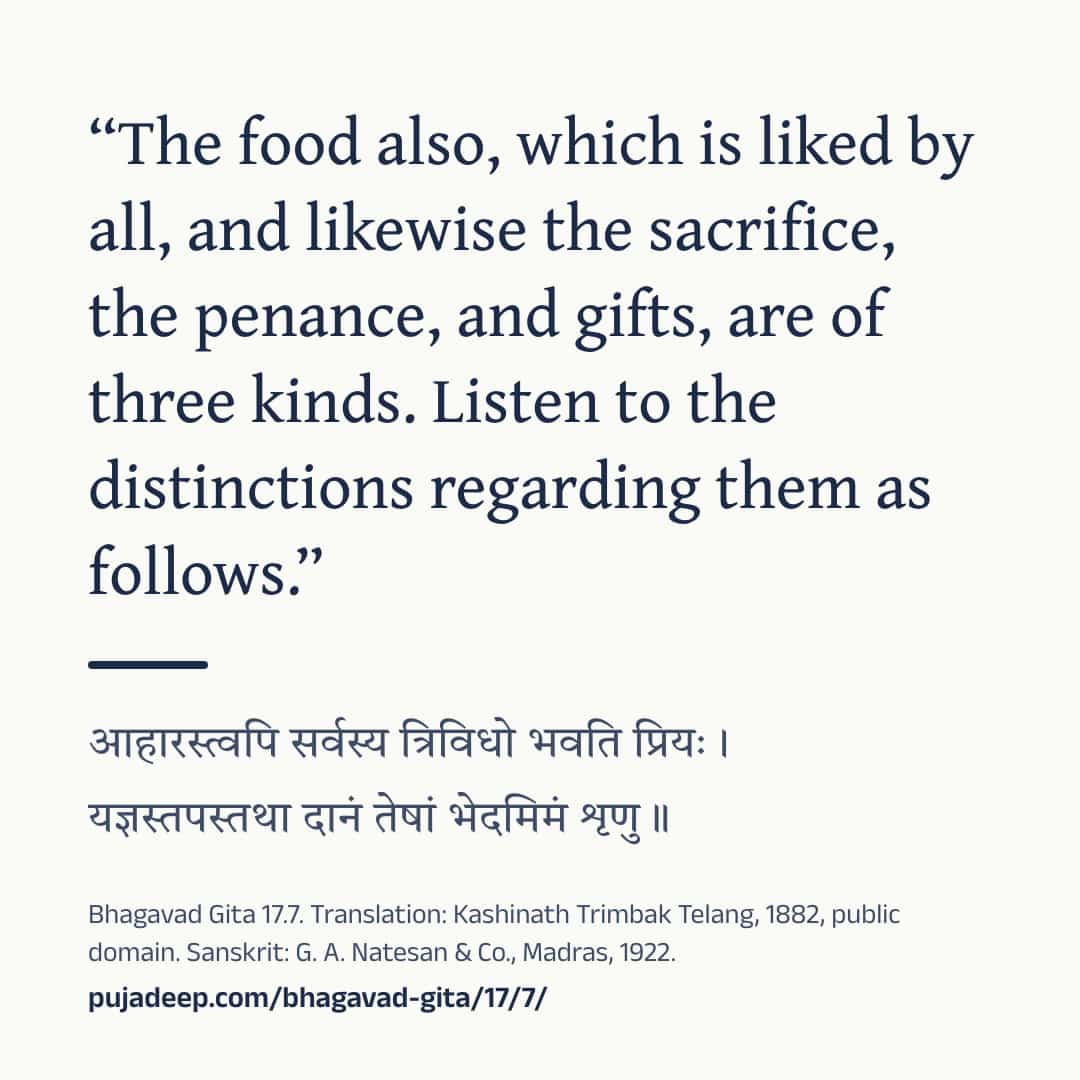
आहारस्त्वपि सर्वस्य त्रिविधो भवति प्रियः ।यज्ञस्तपस्तथा दानं तेषां भेदमिमं शृणु ॥
Aharastvapi sarvasya trividho bhavati priyahYajnastapastatha danam tesham bhedamimam shrinu
āhārastvapi sarvasya trividho bhavati priyaḥ |yajñastapastathā dānaṃ teṣāṃ bhedamimaṃ śṛṇu ||
Our explanation Krishna says that the food each person likes is also of three kinds, and so are sacrifice (yajña), austerity (tapas) and giving (dāna). He asks Arjuna to hear how they differ. Verses 8 to 10 are his words on food, verses 11 to 13 on sacrifice, 14 to 19 on austerity and 20 to 22 on giving. The commentators draw different lessons from this list (see the views). Readings of these verses differ between schools and teachers, and the wording is the text's, not the view of this library.
हिंदी अर्थ कृष्ण कहते हैं कि हर व्यक्ति को जो आहार प्रिय है, वह भी तीन प्रकार का होता है, और वैसे ही यज्ञ, तप और दान भी। वे अर्जुन से इनका भेद सुनने को कहते हैं। श्लोक 8 से 10 में आहार के बारे में उनके वचन हैं, 11 से 13 में यज्ञ, 14 से 19 में तप और 20 से 22 में दान के बारे में। टीकाकार इस सूची से अलग-अलग शिक्षा निकालते हैं। इन श्लोकों को अलग-अलग परंपराएँ और आचार्य अलग ढंग से पढ़ते हैं, और ये शब्द पाठ के हैं, इस पुस्तकालय का मत नहीं।
Word by word
Every word, with its dictionary page
Word by word
- आहारः āhāraḥ · food (noun (masculine), nominative singular) Dictionary: ā-hāra, Monier-Williams 1899, p. 163, col. 1 “taking food; food”
- तु tu · and (indeclinable) Dictionary: 2. tu, Monier-Williams 1899, p. 449, col. 3 “but”
- अपि api · also (indeclinable) Dictionary: api, Monier-Williams 1899, p. 55, col. 1 “in the sense of even, also, very”
- सर्वस्य sarvasya · of everyone (pronoun (masculine), genitive singular) Dictionary: sarva, Monier-Williams 1899, p. 1184, col. 3 “whole, entire, all, every”
- त्रिविधः trividhaḥ · of three kinds (adjective (masculine), nominative singular) Dictionary: tri-vidha, Monier-Williams 1899, p. 460, col. 2 “of 3 kinds, triple, threefold”
- भवति bhavati · is (present, 3rd person singular) Dictionary: 1. bhū, Monier-Williams 1899, p. 760, col. 2 “to become, be”
- प्रियः priyaḥ · liked (adjective (masculine), nominative singular) Dictionary: priya, Monier-Williams 1899, p. 710, col. 1 “beloved, dear to (gen., loc., dat. or comp.), liked, favourite”
- यज्ञः yajñaḥ · sacrifice (noun (masculine), nominative singular) Dictionary: yajña, Monier-Williams 1899, p. 839, col. 2 “worship, devotion, prayer, praise; act of worship or devotion, offering, oblation, sacrifice”
- तपः tapaḥ · austerity (noun (neuter), nominative singular) Dictionary: tapas, Monier-Williams 1899, p. 437, col. 1 “religious austerity, bodily mortification, penance, severe meditation”
- तथा tathā · so also (indeclinable) Dictionary: tathā, Monier-Williams 1899, p. 433, col. 3 “in that manner, so, thus”
- दानम् dānam · giving (noun (neuter), nominative singular) Dictionary: 1. dāna, Monier-Williams 1899, p. 474, col. 1 “the act of giving”
- तेषाम् teṣām · of them (pronoun (masculine), genitive plural) Dictionary: tad, Monier-Williams 1899, p. 434, col. 1 “m. he, f. she, n. it, that, this”
- भेदम् bhedam · difference (noun (masculine), accusative singular) Dictionary: bheda, Monier-Williams 1899, p. 766, col. 1 “distinction, difference, kind, sort, species, variety”
- इमम् imam · this (pronoun (masculine), accusative singular) Dictionary: 1. idam, Monier-Williams 1899, p. 165, col. 2 “this, this here, referring to something near the speaker”
- शृणु śṛṇu · hear (imperative, 2nd person singular) Dictionary: 1. śru, Monier-Williams 1899, p. 1100, col. 3 “to hear, listen or attend to anything”
Old translations
Kashinath Trimbak Telang, 1882. Public domain. Page 118.
The food also, which is liked by all, and likewise the sacrifice, the penance, and gifts, are of three kinds. Listen to the distinctions regarding them as follows.
Compare 3 translations
Kashinath Trimbak Telang, 1882. Public domain. Page 118.
The food also, which is liked by all, and likewise the sacrifice, the penance, and gifts, are of three kinds. Listen to the distinctions regarding them as follows.
You are reading this one
Annie Besant, 1895. Public domain. Page 147.
The food also which is dear to each is threefold, as also sacrifice, austerity and almsgiving. Hear thou this distinction of these.
You are reading this one
Swami Swarupananda, 1909 (first printed 1907). Public domain. Page 309.
The food also which is liked by each of them is threefold, as also Yajna, austerity and alms-giving. Do thou hear this, their distinction.
You are reading this one
Cite this verse
The translation: K. T. Telang, The Bhagavadgîtâ (The Sacred Books of the East, vol. VIII, Oxford: Clarendon Press, 1882), p. 118. Bhagavad Gita 17.7.
The translation: Annie Besant, The Bhagavad Gîtâ, or The Lord's Song (London: Theosophical Publishing Society, 1895), p. 147. Bhagavad Gita 17.7.
The translation: Swami Swarupananda, Srimad-Bhagavad-Gita (Mayavati: Prabuddha Bharata Press, 1909; first printed in Prabuddha Bharata, 1907–1909), p. 309. Bhagavad Gita 17.7.
Our explanation: “Bhagavad Gita 17.7: meaning and translation.” Pujadeep. Updated October 25, 2026. https://pujadeep.com/bhagavad-gita/17/7/
Pujadeep’s explanations are free to quote with credit: name Pujadeep and link to the page. How to credit
Classical readings, by school
Each reading is named by its school. None is presented as the only meaning.
What Advaita, Vishishtadvaita and Dvaita teach, in short
Shankara Advaita
Shankara says the threefold division is given so that a person may tell from his own liking for one kind of food whether he is of sattva, rajas or tamas, and then give up the rājasa and tāmasa kinds and keep to the sāttvika. The division of sacrifice, austerity and giving has the same purpose.
Source: The Bhagavad-Gita, with the commentary of Sri Sankaracharya, translated by A. Mahadeva Sastri (2nd ed., Mysore: G. T. A. Printing Works, 1901), commentary on 17.7, p. 387. Summarised in our own words; none of its text is reproduced.
Ramanuja Vishishtadvaita
Ramanuja says food is described first because, in his reading, sattva and the other guṇas are themselves an effect of the food eaten. He cites two sayings of the Chāndogya Upaniṣad: that the mind is made of food, and that when food is pure the mind becomes pure.
Source: Sri Bhagavad-Gita with Sri Ramanujacharya's Visishtadvaita commentary, translated by A. Govindacharya (Madras, 1898), commentary on 17.7, p. 505. Summarised in our own words; none of its text is reproduced.
Share
Show the ways to share
Send one picture or the text to one chat. The picture names its source and the address of this page.
Drawing the picture
See the words
Bhagavad Gita 17.7

आहारस्त्वपि सर्वस्य त्रिविधो भवति प्रियः ।
यज्ञस्तपस्तथा दानं तेषां भेदमिमं शृणु ॥

“The food also, which is liked by all, and likewise the sacrifice, the penance, and gifts, are of three kinds. Listen to the distinctions regarding them as follows.”
(K. T. Telang, The Bhagavadgîtâ (The Sacred Books of the East, vol. VIII, Oxford: Clarendon Press, 1882), p. 118, public domain)

“The food also which is dear to each is threefold, as also sacrifice, austerity and almsgiving. Hear thou this distinction of these.”
(Annie Besant, The Bhagavad Gîtâ, or The Lord's Song (London: Theosophical Publishing Society, 1895), p. 147, public domain)

“The food also which is liked by each of them is threefold, as also Yajna, austerity and alms-giving. Do thou hear this, their distinction.”
(Swami Swarupananda, Srimad-Bhagavad-Gita (Mayavati: Prabuddha Bharata Press, 1909; first printed in Prabuddha Bharata, 1907–1909), p. 309, public domain)

Sanskrit: G. A. Natesan & Co., Madras, 1922.
https://pujadeep.com/bhagavad-gita/17/7/ Nothing is sent from this site. Your own app sends it, to the chat you choose. The picture quotes the translation you chose on this page, with its name and year.
Sanskrit text: The Bhagavad-Gita, or The Lord's Song, with the text in Devanagari and an English translation, 1922. Meanings: written for Pujadeep and checked against the cited edition. Source and changes
Questions families ask
Who speaks Bhagavad Gita 17.7?
Krishna speaks this verse, in chapter 17 (Shraddhatraya Vibhaga Yoga).
Where does the Sanskrit text come from?
Sanskrit text: The Bhagavad-Gita, or The Lord's Song, with the text in Devanagari and an English translation, 1922. Meanings: written for Pujadeep and checked against the cited edition. See the source
Is the meaning on this page a translation?
Explanation written for this site from the sources listed here, and checked against the cited edition. It is not a translation and not the only way to read the text. Free to quote with credit.
Source and licence
- Sanskrit text
- The Bhagavad-Gita, or The Lord's Song, with the text in Devanagari and an English translation (Annie Besant, G. A. Natesan & Co., Madras, 1922). Public domain. The Sanskrit on these pages was read from this printing’s page images.
- Translation
- The Bhagavadgîtâ with the Sanatsugâtîya and the Anugîtâ, translated by Kâshinâth Trimbak Telang (The Sacred Books of the East, vol. VIII, ed. F. Max Müller) (Kashinath Trimbak Telang, F. Max Müller, Clarendon Press, Oxford, 1882). Public domain. Shown verbatim, as printed.
- Translation
- The Bhagavad Gîtâ, or The Lord's Song, translated by Annie Besant (Annie Besant, Theosophical Publishing Society, London, 1895). Public domain. Shown verbatim, as printed.
- Translation
- Srimad-Bhagavad-Gita, with Sanskrit Text; Paraphrase with Word-by-word Literal Translation; English Rendering and Comments, Index, &c., by the Swami Swarupananda (Himalayan Series, No. XX) (Swami Swarupananda, The Editors and Publishers, Advaita Ashrama, Mayavati, Prabuddha Bharata Press, Mayavati, Almora, Himalayas, 1909). Public domain. Shown verbatim, as printed.
- Commentary
- The Bhagavad-Gita, with the commentary of Sri Sankaracharya, translated by A. Mahadeva Sastri (2nd ed., Mysore: G. T. A. Printing Works, 1901) (Public-domain scan, University of California Libraries). Summarised in our own words; none of its text is reproduced.
- Commentary
- Sri Bhagavad-Gita with Sri Ramanujacharya's Visishtadvaita commentary, translated by A. Govindacharya (Madras, 1898) (Scan uploaded to archive.org (folkscanomy collection)). Summarised in our own words; none of its text is reproduced.
- Common wording
- In this text, 32 words follow today's common wording, checked against sanskritdocuments.org; Sanskrit Wikisource; Gita Press, Gorakhpur; GRETIL, Göttingen and Bhaktivedanta Book Trust.
- Our explanation
- Explanation written for this site from the sources listed here, and checked against the cited edition. It is not a translation and not the only way to read the text. Free to quote with credit.
- Checked
- Checked against the cited edition, October 15, 2026.
- Updated
- October 25, 2026