Bhagavad Gita 17.1: meaning and translation
Chapter 17: Shraddhatraya Vibhaga Yoga. Arjuna says
Arjuna asks about people who set aside the rules of scripture (śāstra-vidhi) and yet worship with faith (śraddhā).
Click or tap a word for its meaning and its dictionary page.
Text and layers
Text and layers
These choices stay in this browser.
Bhagavad Gita 17.1
अर्जुन उवाच ।
ये शास्त्रविधिमुत्सृज्य यजन्ते श्रद्धयाऽन्विताः ।तेषां निष्ठा तु का कृष्ण सत्त्वमाहो रजस्तमः ॥
Ye shastravidhimutsrijya yajante shraddhayanvitahTesham nishtha tu ka krishna sattvamaho rajastamah
ye śāstravidhimutsṛjya yajante śraddhayā’nvitāḥ |teṣāṃ niṣṭhā tu kā kṛṣṇa sattvamāho rajastamaḥ ||
Our explanation Arjuna asks about people who set aside the rules of scripture (śāstra-vidhi) and yet worship with faith (śraddhā). What is their standing, Krishna: sattva, rajas or tamas? These are the three guṇas of chapter 14. The commentators differ on who these people are (see the views).
हिंदी अर्थ अर्जुन उन लोगों के बारे में पूछते हैं जो शास्त्र की विधि छोड़कर भी श्रद्धा से पूजा (यज्ञ) करते हैं। हे कृष्ण, उनकी निष्ठा (स्थिति) क्या है: सत्त्व, रज या तम? ये अध्याय 14 के तीन गुण हैं। ये लोग कौन हैं, इस पर टीकाकारों के मत अलग हैं।
Word by word
Every word, with its dictionary page
Word by word
- ये ye · those who (pronoun (masculine), nominative plural) Dictionary: yad, Monier-Williams 1899, p. 844, col. 2 “who, which, what, whichever, whatever, that”
- शास्त्रविधिम् śāstravidhim · the rule of scripture (compound (masculine), accusative singular) Dictionary: śāstra, Monier-Williams 1899, p. 1069, col. 1 “an order, command, precept, rule”; 2. vidhi, Monier-Williams 1899, p. 968, col. 1 “a rule, formula, injunction, ordinance, statute, precept, law, direction”
- उत्सृज्य utsṛjya · setting aside (absolutive (having done)) Dictionary: ut-sṛj, Monier-Williams 1899, p. 182, col. 3 “to quit, leave, abandon, avoid, eschew”
- यजन्ते yajante · worship (present, 3rd person plural) Dictionary: 1. yaj, Monier-Williams 1899, p. 838, col. 3 “to worship, adore, honour (esp. with sacrifice or oblations)”
- श्रद्धया śraddhayā · with faith (noun (feminine), instrumental singular) Dictionary: śraddhā, Monier-Williams 1899, p. 1095, col. 3 “faith, trust, confidence, trustfulness, faithfulness, belief in”
- अन्विताः anvitāḥ · filled with (past participle (masculine), nominative plural) Dictionary: anv-ita, Monier-Williams 1899, p. 47, col. 2 “endowed with, possessed of”
- तेषाम् teṣām · their (pronoun (masculine), genitive plural) Dictionary: tad, Monier-Williams 1899, p. 434, col. 1 “m. he, f. she, n. it, that, this”
- निष्ठा niṣṭhā · standing, state (noun (feminine), nominative singular) Dictionary: 1. ni-ṣṭhā, Monier-Williams 1899, p. 563, col. 1 “state, condition, position”
- तु tu · then (indeclinable) Dictionary: 2. tu, Monier-Williams 1899, p. 449, col. 3 “but”
- का kā · what (pronoun (feminine), nominative singular) Dictionary: kim, Monier-Williams 1899, p. 282, col. 2 “what? how? whence? wherefore? why?”
- कृष्ण kṛṣṇa · O Krishna (noun (masculine), vocative singular) Dictionary: kṛṣṇa, Monier-Williams 1899, p. 306, col. 2 “N. of a celebrated Avatār of the god Vishṇu, or sometimes identified with Vishṇu himself”
- सत्त्वम् sattvam · sattva (noun (neuter), nominative singular) Dictionary: sat-tva, Monier-Williams 1899, p. 1135, col. 2 “the quality of purity or goodness”
- आहो āho · or (indeclinable) Dictionary: āho, Monier-Williams 1899, p. 163, col. 1 “an interjection of asking and of doubt”
- रजः rajaḥ · rajas (noun (neuter), nominative singular) Dictionary: rajas, Monier-Williams 1899, p. 863, col. 2 “the 'darkening' quality, passion, emotion, affection”
- तमः tamaḥ · tamas (noun (neuter), nominative singular) Dictionary: tamas, Monier-Williams 1899, p. 438, col. 1 “one of the 3 qualities or constituents of everything in creation”
1 printing differs
Edition differences. Another printing or text reads this place differently.
- Spelling A digital text reads Same words. The 1922 edition marks the merged vowel with an avagraha (श्रद्धयाऽन्विताः); this e-text does not.
Old translations
Kashinath Trimbak Telang, 1882. Public domain. Page 117.
Arguna said:
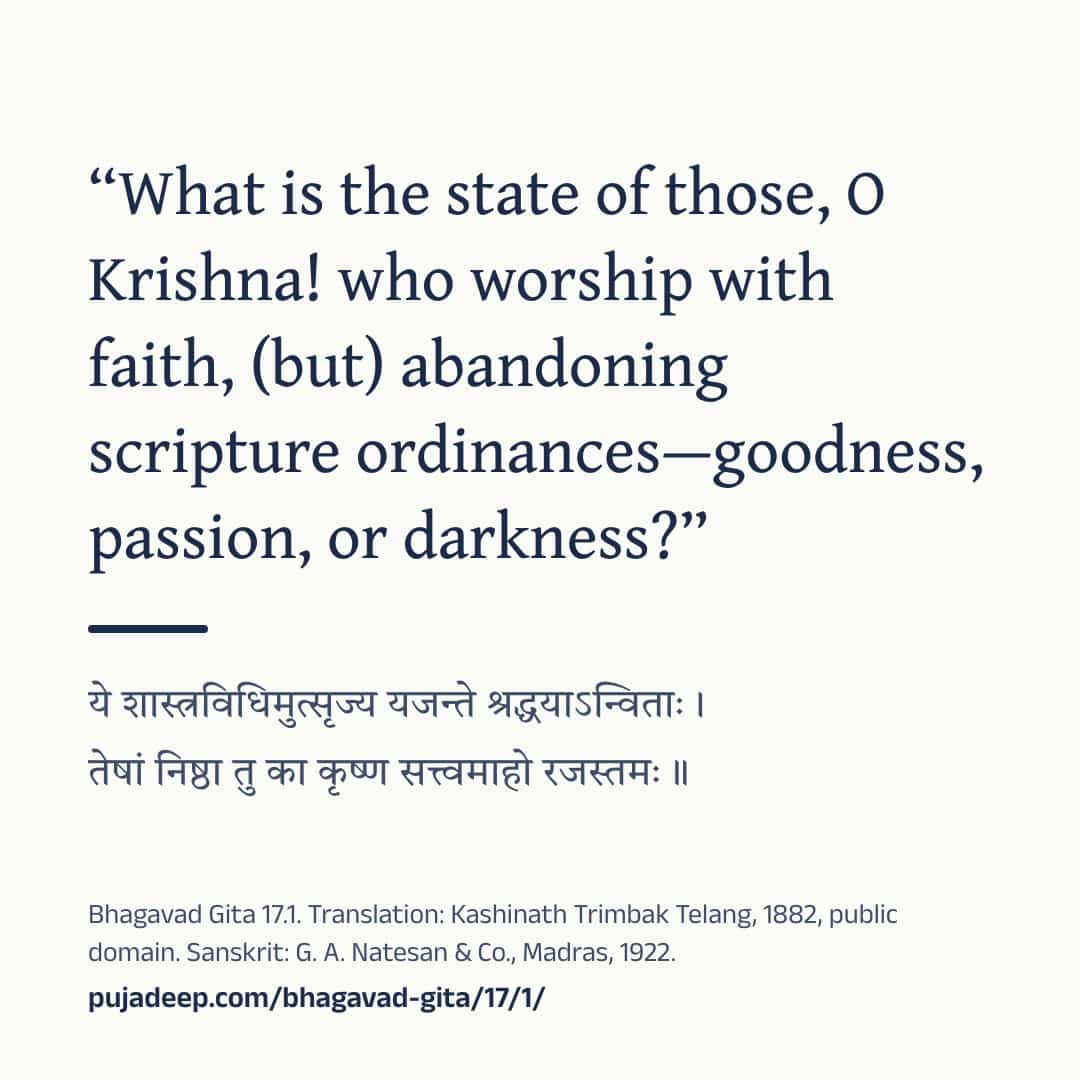
What is the state of those, O Krishna! who worship with faith, (but) abandoning scripture ordinances—goodness, passion, or darkness?
Compare 3 translations
Kashinath Trimbak Telang, 1882. Public domain. Page 117.
Arguna said:
What is the state of those, O Krishna! who worship with faith, (but) abandoning scripture ordinances—goodness, passion, or darkness?
You are reading this one
Annie Besant, 1895. Public domain. Page 146.
Arjuna said:
Those that casting aside the ordinances of the Shâstras, sacrifice and are possessed of faith,1 what is verily their position, O Krishna? Is it one of Sattva, Rajas or Tamas?
Footnotes (the translator’s own) - Shraddhâ. ↩
You are reading this one
Swami Swarupananda, 1909 (first printed 1907). Public domain. Page 306.
Arjuna said:
Those who, setting aside the ordinance of the Shâstras, perform sacrifice with Shraddhâ, what is their condition, O Krishna? (Is it) Satva, Rajas or Tamas?
You are reading this one
Cite this verse
The translation: K. T. Telang, The Bhagavadgîtâ (The Sacred Books of the East, vol. VIII, Oxford: Clarendon Press, 1882), p. 117. Bhagavad Gita 17.1.
The translation: Annie Besant, The Bhagavad Gîtâ, or The Lord's Song (London: Theosophical Publishing Society, 1895), p. 146. Bhagavad Gita 17.1.
The translation: Swami Swarupananda, Srimad-Bhagavad-Gita (Mayavati: Prabuddha Bharata Press, 1909; first printed in Prabuddha Bharata, 1907–1909), p. 306. Bhagavad Gita 17.1.
Our explanation: “Bhagavad Gita 17.1: meaning and translation.” Pujadeep. Updated October 25, 2026. https://pujadeep.com/bhagavad-gita/17/1/
Pujadeep’s explanations are free to quote with credit: name Pujadeep and link to the page. How to credit
Classical readings, by school
Each reading is named by its school. None is presented as the only meaning.
What Advaita, Vishishtadvaita and Dvaita teach, in short
Shankara Advaita
Shankara says the verse means people who do not know the rules of the śruti and smṛti but, seeing how the learned live, worship the gods with faith. People who know the rules and set them aside cannot be meant, because they could not be called people of faith.
Source: The Bhagavad-Gita, with the commentary of Sri Sankaracharya, translated by A. Mahadeva Sastri (2nd ed., Mysore: G. T. A. Printing Works, 1901), commentary on 17.1, pp. 384–385. Summarised in our own words; none of its text is reproduced.
Ramanuja Vishishtadvaita
Ramanuja takes the question to be about sacrifices done with faith but against the rules of scripture. In his reading Krishna first explains the three kinds of works that do follow scripture, and only later shows that works against scripture bear no fruit, even when done with faith.
Source: Sri Bhagavad-Gita with Sri Ramanujacharya's Visishtadvaita commentary, translated by A. Govindacharya (Madras, 1898), commentary on 17.1, pp. 501–502. Summarised in our own words; none of its text is reproduced.
Share
Show the ways to share
Send one picture or the text to one chat. The picture names its source and the address of this page.
Drawing the picture
See the words
Bhagavad Gita 17.1

ये शास्त्रविधिमुत्सृज्य यजन्ते श्रद्धयाऽन्विताः ।
तेषां निष्ठा तु का कृष्ण सत्त्वमाहो रजस्तमः ॥

“What is the state of those, O Krishna! who worship with faith, (but) abandoning scripture ordinances—goodness, passion, or darkness?”
(K. T. Telang, The Bhagavadgîtâ (The Sacred Books of the East, vol. VIII, Oxford: Clarendon Press, 1882), p. 117, public domain)

“Those that casting aside the ordinances of the Shâstras, sacrifice and are possessed of faith, what is verily their position, O Krishna? Is it one of Sattva, Rajas or Tamas?”
(Annie Besant, The Bhagavad Gîtâ, or The Lord's Song (London: Theosophical Publishing Society, 1895), p. 146, public domain)

“Those who, setting aside the ordinance of the Shâstras, perform sacrifice with Shraddhâ, what is their condition, O Krishna? (Is it) Satva, Rajas or Tamas?”
(Swami Swarupananda, Srimad-Bhagavad-Gita (Mayavati: Prabuddha Bharata Press, 1909; first printed in Prabuddha Bharata, 1907–1909), p. 306, public domain)

Sanskrit: G. A. Natesan & Co., Madras, 1922.
https://pujadeep.com/bhagavad-gita/17/1/ Nothing is sent from this site. Your own app sends it, to the chat you choose. The picture quotes the translation you chose on this page, with its name and year.
Sanskrit text: The Bhagavad-Gita, or The Lord's Song, with the text in Devanagari and an English translation, 1922. Meanings: written for Pujadeep and checked against the cited edition. Source and changes
Questions families ask
Who speaks Bhagavad Gita 17.1?
Arjuna speaks this verse, in chapter 17 (Shraddhatraya Vibhaga Yoga).
Where does the Sanskrit text come from?
Sanskrit text: The Bhagavad-Gita, or The Lord's Song, with the text in Devanagari and an English translation, 1922. Meanings: written for Pujadeep and checked against the cited edition. See the source
Is the meaning on this page a translation?
Explanation written for this site from the sources listed here, and checked against the cited edition. It is not a translation and not the only way to read the text. Free to quote with credit.
Source and licence
- Sanskrit text
- The Bhagavad-Gita, or The Lord's Song, with the text in Devanagari and an English translation (Annie Besant, G. A. Natesan & Co., Madras, 1922). Public domain. The Sanskrit on these pages was read from this printing’s page images.
- Translation
- The Bhagavadgîtâ with the Sanatsugâtîya and the Anugîtâ, translated by Kâshinâth Trimbak Telang (The Sacred Books of the East, vol. VIII, ed. F. Max Müller) (Kashinath Trimbak Telang, F. Max Müller, Clarendon Press, Oxford, 1882). Public domain. Shown verbatim, as printed.
- Translation
- The Bhagavad Gîtâ, or The Lord's Song, translated by Annie Besant (Annie Besant, Theosophical Publishing Society, London, 1895). Public domain. Shown verbatim, as printed.
- Translation
- Srimad-Bhagavad-Gita, with Sanskrit Text; Paraphrase with Word-by-word Literal Translation; English Rendering and Comments, Index, &c., by the Swami Swarupananda (Himalayan Series, No. XX) (Swami Swarupananda, The Editors and Publishers, Advaita Ashrama, Mayavati, Prabuddha Bharata Press, Mayavati, Almora, Himalayas, 1909). Public domain. Shown verbatim, as printed.
- Commentary
- The Bhagavad-Gita, with the commentary of Sri Sankaracharya, translated by A. Mahadeva Sastri (2nd ed., Mysore: G. T. A. Printing Works, 1901) (Public-domain scan, University of California Libraries). Summarised in our own words; none of its text is reproduced.
- Commentary
- Sri Bhagavad-Gita with Sri Ramanujacharya's Visishtadvaita commentary, translated by A. Govindacharya (Madras, 1898) (Scan uploaded to archive.org (folkscanomy collection)). Summarised in our own words; none of its text is reproduced.
- Common wording
- In this text, 32 words follow today's common wording, checked against sanskritdocuments.org; Sanskrit Wikisource; Gita Press, Gorakhpur; GRETIL, Göttingen and Bhaktivedanta Book Trust.
- Our explanation
- Explanation written for this site from the sources listed here, and checked against the cited edition. It is not a translation and not the only way to read the text. Free to quote with credit.
- Checked
- Checked against the cited edition, October 15, 2026.
- Updated
- October 25, 2026