Bhagavad Gita 17.12: meaning and translation
Chapter 17: Shraddhatraya Vibhaga Yoga. Krishna says
Krishna says that a sacrifice offered with an eye on its fruit, and also for show (dambha), is to be known as rājasa.
Click or tap a word for its meaning and its dictionary page.
Text and layers
Text and layers
These choices stay in this browser.
Bhagavad Gita 17.12
अभिसन्धाय तु फलं दम्भार्थमपि चैव यत् ।इज्यते भरतश्रेष्ठ तं यज्ञं विद्धि राजसम् ॥
Abhisandhaya tu phalam dambharthamapi chaiva yatIjyate bharatashreshtha tam yajnam viddhi rajasam
abhisandhāya tu phalaṃ dambhārthamapi caiva yat |ijyate bharataśreṣṭha taṃ yajñaṃ viddhi rājasam ||
Our explanation Krishna says that a sacrifice offered with an eye on its fruit, and also for show (dambha), is to be known as rājasa. He calls Arjuna best of the Bharatas.
हिंदी अर्थ कृष्ण कहते हैं कि हे भरतश्रेष्ठ, जो यज्ञ फल को ध्यान में रखकर और दिखावे (दंभ) के लिए भी किया जाता है, उसे राजस जानो।
Word by word
Every word, with its dictionary page
Word by word
- अभिसन्धाय abhisandhāya · aiming at (absolutive (having done)) Dictionary: 1. abhi-saṃ-dhā, Monier-Williams 1899, p. 72, col. 3 “to aim at, have in view”
- तु tu · but (indeclinable) Dictionary: 2. tu, Monier-Williams 1899, p. 449, col. 3 “but”
- फलम् phalam · fruit (noun (neuter), accusative singular) Dictionary: phala, Monier-Williams 1899, p. 716, col. 2 “fruit (met.), consequence, effect, result, retribution (good or bad)”
- दम्भार्थम् dambhārtham · for show (compound, accusative used as an adverb (for the sake of)) Dictionary: dambha, Monier-Williams 1899, p. 469, col. 3 “deceit, fraud, feigning, hypocrisy”; artha, Monier-Williams 1899, p. 90, col. 3 “aim, purpose”
- अपि api · also (indeclinable) Dictionary: api, Monier-Williams 1899, p. 55, col. 1 “in the sense of even, also, very”
- च ca · and (indeclinable) Dictionary: 2. ca, Monier-Williams 1899, p. 380, col. 1 “and, both, also, moreover, as well as”
- एव eva · indeed (indeclinable) Dictionary: 1. eva, Monier-Williams 1899, p. 232, col. 2 “just, exactly, very, same, only, even, alone, merely”
- यत् yat · which (pronoun (neuter), nominative singular) Dictionary: yad, Monier-Williams 1899, p. 844, col. 2 “who, which, what, whichever, whatever, that”
- इज्यते ijyate · is offered (present passive, 3rd person singular) Dictionary: 1. yaj, Monier-Williams 1899, p. 838, col. 3 “to worship, adore, honour (esp. with sacrifice or oblations)”
- भरतश्रेष्ठ bharataśreṣṭha · O best of the Bharatas (compound (masculine), vocative singular) Dictionary: bharata, Monier-Williams 1899, p. 747, col. 2 “of a celebrated hero and monarch of India”; śreṣṭha, Monier-Williams 1899, p. 1102, col. 3 “most excellent, best, first, chief”
- तम् tam · that (pronoun (masculine), accusative singular) Dictionary: tad, Monier-Williams 1899, p. 434, col. 1 “m. he, f. she, n. it, that, this”
- यज्ञम् yajñam · sacrifice (noun (masculine), accusative singular) Dictionary: yajña, Monier-Williams 1899, p. 839, col. 2 “worship, devotion, prayer, praise; act of worship or devotion, offering, oblation, sacrifice”
- विद्धि viddhi · know (imperative, 2nd person singular) Dictionary: 1. vid, Monier-Williams 1899, p. 963, col. 2 “to know, understand, perceive, learn”
- राजसम् rājasam · rājasa (adjective (masculine), accusative singular) Dictionary: rājasa, Monier-Williams 1899, p. 875, col. 2 “belonging or relating to the quality rajas”
Old translations
Kashinath Trimbak Telang, 1882. Public domain. Page 119.
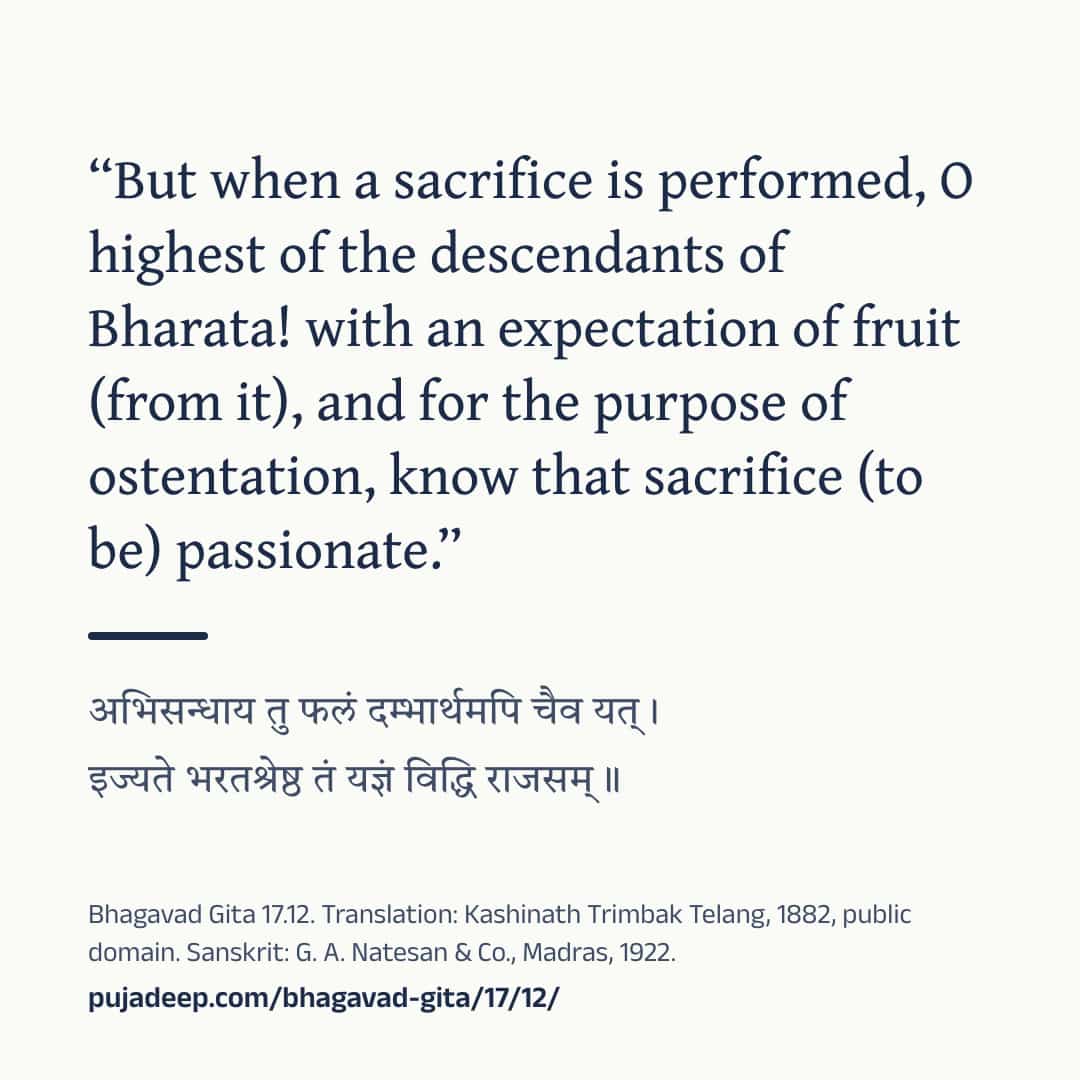
But when a sacrifice is performed, O highest of the descendants of Bharata! with an expectation of fruit (from it), and for the purpose of ostentation, know that sacrifice (to be) passionate.
Compare 3 translations
Kashinath Trimbak Telang, 1882. Public domain. Page 119.
But when a sacrifice is performed, O highest of the descendants of Bharata! with an expectation of fruit (from it), and for the purpose of ostentation, know that sacrifice (to be) passionate.
You are reading this one
Annie Besant, 1895. Public domain. Page 148.
That sacrifice offered with a view verily to fruit, and also indeed for self-glorification, O best of the Bhâratas; know thou to be râjasic.
You are reading this one
Swami Swarupananda, 1909 (first printed 1907). Public domain. Page 311.
That which is performed, O best of the Bhâratas, seeking for fruit and for ostentation, know it to be a Rájasic Yajna.
You are reading this one
Cite this verse
The translation: K. T. Telang, The Bhagavadgîtâ (The Sacred Books of the East, vol. VIII, Oxford: Clarendon Press, 1882), p. 119. Bhagavad Gita 17.12.
The translation: Annie Besant, The Bhagavad Gîtâ, or The Lord's Song (London: Theosophical Publishing Society, 1895), p. 148. Bhagavad Gita 17.12.
The translation: Swami Swarupananda, Srimad-Bhagavad-Gita (Mayavati: Prabuddha Bharata Press, 1909; first printed in Prabuddha Bharata, 1907–1909), p. 311. Bhagavad Gita 17.12.
Our explanation: “Bhagavad Gita 17.12: meaning and translation.” Pujadeep. Updated October 25, 2026. https://pujadeep.com/bhagavad-gita/17/12/
Pujadeep’s explanations are free to quote with credit: name Pujadeep and link to the page. How to credit
Classical readings, by school
No readings by school on this verse yet.
Share
Show the ways to share
Send one picture or the text to one chat. The picture names its source and the address of this page.
Drawing the picture
See the words
Bhagavad Gita 17.12

अभिसन्धाय तु फलं दम्भार्थमपि चैव यत् ।
इज्यते भरतश्रेष्ठ तं यज्ञं विद्धि राजसम् ॥

“But when a sacrifice is performed, O highest of the descendants of Bharata! with an expectation of fruit (from it), and for the purpose of ostentation, know that sacrifice (to be) passionate.”
(K. T. Telang, The Bhagavadgîtâ (The Sacred Books of the East, vol. VIII, Oxford: Clarendon Press, 1882), p. 119, public domain)

“That sacrifice offered with a view verily to fruit, and also indeed for self-glorification, O best of the Bhâratas; know thou to be râjasic.”
(Annie Besant, The Bhagavad Gîtâ, or The Lord's Song (London: Theosophical Publishing Society, 1895), p. 148, public domain)

“That which is performed, O best of the Bhâratas, seeking for fruit and for ostentation, know it to be a Rájasic Yajna.”
(Swami Swarupananda, Srimad-Bhagavad-Gita (Mayavati: Prabuddha Bharata Press, 1909; first printed in Prabuddha Bharata, 1907–1909), p. 311, public domain)

Sanskrit: G. A. Natesan & Co., Madras, 1922.
https://pujadeep.com/bhagavad-gita/17/12/ Nothing is sent from this site. Your own app sends it, to the chat you choose. The picture quotes the translation you chose on this page, with its name and year.
Sanskrit text: The Bhagavad-Gita, or The Lord's Song, with the text in Devanagari and an English translation, 1922. Meanings: written for Pujadeep and checked against the cited edition. Source and changes
Questions families ask
Who speaks Bhagavad Gita 17.12?
Krishna speaks this verse, in chapter 17 (Shraddhatraya Vibhaga Yoga).
Where does the Sanskrit text come from?
Sanskrit text: The Bhagavad-Gita, or The Lord's Song, with the text in Devanagari and an English translation, 1922. Meanings: written for Pujadeep and checked against the cited edition. See the source
Is the meaning on this page a translation?
Explanation written for this site from the sources listed here, and checked against the cited edition. It is not a translation and not the only way to read the text. Free to quote with credit.
Source and licence
- Sanskrit text
- The Bhagavad-Gita, or The Lord's Song, with the text in Devanagari and an English translation (Annie Besant, G. A. Natesan & Co., Madras, 1922). Public domain. The Sanskrit on these pages was read from this printing’s page images.
- Translation
- The Bhagavadgîtâ with the Sanatsugâtîya and the Anugîtâ, translated by Kâshinâth Trimbak Telang (The Sacred Books of the East, vol. VIII, ed. F. Max Müller) (Kashinath Trimbak Telang, F. Max Müller, Clarendon Press, Oxford, 1882). Public domain. Shown verbatim, as printed.
- Translation
- The Bhagavad Gîtâ, or The Lord's Song, translated by Annie Besant (Annie Besant, Theosophical Publishing Society, London, 1895). Public domain. Shown verbatim, as printed.
- Translation
- Srimad-Bhagavad-Gita, with Sanskrit Text; Paraphrase with Word-by-word Literal Translation; English Rendering and Comments, Index, &c., by the Swami Swarupananda (Himalayan Series, No. XX) (Swami Swarupananda, The Editors and Publishers, Advaita Ashrama, Mayavati, Prabuddha Bharata Press, Mayavati, Almora, Himalayas, 1909). Public domain. Shown verbatim, as printed.
- Common wording
- In this text, 32 words follow today's common wording, checked against sanskritdocuments.org; Sanskrit Wikisource; Gita Press, Gorakhpur; GRETIL, Göttingen and Bhaktivedanta Book Trust.
- Our explanation
- Explanation written for this site from the sources listed here, and checked against the cited edition. It is not a translation and not the only way to read the text. Free to quote with credit.
- Checked
- Checked against the cited edition, October 15, 2026.
- Updated
- October 25, 2026