Bhagavad Gita 17.14: meaning and translation
Chapter 17: Shraddhatraya Vibhaga Yoga. Krishna says
Krishna names the austerity of the body (śārīra tapas): honouring the gods, the twice-born (dvija), teachers and the wise; purity (śauca), straightforwardness (ārjava), brahmacarya and not harming (ahiṃsā).
Click or tap a word for its meaning and its dictionary page.
Text and layers
Text and layers
These choices stay in this browser.
Bhagavad Gita 17.14
देवद्विजगुरुप्राज्ञपूजनं शौचमार्जवम् ।ब्रह्मचर्यमहिंसा च शारीरं तप उच्यते ॥
Devadvijaguruprajnapujanam shauchamarjavamBrahmacharyamahinsa cha shariram tapa uchyate
devadvijaguruprājñapūjanaṃ śaucamārjavam |brahmacaryamahiṃsā ca śārīraṃ tapa ucyate ||
Our explanation Krishna names the austerity of the body (śārīra tapas): honouring the gods, the twice-born (dvija), teachers and the wise; purity (śauca), straightforwardness (ārjava), brahmacarya and not harming (ahiṃsā). Telang translates dvija as 'Brâhmanas'; his note explains that these count as bodily because the body is the main instrument in them.
हिंदी अर्थ कृष्ण शरीर का तप बताते हैं: देवताओं, द्विजों, गुरुओं और ज्ञानियों का पूजन; शौच (पवित्रता), आर्जव (सरलता), ब्रह्मचर्य और अहिंसा। तेलंग “द्विज” का अनुवाद Brâhmanas करते हैं; उनकी टिप्पणी बताती है कि ये शरीर के तप इसलिए हैं कि इनमें शरीर ही मुख्य साधन है।
Word by word
Every word, with its dictionary page
Word by word
- देवद्विजगुरुप्राज्ञपूजनम् devadvijaguruprājñapūjanam · honouring gods, twice-born, teachers and the wise (compound (neuter), nominative singular) Dictionary: deva, Monier-Williams 1899, p. 492, col. 2 “a deity, god”; dvi-ja, Monier-Williams 1899, p. 506, col. 1 “twice-born; m. a man of any one of the first 3 classes, any Āryan”; guru, Monier-Williams 1899, p. 359, col. 2 “a spiritual parent or preceptor”; prā-jña, Monier-Williams 1899, p. 702, col. 1 “a wise or learned man”; pūjana, Monier-Williams 1899, p. 641, col. 1 “reverencing, honouring, worship, respect, attention”
- शौचम् śaucam · purity (noun (neuter), nominative singular) Dictionary: śauca, Monier-Williams 1899, p. 1092, col. 3 “cleanness, purity, purification”
- आर्जवम् ārjavam · straightforwardness (noun (neuter), nominative singular) Dictionary: ārjava, Monier-Williams 1899, p. 151, col. 3 “honesty, frankness, sincerity”
- ब्रह्मचर्यम् brahmacaryam · brahmacarya (continence) (noun (neuter), nominative singular) Dictionary: brahma-carya, Monier-Williams 1899, p. 738, col. 2 “the state of an unmarried religious student, a state of continence and chastity”
- अहिंसा ahiṃsā · not harming (noun (feminine), nominative singular) Dictionary: a-hiṃsā, Monier-Williams 1899, p. 125, col. 2 “not injuring anything, harmlessness”
- च ca · and (indeclinable) Dictionary: 2. ca, Monier-Williams 1899, p. 380, col. 1 “and, both, also, moreover, as well as”
- शारीरम् śārīram · of the body (adjective (neuter), nominative singular) Dictionary: śārīra, Monier-Williams 1899, p. 1066, col. 2 “bodily, corporeal”
- तपः tapaḥ · austerity (noun (neuter), nominative singular) Dictionary: tapas, Monier-Williams 1899, p. 437, col. 1 “religious austerity, bodily mortification, penance, severe meditation”
- उच्यते ucyate · is called (present passive, 3rd person singular) Dictionary: vac, Monier-Williams 1899, p. 912, col. 1 “to be called or accounted, be regarded as”
Old translations
Kashinath Trimbak Telang, 1882. Public domain. Page 119.
Paying reverence to gods, Brâhmanas, preceptors, and men of knowledge; purity1, straightforwardness, life as Brahmakârin, and harmlessness, (this) is called the penance bodily.
Footnotes (the translator’s own) - Cleanliness of body; straightforwardness=not doing prohibited acts; harmlessness=not injuring any living beings. These are 'bodily,' because the body is the main instrument in these actions. ↩
Compare 3 translations
Kashinath Trimbak Telang, 1882. Public domain. Page 119.
Paying reverence to gods, Brâhmanas, preceptors, and men of knowledge; purity1, straightforwardness, life as Brahmakârin, and harmlessness, (this) is called the penance bodily.
Footnotes (the translator’s own) - Cleanliness of body; straightforwardness=not doing prohibited acts; harmlessness=not injuring any living beings. These are 'bodily,' because the body is the main instrument in these actions. ↩
You are reading this one
Annie Besant, 1895. Public domain. Page 148–149.
Worship given to the Gods, to the Twice-born, to Gurus and to the wise, purity, straightforwardness, continence and harmlessness, are called the austerity of the body.
You are reading this one
Swami Swarupananda, 1909 (first printed 1907). Public domain. Page 312.
Worship of the Devas, the twice-born, the Gurus and the wise, purity, straightforwardness, continence, and non-injuriousness are called the austerity of the body.
You are reading this one
Cite this verse
The translation: K. T. Telang, The Bhagavadgîtâ (The Sacred Books of the East, vol. VIII, Oxford: Clarendon Press, 1882), p. 119. Bhagavad Gita 17.14.
The translation: Annie Besant, The Bhagavad Gîtâ, or The Lord's Song (London: Theosophical Publishing Society, 1895), pp. 148–149. Bhagavad Gita 17.14.
The translation: Swami Swarupananda, Srimad-Bhagavad-Gita (Mayavati: Prabuddha Bharata Press, 1909; first printed in Prabuddha Bharata, 1907–1909), p. 312. Bhagavad Gita 17.14.
Our explanation: “Bhagavad Gita 17.14: meaning and translation.” Pujadeep. Updated October 25, 2026. https://pujadeep.com/bhagavad-gita/17/14/
Pujadeep’s explanations are free to quote with credit: name Pujadeep and link to the page. How to credit
Classical readings, by school
No readings by school on this verse yet.
Share
Show the ways to share
Send one picture or the text to one chat. The picture names its source and the address of this page.
Drawing the picture
See the words
Bhagavad Gita 17.14

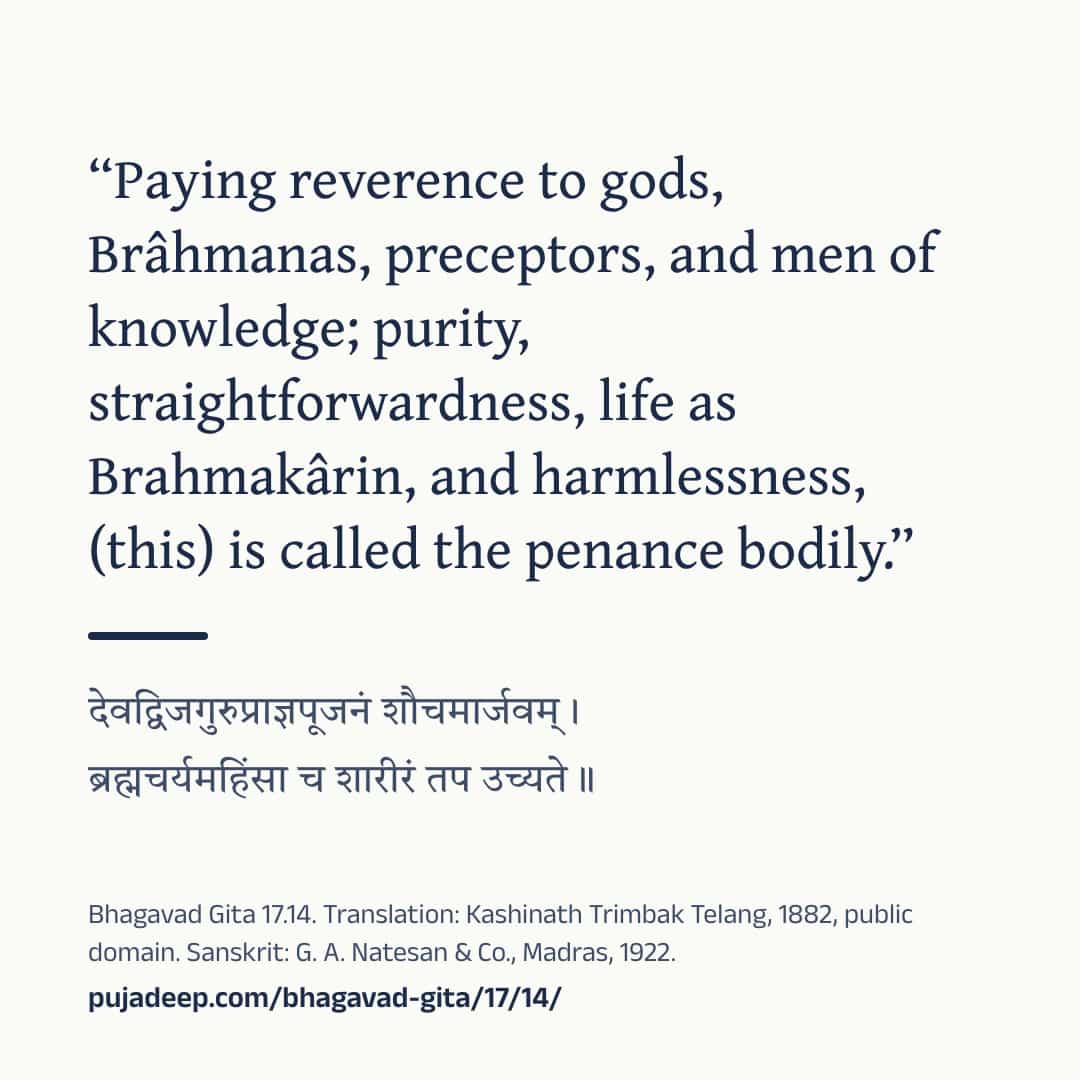
देवद्विजगुरुप्राज्ञपूजनं शौचमार्जवम् ।
ब्रह्मचर्यमहिंसा च शारीरं तप उच्यते ॥

“Paying reverence to gods, Brâhmanas, preceptors, and men of knowledge; purity, straightforwardness, life as Brahmakârin, and harmlessness, (this) is called the penance bodily.”
(K. T. Telang, The Bhagavadgîtâ (The Sacred Books of the East, vol. VIII, Oxford: Clarendon Press, 1882), p. 119, public domain)

“Worship given to the Gods, to the Twice-born, to Gurus and to the wise, purity, straightforwardness, continence and harmlessness, are called the austerity of the body.”
(Annie Besant, The Bhagavad Gîtâ, or The Lord's Song (London: Theosophical Publishing Society, 1895), pp. 148–149, public domain)

“Worship of the Devas, the twice-born, the Gurus and the wise, purity, straightforwardness, continence, and non-injuriousness are called the austerity of the body.”
(Swami Swarupananda, Srimad-Bhagavad-Gita (Mayavati: Prabuddha Bharata Press, 1909; first printed in Prabuddha Bharata, 1907–1909), p. 312, public domain)

Sanskrit: G. A. Natesan & Co., Madras, 1922.
https://pujadeep.com/bhagavad-gita/17/14/ Nothing is sent from this site. Your own app sends it, to the chat you choose. The picture quotes the translation you chose on this page, with its name and year.
Sanskrit text: The Bhagavad-Gita, or The Lord's Song, with the text in Devanagari and an English translation, 1922. Meanings: written for Pujadeep and checked against the cited edition. Source and changes
Questions families ask
Who speaks Bhagavad Gita 17.14?
Krishna speaks this verse, in chapter 17 (Shraddhatraya Vibhaga Yoga).
Where does the Sanskrit text come from?
Sanskrit text: The Bhagavad-Gita, or The Lord's Song, with the text in Devanagari and an English translation, 1922. Meanings: written for Pujadeep and checked against the cited edition. See the source
Is the meaning on this page a translation?
Explanation written for this site from the sources listed here, and checked against the cited edition. It is not a translation and not the only way to read the text. Free to quote with credit.
Source and licence
- Sanskrit text
- The Bhagavad-Gita, or The Lord's Song, with the text in Devanagari and an English translation (Annie Besant, G. A. Natesan & Co., Madras, 1922). Public domain. The Sanskrit on these pages was read from this printing’s page images.
- Translation
- The Bhagavadgîtâ with the Sanatsugâtîya and the Anugîtâ, translated by Kâshinâth Trimbak Telang (The Sacred Books of the East, vol. VIII, ed. F. Max Müller) (Kashinath Trimbak Telang, F. Max Müller, Clarendon Press, Oxford, 1882). Public domain. Shown verbatim, as printed.
- Translation
- The Bhagavad Gîtâ, or The Lord's Song, translated by Annie Besant (Annie Besant, Theosophical Publishing Society, London, 1895). Public domain. Shown verbatim, as printed.
- Translation
- Srimad-Bhagavad-Gita, with Sanskrit Text; Paraphrase with Word-by-word Literal Translation; English Rendering and Comments, Index, &c., by the Swami Swarupananda (Himalayan Series, No. XX) (Swami Swarupananda, The Editors and Publishers, Advaita Ashrama, Mayavati, Prabuddha Bharata Press, Mayavati, Almora, Himalayas, 1909). Public domain. Shown verbatim, as printed.
- Common wording
- In this text, 32 words follow today's common wording, checked against sanskritdocuments.org; Sanskrit Wikisource; Gita Press, Gorakhpur; GRETIL, Göttingen and Bhaktivedanta Book Trust.
- Our explanation
- Explanation written for this site from the sources listed here, and checked against the cited edition. It is not a translation and not the only way to read the text. Free to quote with credit.
- Checked
- Checked against the cited edition, October 15, 2026.
- Updated
- October 25, 2026