Bhagavad Gita 17.24: meaning and translation
Chapter 17: Shraddhatraya Vibhaga Yoga. Krishna says
Therefore, Krishna says, those who expound the Veda (brahma-vādins) always begin their acts of sacrifice, giving and austerity, done as the rules direct, by saying 'Om'.
Click or tap a word for its meaning and its dictionary page.
Text and layers
Text and layers
These choices stay in this browser.
Bhagavad Gita 17.24
तस्मादोमित्युदाहृत्य यज्ञदानतपःक्रियाः ।प्रवर्तन्ते विधानोक्ताः सततं ब्रह्मवादिनाम् ॥
Tasmadomityudahritya yajnadanatapahkriyahPravartante vidhanoktah satatam brahmavadinam
tasmādomityudāhṛtya yajñadānatapaḥkriyāḥ |pravartante vidhānoktāḥ satataṃ brahmavādinām ||
Our explanation Therefore, Krishna says, those who expound the Veda (brahma-vādins) always begin their acts of sacrifice, giving and austerity, done as the rules direct, by saying 'Om'. Telang's note adds that the commentator Nīlakaṇṭha cites Upaniṣad texts in which each of the three words names Brahman.
हिंदी अर्थ कृष्ण कहते हैं कि इसीलिए वेद को कहने वाले (ब्रह्मवादी) विधि के अनुसार किए जाने वाले यज्ञ, दान और तप के कर्म सदा “ओम्” कहकर आरंभ करते हैं। तेलंग की टिप्पणी जोड़ती है कि टीकाकार नीलकंठ उपनिषदों के ऐसे वचन उद्धृत करते हैं जिनमें तीनों शब्द ब्रह्म के नाम हैं।
Word by word
Every word, with its dictionary page
Word by word
- तस्मात् tasmāt · therefore (indeclinable) Dictionary: tasmāt, Monier-Williams 1899, p. 441, col. 2 “from that, on that account, therefore”
- ओम् om · Om (indeclinable) Dictionary: om, Monier-Williams 1899, p. 235, col. 3 “a word of solemn affirmation and respectful assent”
- इति iti · thus (indeclinable) Dictionary: 2. iti, Monier-Williams 1899, p. 165, col. 1 “in this manner, thus”
- उदाहृत्य udāhṛtya · having uttered (absolutive (having done)) Dictionary: ud-ā-hṛ, Monier-Williams 1899, p. 185, col. 3 “to relate, declare, announce”
- यज्ञदानतपःक्रियाः yajñadānatapaḥkriyāḥ · acts of sacrifice, giving and austerity (compound (feminine), nominative plural) Dictionary: yajña, Monier-Williams 1899, p. 839, col. 2 “worship, devotion, prayer, praise; act of worship or devotion, offering, oblation, sacrifice”; 1. dāna, Monier-Williams 1899, p. 474, col. 1 “the act of giving”; tapas, Monier-Williams 1899, p. 437, col. 1 “religious austerity, bodily mortification, penance, severe meditation”; kriyā, Monier-Williams 1899, p. 320, col. 3 “doing, performing, performance”
- प्रवर्तन्ते pravartante · begin (present, 3rd person plural) Dictionary: pra-vṛt, Monier-Williams 1899, p. 693, col. 2 “to commence, begin to (inf.), set about”
- विधानोक्ताः vidhānoktāḥ · as the rules direct (compound (feminine), nominative plural) Dictionary: vi-dhānokta, Monier-Williams 1899, p. 967, col. 3 “proclaimed or enjoined according to rule or (sacred) precept”
- सततम् satatam · always (indeclinable) Dictionary: sa-tata, Monier-Williams 1899, p. 1138, col. 1 “constantly, always, ever”
- ब्रह्मवादिनाम् brahmavādinām · of those who expound the Veda (compound (masculine), genitive plural) Dictionary: brahma-vādin, Monier-Williams 1899, p. 740, col. 1 “a defender or expounder of the Veda”
Old translations
Kashinath Trimbak Telang, 1882. Public domain. Page 120.
Hence, the performance by those who study the Brahman, of sacrifices, gifts, and penances, prescribed by the ordinances (of scripture), always commence after saying 'Om1.'
Footnotes (the translator’s own) - Cf. Âpastamba, p. 21 (p. 49 in this series). Nîlakantha cites texts to show that this and the other two words are used to designate the Brahman. The texts are from the Taittirîya, Aitareya, and Khândogya-upanishads. ↩
Compare 3 translations
Kashinath Trimbak Telang, 1882. Public domain. Page 120.
Hence, the performance by those who study the Brahman, of sacrifices, gifts, and penances, prescribed by the ordinances (of scripture), always commence after saying 'Om1.'
Footnotes (the translator’s own) - Cf. Âpastamba, p. 21 (p. 49 in this series). Nîlakantha cites texts to show that this and the other two words are used to designate the Brahman. The texts are from the Taittirîya, Aitareya, and Khândogya-upanishads. ↩
You are reading this one
Annie Besant, 1895. Public domain. Page 150.
Therefore with the pronunciation of "OM" the acts of sacrifice, gift and austerity are always performed, as laid down in the ordinances by the knowers of Brahman.
You are reading this one
Swami Swarupananda, 1909 (first printed 1907). Public domain. Page 316–317.
Therefore uttering Om, acts of Yajna, gift and austerity of the followers of the Vedas always proceed, as enjoined in the ordinances.
You are reading this one
Cite this verse
The translation: K. T. Telang, The Bhagavadgîtâ (The Sacred Books of the East, vol. VIII, Oxford: Clarendon Press, 1882), p. 120. Bhagavad Gita 17.24.
The translation: Annie Besant, The Bhagavad Gîtâ, or The Lord's Song (London: Theosophical Publishing Society, 1895), p. 150. Bhagavad Gita 17.24.
The translation: Swami Swarupananda, Srimad-Bhagavad-Gita (Mayavati: Prabuddha Bharata Press, 1909; first printed in Prabuddha Bharata, 1907–1909), pp. 316–317. Bhagavad Gita 17.24.
Our explanation: “Bhagavad Gita 17.24: meaning and translation.” Pujadeep. Updated October 25, 2026. https://pujadeep.com/bhagavad-gita/17/24/
Pujadeep’s explanations are free to quote with credit: name Pujadeep and link to the page. How to credit
Classical readings, by school
No readings by school on this verse yet.
Share
Show the ways to share
Send one picture or the text to one chat. The picture names its source and the address of this page.
Drawing the picture
See the words
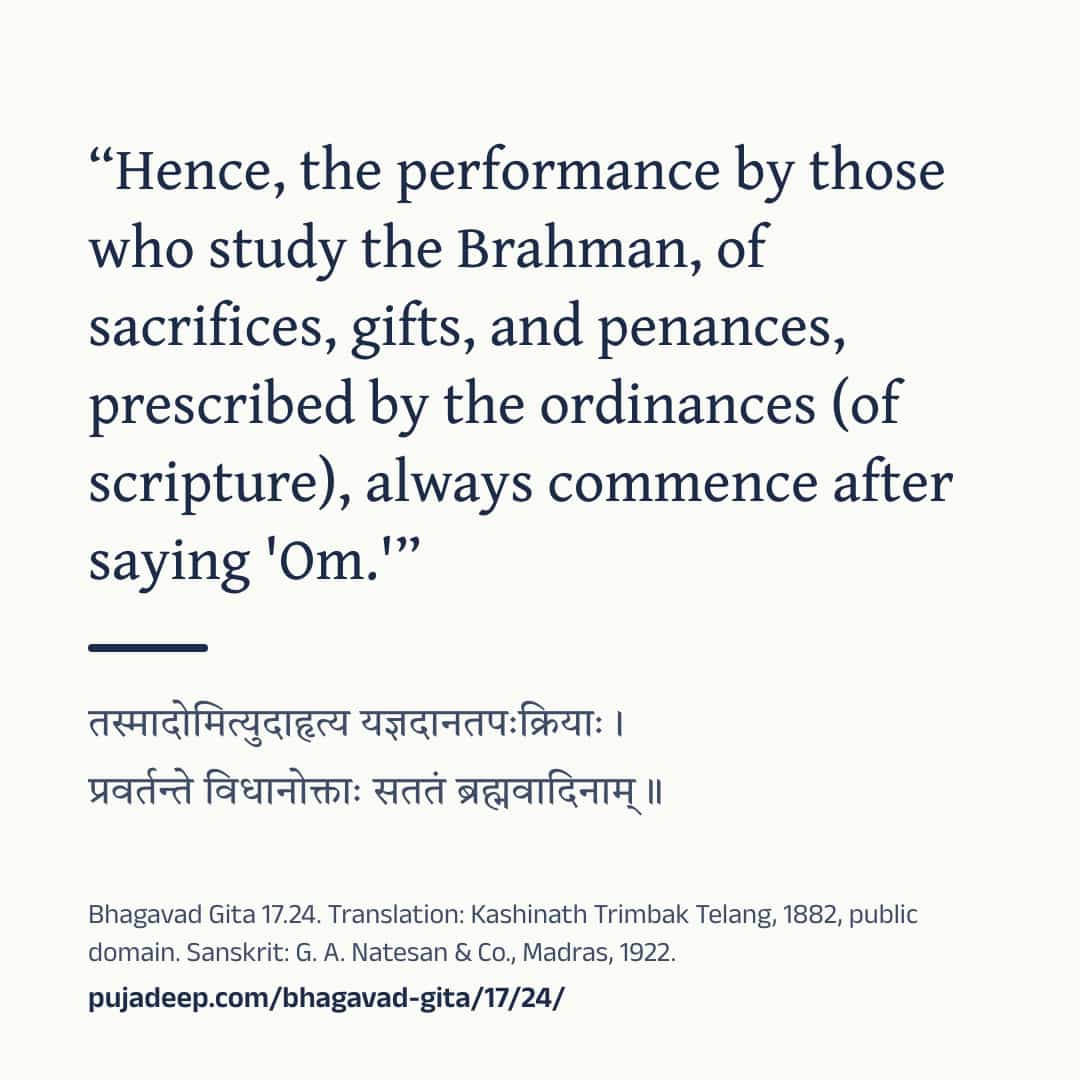
Bhagavad Gita 17.24

तस्मादोमित्युदाहृत्य यज्ञदानतपःक्रियाः ।
प्रवर्तन्ते विधानोक्ताः सततं ब्रह्मवादिनाम् ॥

“Hence, the performance by those who study the Brahman, of sacrifices, gifts, and penances, prescribed by the ordinances (of scripture), always commence after saying 'Om.'”
(K. T. Telang, The Bhagavadgîtâ (The Sacred Books of the East, vol. VIII, Oxford: Clarendon Press, 1882), p. 120, public domain)

“Therefore with the pronunciation of "OM" the acts of sacrifice, gift and austerity are always performed, as laid down in the ordinances by the knowers of Brahman.”
(Annie Besant, The Bhagavad Gîtâ, or The Lord's Song (London: Theosophical Publishing Society, 1895), p. 150, public domain)

“Therefore uttering Om, acts of Yajna, gift and austerity of the followers of the Vedas always proceed, as enjoined in the ordinances.”
(Swami Swarupananda, Srimad-Bhagavad-Gita (Mayavati: Prabuddha Bharata Press, 1909; first printed in Prabuddha Bharata, 1907–1909), pp. 316–317, public domain)

Sanskrit: G. A. Natesan & Co., Madras, 1922.
https://pujadeep.com/bhagavad-gita/17/24/ Nothing is sent from this site. Your own app sends it, to the chat you choose. The picture quotes the translation you chose on this page, with its name and year.
Sanskrit text: The Bhagavad-Gita, or The Lord's Song, with the text in Devanagari and an English translation, 1922. Meanings: written for Pujadeep and checked against the cited edition. Source and changes
Questions families ask
Who speaks Bhagavad Gita 17.24?
Krishna speaks this verse, in chapter 17 (Shraddhatraya Vibhaga Yoga).
Where does the Sanskrit text come from?
Sanskrit text: The Bhagavad-Gita, or The Lord's Song, with the text in Devanagari and an English translation, 1922. Meanings: written for Pujadeep and checked against the cited edition. See the source
Is the meaning on this page a translation?
Explanation written for this site from the sources listed here, and checked against the cited edition. It is not a translation and not the only way to read the text. Free to quote with credit.
Source and licence
- Sanskrit text
- The Bhagavad-Gita, or The Lord's Song, with the text in Devanagari and an English translation (Annie Besant, G. A. Natesan & Co., Madras, 1922). Public domain. The Sanskrit on these pages was read from this printing’s page images.
- Translation
- The Bhagavadgîtâ with the Sanatsugâtîya and the Anugîtâ, translated by Kâshinâth Trimbak Telang (The Sacred Books of the East, vol. VIII, ed. F. Max Müller) (Kashinath Trimbak Telang, F. Max Müller, Clarendon Press, Oxford, 1882). Public domain. Shown verbatim, as printed.
- Translation
- The Bhagavad Gîtâ, or The Lord's Song, translated by Annie Besant (Annie Besant, Theosophical Publishing Society, London, 1895). Public domain. Shown verbatim, as printed.
- Translation
- Srimad-Bhagavad-Gita, with Sanskrit Text; Paraphrase with Word-by-word Literal Translation; English Rendering and Comments, Index, &c., by the Swami Swarupananda (Himalayan Series, No. XX) (Swami Swarupananda, The Editors and Publishers, Advaita Ashrama, Mayavati, Prabuddha Bharata Press, Mayavati, Almora, Himalayas, 1909). Public domain. Shown verbatim, as printed.
- Common wording
- In this text, 32 words follow today's common wording, checked against sanskritdocuments.org; Sanskrit Wikisource; Gita Press, Gorakhpur; GRETIL, Göttingen and Bhaktivedanta Book Trust.
- Our explanation
- Explanation written for this site from the sources listed here, and checked against the cited edition. It is not a translation and not the only way to read the text. Free to quote with credit.
- Checked
- Checked against the cited edition, October 15, 2026.
- Updated
- October 25, 2026