Bhagavad Gita 17.25: meaning and translation
Chapter 17: Shraddhatraya Vibhaga Yoga. Krishna says
With the word 'Tat' ('That'), Krishna says, those who seek liberation (mokṣa) perform their many acts of sacrifice, austerity and giving without aiming at the fruit.
Click or tap a word for its meaning and its dictionary page.
Text and layers
Text and layers
These choices stay in this browser.
Bhagavad Gita 17.25
तदित्यनभिसन्धाय फलं यज्ञतपःक्रियाः ।दानक्रियाश्च विविधाः क्रियन्ते मोक्षकाङ्क्षिभिः ॥
Tadityanabhisandhaya phalam yajnatapahkriyahDanakriyashcha vividhah kriyante mokshakankshibhih
tadityanabhisandhāya phalaṃ yajñatapaḥkriyāḥ |dānakriyāśca vividhāḥ kriyante mokṣakāṅkṣibhiḥ ||
Our explanation With the word 'Tat' ('That'), Krishna says, those who seek liberation (mokṣa) perform their many acts of sacrifice, austerity and giving without aiming at the fruit. The schools explain how 'Tat' goes with these acts (see the views).
हिंदी अर्थ कृष्ण कहते हैं कि मोक्ष चाहने वाले “तत्” (“वह”) कहकर, फल की इच्छा न रखते हुए, यज्ञ, तप और दान के अनेक कर्म करते हैं। “तत्” इन कर्मों से कैसे जुड़ता है, इसे परंपराएँ अलग ढंग से समझाती हैं।
Word by word
Every word, with its dictionary page
Word by word
- तत् tat · Tat ('That') (the pronoun 'that', used as a name) Dictionary: tad, Monier-Williams 1899, p. 434, col. 1 “m. he, f. she, n. it, that, this”
- इति iti · thus (indeclinable) Dictionary: 2. iti, Monier-Williams 1899, p. 165, col. 1 “in this manner, thus”
- अनभिसन्धाय anabhisandhāya · without aiming at (absolutive (having done)) Dictionary: 1. an, Monier-Williams 1899, p. 24, col. 1 “the substitute for 3. a, or a privative”; 1. abhi-saṃ-dhā, Monier-Williams 1899, p. 72, col. 3 “to aim at, have in view”
- फलम् phalam · fruit (noun (neuter), accusative singular) Dictionary: phala, Monier-Williams 1899, p. 716, col. 2 “fruit (met.), consequence, effect, result, retribution (good or bad)”
- यज्ञतपःक्रियाः yajñatapaḥkriyāḥ · acts of sacrifice and austerity (compound (feminine), nominative plural) Dictionary: yajña, Monier-Williams 1899, p. 839, col. 2 “worship, devotion, prayer, praise; act of worship or devotion, offering, oblation, sacrifice”; tapas, Monier-Williams 1899, p. 437, col. 1 “religious austerity, bodily mortification, penance, severe meditation”; kriyā, Monier-Williams 1899, p. 320, col. 3 “doing, performing, performance”
- दानक्रियाः dānakriyāḥ · acts of giving (compound (feminine), nominative plural) Dictionary: 1. dāna, Monier-Williams 1899, p. 474, col. 1 “the act of giving”; kriyā, Monier-Williams 1899, p. 320, col. 3 “doing, performing, performance”
- च ca · and (indeclinable) Dictionary: 2. ca, Monier-Williams 1899, p. 380, col. 1 “and, both, also, moreover, as well as”
- विविधाः vividhāḥ · of many kinds (adjective (feminine), nominative plural) Dictionary: vi-vidha, Monier-Williams 1899, p. 988, col. 1 “of various sorts, manifold, divers”
- क्रियन्ते kriyante · are done (present passive, 3rd person plural) Dictionary: 1. kṛ, Monier-Williams 1899, p. 301, col. 1 “to do, make, perform, accomplish, cause, effect”
- मोक्षकाङ्क्षिभिः mokṣakāṅkṣibhiḥ · by those who seek liberation (compound (masculine), instrumental plural) Dictionary: mokṣa-kāṅkṣin, Monier-Williams 1899, p. 835, col. 1 “desirous of liberation or of final emancipation”
Old translations
Kashinath Trimbak Telang, 1882. Public domain. Page 120.
Those who desire final emancipation perform the various acts of sacrifice and penance, and the various acts of gift, without expectation of fruit, after (saying) 'Tad1.'
Footnotes (the translator’s own) - Nîlakantha says, 'after "Tad"' means considering the act and all are Brahman, and cites p. 61 supra. ↩
Compare 3 translations
Kashinath Trimbak Telang, 1882. Public domain. Page 120.
Those who desire final emancipation perform the various acts of sacrifice and penance, and the various acts of gift, without expectation of fruit, after (saying) 'Tad1.'
Footnotes (the translator’s own) - Nîlakantha says, 'after "Tad"' means considering the act and all are Brahman, and cites p. 61 supra. ↩
You are reading this one
Annie Besant, 1895. Public domain. Page 151.
With the pronunciation of "TAT" are performed the acts of sacrifice, austerity and gift, and without aiming at fruit, by those desiring liberation.
You are reading this one
Swami Swarupananda, 1909 (first printed 1907). Public domain. Page 317.
Uttering Tat, without aiming at fruits, are the various acts of Yajna, austerity and gift, performed by the seekers of Moksha.
You are reading this one
Cite this verse
The translation: K. T. Telang, The Bhagavadgîtâ (The Sacred Books of the East, vol. VIII, Oxford: Clarendon Press, 1882), p. 120. Bhagavad Gita 17.25.
The translation: Annie Besant, The Bhagavad Gîtâ, or The Lord's Song (London: Theosophical Publishing Society, 1895), p. 151. Bhagavad Gita 17.25.
The translation: Swami Swarupananda, Srimad-Bhagavad-Gita (Mayavati: Prabuddha Bharata Press, 1909; first printed in Prabuddha Bharata, 1907–1909), p. 317. Bhagavad Gita 17.25.
Our explanation: “Bhagavad Gita 17.25: meaning and translation.” Pujadeep. Updated October 25, 2026. https://pujadeep.com/bhagavad-gita/17/25/
Pujadeep’s explanations are free to quote with credit: name Pujadeep and link to the page. How to credit
Classical readings, by school
Each reading is named by its school. None is presented as the only meaning.
What Advaita, Vishishtadvaita and Dvaita teach, in short
Shankara Advaita
Shankara says 'with Tat' means with the word Tat spoken aloud, Tat being a name of Brahman; the gifts meant are gifts of land, gold and the like.
Source: The Bhagavad-Gita, with the commentary of Sri Sankaracharya, translated by A. Mahadeva Sastri (2nd ed., Mysore: G. T. A. Printing Works, 1901), commentary on 17.25, p. 393. Summarised in our own words; none of its text is reproduced.
Ramanuja Vishishtadvaita
Ramanuja says the acts of those who seek liberation are themselves called Tat, because they are means to reach Brahman, whom the word Tat denotes.
Source: Sri Bhagavad-Gita with Sri Ramanujacharya's Visishtadvaita commentary, translated by A. Govindacharya (Madras, 1898), commentary on 17.25, pp. 513–514. Summarised in our own words; none of its text is reproduced.
Share
Show the ways to share
Send one picture or the text to one chat. The picture names its source and the address of this page.
Drawing the picture
See the words
Bhagavad Gita 17.25

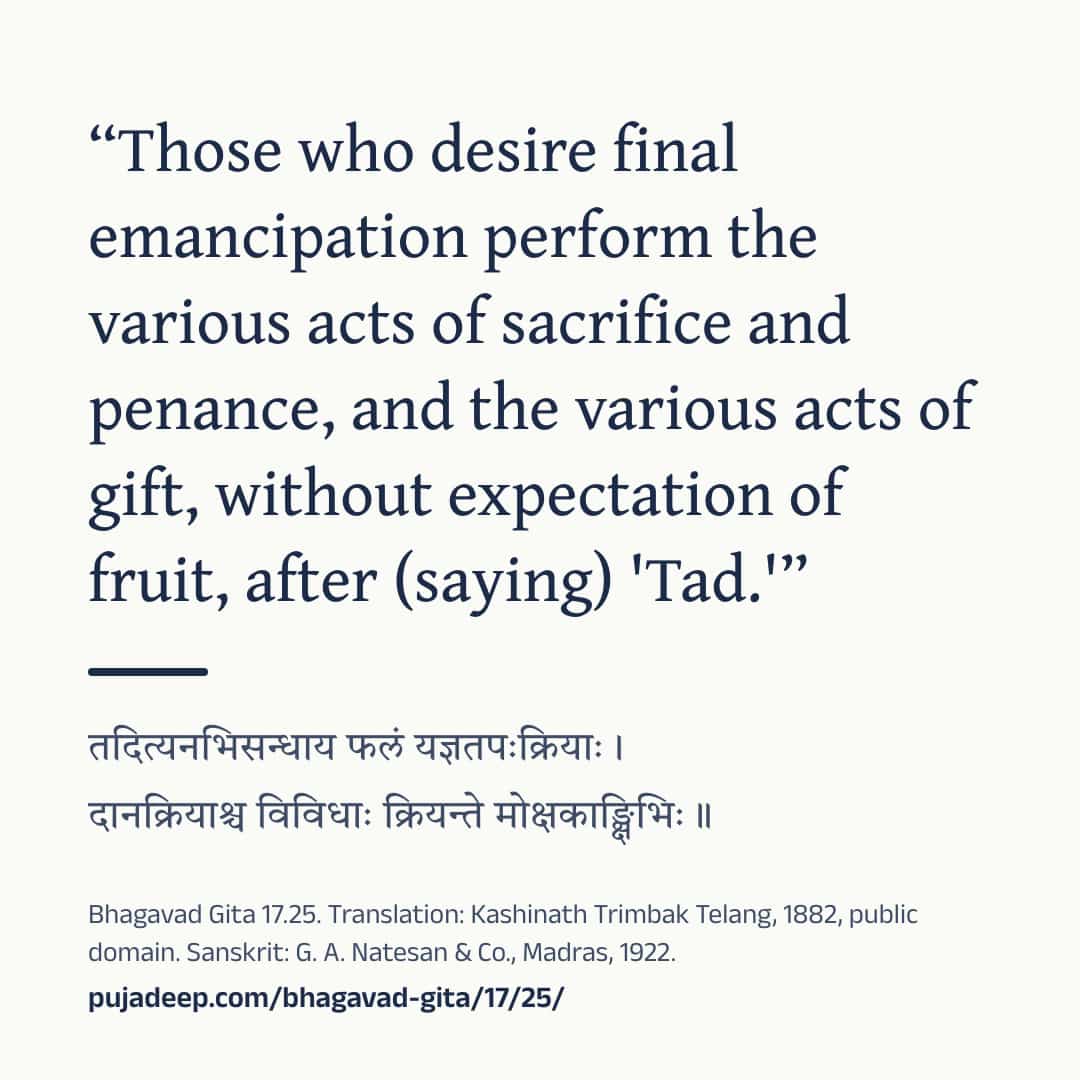
तदित्यनभिसन्धाय फलं यज्ञतपःक्रियाः ।
दानक्रियाश्च विविधाः क्रियन्ते मोक्षकाङ्क्षिभिः ॥

“Those who desire final emancipation perform the various acts of sacrifice and penance, and the various acts of gift, without expectation of fruit, after (saying) 'Tad.'”
(K. T. Telang, The Bhagavadgîtâ (The Sacred Books of the East, vol. VIII, Oxford: Clarendon Press, 1882), p. 120, public domain)

“With the pronunciation of "TAT" are performed the acts of sacrifice, austerity and gift, and without aiming at fruit, by those desiring liberation.”
(Annie Besant, The Bhagavad Gîtâ, or The Lord's Song (London: Theosophical Publishing Society, 1895), p. 151, public domain)

“Uttering Tat, without aiming at fruits, are the various acts of Yajna, austerity and gift, performed by the seekers of Moksha.”
(Swami Swarupananda, Srimad-Bhagavad-Gita (Mayavati: Prabuddha Bharata Press, 1909; first printed in Prabuddha Bharata, 1907–1909), p. 317, public domain)

Sanskrit: G. A. Natesan & Co., Madras, 1922.
https://pujadeep.com/bhagavad-gita/17/25/ Nothing is sent from this site. Your own app sends it, to the chat you choose. The picture quotes the translation you chose on this page, with its name and year.
Sanskrit text: The Bhagavad-Gita, or The Lord's Song, with the text in Devanagari and an English translation, 1922. Meanings: written for Pujadeep and checked against the cited edition. Source and changes
Questions families ask
Who speaks Bhagavad Gita 17.25?
Krishna speaks this verse, in chapter 17 (Shraddhatraya Vibhaga Yoga).
Where does the Sanskrit text come from?
Sanskrit text: The Bhagavad-Gita, or The Lord's Song, with the text in Devanagari and an English translation, 1922. Meanings: written for Pujadeep and checked against the cited edition. See the source
Is the meaning on this page a translation?
Explanation written for this site from the sources listed here, and checked against the cited edition. It is not a translation and not the only way to read the text. Free to quote with credit.
Source and licence
- Sanskrit text
- The Bhagavad-Gita, or The Lord's Song, with the text in Devanagari and an English translation (Annie Besant, G. A. Natesan & Co., Madras, 1922). Public domain. The Sanskrit on these pages was read from this printing’s page images.
- Translation
- The Bhagavadgîtâ with the Sanatsugâtîya and the Anugîtâ, translated by Kâshinâth Trimbak Telang (The Sacred Books of the East, vol. VIII, ed. F. Max Müller) (Kashinath Trimbak Telang, F. Max Müller, Clarendon Press, Oxford, 1882). Public domain. Shown verbatim, as printed.
- Translation
- The Bhagavad Gîtâ, or The Lord's Song, translated by Annie Besant (Annie Besant, Theosophical Publishing Society, London, 1895). Public domain. Shown verbatim, as printed.
- Translation
- Srimad-Bhagavad-Gita, with Sanskrit Text; Paraphrase with Word-by-word Literal Translation; English Rendering and Comments, Index, &c., by the Swami Swarupananda (Himalayan Series, No. XX) (Swami Swarupananda, The Editors and Publishers, Advaita Ashrama, Mayavati, Prabuddha Bharata Press, Mayavati, Almora, Himalayas, 1909). Public domain. Shown verbatim, as printed.
- Commentary
- The Bhagavad-Gita, with the commentary of Sri Sankaracharya, translated by A. Mahadeva Sastri (2nd ed., Mysore: G. T. A. Printing Works, 1901) (Public-domain scan, University of California Libraries). Summarised in our own words; none of its text is reproduced.
- Commentary
- Sri Bhagavad-Gita with Sri Ramanujacharya's Visishtadvaita commentary, translated by A. Govindacharya (Madras, 1898) (Scan uploaded to archive.org (folkscanomy collection)). Summarised in our own words; none of its text is reproduced.
- Common wording
- In this text, 32 words follow today's common wording, checked against sanskritdocuments.org; Sanskrit Wikisource; Gita Press, Gorakhpur; GRETIL, Göttingen and Bhaktivedanta Book Trust.
- Our explanation
- Explanation written for this site from the sources listed here, and checked against the cited edition. It is not a translation and not the only way to read the text. Free to quote with credit.
- Checked
- Checked against the cited edition, October 15, 2026.
- Updated
- October 25, 2026