Bhagavad Gita 17.27: meaning and translation
Chapter 17: Shraddhatraya Vibhaga Yoga. Krishna says
Steadiness (sthiti) in sacrifice, austerity and giving is also called 'Sat', Krishna says, and so is any action done for that purpose (tad-arthīya).
Click or tap a word for its meaning and its dictionary page.
Text and layers
Text and layers
These choices stay in this browser.
Bhagavad Gita 17.27
यज्ञे तपसि दाने च स्थितिः सदिति चोच्यते ।कर्म चैव तदर्थीयं सदित्येवाभिधीयते ॥
Yajne tapasi dane cha sthitih saditi chochyateKarma chaiva tadarthiyam sadityevabhidhiyate
yajñe tapasi dāne ca sthitiḥ saditi cocyate |karma caiva tadarthīyaṃ sadityevābhidhīyate ||
Our explanation Steadiness (sthiti) in sacrifice, austerity and giving is also called 'Sat', Krishna says, and so is any action done for that purpose (tad-arthīya). Telang's note, like Besant's 'these or THAT', gives two readings of 'that': Brahman itself, or sacrifice, austerity and giving (see the views).
हिंदी अर्थ कृष्ण कहते हैं कि यज्ञ, तप और दान में स्थिरता (स्थिति) को भी “सत्” कहा जाता है, और उसी के लिए किए गए कर्म (तदर्थीय) को भी। तेलंग की टिप्पणी, बेसेंट के “these or THAT” की तरह, “उस” के दो अर्थ देती है: स्वयं ब्रह्म, या यज्ञ, तप और दान।
Word by word
Every word, with its dictionary page
Word by word
- यज्ञे yajñe · in sacrifice (noun (masculine), locative singular) Dictionary: yajña, Monier-Williams 1899, p. 839, col. 2 “worship, devotion, prayer, praise; act of worship or devotion, offering, oblation, sacrifice”
- तपसि tapasi · in austerity (noun (neuter), locative singular) Dictionary: tapas, Monier-Williams 1899, p. 437, col. 1 “religious austerity, bodily mortification, penance, severe meditation”
- दाने dāne · in giving (noun (neuter), locative singular) Dictionary: 1. dāna, Monier-Williams 1899, p. 474, col. 1 “the act of giving”
- च ca · and (indeclinable) Dictionary: 2. ca, Monier-Williams 1899, p. 380, col. 1 “and, both, also, moreover, as well as”
- स्थितिः sthitiḥ · steadiness (noun (feminine), nominative singular) Dictionary: sthiti, Monier-Williams 1899, p. 1264, col. 2 “constancy, perseverance”
- सत् sat · Sat (participle 'being', used as a name) Dictionary: sat, Monier-Williams 1899, p. 1134, col. 2 “that which is good or real or true, good, advantage, reality, truth”
- इति iti · thus (indeclinable) Dictionary: 2. iti, Monier-Williams 1899, p. 165, col. 1 “in this manner, thus”
- च ca · and (indeclinable) Dictionary: 2. ca, Monier-Williams 1899, p. 380, col. 1 “and, both, also, moreover, as well as”
- उच्यते ucyate · is called (present passive, 3rd person singular) Dictionary: vac, Monier-Williams 1899, p. 912, col. 1 “to be called or accounted, be regarded as”
- कर्म karma · action (noun (neuter), nominative singular) Dictionary: karman, Monier-Williams 1899, p. 258, col. 2 “act, action, performance, business”
- च ca · and (indeclinable) Dictionary: 2. ca, Monier-Williams 1899, p. 380, col. 1 “and, both, also, moreover, as well as”
- एव eva · also (indeclinable) Dictionary: 1. eva, Monier-Williams 1899, p. 232, col. 2 “just, exactly, very, same, only, even, alone, merely”
- तदर्थीयम् tadarthīyam · done for that purpose (compound (neuter), nominative singular) Dictionary: tad-arthīya, Monier-Williams 1899, p. 434, col. 1 “intended for that, undertaken for that end”
- सत् sat · Sat (participle 'being', used as a name) Dictionary: sat, Monier-Williams 1899, p. 1134, col. 2 “that which is good or real or true, good, advantage, reality, truth”
- इति iti · thus (indeclinable) Dictionary: 2. iti, Monier-Williams 1899, p. 165, col. 1 “in this manner, thus”
- एव eva · just (indeclinable) Dictionary: 1. eva, Monier-Williams 1899, p. 232, col. 2 “just, exactly, very, same, only, even, alone, merely”
- अभिधीयते abhidhīyate · is called (present passive, 3rd person singular) Dictionary: 1. abhi-dhā, Monier-Williams 1899, p. 63, col. 2 “to be named or called”
Old translations
Kashinath Trimbak Telang, 1882. Public domain. Page 120–121.
Constancy in (making) sacrifices, penances, and gifts, is called 'Sat;' and (all) action, too, of which that1 is the object, is also called 'Sat.'
Footnotes (the translator’s own) - I. e. either the Brahman itself, or sacrifice, penance, and gift. ↩
Compare 3 translations
Kashinath Trimbak Telang, 1882. Public domain. Page 120–121.
Constancy in (making) sacrifices, penances, and gifts, is called 'Sat;' and (all) action, too, of which that1 is the object, is also called 'Sat.'
Footnotes (the translator’s own) - I. e. either the Brahman itself, or sacrifice, penance, and gift. ↩
You are reading this one
Annie Besant, 1895. Public domain. Page 151.
Steadfastness in sacrifice, austerity and gift is also called "SAT," and also an action for the sake of these or THAT is even named "SAT."
You are reading this one
Swami Swarupananda, 1909 (first printed 1907). Public domain. Page 100.
Steadiness in Yajna, austerity and gift is also called 'Sat'; as also action in connection with these (or, action for the sake of the Lord) is called Sat.
You are reading this one
Cite this verse
The translation: K. T. Telang, The Bhagavadgîtâ (The Sacred Books of the East, vol. VIII, Oxford: Clarendon Press, 1882), pp. 120–121. Bhagavad Gita 17.27.
The translation: Annie Besant, The Bhagavad Gîtâ, or The Lord's Song (London: Theosophical Publishing Society, 1895), p. 151. Bhagavad Gita 17.27.
The translation: Swami Swarupananda, Srimad-Bhagavad-Gita (Mayavati: Prabuddha Bharata Press, 1909; first printed in Prabuddha Bharata, 1907–1909), p. 100. Bhagavad Gita 17.27.
Our explanation: “Bhagavad Gita 17.27: meaning and translation.” Pujadeep. Updated October 25, 2026. https://pujadeep.com/bhagavad-gita/17/27/
Pujadeep’s explanations are free to quote with credit: name Pujadeep and link to the page. How to credit
Classical readings, by school
Each reading is named by its school. None is presented as the only meaning.
What Advaita, Vishishtadvaita and Dvaita teach, in short
Shankara Advaita
Shankara takes tad-arthīya as action for sacrifice, gift and austerity, or as action for the Lord whose threefold name is the subject here. He holds that such acts, even when imperfect, are made complete by applying this name of Brahman to them with faith.
Source: The Bhagavad-Gita, with the commentary of Sri Sankaracharya, translated by A. Mahadeva Sastri (2nd ed., Mysore: G. T. A. Printing Works, 1901), commentary on 17.27, pp. 394–395. Summarised in our own words; none of its text is reproduced.
Ramanuja Vishishtadvaita
Ramanuja says steadiness in sacrifice, austerity and giving is called Sat because these works are auspicious, and the acts done for them are also called Sat. For him the three words together set Vedic works apart from works outside the Veda.
Source: Sri Bhagavad-Gita with Sri Ramanujacharya's Visishtadvaita commentary, translated by A. Govindacharya (Madras, 1898), commentary on 17.27, pp. 514–515. Summarised in our own words; none of its text is reproduced.
Share
Show the ways to share
Send one picture or the text to one chat. The picture names its source and the address of this page.
Drawing the picture
See the words
Bhagavad Gita 17.27

यज्ञे तपसि दाने च स्थितिः सदिति चोच्यते ।
कर्म चैव तदर्थीयं सदित्येवाभिधीयते ॥

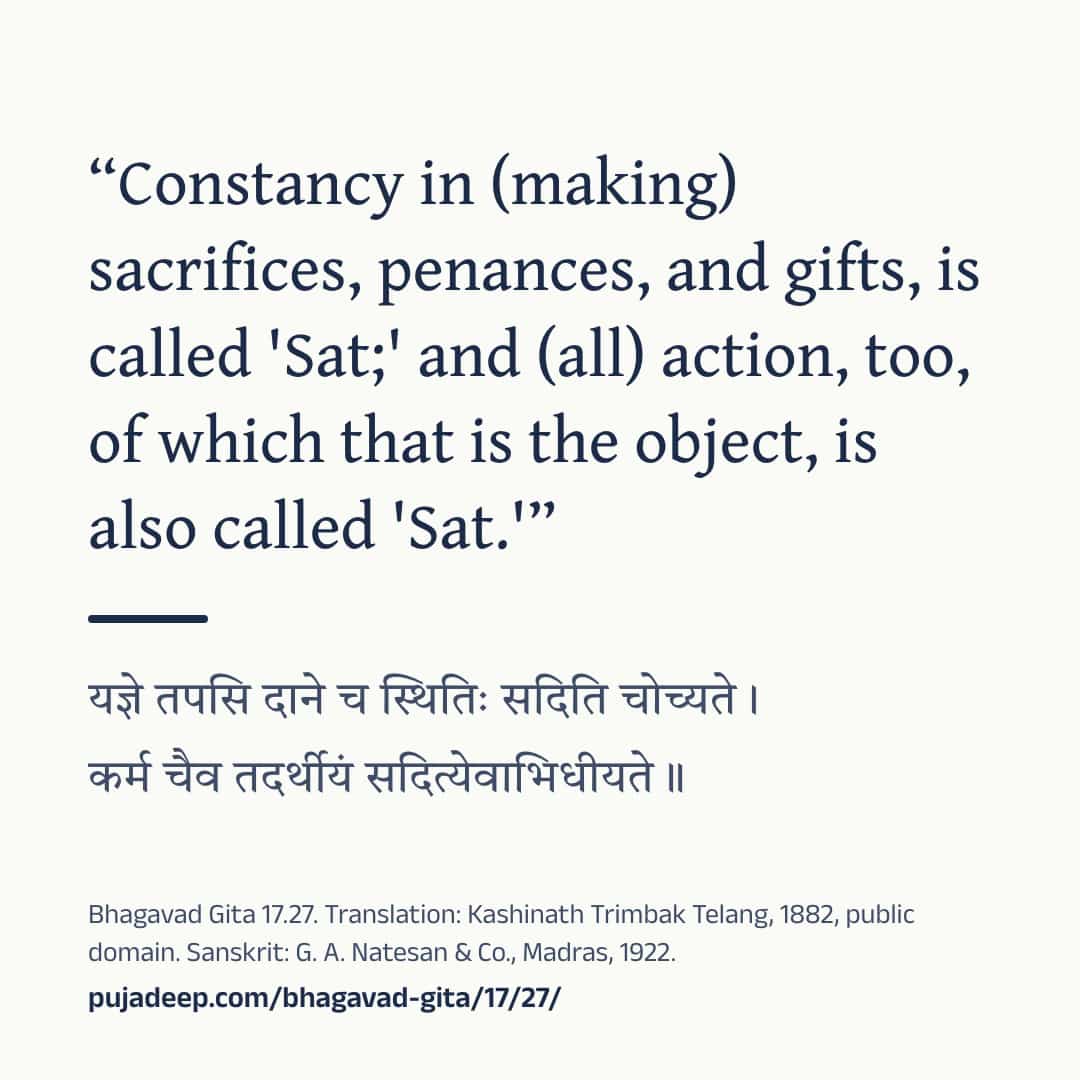
“Constancy in (making) sacrifices, penances, and gifts, is called 'Sat;' and (all) action, too, of which that is the object, is also called 'Sat.'”
(K. T. Telang, The Bhagavadgîtâ (The Sacred Books of the East, vol. VIII, Oxford: Clarendon Press, 1882), pp. 120–121, public domain)

“Steadfastness in sacrifice, austerity and gift is also called "SAT," and also an action for the sake of these or THAT is even named "SAT."”
(Annie Besant, The Bhagavad Gîtâ, or The Lord's Song (London: Theosophical Publishing Society, 1895), p. 151, public domain)

“Steadiness in Yajna, austerity and gift is also called 'Sat'; as also action in connection with these (or, action for the sake of the Lord) is called Sat.”
(Swami Swarupananda, Srimad-Bhagavad-Gita (Mayavati: Prabuddha Bharata Press, 1909; first printed in Prabuddha Bharata, 1907–1909), p. 100, public domain)

Sanskrit: G. A. Natesan & Co., Madras, 1922.
https://pujadeep.com/bhagavad-gita/17/27/ Nothing is sent from this site. Your own app sends it, to the chat you choose. The picture quotes the translation you chose on this page, with its name and year.
Sanskrit text: The Bhagavad-Gita, or The Lord's Song, with the text in Devanagari and an English translation, 1922. Meanings: written for Pujadeep and checked against the cited edition. Source and changes
Questions families ask
Who speaks Bhagavad Gita 17.27?
Krishna speaks this verse, in chapter 17 (Shraddhatraya Vibhaga Yoga).
Where does the Sanskrit text come from?
Sanskrit text: The Bhagavad-Gita, or The Lord's Song, with the text in Devanagari and an English translation, 1922. Meanings: written for Pujadeep and checked against the cited edition. See the source
Is the meaning on this page a translation?
Explanation written for this site from the sources listed here, and checked against the cited edition. It is not a translation and not the only way to read the text. Free to quote with credit.
Source and licence
- Sanskrit text
- The Bhagavad-Gita, or The Lord's Song, with the text in Devanagari and an English translation (Annie Besant, G. A. Natesan & Co., Madras, 1922). Public domain. The Sanskrit on these pages was read from this printing’s page images.
- Translation
- The Bhagavadgîtâ with the Sanatsugâtîya and the Anugîtâ, translated by Kâshinâth Trimbak Telang (The Sacred Books of the East, vol. VIII, ed. F. Max Müller) (Kashinath Trimbak Telang, F. Max Müller, Clarendon Press, Oxford, 1882). Public domain. Shown verbatim, as printed.
- Translation
- The Bhagavad Gîtâ, or The Lord's Song, translated by Annie Besant (Annie Besant, Theosophical Publishing Society, London, 1895). Public domain. Shown verbatim, as printed.
- Translation
- Srimad-Bhagavad-Gita, with Sanskrit Text; Paraphrase with Word-by-word Literal Translation; English Rendering and Comments, Index, &c., by the Swami Swarupananda (Himalayan Series, No. XX) (Swami Swarupananda, The Editors and Publishers, Advaita Ashrama, Mayavati, Prabuddha Bharata Press, Mayavati, Almora, Himalayas, 1909). Public domain. Shown verbatim, as printed.
- Commentary
- The Bhagavad-Gita, with the commentary of Sri Sankaracharya, translated by A. Mahadeva Sastri (2nd ed., Mysore: G. T. A. Printing Works, 1901) (Public-domain scan, University of California Libraries). Summarised in our own words; none of its text is reproduced.
- Commentary
- Sri Bhagavad-Gita with Sri Ramanujacharya's Visishtadvaita commentary, translated by A. Govindacharya (Madras, 1898) (Scan uploaded to archive.org (folkscanomy collection)). Summarised in our own words; none of its text is reproduced.
- Common wording
- In this text, 32 words follow today's common wording, checked against sanskritdocuments.org; Sanskrit Wikisource; Gita Press, Gorakhpur; GRETIL, Göttingen and Bhaktivedanta Book Trust.
- Our explanation
- Explanation written for this site from the sources listed here, and checked against the cited edition. It is not a translation and not the only way to read the text. Free to quote with credit.
- Checked
- Checked against the cited edition, October 15, 2026.
- Updated
- October 25, 2026