Bhagavad Gita 17.18: meaning and translation
Chapter 17: Shraddhatraya Vibhaga Yoga. Krishna says
Austerity done to win respect, honour and worship from others, and for show, Krishna says, is called rājasa; it is unsteady and does not last (cala, adhruva).
Click or tap a word for its meaning and its dictionary page.
Text and layers
Text and layers
These choices stay in this browser.
Bhagavad Gita 17.18
सत्कारमानपूजार्थं तपो दम्भेन चैव यत् ।क्रियते तदिह प्रोक्तं राजसं चलमध्रुवम् ॥
Satkaramanapujartham tapo dambhena chaiva yatKriyate tadiha proktam rajasam chalamadhruvam
satkāramānapūjārthaṃ tapo dambhena caiva yat |kriyate tadiha proktaṃ rājasaṃ calamadhruvam ||
Our explanation Austerity done to win respect, honour and worship from others, and for show, Krishna says, is called rājasa; it is unsteady and does not last (cala, adhruva). Telang's note gives examples of the three: people rising to greet one, people calling one a holy man, people washing one's feet.
हिंदी अर्थ कृष्ण कहते हैं कि जो तप दूसरों से सत्कार, मान और पूजा पाने के लिए, और दिखावे के लिए किया जाता है, वह राजस कहलाता है; वह चंचल है और टिकता नहीं (चल, अध्रुव)। तेलंग की टिप्पणी तीनों के उदाहरण देती है: लोगों का स्वागत में उठ खड़ा होना, किसी को पवित्र व्यक्ति कहना, और उसके पैर धोना।
Word by word
Every word, with its dictionary page
Word by word
- सत्कारमानपूजार्थम् satkāramānapūjārtham · to win respect, honour and worship (compound, accusative used as an adverb (for the sake of)) Dictionary: sat-kāra, Monier-Williams 1899, p. 1134, col. 2 “kind treatment, honour, favour, reverence”; 1. māna, Monier-Williams 1899, p. 809, col. 1 “consideration, regard, respect, honour”; pūjā, Monier-Williams 1899, p. 641, col. 1 “honour, worship, respect, reverence, veneration”; artha, Monier-Williams 1899, p. 90, col. 3 “aim, purpose”
- तपः tapaḥ · austerity (noun (neuter), nominative singular) Dictionary: tapas, Monier-Williams 1899, p. 437, col. 1 “religious austerity, bodily mortification, penance, severe meditation”
- दम्भेन dambhena · for show (noun (masculine), instrumental singular) Dictionary: dambha, Monier-Williams 1899, p. 469, col. 3 “deceit, fraud, feigning, hypocrisy”
- च ca · and (indeclinable) Dictionary: 2. ca, Monier-Williams 1899, p. 380, col. 1 “and, both, also, moreover, as well as”
- एव eva · also (indeclinable) Dictionary: 1. eva, Monier-Williams 1899, p. 232, col. 2 “just, exactly, very, same, only, even, alone, merely”
- यत् yat · which (pronoun (neuter), nominative singular) Dictionary: yad, Monier-Williams 1899, p. 844, col. 2 “who, which, what, whichever, whatever, that”
- क्रियते kriyate · is done (present passive, 3rd person singular) Dictionary: 1. kṛ, Monier-Williams 1899, p. 301, col. 1 “to do, make, perform, accomplish, cause, effect”
- तत् tat · that (pronoun (neuter), nominative singular) Dictionary: tad, Monier-Williams 1899, p. 434, col. 1 “m. he, f. she, n. it, that, this”
- इह iha · here (indeclinable) Dictionary: iha, Monier-Williams 1899, p. 169, col. 3 “in this place, here”
- प्रोक्तम् proktam · is called (past participle (neuter), nominative singular) Dictionary: prokta, Monier-Williams 1899, p. 690, col. 2 “called, declared, said”
- राजसम् rājasam · rājasa (adjective (neuter), nominative singular) Dictionary: rājasa, Monier-Williams 1899, p. 875, col. 2 “belonging or relating to the quality rajas”
- चलम् calam · unsteady (adjective (neuter), nominative singular) Dictionary: cala, Monier-Williams 1899, p. 391, col. 1 “unsteady, fluctuating, perishable”
- अध्रुवम् adhruvam · not lasting (adjective (neuter), nominative singular) Dictionary: a-dhruva, Monier-Williams 1899, p. 23, col. 3 “not fixed, not permanent; uncertain, doubtful”
Old translations
Kashinath Trimbak Telang, 1882. Public domain. Page 119–120.
The penance which is done for respect, honour, and reverence1, and with ostentatiousness, and which is uncertain and transient2, is here called passionate.
Footnotes (the translator’s own) Compare 3 translations
Kashinath Trimbak Telang, 1882. Public domain. Page 119–120.
The penance which is done for respect, honour, and reverence1, and with ostentatiousness, and which is uncertain and transient2, is here called passionate.
Footnotes (the translator’s own) You are reading this one
Annie Besant, 1895. Public domain. Page 149.
The austerity which is practised with the object of gaining respect, honour and reverence, and with hypocrisy, is said to be râjasic, unstable and transitory.
You are reading this one
Swami Swarupananda, 1909 (first printed 1907). Public domain. Page 314.
That austerity which is practised with the object of gaining welcome, honour and worship, and with ostentation, is here said to be Râjasic, unstable and transitory.
You are reading this one
Cite this verse
The translation: K. T. Telang, The Bhagavadgîtâ (The Sacred Books of the East, vol. VIII, Oxford: Clarendon Press, 1882), pp. 119–120. Bhagavad Gita 17.18.
The translation: Annie Besant, The Bhagavad Gîtâ, or The Lord's Song (London: Theosophical Publishing Society, 1895), p. 149. Bhagavad Gita 17.18.
The translation: Swami Swarupananda, Srimad-Bhagavad-Gita (Mayavati: Prabuddha Bharata Press, 1909; first printed in Prabuddha Bharata, 1907–1909), p. 314. Bhagavad Gita 17.18.
Our explanation: “Bhagavad Gita 17.18: meaning and translation.” Pujadeep. Updated October 25, 2026. https://pujadeep.com/bhagavad-gita/17/18/
Pujadeep’s explanations are free to quote with credit: name Pujadeep and link to the page. How to credit
Classical readings, by school
No readings by school on this verse yet.
Share
Show the ways to share
Send one picture or the text to one chat. The picture names its source and the address of this page.
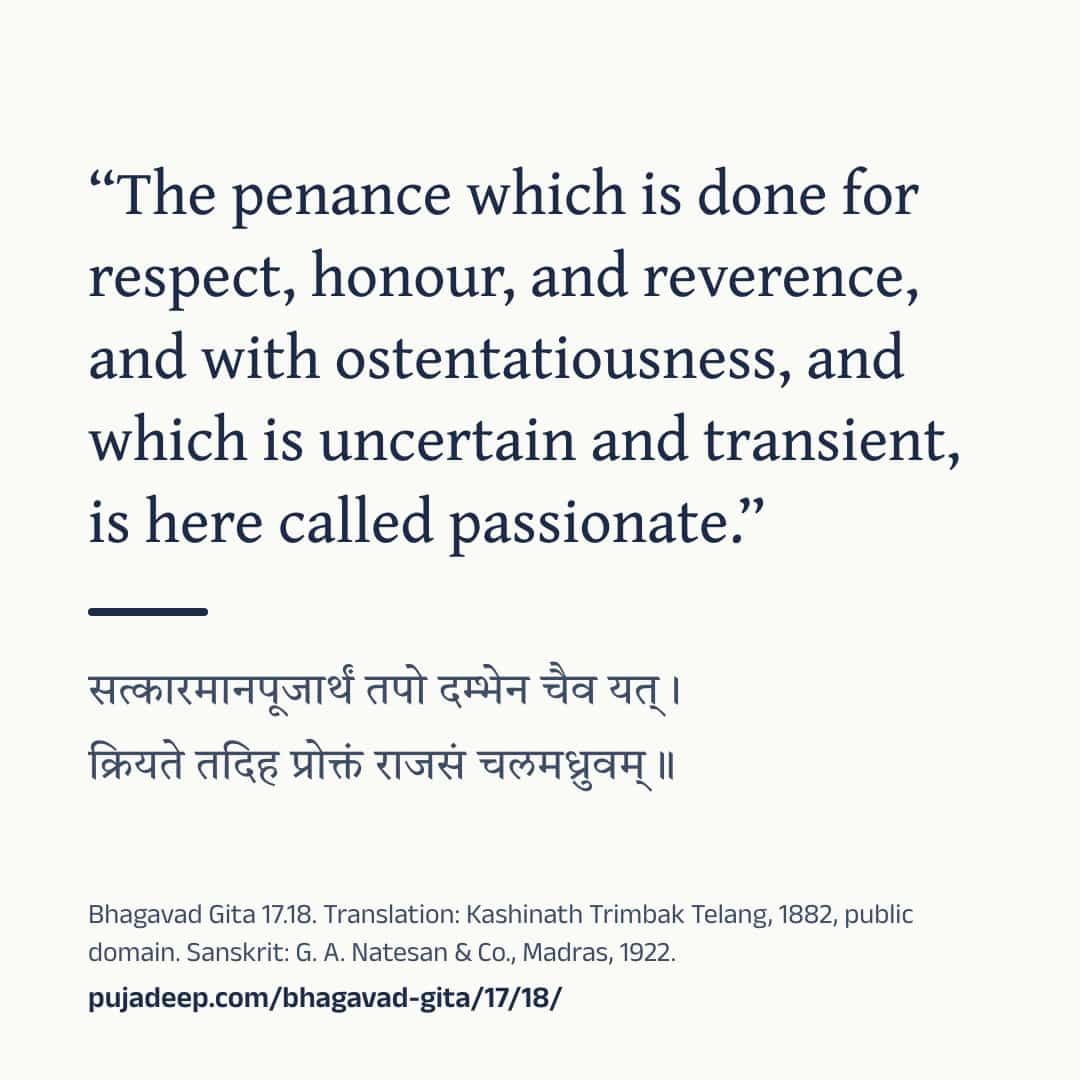
Drawing the picture
See the words
Bhagavad Gita 17.18

सत्कारमानपूजार्थं तपो दम्भेन चैव यत् ।
क्रियते तदिह प्रोक्तं राजसं चलमध्रुवम् ॥

“The penance which is done for respect, honour, and reverence, and with ostentatiousness, and which is uncertain and transient, is here called passionate.”
(K. T. Telang, The Bhagavadgîtâ (The Sacred Books of the East, vol. VIII, Oxford: Clarendon Press, 1882), pp. 119–120, public domain)

“The austerity which is practised with the object of gaining respect, honour and reverence, and with hypocrisy, is said to be râjasic, unstable and transitory.”
(Annie Besant, The Bhagavad Gîtâ, or The Lord's Song (London: Theosophical Publishing Society, 1895), p. 149, public domain)

“That austerity which is practised with the object of gaining welcome, honour and worship, and with ostentation, is here said to be Râjasic, unstable and transitory.”
(Swami Swarupananda, Srimad-Bhagavad-Gita (Mayavati: Prabuddha Bharata Press, 1909; first printed in Prabuddha Bharata, 1907–1909), p. 314, public domain)

Sanskrit: G. A. Natesan & Co., Madras, 1922.
https://pujadeep.com/bhagavad-gita/17/18/ Nothing is sent from this site. Your own app sends it, to the chat you choose. The picture quotes the translation you chose on this page, with its name and year.
Sanskrit text: The Bhagavad-Gita, or The Lord's Song, with the text in Devanagari and an English translation, 1922. Meanings: written for Pujadeep and checked against the cited edition. Source and changes
Questions families ask
Who speaks Bhagavad Gita 17.18?
Krishna speaks this verse, in chapter 17 (Shraddhatraya Vibhaga Yoga).
Where does the Sanskrit text come from?
Sanskrit text: The Bhagavad-Gita, or The Lord's Song, with the text in Devanagari and an English translation, 1922. Meanings: written for Pujadeep and checked against the cited edition. See the source
Is the meaning on this page a translation?
Explanation written for this site from the sources listed here, and checked against the cited edition. It is not a translation and not the only way to read the text. Free to quote with credit.
Source and licence
- Sanskrit text
- The Bhagavad-Gita, or The Lord's Song, with the text in Devanagari and an English translation (Annie Besant, G. A. Natesan & Co., Madras, 1922). Public domain. The Sanskrit on these pages was read from this printing’s page images.
- Translation
- The Bhagavadgîtâ with the Sanatsugâtîya and the Anugîtâ, translated by Kâshinâth Trimbak Telang (The Sacred Books of the East, vol. VIII, ed. F. Max Müller) (Kashinath Trimbak Telang, F. Max Müller, Clarendon Press, Oxford, 1882). Public domain. Shown verbatim, as printed.
- Translation
- The Bhagavad Gîtâ, or The Lord's Song, translated by Annie Besant (Annie Besant, Theosophical Publishing Society, London, 1895). Public domain. Shown verbatim, as printed.
- Translation
- Srimad-Bhagavad-Gita, with Sanskrit Text; Paraphrase with Word-by-word Literal Translation; English Rendering and Comments, Index, &c., by the Swami Swarupananda (Himalayan Series, No. XX) (Swami Swarupananda, The Editors and Publishers, Advaita Ashrama, Mayavati, Prabuddha Bharata Press, Mayavati, Almora, Himalayas, 1909). Public domain. Shown verbatim, as printed.
- Common wording
- In this text, 32 words follow today's common wording, checked against sanskritdocuments.org; Sanskrit Wikisource; Gita Press, Gorakhpur; GRETIL, Göttingen and Bhaktivedanta Book Trust.
- Our explanation
- Explanation written for this site from the sources listed here, and checked against the cited edition. It is not a translation and not the only way to read the text. Free to quote with credit.
- Checked
- Checked against the cited edition, October 15, 2026.
- Updated
- October 25, 2026