Bhagavad Gita 17.13: meaning and translation
Chapter 17: Shraddhatraya Vibhaga Yoga. Krishna says
A sacrifice is called tāmasa, Krishna says, when it ignores the rules (vidhi), gives out no food (asṛṣṭa-anna), has no mantras, gives no fee to the priests (dakṣiṇā), and is empty of faith.
Click or tap a word for its meaning and its dictionary page.
Text and layers
Text and layers
These choices stay in this browser.
Bhagavad Gita 17.13
विधिहीनमसृष्टान्नं मन्त्रहीनमदक्षिणम् ।श्रद्धाविरहितं यज्ञं तामसं परिचक्षते ॥
Vidhihinamasrishtannam mantrahinamadakshinamShraddhavirahitam yajnam tamasam parichakshate
vidhihīnamasṛṣṭānnaṃ mantrahīnamadakṣiṇam |śraddhāvirahitaṃ yajñaṃ tāmasaṃ paricakṣate ||
Our explanation A sacrifice is called tāmasa, Krishna says, when it ignores the rules (vidhi), gives out no food (asṛṣṭa-anna), has no mantras, gives no fee to the priests (dakṣiṇā), and is empty of faith. The commentators explain 'no food given out' and 'without the rules' differently (see the views).
हिंदी अर्थ कृष्ण कहते हैं कि वह यज्ञ तामस कहलाता है जो विधि से रहित हो, जिसमें अन्न न बाँटा जाए (असृष्टान्न), जिसमें मंत्र न हों, जिसमें पुरोहितों को दक्षिणा न दी जाए, और जो श्रद्धा से खाली हो। “असृष्टान्न” और “विधिहीन” को टीकाकार अलग-अलग ढंग से समझाते हैं।
Word by word
Every word, with its dictionary page
Word by word
- विधिहीनम् vidhihīnam · without the rules (compound (masculine), accusative singular) Dictionary: 2. vidhi, Monier-Williams 1899, p. 968, col. 1 “a rule, formula, injunction, ordinance, statute, precept, law, direction”; hīna, Monier-Williams 1899, p. 1296, col. 3 “bereft or deprived of, free from, devoid or destitute of, without”
- असृष्टान्नम् asṛṣṭānnam · in which no food is given out (compound (masculine), accusative singular) Dictionary: a-sṛṣṭānna, Monier-Williams 1899, p. 121, col. 3 “who does not distribute food”
- मन्त्रहीनम् mantrahīnam · without mantras (compound (masculine), accusative singular) Dictionary: mantra, Monier-Williams 1899, p. 786, col. 1 “a sacred formula addressed to any individual deity”; hīna, Monier-Williams 1899, p. 1296, col. 3 “bereft or deprived of, free from, devoid or destitute of, without”
- अदक्षिणम् adakṣiṇam · with no fee to the priests (adjective (masculine), accusative singular) Dictionary: a-dakṣiṇa, Monier-Williams 1899, p. 17, col. 3 “not giving or bringing in a dakshiṇā or present to the priest”
- श्रद्धाविरहितम् śraddhāvirahitam · empty of faith (compound (masculine), accusative singular) Dictionary: śraddhā, Monier-Williams 1899, p. 1095, col. 3 “faith, trust, confidence, trustfulness, faithfulness, belief in”; vi-rahita, Monier-Williams 1899, p. 982, col. 3 “separated or free from, deprived of”
- यज्ञम् yajñam · sacrifice (noun (masculine), accusative singular) Dictionary: yajña, Monier-Williams 1899, p. 839, col. 2 “worship, devotion, prayer, praise; act of worship or devotion, offering, oblation, sacrifice”
- तामसम् tāmasam · tāmasa (adjective (masculine), accusative singular) Dictionary: tāmasa, Monier-Williams 1899, p. 442, col. 3 “appertaining to or affected by the quality tamas”
- परिचक्षते paricakṣate · they call (present, 3rd person plural) Dictionary: pari-cakṣ, Monier-Williams 1899, p. 593, col. 2 “to call, name”
Old translations
Kashinath Trimbak Telang, 1882. Public domain. Page 119.
They call that sacrifice dark, which is against the ordinances (of scripture), in which no food is dealt out (to Brâhmanas, &c.), which is devoid of Mantras1, devoid of Dakshinâ presents, and which is without faith.
Footnotes (the translator’s own) - Texts from the Vedas which ought to be recited on such occasions. Presents (Dakshinâ) to Brâhmanas are insisted on in Brihad-âranyaka-upanishad, p. 661; Âsvalâyana Grihya I, 23, 14. ↩
Compare 3 translations
Kashinath Trimbak Telang, 1882. Public domain. Page 119.
They call that sacrifice dark, which is against the ordinances (of scripture), in which no food is dealt out (to Brâhmanas, &c.), which is devoid of Mantras1, devoid of Dakshinâ presents, and which is without faith.
Footnotes (the translator’s own) - Texts from the Vedas which ought to be recited on such occasions. Presents (Dakshinâ) to Brâhmanas are insisted on in Brihad-âranyaka-upanishad, p. 661; Âsvalâyana Grihya I, 23, 14. ↩
You are reading this one
Annie Besant, 1895. Public domain. Page 148.
The sacrifice contrary to the ordinances, without distributing food, devoid of the Mantras and without gifts,1 empty of faith, is said to be tâmasic.
Footnotes (the translator’s own) - To the officiating priests, ↩
You are reading this one
Swami Swarupananda, 1909 (first printed 1907). Public domain. Page 311–312.
The Yajna performed without heed to ordinance, in which no food is distributed, which is devoid of Mantras, gifts, and Shraddhá, is said to be Tâmasic.
You are reading this one
Cite this verse
The translation: K. T. Telang, The Bhagavadgîtâ (The Sacred Books of the East, vol. VIII, Oxford: Clarendon Press, 1882), p. 119. Bhagavad Gita 17.13.
The translation: Annie Besant, The Bhagavad Gîtâ, or The Lord's Song (London: Theosophical Publishing Society, 1895), p. 148. Bhagavad Gita 17.13.
The translation: Swami Swarupananda, Srimad-Bhagavad-Gita (Mayavati: Prabuddha Bharata Press, 1909; first printed in Prabuddha Bharata, 1907–1909), pp. 311–312. Bhagavad Gita 17.13.
Our explanation: “Bhagavad Gita 17.13: meaning and translation.” Pujadeep. Updated October 25, 2026. https://pujadeep.com/bhagavad-gita/17/13/
Pujadeep’s explanations are free to quote with credit: name Pujadeep and link to the page. How to credit
Classical readings, by school
Each reading is named by its school. None is presented as the only meaning.
What Advaita, Vishishtadvaita and Dvaita teach, in short
Shankara Advaita
Shankara says asṛṣṭa-anna means that no food is given out to brāhmaṇas; 'without mantras' means with hymns faulty in sound and accent; and dakṣiṇā is the fee prescribed for the priests.
Source: The Bhagavad-Gita, with the commentary of Sri Sankaracharya, translated by A. Mahadeva Sastri (2nd ed., Mysore: G. T. A. Printing Works, 1901), commentary on 17.13, p. 389. Summarised in our own words; none of its text is reproduced.
Ramanuja Vishishtadvaita
Ramanuja says vidhi-hīna means without the sanction of brāhmaṇas wise in rule and practice, and asṛṣṭa-anna means that the things used in the sacrifice were not rightly earned, or are things the rules forbid.
Source: Sri Bhagavad-Gita with Sri Ramanujacharya's Visishtadvaita commentary, translated by A. Govindacharya (Madras, 1898), commentary on 17.13, p. 508. Summarised in our own words; none of its text is reproduced.
Share
Show the ways to share
Send one picture or the text to one chat. The picture names its source and the address of this page.
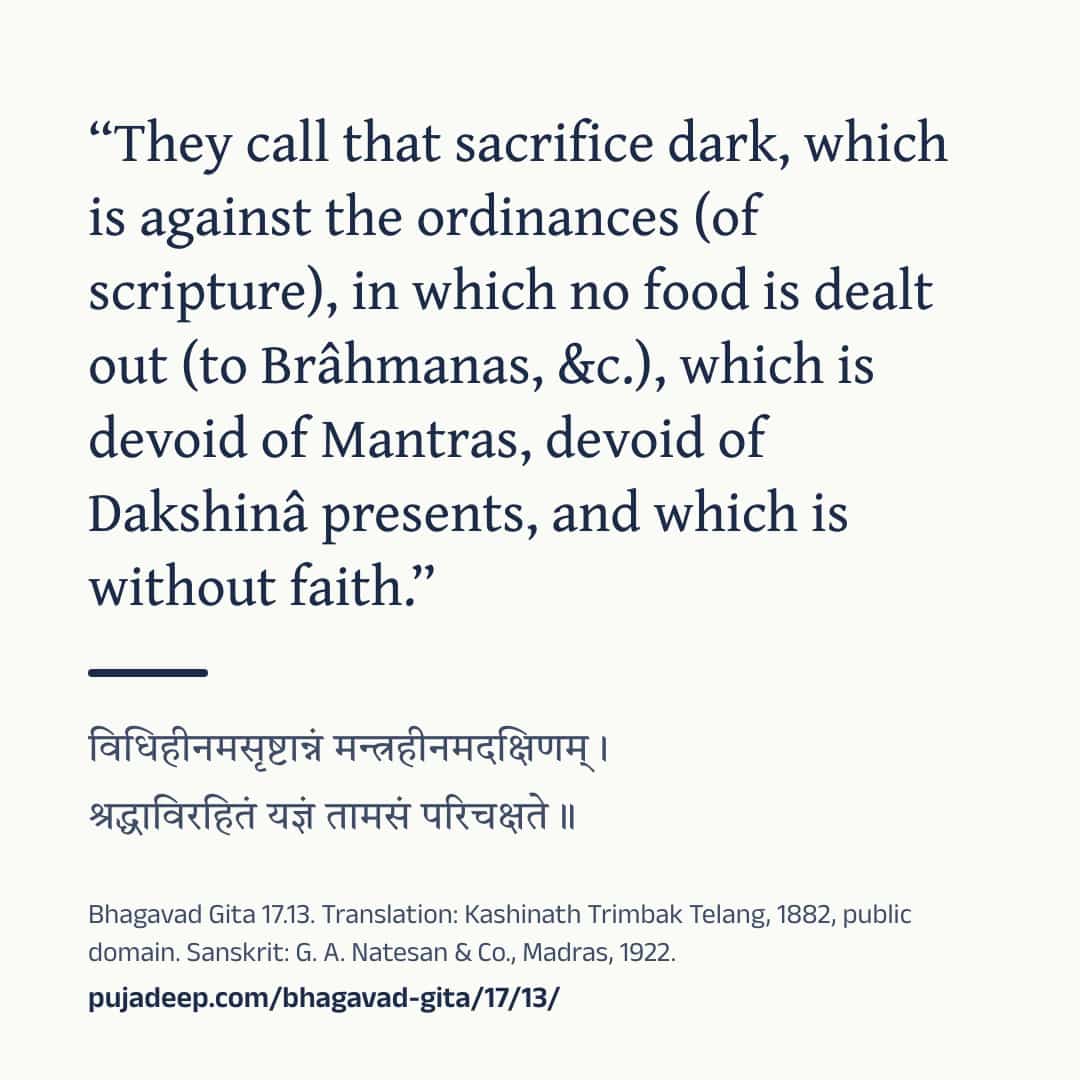
Drawing the picture
See the words
Bhagavad Gita 17.13

विधिहीनमसृष्टान्नं मन्त्रहीनमदक्षिणम् ।
श्रद्धाविरहितं यज्ञं तामसं परिचक्षते ॥

“They call that sacrifice dark, which is against the ordinances (of scripture), in which no food is dealt out (to Brâhmanas, &c.), which is devoid of Mantras, devoid of Dakshinâ presents, and which is without faith.”
(K. T. Telang, The Bhagavadgîtâ (The Sacred Books of the East, vol. VIII, Oxford: Clarendon Press, 1882), p. 119, public domain)

“The sacrifice contrary to the ordinances, without distributing food, devoid of the Mantras and without gifts, empty of faith, is said to be tâmasic.”
(Annie Besant, The Bhagavad Gîtâ, or The Lord's Song (London: Theosophical Publishing Society, 1895), p. 148, public domain)

“The Yajna performed without heed to ordinance, in which no food is distributed, which is devoid of Mantras, gifts, and Shraddhá, is said to be Tâmasic.”
(Swami Swarupananda, Srimad-Bhagavad-Gita (Mayavati: Prabuddha Bharata Press, 1909; first printed in Prabuddha Bharata, 1907–1909), pp. 311–312, public domain)

Sanskrit: G. A. Natesan & Co., Madras, 1922.
https://pujadeep.com/bhagavad-gita/17/13/ Nothing is sent from this site. Your own app sends it, to the chat you choose. The picture quotes the translation you chose on this page, with its name and year.
Sanskrit text: The Bhagavad-Gita, or The Lord's Song, with the text in Devanagari and an English translation, 1922. Meanings: written for Pujadeep and checked against the cited edition. Source and changes
Questions families ask
Who speaks Bhagavad Gita 17.13?
Krishna speaks this verse, in chapter 17 (Shraddhatraya Vibhaga Yoga).
Where does the Sanskrit text come from?
Sanskrit text: The Bhagavad-Gita, or The Lord's Song, with the text in Devanagari and an English translation, 1922. Meanings: written for Pujadeep and checked against the cited edition. See the source
Is the meaning on this page a translation?
Explanation written for this site from the sources listed here, and checked against the cited edition. It is not a translation and not the only way to read the text. Free to quote with credit.
Source and licence
- Sanskrit text
- The Bhagavad-Gita, or The Lord's Song, with the text in Devanagari and an English translation (Annie Besant, G. A. Natesan & Co., Madras, 1922). Public domain. The Sanskrit on these pages was read from this printing’s page images.
- Translation
- The Bhagavadgîtâ with the Sanatsugâtîya and the Anugîtâ, translated by Kâshinâth Trimbak Telang (The Sacred Books of the East, vol. VIII, ed. F. Max Müller) (Kashinath Trimbak Telang, F. Max Müller, Clarendon Press, Oxford, 1882). Public domain. Shown verbatim, as printed.
- Translation
- The Bhagavad Gîtâ, or The Lord's Song, translated by Annie Besant (Annie Besant, Theosophical Publishing Society, London, 1895). Public domain. Shown verbatim, as printed.
- Translation
- Srimad-Bhagavad-Gita, with Sanskrit Text; Paraphrase with Word-by-word Literal Translation; English Rendering and Comments, Index, &c., by the Swami Swarupananda (Himalayan Series, No. XX) (Swami Swarupananda, The Editors and Publishers, Advaita Ashrama, Mayavati, Prabuddha Bharata Press, Mayavati, Almora, Himalayas, 1909). Public domain. Shown verbatim, as printed.
- Commentary
- The Bhagavad-Gita, with the commentary of Sri Sankaracharya, translated by A. Mahadeva Sastri (2nd ed., Mysore: G. T. A. Printing Works, 1901) (Public-domain scan, University of California Libraries). Summarised in our own words; none of its text is reproduced.
- Commentary
- Sri Bhagavad-Gita with Sri Ramanujacharya's Visishtadvaita commentary, translated by A. Govindacharya (Madras, 1898) (Scan uploaded to archive.org (folkscanomy collection)). Summarised in our own words; none of its text is reproduced.
- Common wording
- In this text, 32 words follow today's common wording, checked against sanskritdocuments.org; Sanskrit Wikisource; Gita Press, Gorakhpur; GRETIL, Göttingen and Bhaktivedanta Book Trust.
- Our explanation
- Explanation written for this site from the sources listed here, and checked against the cited edition. It is not a translation and not the only way to read the text. Free to quote with credit.
- Checked
- Checked against the cited edition, October 15, 2026.
- Updated
- October 25, 2026