Bhagavad Gita 17.10: meaning and translation
Chapter 17: Shraddhatraya Vibhaga Yoga. Krishna says
Krishna describes the food that people of tamas like: food that is yāta-yāma (stale, or long past its cooking), gata-rasa (gone flat), pūti (foul-smelling), paryuṣita (kept overnight), ucchiṣṭa (left over from another's meal) and amedhya (impure, unfit for offering).
Click or tap a word for its meaning and its dictionary page.
Text and layers
Text and layers
These choices stay in this browser.
Bhagavad Gita 17.10
यातयामं गतरसं पूति पर्युषितं च यत् ।उच्छिष्टमपि चामेध्यं भोजनं तामसप्रियम् ॥
Yatayamam gatarasam puti paryushitam cha yatUchchhishtamapi chamedhyam bhojanam tamasapriyam
yātayāmaṃ gatarasaṃ pūti paryuṣitaṃ ca yat |ucchiṣṭamapi cāmedhyaṃ bhojanaṃ tāmasapriyam ||
Our explanation Krishna describes the food that people of tamas like: food that is yāta-yāma (stale, or long past its cooking), gata-rasa (gone flat), pūti (foul-smelling), paryuṣita (kept overnight), ucchiṣṭa (left over from another's meal) and amedhya (impure, unfit for offering). The commentators explain yāta-yāma in different ways (see the views). Readings of these verses differ between schools and teachers, and the wording is the text's, not the view of this library.
हिंदी अर्थ कृष्ण बताते हैं कि तामस लोगों को कैसा भोजन प्रिय होता है: यातयाम (बासी, या पकने के बहुत बाद का), गतरस (जिसका रस चला गया हो), पूति (दुर्गंध वाला), पर्युषित (रात भर रखा हुआ), उच्छिष्ट (किसी और के खाने से बचा हुआ) और अमेध्य (अपवित्र, भोग के अयोग्य)। “यातयाम” को टीकाकार अलग-अलग ढंग से समझाते हैं। इन श्लोकों को अलग-अलग परंपराएँ और आचार्य अलग ढंग से पढ़ते हैं, और ये शब्द पाठ के हैं, इस पुस्तकालय का मत नहीं।
Word by word
Every word, with its dictionary page
Word by word
- यातयामम् yātayāmam · stale (compound (neuter), nominative singular) Dictionary: yāta-yāma, Monier-Williams 1899, p. 849, col. 2 “'having completed its course,' used, spoiled, useless, rejected”
- गतरसम् gatarasam · gone flat, tasteless (compound (neuter), nominative singular) Dictionary: gata-rasa, Monier-Williams 1899, p. 347, col. 2 “(anything) which has lost its flavour or sap”
- पूति pūti · foul-smelling (adjective (neuter), nominative singular) Dictionary: 2. pūti, Monier-Williams 1899, p. 641, col. 3 “putrid, foul-smelling, stinking, fetid, ill-smelling”
- पर्युषितम् paryuṣitam · kept overnight (past participle (neuter), nominative singular) Dictionary: pary-uṣita, Monier-Williams 1899, p. 600, col. 3 “having passed the night”
- च ca · and (indeclinable) Dictionary: 2. ca, Monier-Williams 1899, p. 380, col. 1 “and, both, also, moreover, as well as”
- यत् yat · which (pronoun (neuter), nominative singular) Dictionary: yad, Monier-Williams 1899, p. 844, col. 2 “who, which, what, whichever, whatever, that”
- उच्छिष्टम् ucchiṣṭam · left over (past participle (neuter), nominative singular) Dictionary: uc-chiṣṭa, Monier-Williams 1899, p. 173, col. 3 “left, rejected, stale”
- अपि api · also (indeclinable) Dictionary: api, Monier-Williams 1899, p. 55, col. 1 “in the sense of even, also, very”
- च ca · and (indeclinable) Dictionary: 2. ca, Monier-Williams 1899, p. 380, col. 1 “and, both, also, moreover, as well as”
- अमेध्यम् amedhyam · impure (adjective (neuter), nominative singular) Dictionary: a-medhya, Monier-Williams 1899, p. 83, col. 1 “not able or not allowed to sacrifice, not fit for sacrifice, impure, unholy”
- भोजनम् bhojanam · food (noun (neuter), nominative singular) Dictionary: bhojana, Monier-Williams 1899, p. 768, col. 1 “a meal, food”
- तामसप्रियम् tāmasapriyam · liked by people of tamas (compound (neuter), nominative singular) Dictionary: tāmasa, Monier-Williams 1899, p. 442, col. 3 “appertaining to or affected by the quality tamas”; priya, Monier-Williams 1899, p. 710, col. 1 “beloved, dear to (gen., loc., dat. or comp.), liked, favourite”
2 printings differ
Edition differences. Another printing or text reads this place differently.
- The printed edition reads: यातयामं गतरसं पूति पर्युंषितं च यत् ।
उच्छिष्टमपि चामेध्यं भोजनं तामसप्रियम् ॥ The print shows an anusvara over यु (पर्युंषितं); read as a stray sort and not shown, because paryuṣita ('kept overnight') has no nasal and both proofreading references read पर्युषितं. - Word The 1922 Madras printing reads: यातयामं गतरसं पूति पर्युंषितं च यत् The 1922 base printing (leaf n239) shows a stray anusvara over यु (पर्युंषितं), a printing flaw; see normalisations.
Old translations
Kashinath Trimbak Telang, 1882. Public domain. Page 118.
And the food1 which is cold, tasteless, stinking, stale, impure, and even leavings, are liked by the dark.
Footnotes (the translator’s own) - Cf. Sutta Nipâta, p. 109, and Âpastamba, p. 31 (p. 62 in this series). ↩
Compare 3 translations
Kashinath Trimbak Telang, 1882. Public domain. Page 118.
And the food1 which is cold, tasteless, stinking, stale, impure, and even leavings, are liked by the dark.
Footnotes (the translator’s own) - Cf. Sutta Nipâta, p. 109, and Âpastamba, p. 31 (p. 62 in this series). ↩
You are reading this one
Annie Besant, 1895. Public domain. Page 148.
That which is stale and tasteless, putrid and corrupt, leavings also and filth, is the food dear to the Tâmasic.
You are reading this one
Swami Swarupananda, 1909 (first printed 1907). Public domain. Page 310.
That which is stale and become tasteless, which is stinking and cooked over-night, which is refuse and impure, is the food liked by the Támasic.
You are reading this one
Cite this verse
The translation: K. T. Telang, The Bhagavadgîtâ (The Sacred Books of the East, vol. VIII, Oxford: Clarendon Press, 1882), p. 118. Bhagavad Gita 17.10.
The translation: Annie Besant, The Bhagavad Gîtâ, or The Lord's Song (London: Theosophical Publishing Society, 1895), p. 148. Bhagavad Gita 17.10.
The translation: Swami Swarupananda, Srimad-Bhagavad-Gita (Mayavati: Prabuddha Bharata Press, 1909; first printed in Prabuddha Bharata, 1907–1909), p. 310. Bhagavad Gita 17.10.
Our explanation: “Bhagavad Gita 17.10: meaning and translation.” Pujadeep. Updated October 25, 2026. https://pujadeep.com/bhagavad-gita/17/10/
Pujadeep’s explanations are free to quote with credit: name Pujadeep and link to the page. How to credit
Classical readings, by school
Each reading is named by its school. None is presented as the only meaning.
What Advaita, Vishishtadvaita and Dvaita teach, in short
Shankara Advaita
Shankara takes yāta-yāma, literally 'cooked a yāma (three hours) ago', to mean half-cooked, food without strength, so that it does not repeat gata-rasa, the next word. Paryuṣita is cooked food over which a night has passed, ucchiṣṭa is what is left after a meal, and amedhya is food unfit for offering.
Source: The Bhagavad-Gita, with the commentary of Sri Sankaracharya, translated by A. Mahadeva Sastri (2nd ed., Mysore: G. T. A. Printing Works, 1901), commentary on 17.10, p. 388. Summarised in our own words; none of its text is reproduced.
Ramanuja Vishishtadvaita
Ramanuja takes yāta-yāma to mean stale, old by a yāma or kept overnight, and paryuṣita to mean food whose taste has changed by long standing. Ucchiṣṭa is what others have left, except the leavings of teachers and other holy persons, and amedhya is what has not been made fit by offering at a sacrifice. He adds that tāmasa food increases tamas, and that those who care for their own good should take sāttvika food.
Source: Sri Bhagavad-Gita with Sri Ramanujacharya's Visishtadvaita commentary, translated by A. Govindacharya (Madras, 1898), commentary on 17.10, p. 507. Summarised in our own words; none of its text is reproduced.
Share
Show the ways to share
Send one picture or the text to one chat. The picture names its source and the address of this page.
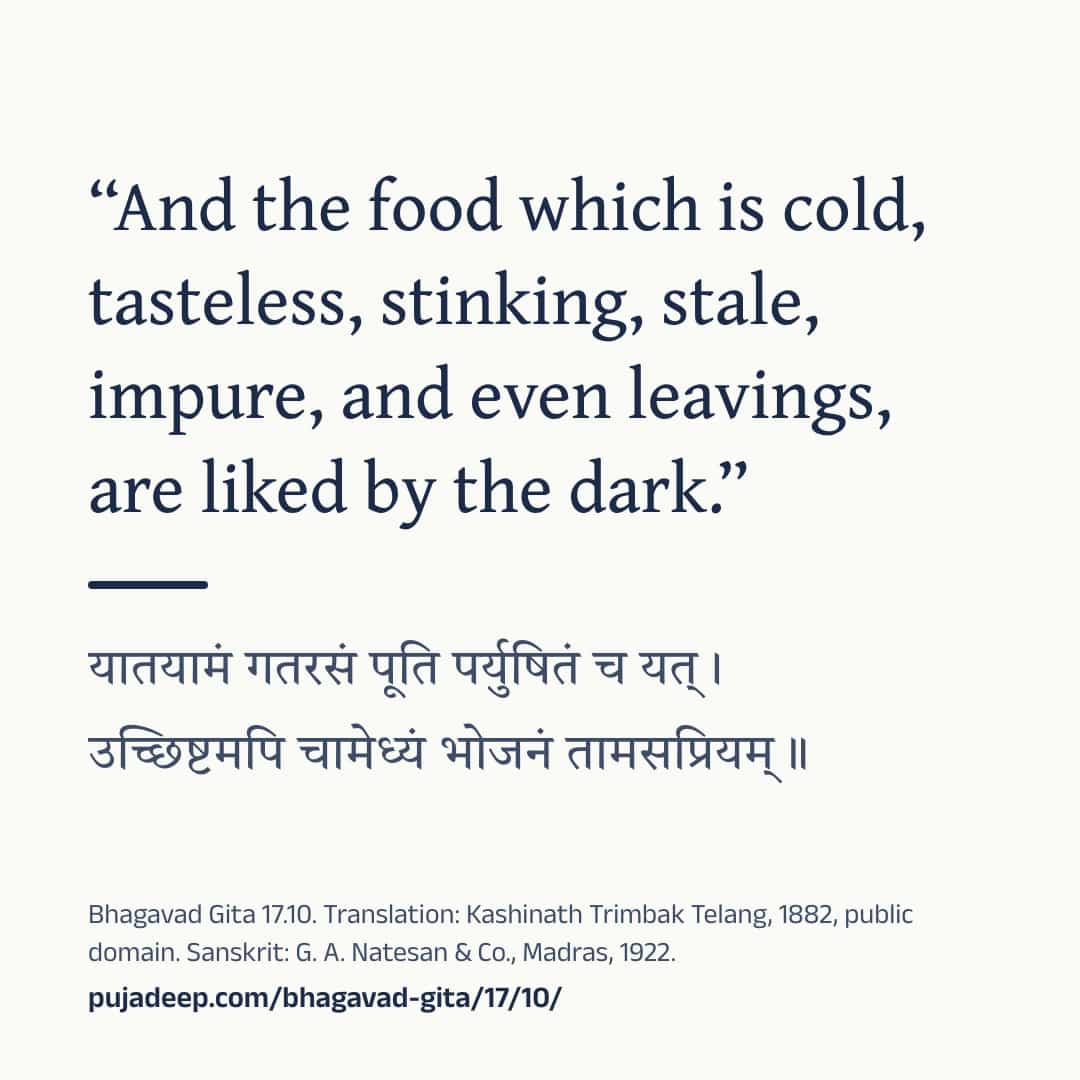
Drawing the picture
See the words
Bhagavad Gita 17.10

यातयामं गतरसं पूति पर्युषितं च यत् ।
उच्छिष्टमपि चामेध्यं भोजनं तामसप्रियम् ॥

“And the food which is cold, tasteless, stinking, stale, impure, and even leavings, are liked by the dark.”
(K. T. Telang, The Bhagavadgîtâ (The Sacred Books of the East, vol. VIII, Oxford: Clarendon Press, 1882), p. 118, public domain)

“That which is stale and tasteless, putrid and corrupt, leavings also and filth, is the food dear to the Tâmasic.”
(Annie Besant, The Bhagavad Gîtâ, or The Lord's Song (London: Theosophical Publishing Society, 1895), p. 148, public domain)

“That which is stale and become tasteless, which is stinking and cooked over-night, which is refuse and impure, is the food liked by the Támasic.”
(Swami Swarupananda, Srimad-Bhagavad-Gita (Mayavati: Prabuddha Bharata Press, 1909; first printed in Prabuddha Bharata, 1907–1909), p. 310, public domain)

Sanskrit: G. A. Natesan & Co., Madras, 1922.
https://pujadeep.com/bhagavad-gita/17/10/ Nothing is sent from this site. Your own app sends it, to the chat you choose. The picture quotes the translation you chose on this page, with its name and year.
Sanskrit text: The Bhagavad-Gita, or The Lord's Song, with the text in Devanagari and an English translation, 1922. Meanings: written for Pujadeep and checked against the cited edition. Source and changes
Questions families ask
Who speaks Bhagavad Gita 17.10?
Krishna speaks this verse, in chapter 17 (Shraddhatraya Vibhaga Yoga).
Where does the Sanskrit text come from?
Sanskrit text: The Bhagavad-Gita, or The Lord's Song, with the text in Devanagari and an English translation, 1922. Meanings: written for Pujadeep and checked against the cited edition. See the source
Is the meaning on this page a translation?
Explanation written for this site from the sources listed here, and checked against the cited edition. It is not a translation and not the only way to read the text. Free to quote with credit.
Source and licence
- Sanskrit text
- The Bhagavad-Gita, or The Lord's Song, with the text in Devanagari and an English translation (Annie Besant, G. A. Natesan & Co., Madras, 1922). Public domain. The Sanskrit on these pages was read from this printing’s page images.
- Translation
- The Bhagavadgîtâ with the Sanatsugâtîya and the Anugîtâ, translated by Kâshinâth Trimbak Telang (The Sacred Books of the East, vol. VIII, ed. F. Max Müller) (Kashinath Trimbak Telang, F. Max Müller, Clarendon Press, Oxford, 1882). Public domain. Shown verbatim, as printed.
- Translation
- The Bhagavad Gîtâ, or The Lord's Song, translated by Annie Besant (Annie Besant, Theosophical Publishing Society, London, 1895). Public domain. Shown verbatim, as printed.
- Translation
- Srimad-Bhagavad-Gita, with Sanskrit Text; Paraphrase with Word-by-word Literal Translation; English Rendering and Comments, Index, &c., by the Swami Swarupananda (Himalayan Series, No. XX) (Swami Swarupananda, The Editors and Publishers, Advaita Ashrama, Mayavati, Prabuddha Bharata Press, Mayavati, Almora, Himalayas, 1909). Public domain. Shown verbatim, as printed.
- Commentary
- The Bhagavad-Gita, with the commentary of Sri Sankaracharya, translated by A. Mahadeva Sastri (2nd ed., Mysore: G. T. A. Printing Works, 1901) (Public-domain scan, University of California Libraries). Summarised in our own words; none of its text is reproduced.
- Commentary
- Sri Bhagavad-Gita with Sri Ramanujacharya's Visishtadvaita commentary, translated by A. Govindacharya (Madras, 1898) (Scan uploaded to archive.org (folkscanomy collection)). Summarised in our own words; none of its text is reproduced.
- Common wording
- In this text, 32 words follow today's common wording, checked against sanskritdocuments.org; Sanskrit Wikisource; Gita Press, Gorakhpur; GRETIL, Göttingen and Bhaktivedanta Book Trust.
- Our explanation
- Explanation written for this site from the sources listed here, and checked against the cited edition. It is not a translation and not the only way to read the text. Free to quote with credit.
- Checked
- Checked against the cited edition, October 15, 2026.
- Updated
- October 25, 2026