Bhagavad Gita 17.3: meaning and translation
Chapter 17: Shraddhatraya Vibhaga Yoga. Krishna says
Krishna says that everyone's faith takes the shape of his sattva, his inner nature, Bharata.
Click or tap a word for its meaning and its dictionary page.
Text and layers
Text and layers
These choices stay in this browser.
Bhagavad Gita 17.3
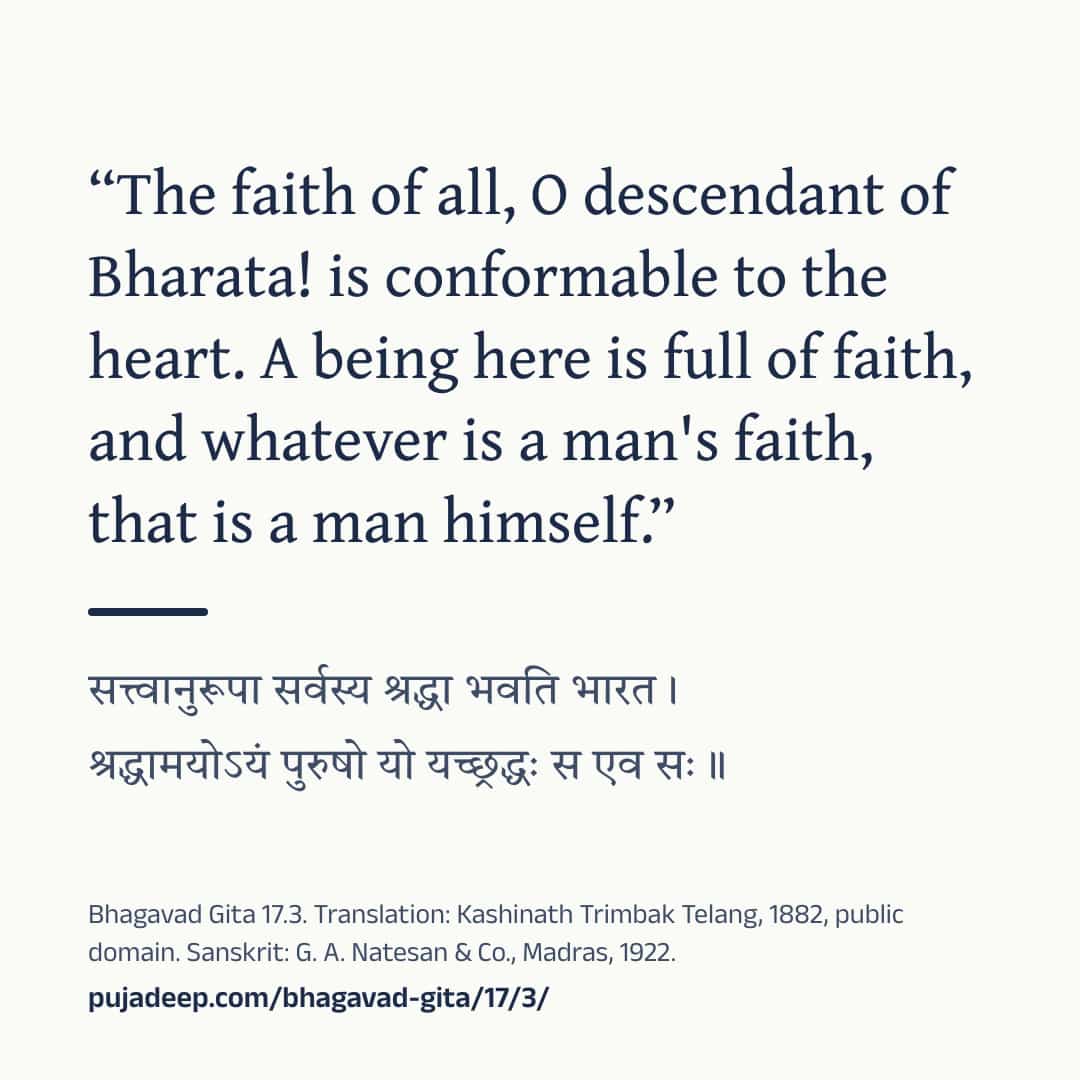
सत्त्वानुरूपा सर्वस्य श्रद्धा भवति भारत ।श्रद्धामयोऽयं पुरुषो यो यच्छ्रद्धः स एव सः ॥
Sattvanurupa sarvasya shraddha bhavati bharataShraddhamayoyam purusho yo yachchhraddhah sa eva sah
sattvānurūpā sarvasya śraddhā bhavati bhārata |śraddhāmayo’yaṃ puruṣo yo yacchraddhaḥ sa eva saḥ ||
Our explanation Krishna says that everyone's faith takes the shape of his sattva, his inner nature, Bharata. A person is made of faith (śraddhā-maya): whatever his faith is, that is what he is. The schools explain the word sattva here (see the views).
हिंदी अर्थ कृष्ण कहते हैं कि हे भारत, हर व्यक्ति की श्रद्धा उसके सत्त्व, यानी उसके भीतर के स्वभाव, के अनुरूप होती है। मनुष्य श्रद्धामय है: जिसकी जैसी श्रद्धा है, वह वैसा ही है। यहाँ “सत्त्व” शब्द को परंपराएँ अलग ढंग से समझाती हैं।
Word by word
Every word, with its dictionary page
Word by word
- सत्त्वानुरूपा sattvānurūpā · in keeping with one's nature (sattva) (compound (feminine), nominative singular) Dictionary: sattvānurūpa, Monier-Williams 1899, p. 1135, col. 3 “according to nature, acc° to one's innate disposition”
- सर्वस्य sarvasya · of everyone (pronoun (masculine), genitive singular) Dictionary: sarva, Monier-Williams 1899, p. 1184, col. 3 “whole, entire, all, every”
- श्रद्धा śraddhā · faith (noun (feminine), nominative singular) Dictionary: śraddhā, Monier-Williams 1899, p. 1095, col. 3 “faith, trust, confidence, trustfulness, faithfulness, belief in”
- भवति bhavati · is (present, 3rd person singular) Dictionary: 1. bhū, Monier-Williams 1899, p. 760, col. 2 “to become, be”
- भारत bhārata · O Bharata (Arjuna) (noun (masculine), vocative singular) Dictionary: bhārata, Monier-Williams 1899, p. 753, col. 1 “a descendant of Bharata”
- श्रद्धामयः śraddhāmayaḥ · made of faith (compound (masculine), nominative singular) Dictionary: śraddhā-maya, Monier-Williams 1899, p. 1095, col. 3 “full of faith, believing”
- अयम् ayam · this (pronoun (masculine), nominative singular) Dictionary: 1. idam, Monier-Williams 1899, p. 165, col. 2 “this, this here, referring to something near the speaker”
- पुरुषः puruṣaḥ · person (noun (masculine), nominative singular) Dictionary: puruṣa, Monier-Williams 1899, p. 637, col. 1 “the personal and animating principle in men and other beings, the soul or spirit”
- यः yaḥ · who (pronoun (masculine), nominative singular) Dictionary: yad, Monier-Williams 1899, p. 844, col. 2 “who, which, what, whichever, whatever, that”
- यच्छ्रद्धः yacchraddhaḥ · whatever his faith (compound (masculine), nominative singular) Dictionary: yad, Monier-Williams 1899, p. 844, col. 2 “who, which, what, whichever, whatever, that”; śraddhā, Monier-Williams 1899, p. 1095, col. 3 “faith, trust, confidence, trustfulness, faithfulness, belief in”
- सः saḥ · he (pronoun (masculine), nominative singular) Dictionary: tad, Monier-Williams 1899, p. 434, col. 1 “m. he, f. she, n. it, that, this”
- एव eva · just (indeclinable) Dictionary: 1. eva, Monier-Williams 1899, p. 232, col. 2 “just, exactly, very, same, only, even, alone, merely”
- सः saḥ · that (pronoun (masculine), nominative singular) Dictionary: tad, Monier-Williams 1899, p. 434, col. 1 “m. he, f. she, n. it, that, this”
Old translations
Kashinath Trimbak Telang, 1882. Public domain. Page 117–118.
The faith of all, O descendant of Bharata! is conformable to the heart1. A being here is full of faith, and whatever is a man's faith, that is a man himself2.
Footnotes (the translator’s own) Compare 3 translations
Kashinath Trimbak Telang, 1882. Public domain. Page 117–118.
The faith of all, O descendant of Bharata! is conformable to the heart1. A being here is full of faith, and whatever is a man's faith, that is a man himself2.
Footnotes (the translator’s own) You are reading this one
Annie Besant, 1895. Public domain. Page 146.
The faith of each is shaped to his own nature, O Bhârata. The man consists of his faith;1 that which his faith is, he is even that.
Footnotes (the translator’s own) - That is, the man's faith shows what is the man's character. ↩
You are reading this one
Swami Swarupananda, 1909 (first printed 1907). Public domain. Page 307.
The Shraddhá of each is according to the constitution of his heart, O descendant of Bharata; the man consists of his Shraddhá. He verily is what his Shraddhâ is.
You are reading this one
Cite this verse
The translation: K. T. Telang, The Bhagavadgîtâ (The Sacred Books of the East, vol. VIII, Oxford: Clarendon Press, 1882), pp. 117–118. Bhagavad Gita 17.3.
The translation: Annie Besant, The Bhagavad Gîtâ, or The Lord's Song (London: Theosophical Publishing Society, 1895), p. 146. Bhagavad Gita 17.3.
The translation: Swami Swarupananda, Srimad-Bhagavad-Gita (Mayavati: Prabuddha Bharata Press, 1909; first printed in Prabuddha Bharata, 1907–1909), p. 307. Bhagavad Gita 17.3.
Our explanation: “Bhagavad Gita 17.3: meaning and translation.” Pujadeep. Updated October 25, 2026. https://pujadeep.com/bhagavad-gita/17/3/
Pujadeep’s explanations are free to quote with credit: name Pujadeep and link to the page. How to credit
Classical readings, by school
Each reading is named by its school. None is presented as the only meaning.
What Advaita, Vishishtadvaita and Dvaita teach, in short
Shankara Advaita
Shankara takes sattva to be the inner sense (antaḥkaraṇa) with its stored tendencies (saṃskāra), and the person to be the jīva in the round of births. A person's kind of faith is known from what it leads to, such as the worship of the gods.
Source: The Bhagavad-Gita, with the commentary of Sri Sankaracharya, translated by A. Mahadeva Sastri (2nd ed., Mysore: G. T. A. Printing Works, 1901), commentary on 17.3, p. 386. Summarised in our own words; none of its text is reproduced.
Ramanuja Vishishtadvaita
Ramanuja takes sattva to be the mind, a word that here also covers the body and the senses. Faith arises for things of the same quality as the mind it is joined with, and each kind of faith leads to a fruit of its own kind.
Source: Sri Bhagavad-Gita with Sri Ramanujacharya's Visishtadvaita commentary, translated by A. Govindacharya (Madras, 1898), commentary on 17.3, p. 503. Summarised in our own words; none of its text is reproduced.
Share
Show the ways to share
Send one picture or the text to one chat. The picture names its source and the address of this page.
Drawing the picture
See the words
Bhagavad Gita 17.3

सत्त्वानुरूपा सर्वस्य श्रद्धा भवति भारत ।
श्रद्धामयोऽयं पुरुषो यो यच्छ्रद्धः स एव सः ॥

“The faith of all, O descendant of Bharata! is conformable to the heart. A being here is full of faith, and whatever is a man's faith, that is a man himself.”
(K. T. Telang, The Bhagavadgîtâ (The Sacred Books of the East, vol. VIII, Oxford: Clarendon Press, 1882), pp. 117–118, public domain)

“The faith of each is shaped to his own nature, O Bhârata. The man consists of his faith; that which his faith is, he is even that.”
(Annie Besant, The Bhagavad Gîtâ, or The Lord's Song (London: Theosophical Publishing Society, 1895), p. 146, public domain)

“The Shraddhá of each is according to the constitution of his heart, O descendant of Bharata; the man consists of his Shraddhá. He verily is what his Shraddhâ is.”
(Swami Swarupananda, Srimad-Bhagavad-Gita (Mayavati: Prabuddha Bharata Press, 1909; first printed in Prabuddha Bharata, 1907–1909), p. 307, public domain)

Sanskrit: G. A. Natesan & Co., Madras, 1922.
https://pujadeep.com/bhagavad-gita/17/3/ Nothing is sent from this site. Your own app sends it, to the chat you choose. The picture quotes the translation you chose on this page, with its name and year.
Sanskrit text: The Bhagavad-Gita, or The Lord's Song, with the text in Devanagari and an English translation, 1922. Meanings: written for Pujadeep and checked against the cited edition. Source and changes
Questions families ask
Who speaks Bhagavad Gita 17.3?
Krishna speaks this verse, in chapter 17 (Shraddhatraya Vibhaga Yoga).
Where does the Sanskrit text come from?
Sanskrit text: The Bhagavad-Gita, or The Lord's Song, with the text in Devanagari and an English translation, 1922. Meanings: written for Pujadeep and checked against the cited edition. See the source
Is the meaning on this page a translation?
Explanation written for this site from the sources listed here, and checked against the cited edition. It is not a translation and not the only way to read the text. Free to quote with credit.
Source and licence
- Sanskrit text
- The Bhagavad-Gita, or The Lord's Song, with the text in Devanagari and an English translation (Annie Besant, G. A. Natesan & Co., Madras, 1922). Public domain. The Sanskrit on these pages was read from this printing’s page images.
- Translation
- The Bhagavadgîtâ with the Sanatsugâtîya and the Anugîtâ, translated by Kâshinâth Trimbak Telang (The Sacred Books of the East, vol. VIII, ed. F. Max Müller) (Kashinath Trimbak Telang, F. Max Müller, Clarendon Press, Oxford, 1882). Public domain. Shown verbatim, as printed.
- Translation
- The Bhagavad Gîtâ, or The Lord's Song, translated by Annie Besant (Annie Besant, Theosophical Publishing Society, London, 1895). Public domain. Shown verbatim, as printed.
- Translation
- Srimad-Bhagavad-Gita, with Sanskrit Text; Paraphrase with Word-by-word Literal Translation; English Rendering and Comments, Index, &c., by the Swami Swarupananda (Himalayan Series, No. XX) (Swami Swarupananda, The Editors and Publishers, Advaita Ashrama, Mayavati, Prabuddha Bharata Press, Mayavati, Almora, Himalayas, 1909). Public domain. Shown verbatim, as printed.
- Commentary
- The Bhagavad-Gita, with the commentary of Sri Sankaracharya, translated by A. Mahadeva Sastri (2nd ed., Mysore: G. T. A. Printing Works, 1901) (Public-domain scan, University of California Libraries). Summarised in our own words; none of its text is reproduced.
- Commentary
- Sri Bhagavad-Gita with Sri Ramanujacharya's Visishtadvaita commentary, translated by A. Govindacharya (Madras, 1898) (Scan uploaded to archive.org (folkscanomy collection)). Summarised in our own words; none of its text is reproduced.
- Common wording
- In this text, 32 words follow today's common wording, checked against sanskritdocuments.org; Sanskrit Wikisource; Gita Press, Gorakhpur; GRETIL, Göttingen and Bhaktivedanta Book Trust.
- Our explanation
- Explanation written for this site from the sources listed here, and checked against the cited edition. It is not a translation and not the only way to read the text. Free to quote with credit.
- Checked
- Checked against the cited edition, October 15, 2026.
- Updated
- October 25, 2026