Bhagavad Gita 17.5: meaning and translation
Chapter 17: Shraddhatraya Vibhaga Yoga. Krishna says
Krishna speaks of people who practise fierce austerities (tapas) that the scriptures do not prescribe, full of hypocrisy (dambha) and egoism, and driven by the force of desire and passion.
Click or tap a word for its meaning and its dictionary page.
Text and layers
Text and layers
These choices stay in this browser.
Bhagavad Gita 17.5
अशास्त्रविहितं घोरं तप्यन्ते ये तपो जनाः ।दम्भाहङ्कारसंयुक्ताः कामरागबलान्विताः ॥
Ashastravihitam ghoram tapyante ye tapo janahDambhahankarasanyuktah kamaragabalanvitah
aśāstravihitaṃ ghoraṃ tapyante ye tapo janāḥ |dambhāhaṅkārasaṃyuktāḥ kāmarāgabalānvitāḥ ||
Our explanation Krishna speaks of people who practise fierce austerities (tapas) that the scriptures do not prescribe, full of hypocrisy (dambha) and egoism, and driven by the force of desire and passion. Telang's note gives standing on heated stones as an example of such austerity. The sentence goes on in verse 6.
हिंदी अर्थ कृष्ण उन लोगों की बात करते हैं जो शास्त्र में न बताए गए घोर तप करते हैं, जो दंभ (दिखावे) और अहंकार से भरे हैं, और काम और राग के बल से चलते हैं। तेलंग की टिप्पणी ऐसे तप का एक उदाहरण देती है, तपे हुए पत्थरों पर खड़े रहना। वाक्य श्लोक 6 में आगे चलता है।
Word by word
Every word, with its dictionary page
Word by word
- अशास्त्रविहितम् aśāstravihitam · not laid down in scripture (compound (neuter), accusative singular) Dictionary: 3. a, Monier-Williams 1899, p. 1, col. 1 “having a negative or privative or contrary sense”; śāstra, Monier-Williams 1899, p. 1069, col. 1 “an order, command, precept, rule”; 2. vi-hita, Monier-Williams 1899, p. 1003, col. 2 “put in order, arranged, determined, fixed, ordained, ordered”
- घोरम् ghoram · fierce (adjective (neuter), accusative singular) Dictionary: ghora, Monier-Williams 1899, p. 379, col. 2 “terrific, frightful, terrible, dreadful, violent, vehement”
- तप्यन्ते tapyante · practise (austerity) (present, middle voice, 3rd person plural) Dictionary: 2. tap, Monier-Williams 1899, p. 436, col. 3 “to torment one's self, undergo self-mortification, practise austerity”
- ये ye · who (pronoun (masculine), nominative plural) Dictionary: yad, Monier-Williams 1899, p. 844, col. 2 “who, which, what, whichever, whatever, that”
- तपः tapaḥ · austerity (noun (neuter), accusative singular) Dictionary: tapas, Monier-Williams 1899, p. 437, col. 1 “religious austerity, bodily mortification, penance, severe meditation”
- जनाः janāḥ · people (noun (masculine), nominative plural) Dictionary: jana, Monier-Williams 1899, p. 410, col. 1 “creature, living being, man, person, race”
- दम्भाहङ्कारसंयुक्ताः dambhāhaṅkārasaṃyuktāḥ · full of hypocrisy and egoism (compound (masculine), nominative plural) Dictionary: dambha, Monier-Williams 1899, p. 469, col. 3 “deceit, fraud, feigning, hypocrisy”; ahaṃ-kāra, Monier-Williams 1899, p. 124, col. 2 “conception of one's individuality, self-consciousness”; saṃ-yukta, Monier-Williams 1899, p. 1112, col. 2 “accompanied or attended by, endowed or furnished with, full of”
- कामरागबलान्विताः kāmarāgabalānvitāḥ · driven by the force of desire and passion (compound (masculine), nominative plural) Dictionary: kāma, Monier-Williams 1899, p. 271, col. 3 “wish, desire, longing”; rāga, Monier-Williams 1899, p. 872, col. 1 “any feeling or passion, (esp.) love, affection or sympathy for”; bala, Monier-Williams 1899, p. 722, col. 3 “power, strength, might, vigour, force”; anv-ita, Monier-Williams 1899, p. 47, col. 2 “endowed with, possessed of”
Old translations
Kashinath Trimbak Telang, 1882. Public domain. Page 118.
Know those to be of demoniac convictions, who practise fierce penance1 not ordained by scripture; who are full of ostentatiousness and egoism, and of desire, attachment, and stubbornness; who are without discernment; and who torment the groups of organs in (their) bodies, and me also seated within (those) bodies.
This sentence covers verses 17.5 to 17.6.
Footnotes (the translator’s own) - Troublesome to oneself and others, as standing on heated stones, &c. 'Egoism' (Ahaṅkâra)=the feeling that one is worthy of honour, Nîlakantha. ↩
Compare 3 translations
Kashinath Trimbak Telang, 1882. Public domain. Page 118.
Know those to be of demoniac convictions, who practise fierce penance1 not ordained by scripture; who are full of ostentatiousness and egoism, and of desire, attachment, and stubbornness; who are without discernment; and who torment the groups of organs in (their) bodies, and me also seated within (those) bodies.
This sentence covers verses 17.5 to 17.6.
Footnotes (the translator’s own) - Troublesome to oneself and others, as standing on heated stones, &c. 'Egoism' (Ahaṅkâra)=the feeling that one is worthy of honour, Nîlakantha. ↩
You are reading this one
Annie Besant, 1895. Public domain. Page 147.
The men who perform severe austerities, unenjoined by the Shâstras, wedded to hypocrisy and egoism, impelled by the force of their desires and passions,
This sentence goes on in 17.6.
You are reading this one
Swami Swarupananda, 1909 (first printed 1907). Public domain. Page 308.
Those men who practise severe austerities not enjoined by the Shàstras, given to ostentation and egoism, possessed with the power of lust and attachment, torturing, senseless as they are, all the organs in the body, and Me dwelling in the body within;—know them to be of Asuric resolves.
This sentence covers verses 17.5 to 17.6.
You are reading this one
Cite this verse
The translation: K. T. Telang, The Bhagavadgîtâ (The Sacred Books of the East, vol. VIII, Oxford: Clarendon Press, 1882), p. 118. Bhagavad Gita 17.5–6.
The translation: Annie Besant, The Bhagavad Gîtâ, or The Lord's Song (London: Theosophical Publishing Society, 1895), p. 147. Bhagavad Gita 17.5.
The translation: Swami Swarupananda, Srimad-Bhagavad-Gita (Mayavati: Prabuddha Bharata Press, 1909; first printed in Prabuddha Bharata, 1907–1909), p. 308. Bhagavad Gita 17.5–6.
Our explanation: “Bhagavad Gita 17.5: meaning and translation.” Pujadeep. Updated October 25, 2026. https://pujadeep.com/bhagavad-gita/17/5/
Pujadeep’s explanations are free to quote with credit: name Pujadeep and link to the page. How to credit
Classical readings, by school
No readings by school on this verse yet.
Share
Show the ways to share
Send one picture or the text to one chat. The picture names its source and the address of this page.
Drawing the picture
See the words
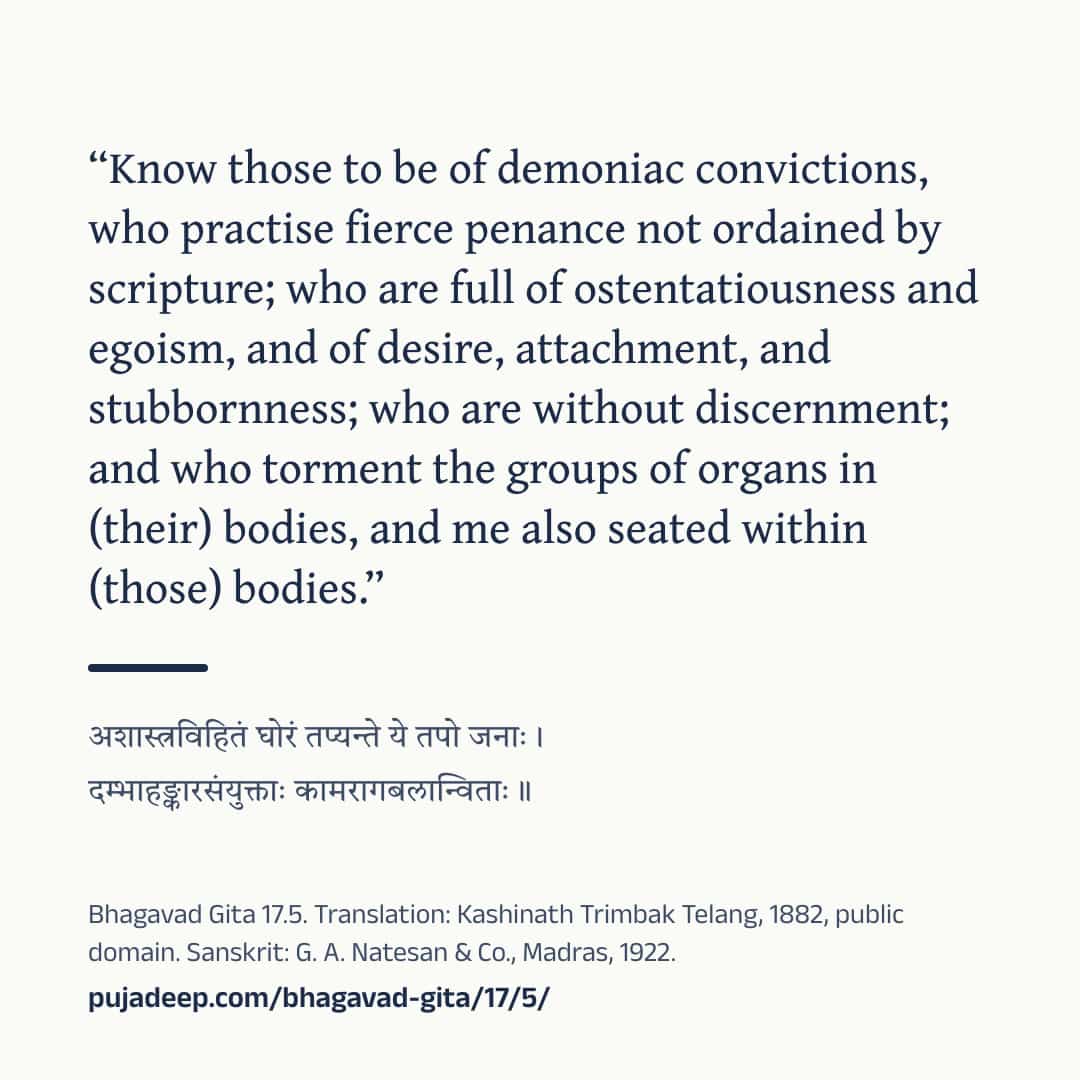
Bhagavad Gita 17.5

अशास्त्रविहितं घोरं तप्यन्ते ये तपो जनाः ।
दम्भाहङ्कारसंयुक्ताः कामरागबलान्विताः ॥

“Know those to be of demoniac convictions, who practise fierce penance not ordained by scripture; who are full of ostentatiousness and egoism, and of desire, attachment, and stubbornness; who are without discernment; and who torment the groups of organs in (their) bodies, and me also seated within (those) bodies.”
(K. T. Telang, The Bhagavadgîtâ (The Sacred Books of the East, vol. VIII, Oxford: Clarendon Press, 1882), p. 118, public domain)
This sentence covers verses 17.5 to 17.6.

“The men who perform severe austerities, unenjoined by the Shâstras, wedded to hypocrisy and egoism, impelled by the force of their desires and passions,”
(Annie Besant, The Bhagavad Gîtâ, or The Lord's Song (London: Theosophical Publishing Society, 1895), p. 147, public domain)
This sentence goes on in 17.6.

“Those men who practise severe austerities not enjoined by the Shàstras, given to ostentation and egoism, possessed with the power of lust and attachment, torturing, senseless as they are, all the organs in the body, and Me dwelling in the body within;—know them to be of Asuric resolves.”
(Swami Swarupananda, Srimad-Bhagavad-Gita (Mayavati: Prabuddha Bharata Press, 1909; first printed in Prabuddha Bharata, 1907–1909), p. 308, public domain)
This sentence covers verses 17.5 to 17.6.

Sanskrit: G. A. Natesan & Co., Madras, 1922.
https://pujadeep.com/bhagavad-gita/17/5/ Nothing is sent from this site. Your own app sends it, to the chat you choose. The picture quotes the translation you chose on this page, with its name and year.
Sanskrit text: The Bhagavad-Gita, or The Lord's Song, with the text in Devanagari and an English translation, 1922. Meanings: written for Pujadeep and checked against the cited edition. Source and changes
Questions families ask
Who speaks Bhagavad Gita 17.5?
Krishna speaks this verse, in chapter 17 (Shraddhatraya Vibhaga Yoga).
Where does the Sanskrit text come from?
Sanskrit text: The Bhagavad-Gita, or The Lord's Song, with the text in Devanagari and an English translation, 1922. Meanings: written for Pujadeep and checked against the cited edition. See the source
Is the meaning on this page a translation?
Explanation written for this site from the sources listed here, and checked against the cited edition. It is not a translation and not the only way to read the text. Free to quote with credit.
Source and licence
- Sanskrit text
- The Bhagavad-Gita, or The Lord's Song, with the text in Devanagari and an English translation (Annie Besant, G. A. Natesan & Co., Madras, 1922). Public domain. The Sanskrit on these pages was read from this printing’s page images.
- Translation
- The Bhagavadgîtâ with the Sanatsugâtîya and the Anugîtâ, translated by Kâshinâth Trimbak Telang (The Sacred Books of the East, vol. VIII, ed. F. Max Müller) (Kashinath Trimbak Telang, F. Max Müller, Clarendon Press, Oxford, 1882). Public domain. Shown verbatim, as printed.
- Translation
- The Bhagavad Gîtâ, or The Lord's Song, translated by Annie Besant (Annie Besant, Theosophical Publishing Society, London, 1895). Public domain. Shown verbatim, as printed.
- Translation
- Srimad-Bhagavad-Gita, with Sanskrit Text; Paraphrase with Word-by-word Literal Translation; English Rendering and Comments, Index, &c., by the Swami Swarupananda (Himalayan Series, No. XX) (Swami Swarupananda, The Editors and Publishers, Advaita Ashrama, Mayavati, Prabuddha Bharata Press, Mayavati, Almora, Himalayas, 1909). Public domain. Shown verbatim, as printed.
- Common wording
- In this text, 32 words follow today's common wording, checked against sanskritdocuments.org; Sanskrit Wikisource; Gita Press, Gorakhpur; GRETIL, Göttingen and Bhaktivedanta Book Trust.
- Our explanation
- Explanation written for this site from the sources listed here, and checked against the cited edition. It is not a translation and not the only way to read the text. Free to quote with credit.
- Checked
- Checked against the cited edition, October 15, 2026.
- Updated
- October 25, 2026