Bhagavad Gita 17.2: meaning and translation
Chapter 17: Shraddhatraya Vibhaga Yoga. Krishna says
Krishna answers.
Click or tap a word for its meaning and its dictionary page.
Text and layers
Text and layers
These choices stay in this browser.
Bhagavad Gita 17.2
श्रीभगवानुवाच ।
त्रिविधा भवति श्रद्धा देहिनां सा स्वभावजा ।सात्त्विकी राजसी चैव तामसी चेति तां शृणु ॥
Trividha bhavati shraddha dehinam sa svabhavajaSattviki rajasi chaiva tamasi cheti tam shrinu
trividhā bhavati śraddhā dehināṃ sā svabhāvajā |sāttvikī rājasī caiva tāmasī ceti tāṃ śṛṇu ||
Our explanation Krishna answers. The faith of embodied beings is of three kinds, he says, and it is born of each one's own nature (svabhāva): sāttvika, rājasa and tāmasa. He asks Arjuna to hear about it. Telang's note explains this nature as the result of actions in a former birth.
हिंदी अर्थ कृष्ण उत्तर देते हैं। वे कहते हैं कि देहधारियों की श्रद्धा तीन प्रकार की होती है, और वह हर एक के अपने स्वभाव से उत्पन्न होती है: सात्त्विकी, राजसी और तामसी। वे अर्जुन से इसे सुनने को कहते हैं। तेलंग की टिप्पणी इस स्वभाव को पिछले जन्म के कर्मों का फल बताती है।
Word by word
Every word, with its dictionary page
Word by word
- त्रिविधा trividhā · of three kinds (adjective (feminine), nominative singular) Dictionary: tri-vidha, Monier-Williams 1899, p. 460, col. 2 “of 3 kinds, triple, threefold”
- भवति bhavati · is (present, 3rd person singular) Dictionary: 1. bhū, Monier-Williams 1899, p. 760, col. 2 “to become, be”
- श्रद्धा śraddhā · faith (noun (feminine), nominative singular) Dictionary: śraddhā, Monier-Williams 1899, p. 1095, col. 3 “faith, trust, confidence, trustfulness, faithfulness, belief in”
- देहिनाम् dehinām · of embodied beings (noun (masculine), genitive plural) Dictionary: dehin, Monier-Williams 1899, p. 497, col. 1 “having a body, corporeal; m. a living creature, man”
- सा sā · that, it (pronoun (feminine), nominative singular) Dictionary: tad, Monier-Williams 1899, p. 434, col. 1 “m. he, f. she, n. it, that, this”
- स्वभावजा svabhāvajā · born of one's own nature (compound (feminine), nominative singular) Dictionary: sva-bhāva, Monier-Williams 1899, p. 1276, col. 1 “own condition or state of being, natural state or constitution, innate or inherent disposition, nature”; 2. ja, Monier-Williams 1899, p. 407, col. 3 “ifc. born or descended from, produced or caused by”
- सात्त्विकी sāttvikī · sāttvika (of sattva) (adjective (feminine), nominative singular) Dictionary: sāttvika, Monier-Williams 1899, p. 1200, col. 1 “relating to or endowed with the quality Sattva (i.e. 'purity' or 'goodness')”
- राजसी rājasī · rājasa (of rajas) (adjective (feminine), nominative singular) Dictionary: rājasa, Monier-Williams 1899, p. 875, col. 2 “belonging or relating to the quality rajas”
- च ca · and (indeclinable) Dictionary: 2. ca, Monier-Williams 1899, p. 380, col. 1 “and, both, also, moreover, as well as”
- एव eva · also (indeclinable) Dictionary: 1. eva, Monier-Williams 1899, p. 232, col. 2 “just, exactly, very, same, only, even, alone, merely”
- तामसी tāmasī · tāmasa (of tamas) (adjective (feminine), nominative singular) Dictionary: tāmasa, Monier-Williams 1899, p. 442, col. 3 “appertaining to or affected by the quality tamas”
- च ca · and (indeclinable) Dictionary: 2. ca, Monier-Williams 1899, p. 380, col. 1 “and, both, also, moreover, as well as”
- इति iti · thus (indeclinable) Dictionary: 2. iti, Monier-Williams 1899, p. 165, col. 1 “in this manner, thus”
- ताम् tām · of it (pronoun (feminine), accusative singular) Dictionary: tad, Monier-Williams 1899, p. 434, col. 1 “m. he, f. she, n. it, that, this”
- शृणु śṛṇu · hear (imperative, 2nd person singular) Dictionary: 1. śru, Monier-Williams 1899, p. 1100, col. 3 “to hear, listen or attend to anything”
Old translations
Kashinath Trimbak Telang, 1882. Public domain. Page 117.
The Deity said:
Faith is of three kinds in embodied (beings), it is produced from dispositions1. It is of the quality of goodness, of the quality of passion, and of the quality of darkness. Hear about it.
Footnotes (the translator’s own) - I. e. the result of the actions in a former birth, cf. p. 56 supra. ↩
Compare 3 translations
Kashinath Trimbak Telang, 1882. Public domain. Page 117.
The Deity said:
Faith is of three kinds in embodied (beings), it is produced from dispositions1. It is of the quality of goodness, of the quality of passion, and of the quality of darkness. Hear about it.
Footnotes (the translator’s own) - I. e. the result of the actions in a former birth, cf. p. 56 supra. ↩
You are reading this one
Annie Besant, 1895. Public domain. Page 146.
The Blessed Lord said:
Threefold is the faith of the Embodied, each born of its own nature—sâttvic, râjasic and tâmasic. Hear thou of each of these.
You are reading this one
Swami Swarupananda, 1909 (first printed 1907). Public domain. Page 307.
The Blessed Lord said:
Threefold is the Shraddhá of the embodied, which is inherent in their nature,—the Sâtvic, the Rájasic and the Támasic. Do thou hear of it.
You are reading this one
Cite this verse
The translation: K. T. Telang, The Bhagavadgîtâ (The Sacred Books of the East, vol. VIII, Oxford: Clarendon Press, 1882), p. 117. Bhagavad Gita 17.2.
The translation: Annie Besant, The Bhagavad Gîtâ, or The Lord's Song (London: Theosophical Publishing Society, 1895), p. 146. Bhagavad Gita 17.2.
The translation: Swami Swarupananda, Srimad-Bhagavad-Gita (Mayavati: Prabuddha Bharata Press, 1909; first printed in Prabuddha Bharata, 1907–1909), p. 307. Bhagavad Gita 17.2.
Our explanation: “Bhagavad Gita 17.2: meaning and translation.” Pujadeep. Updated October 25, 2026. https://pujadeep.com/bhagavad-gita/17/2/
Pujadeep’s explanations are free to quote with credit: name Pujadeep and link to the page. How to credit
Classical readings, by school
No readings by school on this verse yet.
Share
Show the ways to share
Send one picture or the text to one chat. The picture names its source and the address of this page.
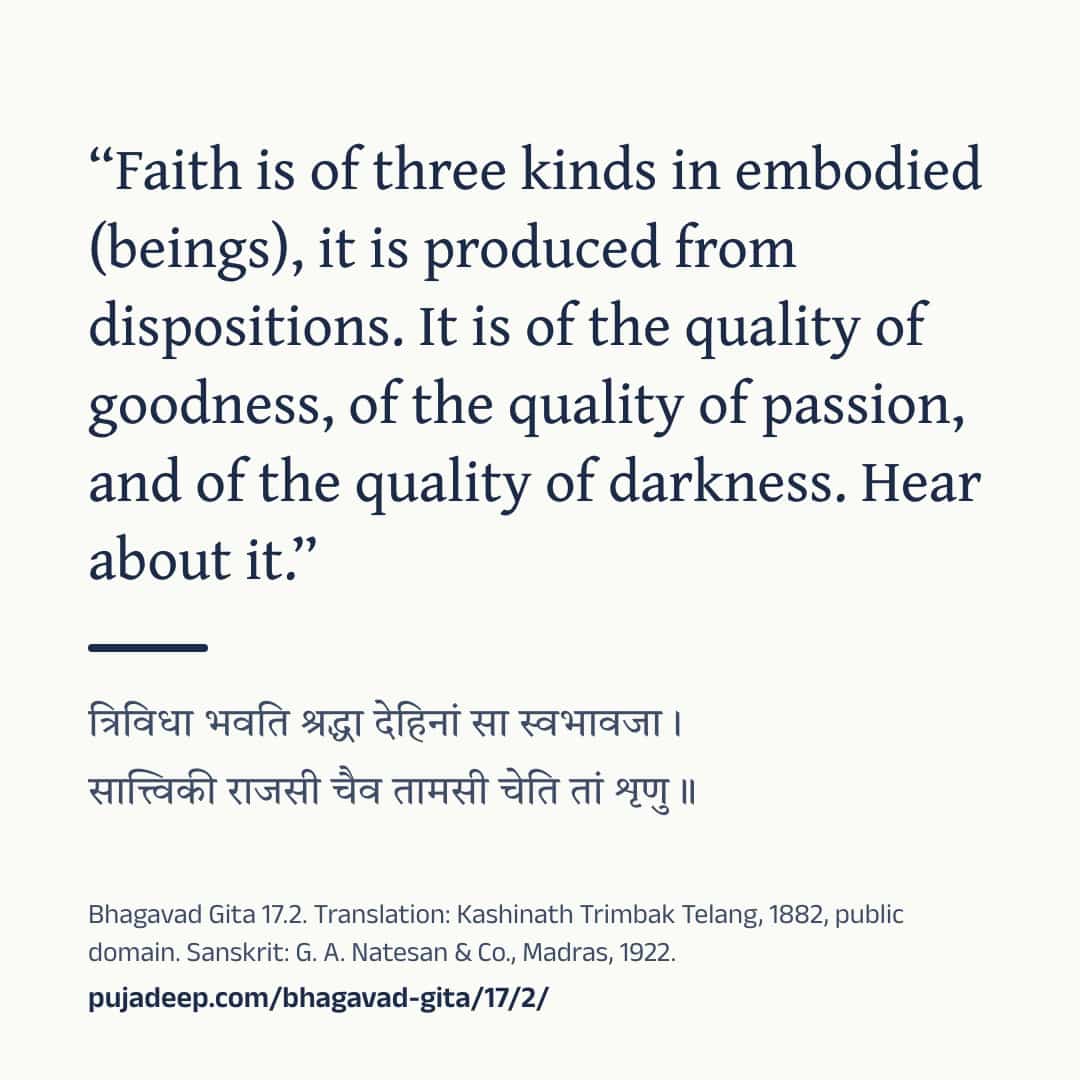
Drawing the picture
See the words
Bhagavad Gita 17.2

त्रिविधा भवति श्रद्धा देहिनां सा स्वभावजा ।
सात्त्विकी राजसी चैव तामसी चेति तां शृणु ॥

“Faith is of three kinds in embodied (beings), it is produced from dispositions. It is of the quality of goodness, of the quality of passion, and of the quality of darkness. Hear about it.”
(K. T. Telang, The Bhagavadgîtâ (The Sacred Books of the East, vol. VIII, Oxford: Clarendon Press, 1882), p. 117, public domain)

“Threefold is the faith of the Embodied, each born of its own nature—sâttvic, râjasic and tâmasic. Hear thou of each of these.”
(Annie Besant, The Bhagavad Gîtâ, or The Lord's Song (London: Theosophical Publishing Society, 1895), p. 146, public domain)

“Threefold is the Shraddhá of the embodied, which is inherent in their nature,—the Sâtvic, the Rájasic and the Támasic. Do thou hear of it.”
(Swami Swarupananda, Srimad-Bhagavad-Gita (Mayavati: Prabuddha Bharata Press, 1909; first printed in Prabuddha Bharata, 1907–1909), p. 307, public domain)

Sanskrit: G. A. Natesan & Co., Madras, 1922.
https://pujadeep.com/bhagavad-gita/17/2/ Nothing is sent from this site. Your own app sends it, to the chat you choose. The picture quotes the translation you chose on this page, with its name and year.
Sanskrit text: The Bhagavad-Gita, or The Lord's Song, with the text in Devanagari and an English translation, 1922. Meanings: written for Pujadeep and checked against the cited edition. Source and changes
Questions families ask
Who speaks Bhagavad Gita 17.2?
Krishna speaks this verse, in chapter 17 (Shraddhatraya Vibhaga Yoga).
Where does the Sanskrit text come from?
Sanskrit text: The Bhagavad-Gita, or The Lord's Song, with the text in Devanagari and an English translation, 1922. Meanings: written for Pujadeep and checked against the cited edition. See the source
Is the meaning on this page a translation?
Explanation written for this site from the sources listed here, and checked against the cited edition. It is not a translation and not the only way to read the text. Free to quote with credit.
Source and licence
- Sanskrit text
- The Bhagavad-Gita, or The Lord's Song, with the text in Devanagari and an English translation (Annie Besant, G. A. Natesan & Co., Madras, 1922). Public domain. The Sanskrit on these pages was read from this printing’s page images.
- Translation
- The Bhagavadgîtâ with the Sanatsugâtîya and the Anugîtâ, translated by Kâshinâth Trimbak Telang (The Sacred Books of the East, vol. VIII, ed. F. Max Müller) (Kashinath Trimbak Telang, F. Max Müller, Clarendon Press, Oxford, 1882). Public domain. Shown verbatim, as printed.
- Translation
- The Bhagavad Gîtâ, or The Lord's Song, translated by Annie Besant (Annie Besant, Theosophical Publishing Society, London, 1895). Public domain. Shown verbatim, as printed.
- Translation
- Srimad-Bhagavad-Gita, with Sanskrit Text; Paraphrase with Word-by-word Literal Translation; English Rendering and Comments, Index, &c., by the Swami Swarupananda (Himalayan Series, No. XX) (Swami Swarupananda, The Editors and Publishers, Advaita Ashrama, Mayavati, Prabuddha Bharata Press, Mayavati, Almora, Himalayas, 1909). Public domain. Shown verbatim, as printed.
- Common wording
- In this text, 32 words follow today's common wording, checked against sanskritdocuments.org; Sanskrit Wikisource; Gita Press, Gorakhpur; GRETIL, Göttingen and Bhaktivedanta Book Trust.
- Our explanation
- Explanation written for this site from the sources listed here, and checked against the cited edition. It is not a translation and not the only way to read the text. Free to quote with credit.
- Checked
- Checked against the cited edition, October 15, 2026.
- Updated
- October 25, 2026