Bhagavad Gita 17.8: meaning and translation
Chapter 17: Shraddhatraya Vibhaga Yoga. Krishna says
Krishna describes the food that people of sattva like: food that, in his words, increases life, energy (sattva), strength, health, happiness and cheer, and that is rasya, snigdha, sthira and hṛdya.
Click or tap a word for its meaning and its dictionary page.
Text and layers
Text and layers
These choices stay in this browser.
Bhagavad Gita 17.8
आयुःसत्त्वबलारोग्यसुखप्रीतिविवर्धनाः ।रस्याः स्निग्धाः स्थिरा हृद्या आहाराः सात्त्विकप्रियाः ॥
AyuhsattvabalarogyasukhapritivivardhanahRasyah snigdhah sthira hridya aharah sattvikapriyah
āyuḥsattvabalārogyasukhaprītivivardhanāḥ |rasyāḥ snigdhāḥ sthirā hṛdyā āhārāḥ sāttvikapriyāḥ ||
Our explanation Krishna describes the food that people of sattva like: food that, in his words, increases life, energy (sattva), strength, health, happiness and cheer, and that is rasya, snigdha, sthira and hṛdya. Telang renders these four words 'savoury, oleaginous, full of nutrition, and agreeable'; Besant 'savoury, oleaginous, solid and agreeable'. Readings of these verses differ between schools and teachers, and the wording is the text's, not the view of this library.
हिंदी अर्थ कृष्ण बताते हैं कि सात्त्विक लोगों को कैसा आहार प्रिय होता है: उनके शब्दों में, ऐसा आहार जो आयु, सत्त्व (ऊर्जा), बल, आरोग्य, सुख और प्रीति को बढ़ाता है, और जो रस्य (रसीला), स्निग्ध (चिकनाई वाला), स्थिर (देर तक टिकने वाला) और हृद्य (मन को भाने वाला) है। तेलंग इन चार शब्दों का अनुवाद 'savoury, oleaginous, full of nutrition, and agreeable' करते हैं, और बेसेंट 'savoury, oleaginous, solid and agreeable'। इन श्लोकों को अलग-अलग परंपराएँ और आचार्य अलग ढंग से पढ़ते हैं, और ये शब्द पाठ के हैं, इस पुस्तकालय का मत नहीं।
Word by word
Every word, with its dictionary page
Word by word
- आयुःसत्त्वबलारोग्यसुखप्रीतिविवर्धनाः āyuḥsattvabalārogyasukhaprītivivardhanāḥ · increasing life, energy, strength, health, happiness, cheer (compound (masculine), nominative plural) Dictionary: āyus, Monier-Williams 1899, p. 149, col. 1 “life, vital power, vigour, health, duration of life, long life”; sat-tva, Monier-Williams 1899, p. 1135, col. 2 “strength, firmness, energy”; bala, Monier-Williams 1899, p. 722, col. 3 “power, strength, might, vigour, force”; ārogya, Monier-Williams 1899, p. 151, col. 2 “freedom from disease, health”; sukha, Monier-Williams 1899, p. 1221, col. 1 “ease, easiness, comfort, prosperity, pleasure, happiness”; prīti, Monier-Williams 1899, p. 711, col. 1 “any pleasurable sensation, pleasure, joy, gladness, satisfaction”; 2. vi-vardhana, Monier-Williams 1899, p. 989, col. 1 “augmenting, increasing, furthering, promoting”
- रस्याः rasyāḥ · savoury (adjective (masculine), nominative plural) Dictionary: rasya, Monier-Williams 1899, p. 871, col. 1 “juicy, tasty, savoury, palatable”
- स्निग्धाः snigdhāḥ · oily, smooth (adjective (masculine), nominative plural) Dictionary: snigdha, Monier-Williams 1899, p. 1267, col. 2 “sticky, viscous or viscid, glutinous, unctuous, slippery, smooth”
- स्थिराः sthirāḥ · lasting, substantial (adjective (masculine), nominative plural) Dictionary: sthira, Monier-Williams 1899, p. 1264, col. 3 “unfluctuating, durable, lasting, permanent”
- हृद्याः hṛdyāḥ · pleasing to the heart (adjective (masculine), nominative plural) Dictionary: hṛdya, Monier-Williams 1899, p. 1303, col. 1 “pleasing or dear to the heart, beloved, cherished”
- आहाराः āhārāḥ · foods (noun (masculine), nominative plural) Dictionary: ā-hāra, Monier-Williams 1899, p. 163, col. 1 “taking food; food”
- सात्त्विकप्रियाः sāttvikapriyāḥ · liked by people of sattva (compound (masculine), nominative plural) Dictionary: sāttvika, Monier-Williams 1899, p. 1200, col. 1 “relating to or endowed with the quality Sattva (i.e. 'purity' or 'goodness')”; priya, Monier-Williams 1899, p. 710, col. 1 “beloved, dear to (gen., loc., dat. or comp.), liked, favourite”
Old translations
Kashinath Trimbak Telang, 1882. Public domain. Page 118.
The kinds of food which increase life, energy, strength, health, comfort, and relish, which are savoury, oleaginous, full of nutrition, and agreeable, are liked by the good.
Compare 3 translations
Kashinath Trimbak Telang, 1882. Public domain. Page 118.
The kinds of food which increase life, energy, strength, health, comfort, and relish, which are savoury, oleaginous, full of nutrition, and agreeable, are liked by the good.
You are reading this one
Annie Besant, 1895. Public domain. Page 147.
The foods that augment vitality, energy, vigour, health, joy and relish, savoury, oleaginous, solid and agreeable, are dear to the Sâttvic.
You are reading this one
Swami Swarupananda, 1909 (first printed 1907). Public domain. Page 309–310.
The foods which augment vitality, energy, strength, health, cheerfulness and appetite, which are savoury and oleaginous, substantial and agreeable, are liked by the Sátvic.
You are reading this one
Cite this verse
The translation: K. T. Telang, The Bhagavadgîtâ (The Sacred Books of the East, vol. VIII, Oxford: Clarendon Press, 1882), p. 118. Bhagavad Gita 17.8.
The translation: Annie Besant, The Bhagavad Gîtâ, or The Lord's Song (London: Theosophical Publishing Society, 1895), p. 147. Bhagavad Gita 17.8.
The translation: Swami Swarupananda, Srimad-Bhagavad-Gita (Mayavati: Prabuddha Bharata Press, 1909; first printed in Prabuddha Bharata, 1907–1909), pp. 309–310. Bhagavad Gita 17.8.
Our explanation: “Bhagavad Gita 17.8: meaning and translation.” Pujadeep. Updated October 25, 2026. https://pujadeep.com/bhagavad-gita/17/8/
Pujadeep’s explanations are free to quote with credit: name Pujadeep and link to the page. How to credit
Classical readings, by school
No readings by school on this verse yet.
Share
Show the ways to share
Send one picture or the text to one chat. The picture names its source and the address of this page.
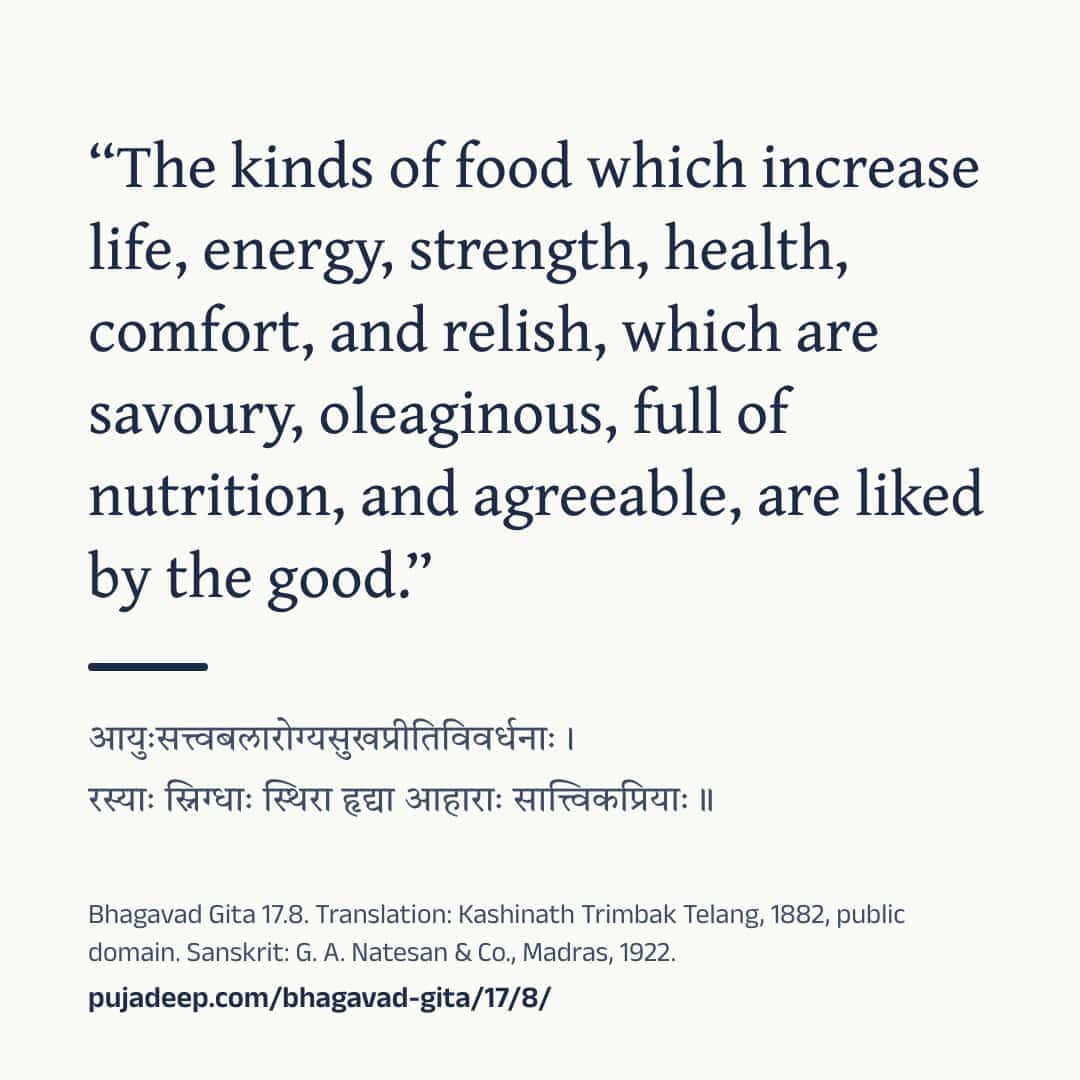
Drawing the picture
See the words
Bhagavad Gita 17.8

आयुःसत्त्वबलारोग्यसुखप्रीतिविवर्धनाः ।
रस्याः स्निग्धाः स्थिरा हृद्या आहाराः सात्त्विकप्रियाः ॥

“The kinds of food which increase life, energy, strength, health, comfort, and relish, which are savoury, oleaginous, full of nutrition, and agreeable, are liked by the good.”
(K. T. Telang, The Bhagavadgîtâ (The Sacred Books of the East, vol. VIII, Oxford: Clarendon Press, 1882), p. 118, public domain)

“The foods that augment vitality, energy, vigour, health, joy and relish, savoury, oleaginous, solid and agreeable, are dear to the Sâttvic.”
(Annie Besant, The Bhagavad Gîtâ, or The Lord's Song (London: Theosophical Publishing Society, 1895), p. 147, public domain)

“The foods which augment vitality, energy, strength, health, cheerfulness and appetite, which are savoury and oleaginous, substantial and agreeable, are liked by the Sátvic.”
(Swami Swarupananda, Srimad-Bhagavad-Gita (Mayavati: Prabuddha Bharata Press, 1909; first printed in Prabuddha Bharata, 1907–1909), pp. 309–310, public domain)

Sanskrit: G. A. Natesan & Co., Madras, 1922.
https://pujadeep.com/bhagavad-gita/17/8/ Nothing is sent from this site. Your own app sends it, to the chat you choose. The picture quotes the translation you chose on this page, with its name and year.
Sanskrit text: The Bhagavad-Gita, or The Lord's Song, with the text in Devanagari and an English translation, 1922. Meanings: written for Pujadeep and checked against the cited edition. Source and changes
Questions families ask
Who speaks Bhagavad Gita 17.8?
Krishna speaks this verse, in chapter 17 (Shraddhatraya Vibhaga Yoga).
Where does the Sanskrit text come from?
Sanskrit text: The Bhagavad-Gita, or The Lord's Song, with the text in Devanagari and an English translation, 1922. Meanings: written for Pujadeep and checked against the cited edition. See the source
Is the meaning on this page a translation?
Explanation written for this site from the sources listed here, and checked against the cited edition. It is not a translation and not the only way to read the text. Free to quote with credit.
Source and licence
- Sanskrit text
- The Bhagavad-Gita, or The Lord's Song, with the text in Devanagari and an English translation (Annie Besant, G. A. Natesan & Co., Madras, 1922). Public domain. The Sanskrit on these pages was read from this printing’s page images.
- Translation
- The Bhagavadgîtâ with the Sanatsugâtîya and the Anugîtâ, translated by Kâshinâth Trimbak Telang (The Sacred Books of the East, vol. VIII, ed. F. Max Müller) (Kashinath Trimbak Telang, F. Max Müller, Clarendon Press, Oxford, 1882). Public domain. Shown verbatim, as printed.
- Translation
- The Bhagavad Gîtâ, or The Lord's Song, translated by Annie Besant (Annie Besant, Theosophical Publishing Society, London, 1895). Public domain. Shown verbatim, as printed.
- Translation
- Srimad-Bhagavad-Gita, with Sanskrit Text; Paraphrase with Word-by-word Literal Translation; English Rendering and Comments, Index, &c., by the Swami Swarupananda (Himalayan Series, No. XX) (Swami Swarupananda, The Editors and Publishers, Advaita Ashrama, Mayavati, Prabuddha Bharata Press, Mayavati, Almora, Himalayas, 1909). Public domain. Shown verbatim, as printed.
- Common wording
- In this text, 32 words follow today's common wording, checked against sanskritdocuments.org; Sanskrit Wikisource; Gita Press, Gorakhpur; GRETIL, Göttingen and Bhaktivedanta Book Trust.
- Our explanation
- Explanation written for this site from the sources listed here, and checked against the cited edition. It is not a translation and not the only way to read the text. Free to quote with credit.
- Checked
- Checked against the cited edition, October 15, 2026.
- Updated
- October 25, 2026