Bhagavad Gita 17.20: meaning and translation
Chapter 17: Shraddhatraya Vibhaga Yoga. Krishna says
A gift is sāttvika, Krishna says, when it is given because giving is right ('it ought to be given'), to one who does nothing in return, at a fit place and time, and to a worthy person (pātra).
Click or tap a word for its meaning and its dictionary page.
Text and layers
Text and layers
These choices stay in this browser.
Bhagavad Gita 17.20
दातव्यमिति यद्दानं दीयतेऽनुपकारिणे ।देशे काले च पात्रे च तद्दानं सात्त्विकं स्मृतम् ॥
Datavyamiti yaddanam diyatenupakarineDeshe kale cha patre cha taddanam sattvikam smritam
dātavyamiti yaddānaṃ dīyate’nupakāriṇe |deśe kāle ca pātre ca taddānaṃ sāttvikaṃ smṛtam ||
Our explanation A gift is sāttvika, Krishna says, when it is given because giving is right ('it ought to be given'), to one who does nothing in return, at a fit place and time, and to a worthy person (pātra). Shankara gives examples: a place such as Kurukshetra, a time such as Saṅkrānti, and a person learned in the six aṅgas, the sciences of the Veda.
हिंदी अर्थ कृष्ण कहते हैं कि वह दान सात्त्विक है जो “देना ही चाहिए” इस भाव से, बदले में कुछ न करने वाले को, उचित स्थान और समय पर, और योग्य व्यक्ति (पात्र) को दिया जाता है। शंकराचार्य उदाहरण देते हैं: कुरुक्षेत्र जैसा स्थान, संक्रांति जैसा समय, और छह वेदांगों को जानने वाला व्यक्ति।
Word by word
Every word, with its dictionary page
Word by word
- दातव्यम् dātavyam · it ought to be given (gerundive (to be done) (neuter), nominative singular) Dictionary: dātavya, Monier-Williams 1899, p. 474, col. 1 “to be given”
- इति iti · thus (indeclinable) Dictionary: 2. iti, Monier-Williams 1899, p. 165, col. 1 “in this manner, thus”
- यत् yat · which (pronoun (neuter), nominative singular) Dictionary: yad, Monier-Williams 1899, p. 844, col. 2 “who, which, what, whichever, whatever, that”
- दानम् dānam · gift (noun (neuter), nominative singular) Dictionary: 1. dāna, Monier-Williams 1899, p. 474, col. 1 “the act of giving”
- दीयते dīyate · is given (present passive, 3rd person singular) Dictionary: 1. dā, Monier-Williams 1899, p. 473, col. 3 “to give, bestow, grant”
- अनुपकारिणे anupakāriṇe · to one who does nothing in return (adjective (masculine), dative singular) Dictionary: an-upakārin, Monier-Williams 1899, p. 34, col. 2 “not assisting, disobliging, ungrateful, not making a return for benefits received”
- देशे deśe · at a fit place (noun (masculine), locative singular) Dictionary: deśa, Monier-Williams 1899, p. 496, col. 2 “point, region, spot, place”
- काले kāle · at a fit time (noun (masculine), locative singular) Dictionary: 2. kāla, Monier-Williams 1899, p. 278, col. 1 “a fixed or right point of time, a space of time, time (in general)”
- च ca · and (indeclinable) Dictionary: 2. ca, Monier-Williams 1899, p. 380, col. 1 “and, both, also, moreover, as well as”
- पात्रे pātre · to a worthy person (noun (neuter), locative singular) Dictionary: pātra, Monier-Williams 1899, p. 613, col. 1 “any one worthy of or fit for”
- च ca · and (indeclinable) Dictionary: 2. ca, Monier-Williams 1899, p. 380, col. 1 “and, both, also, moreover, as well as”
- तत् tat · that (pronoun (neuter), nominative singular) Dictionary: tad, Monier-Williams 1899, p. 434, col. 1 “m. he, f. she, n. it, that, this”
- दानम् dānam · gift (noun (neuter), nominative singular) Dictionary: 1. dāna, Monier-Williams 1899, p. 474, col. 1 “the act of giving”
- सात्त्विकम् sāttvikam · sāttvika (adjective (neuter), nominative singular) Dictionary: sāttvika, Monier-Williams 1899, p. 1200, col. 1 “relating to or endowed with the quality Sattva (i.e. 'purity' or 'goodness')”
- स्मृतम् smṛtam · is held to be (past participle (neuter), nominative singular) Dictionary: smṛta, Monier-Williams 1899, p. 1272, col. 2 “declared as, passing for (nom., loc., or dat.)”
Old translations
Kashinath Trimbak Telang, 1882. Public domain. Page 120.
That gift is said (to be) good, which is given, because it ought to be given, to one who (can) do no service (in return), at a (proper) place and time, and to a (proper) person.
Compare 3 translations
Kashinath Trimbak Telang, 1882. Public domain. Page 120.
That gift is said (to be) good, which is given, because it ought to be given, to one who (can) do no service (in return), at a (proper) place and time, and to a (proper) person.
You are reading this one
Annie Besant, 1895. Public domain. Page 150.
"Gift ought to be made;" thus saying, that alms given without chance of return, in a (fit) place and time, to a worthy person, that alms is accounted sâttvic.
You are reading this one
Swami Swarupananda, 1909 (first printed 1907). Public domain. Page 315.
To give is right,—gift given with this idea, to one who does no service in return, in a fit place and time, and to a worthy person, that gift is held to be Sátvic.
You are reading this one
Cite this verse
The translation: K. T. Telang, The Bhagavadgîtâ (The Sacred Books of the East, vol. VIII, Oxford: Clarendon Press, 1882), p. 120. Bhagavad Gita 17.20.
The translation: Annie Besant, The Bhagavad Gîtâ, or The Lord's Song (London: Theosophical Publishing Society, 1895), p. 150. Bhagavad Gita 17.20.
The translation: Swami Swarupananda, Srimad-Bhagavad-Gita (Mayavati: Prabuddha Bharata Press, 1909; first printed in Prabuddha Bharata, 1907–1909), p. 315. Bhagavad Gita 17.20.
Our explanation: “Bhagavad Gita 17.20: meaning and translation.” Pujadeep. Updated October 25, 2026. https://pujadeep.com/bhagavad-gita/17/20/
Pujadeep’s explanations are free to quote with credit: name Pujadeep and link to the page. How to credit
Classical readings, by school
No readings by school on this verse yet.
Share
Show the ways to share
Send one picture or the text to one chat. The picture names its source and the address of this page.
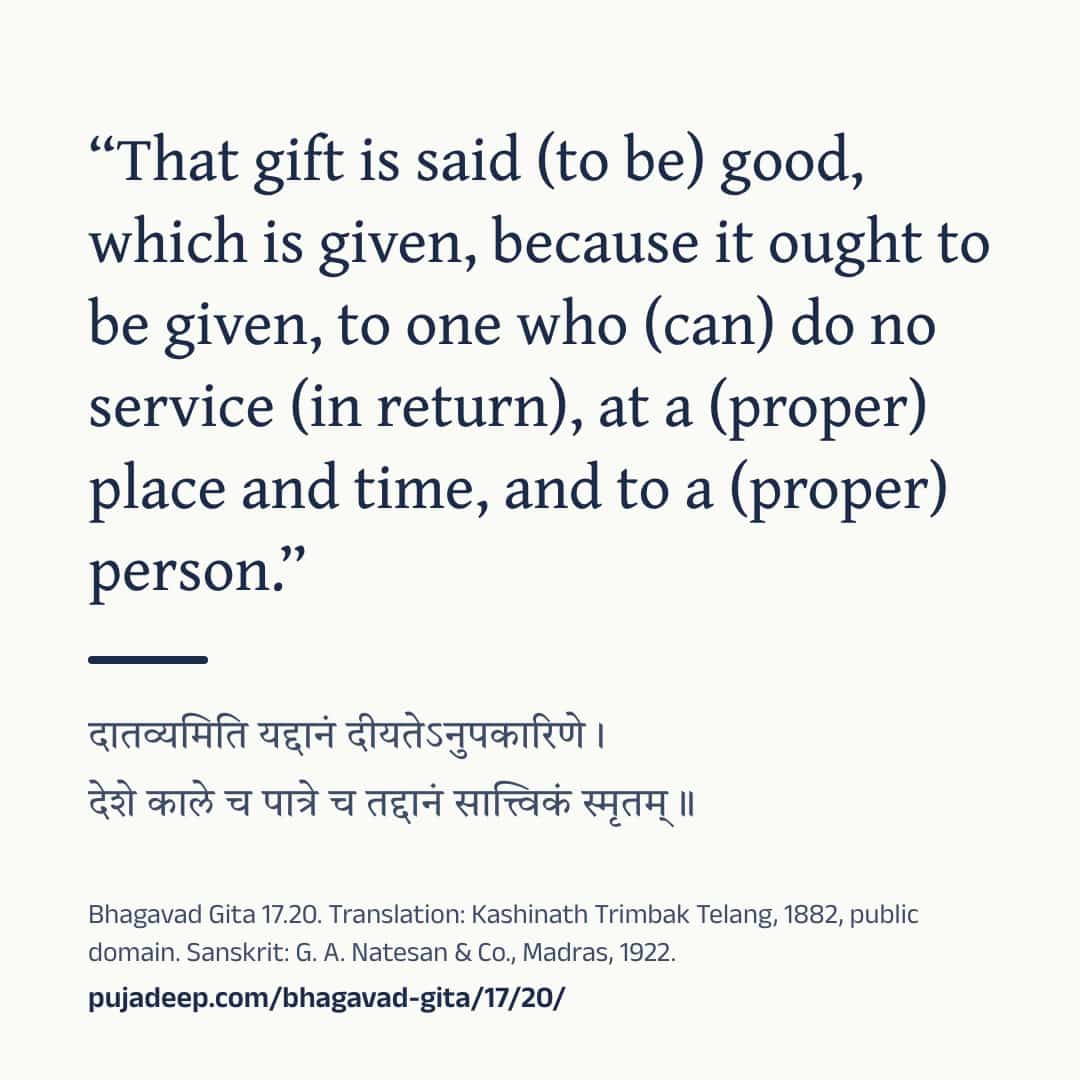
Drawing the picture
See the words
Bhagavad Gita 17.20

दातव्यमिति यद्दानं दीयतेऽनुपकारिणे ।
देशे काले च पात्रे च तद्दानं सात्त्विकं स्मृतम् ॥

“That gift is said (to be) good, which is given, because it ought to be given, to one who (can) do no service (in return), at a (proper) place and time, and to a (proper) person.”
(K. T. Telang, The Bhagavadgîtâ (The Sacred Books of the East, vol. VIII, Oxford: Clarendon Press, 1882), p. 120, public domain)

“"Gift ought to be made;" thus saying, that alms given without chance of return, in a (fit) place and time, to a worthy person, that alms is accounted sâttvic.”
(Annie Besant, The Bhagavad Gîtâ, or The Lord's Song (London: Theosophical Publishing Society, 1895), p. 150, public domain)

“To give is right,—gift given with this idea, to one who does no service in return, in a fit place and time, and to a worthy person, that gift is held to be Sátvic.”
(Swami Swarupananda, Srimad-Bhagavad-Gita (Mayavati: Prabuddha Bharata Press, 1909; first printed in Prabuddha Bharata, 1907–1909), p. 315, public domain)

Sanskrit: G. A. Natesan & Co., Madras, 1922.
https://pujadeep.com/bhagavad-gita/17/20/ Nothing is sent from this site. Your own app sends it, to the chat you choose. The picture quotes the translation you chose on this page, with its name and year.
Sanskrit text: The Bhagavad-Gita, or The Lord's Song, with the text in Devanagari and an English translation, 1922. Meanings: written for Pujadeep and checked against the cited edition. Source and changes
Questions families ask
Who speaks Bhagavad Gita 17.20?
Krishna speaks this verse, in chapter 17 (Shraddhatraya Vibhaga Yoga).
Where does the Sanskrit text come from?
Sanskrit text: The Bhagavad-Gita, or The Lord's Song, with the text in Devanagari and an English translation, 1922. Meanings: written for Pujadeep and checked against the cited edition. See the source
Is the meaning on this page a translation?
Explanation written for this site from the sources listed here, and checked against the cited edition. It is not a translation and not the only way to read the text. Free to quote with credit.
Source and licence
- Sanskrit text
- The Bhagavad-Gita, or The Lord's Song, with the text in Devanagari and an English translation (Annie Besant, G. A. Natesan & Co., Madras, 1922). Public domain. The Sanskrit on these pages was read from this printing’s page images.
- Translation
- The Bhagavadgîtâ with the Sanatsugâtîya and the Anugîtâ, translated by Kâshinâth Trimbak Telang (The Sacred Books of the East, vol. VIII, ed. F. Max Müller) (Kashinath Trimbak Telang, F. Max Müller, Clarendon Press, Oxford, 1882). Public domain. Shown verbatim, as printed.
- Translation
- The Bhagavad Gîtâ, or The Lord's Song, translated by Annie Besant (Annie Besant, Theosophical Publishing Society, London, 1895). Public domain. Shown verbatim, as printed.
- Translation
- Srimad-Bhagavad-Gita, with Sanskrit Text; Paraphrase with Word-by-word Literal Translation; English Rendering and Comments, Index, &c., by the Swami Swarupananda (Himalayan Series, No. XX) (Swami Swarupananda, The Editors and Publishers, Advaita Ashrama, Mayavati, Prabuddha Bharata Press, Mayavati, Almora, Himalayas, 1909). Public domain. Shown verbatim, as printed.
- Common wording
- In this text, 32 words follow today's common wording, checked against sanskritdocuments.org; Sanskrit Wikisource; Gita Press, Gorakhpur; GRETIL, Göttingen and Bhaktivedanta Book Trust.
- Our explanation
- Explanation written for this site from the sources listed here, and checked against the cited edition. It is not a translation and not the only way to read the text. Free to quote with credit.
- Checked
- Checked against the cited edition, October 15, 2026.
- Updated
- October 25, 2026