Bhagavad Gita 17.26: meaning and translation
Chapter 17: Shraddhatraya Vibhaga Yoga. Krishna says
The word 'Sat', Krishna says, is used in the sense of being (sad-bhāva) and of goodness (sādhu-bhāva); and, Partha, the word 'Sat' is also used for a praiseworthy act.
Click or tap a word for its meaning and its dictionary page.
Text and layers
Text and layers
These choices stay in this browser.
Bhagavad Gita 17.26
सद्भावे साधुभावे च सदित्येतत्प्रयुज्यते ।प्रशस्ते कर्मणि तथा सच्छब्दः पार्थ युज्यते ॥
Sadbhave sadhubhave cha sadityetatprayujyatePrashaste karmani tatha sachchhabdah partha yujyate
sadbhāve sādhubhāve ca sadityetatprayujyate |praśaste karmaṇi tathā sacchabdaḥ pārtha yujyate ||
Our explanation The word 'Sat', Krishna says, is used in the sense of being (sad-bhāva) and of goodness (sādhu-bhāva); and, Partha, the word 'Sat' is also used for a praiseworthy act. Telang's note at verse 28 gives Shankara's examples: the birth of a first son for being, the reform of a bad man for goodness, and a marriage for an auspicious act.
हिंदी अर्थ कृष्ण कहते हैं कि “सत्” शब्द सद्भाव (होने) और साधुभाव (अच्छाई) के अर्थ में प्रयोग होता है; और हे पार्थ, किसी प्रशंसनीय कर्म के लिए भी “सत्” शब्द का प्रयोग होता है। श्लोक 28 पर तेलंग की टिप्पणी शंकराचार्य के उदाहरण देती है: होने के लिए पहले पुत्र का जन्म, अच्छाई के लिए किसी बुरे व्यक्ति का सुधरना, और शुभ कर्म के लिए विवाह।
Word by word
Every word, with its dictionary page
Word by word
- सद्भावे sadbhāve · in the sense of being (compound (masculine), locative singular) Dictionary: sad-bhāva, Monier-Williams 1899, p. 1137, col. 2 “real being, existence”
- साधुभावे sādhubhāve · in the sense of goodness (compound (masculine), locative singular) Dictionary: sādhu-bhāva, Monier-Williams 1899, p. 1201, col. 3 “good nature, goodness, kindness”
- च ca · and (indeclinable) Dictionary: 2. ca, Monier-Williams 1899, p. 380, col. 1 “and, both, also, moreover, as well as”
- सत् sat · Sat (participle 'being', used as a name) Dictionary: sat, Monier-Williams 1899, p. 1134, col. 2 “that which is good or real or true, good, advantage, reality, truth”
- इति iti · thus (indeclinable) Dictionary: 2. iti, Monier-Williams 1899, p. 165, col. 1 “in this manner, thus”
- एतत् etat · this (pronoun (neuter), nominative singular) Dictionary: etad, Monier-Williams 1899, p. 231, col. 2 “this, this here, here”
- प्रयुज्यते prayujyate · is used (present passive, 3rd person singular) Dictionary: pra-yuj, Monier-Williams 1899, p. 688, col. 2 “to use, employ, practise”
- प्रशस्ते praśaste · praiseworthy (past participle (neuter), locative singular) Dictionary: praśasta, Monier-Williams 1899, p. 695, col. 1 “praised, commended, considered fit or good”
- कर्मणि karmaṇi · for an act (noun (neuter), locative singular) Dictionary: karman, Monier-Williams 1899, p. 258, col. 2 “act, action, performance, business”
- तथा tathā · so also (indeclinable) Dictionary: tathā, Monier-Williams 1899, p. 433, col. 3 “in that manner, so, thus”
- सच्छब्दः sacchabdaḥ · the word 'Sat' (compound (masculine), nominative singular) Dictionary: sat, Monier-Williams 1899, p. 1134, col. 2 “that which is good or real or true, good, advantage, reality, truth”; śabda, Monier-Williams 1899, p. 1052, col. 2 “sound, noise, voice, tone, note”
- पार्थ pārtha · O Partha (Arjuna) (noun (masculine), vocative singular) Dictionary: 2. pārtha, Monier-Williams 1899, p. 621, col. 3 “metron. of Yudhi-shṭhira or Bhīma-sena or Arjuna”
- युज्यते yujyate · is used (present passive, 3rd person singular) Dictionary: 1. yuj, Monier-Williams 1899, p. 853, col. 2 “to be made ready or prepared for (dat.), Bhag.; to be united”
Old translations
Kashinath Trimbak Telang, 1882. Public domain. Page 120.
'Sat' is employed to express existence and goodness; and likewise, O son of Prithâ! the word 'Sat' is used to express an auspicious act.
Compare 3 translations
Kashinath Trimbak Telang, 1882. Public domain. Page 120.
'Sat' is employed to express existence and goodness; and likewise, O son of Prithâ! the word 'Sat' is used to express an auspicious act.
You are reading this one
Annie Besant, 1895. Public domain. Page 151.
"SAT" is used in the sense of reality and goodness; likewise, O Pârtha, the sound "SAT" is used in the sense of a good work.
You are reading this one
Swami Swarupananda, 1909 (first printed 1907). Public domain. Page 317.
The word Sat is used in the sense of reality and of goodness; and so also, O Pàrtha, the word Sat is used in the sense of an auspicious act.
You are reading this one
Cite this verse
The translation: K. T. Telang, The Bhagavadgîtâ (The Sacred Books of the East, vol. VIII, Oxford: Clarendon Press, 1882), p. 120. Bhagavad Gita 17.26.
The translation: Annie Besant, The Bhagavad Gîtâ, or The Lord's Song (London: Theosophical Publishing Society, 1895), p. 151. Bhagavad Gita 17.26.
The translation: Swami Swarupananda, Srimad-Bhagavad-Gita (Mayavati: Prabuddha Bharata Press, 1909; first printed in Prabuddha Bharata, 1907–1909), p. 317. Bhagavad Gita 17.26.
Our explanation: “Bhagavad Gita 17.26: meaning and translation.” Pujadeep. Updated October 25, 2026. https://pujadeep.com/bhagavad-gita/17/26/
Pujadeep’s explanations are free to quote with credit: name Pujadeep and link to the page. How to credit
Classical readings, by school
No readings by school on this verse yet.
Share
Show the ways to share
Send one picture or the text to one chat. The picture names its source and the address of this page.
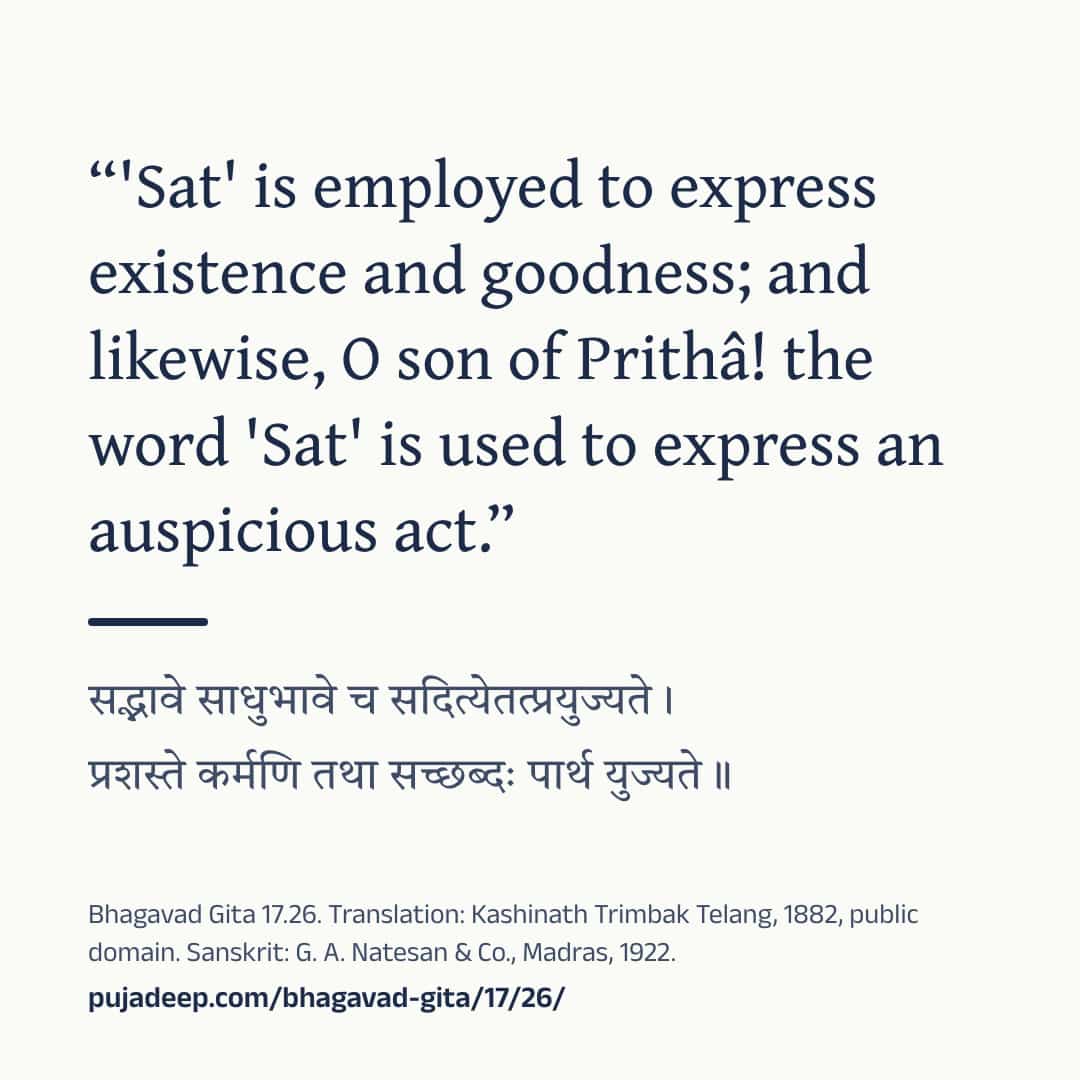
Drawing the picture
See the words
Bhagavad Gita 17.26

सद्भावे साधुभावे च सदित्येतत्प्रयुज्यते ।
प्रशस्ते कर्मणि तथा सच्छब्दः पार्थ युज्यते ॥

“'Sat' is employed to express existence and goodness; and likewise, O son of Prithâ! the word 'Sat' is used to express an auspicious act.”
(K. T. Telang, The Bhagavadgîtâ (The Sacred Books of the East, vol. VIII, Oxford: Clarendon Press, 1882), p. 120, public domain)

“"SAT" is used in the sense of reality and goodness; likewise, O Pârtha, the sound "SAT" is used in the sense of a good work.”
(Annie Besant, The Bhagavad Gîtâ, or The Lord's Song (London: Theosophical Publishing Society, 1895), p. 151, public domain)

“The word Sat is used in the sense of reality and of goodness; and so also, O Pàrtha, the word Sat is used in the sense of an auspicious act.”
(Swami Swarupananda, Srimad-Bhagavad-Gita (Mayavati: Prabuddha Bharata Press, 1909; first printed in Prabuddha Bharata, 1907–1909), p. 317, public domain)

Sanskrit: G. A. Natesan & Co., Madras, 1922.
https://pujadeep.com/bhagavad-gita/17/26/ Nothing is sent from this site. Your own app sends it, to the chat you choose. The picture quotes the translation you chose on this page, with its name and year.
Sanskrit text: The Bhagavad-Gita, or The Lord's Song, with the text in Devanagari and an English translation, 1922. Meanings: written for Pujadeep and checked against the cited edition. Source and changes
Questions families ask
Who speaks Bhagavad Gita 17.26?
Krishna speaks this verse, in chapter 17 (Shraddhatraya Vibhaga Yoga).
Where does the Sanskrit text come from?
Sanskrit text: The Bhagavad-Gita, or The Lord's Song, with the text in Devanagari and an English translation, 1922. Meanings: written for Pujadeep and checked against the cited edition. See the source
Is the meaning on this page a translation?
Explanation written for this site from the sources listed here, and checked against the cited edition. It is not a translation and not the only way to read the text. Free to quote with credit.
Source and licence
- Sanskrit text
- The Bhagavad-Gita, or The Lord's Song, with the text in Devanagari and an English translation (Annie Besant, G. A. Natesan & Co., Madras, 1922). Public domain. The Sanskrit on these pages was read from this printing’s page images.
- Translation
- The Bhagavadgîtâ with the Sanatsugâtîya and the Anugîtâ, translated by Kâshinâth Trimbak Telang (The Sacred Books of the East, vol. VIII, ed. F. Max Müller) (Kashinath Trimbak Telang, F. Max Müller, Clarendon Press, Oxford, 1882). Public domain. Shown verbatim, as printed.
- Translation
- The Bhagavad Gîtâ, or The Lord's Song, translated by Annie Besant (Annie Besant, Theosophical Publishing Society, London, 1895). Public domain. Shown verbatim, as printed.
- Translation
- Srimad-Bhagavad-Gita, with Sanskrit Text; Paraphrase with Word-by-word Literal Translation; English Rendering and Comments, Index, &c., by the Swami Swarupananda (Himalayan Series, No. XX) (Swami Swarupananda, The Editors and Publishers, Advaita Ashrama, Mayavati, Prabuddha Bharata Press, Mayavati, Almora, Himalayas, 1909). Public domain. Shown verbatim, as printed.
- Common wording
- In this text, 32 words follow today's common wording, checked against sanskritdocuments.org; Sanskrit Wikisource; Gita Press, Gorakhpur; GRETIL, Göttingen and Bhaktivedanta Book Trust.
- Our explanation
- Explanation written for this site from the sources listed here, and checked against the cited edition. It is not a translation and not the only way to read the text. Free to quote with credit.
- Checked
- Checked against the cited edition, October 15, 2026.
- Updated
- October 25, 2026