Bhagavad Gita 17.23: meaning and translation
Chapter 17: Shraddhatraya Vibhaga Yoga. Krishna says
Krishna gives 'Om Tat Sat' as the threefold name (nirdeśa) of Brahman.
Click or tap a word for its meaning and its dictionary page.
Text and layers
Text and layers
These choices stay in this browser.
Bhagavad Gita 17.23
ओं तत्सदिति निर्देशो ब्रह्मणस्त्रिविधः स्मृतः ।ब्राह्मणास्तेन वेदाश्च यज्ञाश्च विहिताः पुरा ॥
Om tatsaditi nirdesho brahmanastrividhah smritahBrahmanastena vedashcha yajnashcha vihitah pura
oṃ tatsaditi nirdeśo brahmaṇastrividhaḥ smṛtaḥ |brāhmaṇāstena vedāśca yajñāśca vihitāḥ purā ||
Our explanation Krishna gives 'Om Tat Sat' as the threefold name (nirdeśa) of Brahman. By it, he says, the brāhmaṇas, the Vedas and the sacrifices were set out in the beginning. Verses 24 to 27 explain the use of each word in turn. The schools read 'Brahman' and 'brāhmaṇas' here differently (see the views). Readings of these verses differ between schools and teachers, and the wording is the text's, not the view of this library.
हिंदी अर्थ कृष्ण “ओं तत् सत्” को ब्रह्म का तीन प्रकार का नाम (निर्देश) बताते हैं। वे कहते हैं कि इसी से आरंभ में ब्राह्मण, वेद और यज्ञ रचे गए। श्लोक 24 से 27 हर शब्द का उपयोग बारी-बारी से बताते हैं। यहाँ “ब्रह्म” और “ब्राह्मण” को परंपराएँ अलग-अलग ढंग से पढ़ती हैं। इन श्लोकों को अलग-अलग परंपराएँ और आचार्य अलग ढंग से पढ़ते हैं, और ये शब्द पाठ के हैं, इस पुस्तकालय का मत नहीं।
Word by word
Every word, with its dictionary page
Word by word
- ओं oṃ · Om (indeclinable) Dictionary: om, Monier-Williams 1899, p. 235, col. 3 “a word of solemn affirmation and respectful assent”
- तत् tat · Tat ('That') (the pronoun 'that', used as a name) Dictionary: tad, Monier-Williams 1899, p. 434, col. 1 “m. he, f. she, n. it, that, this”
- सत् sat · Sat ('being, the good') (participle 'being', used as a name) Dictionary: sat, Monier-Williams 1899, p. 1134, col. 2 “that which is good or real or true, good, advantage, reality, truth”
- इति iti · thus (indeclinable) Dictionary: 2. iti, Monier-Williams 1899, p. 165, col. 1 “in this manner, thus”
- निर्देशः nirdeśaḥ · designation, name (noun (masculine), nominative singular) Dictionary: nir-deśa, Monier-Williams 1899, p. 555, col. 2 “pointing out, indicating, directing”
- ब्रह्मणः brahmaṇaḥ · of Brahman (noun (neuter), genitive singular) Dictionary: brahman, Monier-Williams 1899, p. 738, col. 1 “one self-existent impersonal Spirit, the one universal Soul”
- त्रिविधः trividhaḥ · threefold (adjective (masculine), nominative singular) Dictionary: tri-vidha, Monier-Williams 1899, p. 460, col. 2 “of 3 kinds, triple, threefold”
- स्मृतः smṛtaḥ · is held to be (past participle (masculine), nominative singular) Dictionary: smṛta, Monier-Williams 1899, p. 1272, col. 2 “declared as, passing for (nom., loc., or dat.)”
- ब्राह्मणाः brāhmaṇāḥ · the brāhmaṇas (noun (masculine), nominative plural) Dictionary: brāhmaṇa, Monier-Williams 1899, p. 741, col. 2 “one who has divine knowledge (sometimes applied to Agni), a Brāhman”
- तेन tena · by it (pronoun (masculine), instrumental singular) Dictionary: tad, Monier-Williams 1899, p. 434, col. 1 “m. he, f. she, n. it, that, this”
- वेदाः vedāḥ · the Vedas (noun (masculine), nominative plural) Dictionary: 1. veda, Monier-Williams 1899, p. 1015, col. 1 “knowledge, true or sacred knowledge or lore, knowledge of ritual”
- च ca · and (indeclinable) Dictionary: 2. ca, Monier-Williams 1899, p. 380, col. 1 “and, both, also, moreover, as well as”
- यज्ञाः yajñāḥ · the sacrifices (noun (masculine), nominative plural) Dictionary: yajña, Monier-Williams 1899, p. 839, col. 2 “worship, devotion, prayer, praise; act of worship or devotion, offering, oblation, sacrifice”
- च ca · and (indeclinable) Dictionary: 2. ca, Monier-Williams 1899, p. 380, col. 1 “and, both, also, moreover, as well as”
- विहिताः vihitāḥ · were set out (past participle (masculine), nominative plural) Dictionary: 2. vi-hita, Monier-Williams 1899, p. 1003, col. 2 “put in order, arranged, determined, fixed, ordained, ordered”
- पुरा purā · in the beginning (indeclinable) Dictionary: purā, Monier-Williams 1899, p. 634, col. 3 “at first, in the beginning”
1 printing differs
Edition differences. Another printing or text reads this place differently.
- Spelling A digital text reads Same word. The e-text writes the sign ॐ joined to तत्सदिति; the 1922 edition spells the syllable out as ओं and prints it as a separate word, as another digital text does (oṃ tat sad iti).
Old translations
Kashinath Trimbak Telang, 1882. Public domain. Page 120.
Om, Tad, and Sat, this is said (to be) the threefold designation of the Brahman. By that1, the Brâhmanas and the Vedas and sacrifices were created in olden times.
Footnotes (the translator’s own) - I. e. the Brahman, according to Srîdhara. ↩
Compare 3 translations
Kashinath Trimbak Telang, 1882. Public domain. Page 120.
Om, Tad, and Sat, this is said (to be) the threefold designation of the Brahman. By that1, the Brâhmanas and the Vedas and sacrifices were created in olden times.
Footnotes (the translator’s own) - I. e. the Brahman, according to Srîdhara. ↩
You are reading this one
Annie Besant, 1895. Public domain. Page 150.
"OM TAT SAT," this has been declared to be the threefold designation of Brahman. By that were created of old Brâhmans, Vedas and sacrifices.
You are reading this one
Swami Swarupananda, 1909 (first printed 1907). Public domain. Page 316.
"Om, Tat, Sat": this has been declared to be the triple designation of Brahman. By that were made of old the Bráhmanas and the Vedas and the Yajnas.
You are reading this one
Cite this verse
The translation: K. T. Telang, The Bhagavadgîtâ (The Sacred Books of the East, vol. VIII, Oxford: Clarendon Press, 1882), p. 120. Bhagavad Gita 17.23.
The translation: Annie Besant, The Bhagavad Gîtâ, or The Lord's Song (London: Theosophical Publishing Society, 1895), p. 150. Bhagavad Gita 17.23.
The translation: Swami Swarupananda, Srimad-Bhagavad-Gita (Mayavati: Prabuddha Bharata Press, 1909; first printed in Prabuddha Bharata, 1907–1909), p. 316. Bhagavad Gita 17.23.
Our explanation: “Bhagavad Gita 17.23: meaning and translation.” Pujadeep. Updated October 25, 2026. https://pujadeep.com/bhagavad-gita/17/23/
Pujadeep’s explanations are free to quote with credit: name Pujadeep and link to the page. How to credit
Classical readings, by school
Each reading is named by its school. None is presented as the only meaning.
What Advaita, Vishishtadvaita and Dvaita teach, in short
Shankara Advaita
Shankara introduces verses 23 to 28 as teaching for making sacrifices, gifts and austerities complete. The threefold name is the one taught in the Vedānta by the knowers of Brahman, and the words about the brāhmaṇas, the Vedas and the sacrifices being made by it are said in praise of the name.
Source: The Bhagavad-Gita, with the commentary of Sri Sankaracharya, translated by A. Mahadeva Sastri (2nd ed., Mysore: G. T. A. Printing Works, 1901), commentary on 17.23, p. 393. Summarised in our own words; none of its text is reproduced.
Ramanuja Vishishtadvaita
Ramanuja takes brahma here to mean the Veda, and through it the works the Veda prescribes, such as sacrifice. He reads 'brāhmaṇas' as standing for the three varṇas entitled to Vedic rites. Om, Tat and Sat are linked with these works, and the verse says that the Lord made the brāhmaṇas, the Vedas and the sacrifices of old.
Source: Sri Bhagavad-Gita with Sri Ramanujacharya's Visishtadvaita commentary, translated by A. Govindacharya (Madras, 1898), commentary on 17.23, pp. 512–513. Summarised in our own words; none of its text is reproduced.
Share
Show the ways to share
Send one picture or the text to one chat. The picture names its source and the address of this page.
Drawing the picture
See the words
Bhagavad Gita 17.23

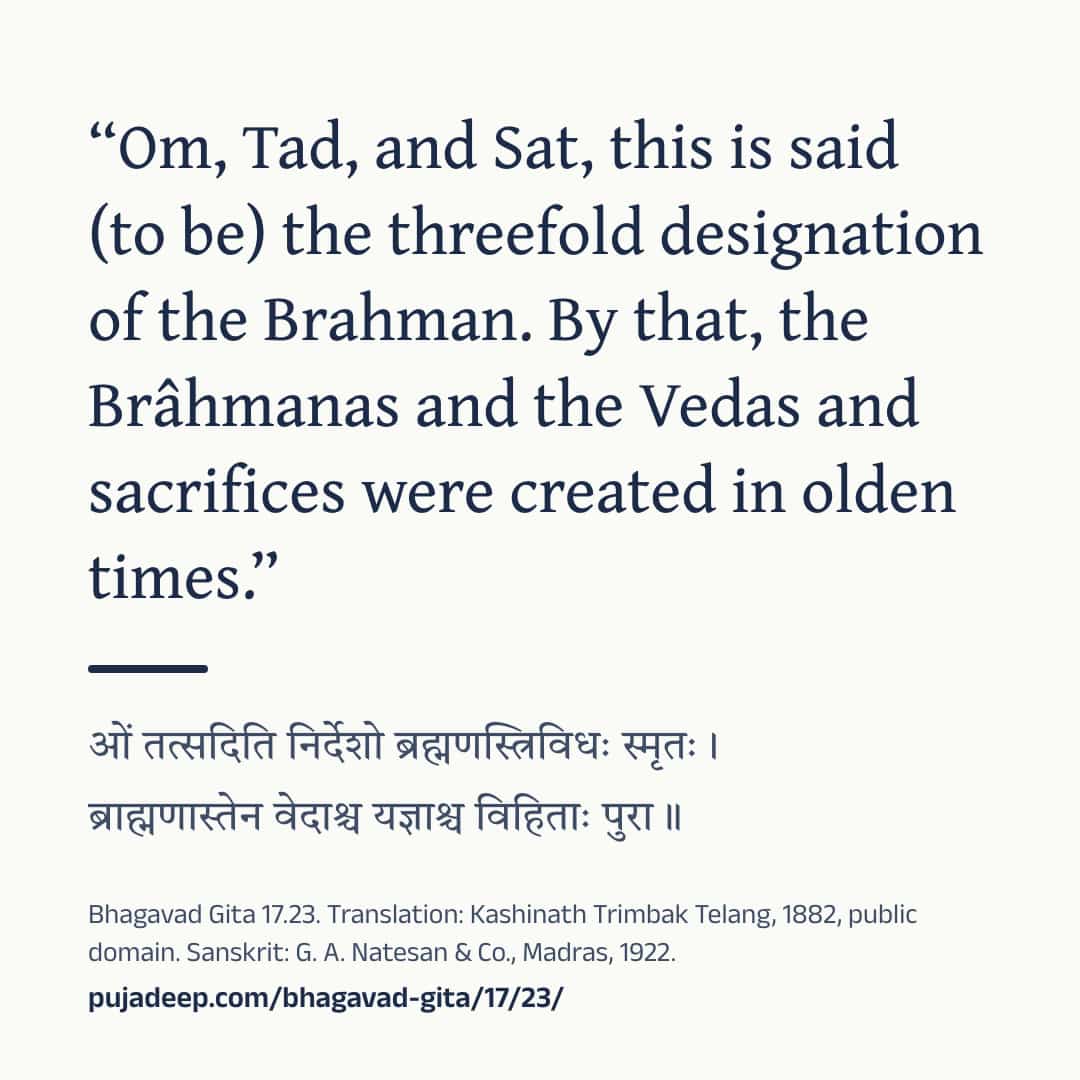
ओं तत्सदिति निर्देशो ब्रह्मणस्त्रिविधः स्मृतः ।
ब्राह्मणास्तेन वेदाश्च यज्ञाश्च विहिताः पुरा ॥

“Om, Tad, and Sat, this is said (to be) the threefold designation of the Brahman. By that, the Brâhmanas and the Vedas and sacrifices were created in olden times.”
(K. T. Telang, The Bhagavadgîtâ (The Sacred Books of the East, vol. VIII, Oxford: Clarendon Press, 1882), p. 120, public domain)

“"OM TAT SAT," this has been declared to be the threefold designation of Brahman. By that were created of old Brâhmans, Vedas and sacrifices.”
(Annie Besant, The Bhagavad Gîtâ, or The Lord's Song (London: Theosophical Publishing Society, 1895), p. 150, public domain)

“"Om, Tat, Sat": this has been declared to be the triple designation of Brahman. By that were made of old the Bráhmanas and the Vedas and the Yajnas.”
(Swami Swarupananda, Srimad-Bhagavad-Gita (Mayavati: Prabuddha Bharata Press, 1909; first printed in Prabuddha Bharata, 1907–1909), p. 316, public domain)

Sanskrit: G. A. Natesan & Co., Madras, 1922.
https://pujadeep.com/bhagavad-gita/17/23/ Nothing is sent from this site. Your own app sends it, to the chat you choose. The picture quotes the translation you chose on this page, with its name and year.
Sanskrit text: The Bhagavad-Gita, or The Lord's Song, with the text in Devanagari and an English translation, 1922. Meanings: written for Pujadeep and checked against the cited edition. Source and changes
Questions families ask
Who speaks Bhagavad Gita 17.23?
Krishna speaks this verse, in chapter 17 (Shraddhatraya Vibhaga Yoga).
Where does the Sanskrit text come from?
Sanskrit text: The Bhagavad-Gita, or The Lord's Song, with the text in Devanagari and an English translation, 1922. Meanings: written for Pujadeep and checked against the cited edition. See the source
Is the meaning on this page a translation?
Explanation written for this site from the sources listed here, and checked against the cited edition. It is not a translation and not the only way to read the text. Free to quote with credit.
Source and licence
- Sanskrit text
- The Bhagavad-Gita, or The Lord's Song, with the text in Devanagari and an English translation (Annie Besant, G. A. Natesan & Co., Madras, 1922). Public domain. The Sanskrit on these pages was read from this printing’s page images.
- Translation
- The Bhagavadgîtâ with the Sanatsugâtîya and the Anugîtâ, translated by Kâshinâth Trimbak Telang (The Sacred Books of the East, vol. VIII, ed. F. Max Müller) (Kashinath Trimbak Telang, F. Max Müller, Clarendon Press, Oxford, 1882). Public domain. Shown verbatim, as printed.
- Translation
- The Bhagavad Gîtâ, or The Lord's Song, translated by Annie Besant (Annie Besant, Theosophical Publishing Society, London, 1895). Public domain. Shown verbatim, as printed.
- Translation
- Srimad-Bhagavad-Gita, with Sanskrit Text; Paraphrase with Word-by-word Literal Translation; English Rendering and Comments, Index, &c., by the Swami Swarupananda (Himalayan Series, No. XX) (Swami Swarupananda, The Editors and Publishers, Advaita Ashrama, Mayavati, Prabuddha Bharata Press, Mayavati, Almora, Himalayas, 1909). Public domain. Shown verbatim, as printed.
- Commentary
- The Bhagavad-Gita, with the commentary of Sri Sankaracharya, translated by A. Mahadeva Sastri (2nd ed., Mysore: G. T. A. Printing Works, 1901) (Public-domain scan, University of California Libraries). Summarised in our own words; none of its text is reproduced.
- Commentary
- Sri Bhagavad-Gita with Sri Ramanujacharya's Visishtadvaita commentary, translated by A. Govindacharya (Madras, 1898) (Scan uploaded to archive.org (folkscanomy collection)). Summarised in our own words; none of its text is reproduced.
- Common wording
- In this text, 32 words follow today's common wording, checked against sanskritdocuments.org; Sanskrit Wikisource; Gita Press, Gorakhpur; GRETIL, Göttingen and Bhaktivedanta Book Trust.
- Our explanation
- Explanation written for this site from the sources listed here, and checked against the cited edition. It is not a translation and not the only way to read the text. Free to quote with credit.
- Checked
- Checked against the cited edition, October 15, 2026.
- Updated
- October 25, 2026