Bhagavad Gita 16.24: meaning and translation
Chapter 16: Daivasura Sampad Vibhaga Yoga. Krishna says
Krishna closes the chapter.
Click or tap a word for its meaning and its dictionary page.
Text and layers
Text and layers
These choices stay in this browser.
Bhagavad Gita 16.24
तस्माच्छास्त्रं प्रमाणं ते कार्याकार्यव्यवस्थितौ ।ज्ञात्वा शास्त्रविधानोक्तं कर्म कर्तुमिहार्हसि ॥
Tasmachchhastram pramanam te karyakaryavyavasthitauJnatva shastravidhanoktam karma kartumiharhasi
tasmācchāstraṃ pramāṇaṃ te kāryākāryavyavasthitau |jñātvā śāstravidhānoktaṃ karma kartumihārhasi ||
Our explanation Krishna closes the chapter. So, he tells Arjuna, let the scriptures be his measure in deciding what should be done and what should not. Knowing what the rule of the scriptures says, he should do his work here. The schools explain which scriptures are meant and what 'here' points to (see the views).
हिंदी अर्थ कृष्ण अध्याय पूरा करते हैं। वे अर्जुन से कहते हैं कि क्या करना चाहिए और क्या नहीं, यह तय करने में शास्त्र ही उनका प्रमाण हो। शास्त्र की विधि में जो कहा गया है उसे जानकर उन्हें यहाँ कर्म करना चाहिए। कौन से शास्त्र और “यहाँ” से किस अवस्था की बात है, इसे टीकाकार अपने-अपने ढंग से बताते हैं।
Word by word
Every word, with its dictionary page
Word by word
- तस्मात् tasmāt · therefore (indeclinable) Dictionary: tasmāt, Monier-Williams 1899, p. 441, col. 2 “from that, on that account, therefore”
- शास्त्रम् śāstram · scripture (noun (neuter), nominative singular) Dictionary: śāstra, Monier-Williams 1899, p. 1069, col. 1 “any religious or scientific treatise, any sacred book”
- प्रमाणम् pramāṇam · authority, standard (noun (neuter), nominative singular) Dictionary: pra-māṇa, Monier-Williams 1899, p. 685, col. 3 “right measure, standard, authority”
- ते te · for you (Arjuna) (pronoun, genitive singular) Dictionary: 2. tva, Monier-Williams 1899, p. 463, col. 2 “base of the 2nd personal pron.”
- कार्याकार्यव्यवस्थितौ kāryākāryavyavasthitau · in deciding what to do and not do (compound (feminine), locative singular) Dictionary: kārya, Monier-Williams 1899, p. 276, col. 1 “work or business to be done, duty”; a-kārya, Monier-Williams 1899, p. 2, col. 1 “not to be done, improper”; vy-avasthiti, Monier-Williams 1899, p. 1034, col. 1 “decision, determination”
- ज्ञात्वा jñātvā · having known (absolutive (having done)) Dictionary: 1. jñā, Monier-Williams 1899, p. 425, col. 3 “to know, have knowledge, become acquainted with”
- शास्त्रविधानोक्तम् śāstravidhānoktam · told by the rules of scripture (compound (neuter), accusative singular) Dictionary: śāstra, Monier-Williams 1899, p. 1069, col. 1 “any religious or scientific treatise, any sacred book”; vi-dhānokta, Monier-Williams 1899, p. 967, col. 3 “proclaimed or enjoined according to rule or (sacred) precept”
- कर्म karma · action (noun (neuter), accusative singular) Dictionary: karman, Monier-Williams 1899, p. 258, col. 2 “act, action, performance, business”
- कर्तुम् kartum · to do (infinitive (to do)) Dictionary: 1. kṛ, Monier-Williams 1899, p. 301, col. 1 “to do, make, perform, accomplish, cause, effect, prepare, undertake”
- इह iha · here, in this world (indeclinable) Dictionary: iha, Monier-Williams 1899, p. 169, col. 3 “in this place, here; to this place; in this world”
- अर्हसि arhasi · you ought (present, 2nd person singular) Dictionary: arh, Monier-Williams 1899, p. 93, col. 3 “arhasi, 2. sg. with an Inf. is often used as a softened form of Imper.”
1 printing differs
Edition differences. Another printing or text reads this place differently.
- The printed edition reads: तस्माच्छास्त्रं प्रमाणं ते कार्यांकार्यव्यवस्थितौ ।
ज्ञात्वा शास्त्रविधानोक्तं कर्म कर्तुमिहार्हसि ॥ The print shows an anusvara beside the reph over the first र्या (कार्यांकार्य…, leaf n234); read as a stray sort and not shown, because kāryākārya ('what should and should not be done') has no nasal and both proofreading references read कार्याकार्यव्यवस्थितौ.
Old translations
Kashinath Trimbak Telang, 1882. Public domain. Page 117.
Therefore in discriminating between what should be done and what should not be done, your authority (must be) scripture. And knowing what is declared by the ordinances of scripture, you should perform action in this world.
Compare 3 translations
Kashinath Trimbak Telang, 1882. Public domain. Page 117.
Therefore in discriminating between what should be done and what should not be done, your authority (must be) scripture. And knowing what is declared by the ordinances of scripture, you should perform action in this world.
You are reading this one
Annie Besant, 1895. Public domain. Page 144.
Therefore let the Shâstras be thy authority, in determining what ought to be done, or what ought not to be done. Having learned what hath been said by the scriptural texts, thou oughtest to work in this world.
You are reading this one
Swami Swarupananda, 1909 (first printed 1907). Public domain. Page 305.
So let the Shâstra be thy authority in ascertaining what ought to be done and what ought not to be done. Having known what is said in the ordinances of the Shâstra, thou shouldst act here.
You are reading this one
Cite this verse
The translation: K. T. Telang, The Bhagavadgîtâ (The Sacred Books of the East, vol. VIII, Oxford: Clarendon Press, 1882), p. 117. Bhagavad Gita 16.24.
The translation: Annie Besant, The Bhagavad Gîtâ, or The Lord's Song (London: Theosophical Publishing Society, 1895), p. 144. Bhagavad Gita 16.24.
The translation: Swami Swarupananda, Srimad-Bhagavad-Gita (Mayavati: Prabuddha Bharata Press, 1909; first printed in Prabuddha Bharata, 1907–1909), p. 305. Bhagavad Gita 16.24.
Our explanation: “Bhagavad Gita 16.24: meaning and translation.” Pujadeep. Updated October 25, 2026. https://pujadeep.com/bhagavad-gita/16/24/
Pujadeep’s explanations are free to quote with credit: name Pujadeep and link to the page. How to credit
Classical readings, by school
Each reading is named by its school. None is presented as the only meaning.
What Advaita, Vishishtadvaita and Dvaita teach, in short
Shankara Advaita
Shankara says scripture is the authority on which both giving up the asura nature and doing what is good rest. The rule of scripture is the Veda's command, in the form of injunctions and prohibitions. 'Here' (iha, rendered 'now') refers to the stage at which the disciple is fit for karma-yoga.
Source: The Bhagavad-Gita, with the commentary of Sri Sankaracharya, translated by A. Mahadeva Sastri (2nd ed., Mysore: G. T. A. Printing Works, 1901), commentary on 16.23–16.24, pp. 382–383. Summarised in our own words; none of its text is reproduced.
Ramanuja Vishishtadvaita
Ramanuja says the Vedas are the Lord's own commands. What the scriptures teach, through the Vedas and the works that explain them (the dharma-śāstras, itihāsas and purāṇas), is the truth about Puruṣottama and the works that please him and are the means of reaching him; knowing both, Arjuna is to act.
Source: Sri Bhagavad-Gita with Sri Ramanujacharya's Visishtadvaita commentary, translated by A. Govindacharya (Madras, 1898), commentary on 16.23–16.24, pp. 496–497. Summarised in our own words; none of its text is reproduced.
Share
Show the ways to share
Send one picture or the text to one chat. The picture names its source and the address of this page.
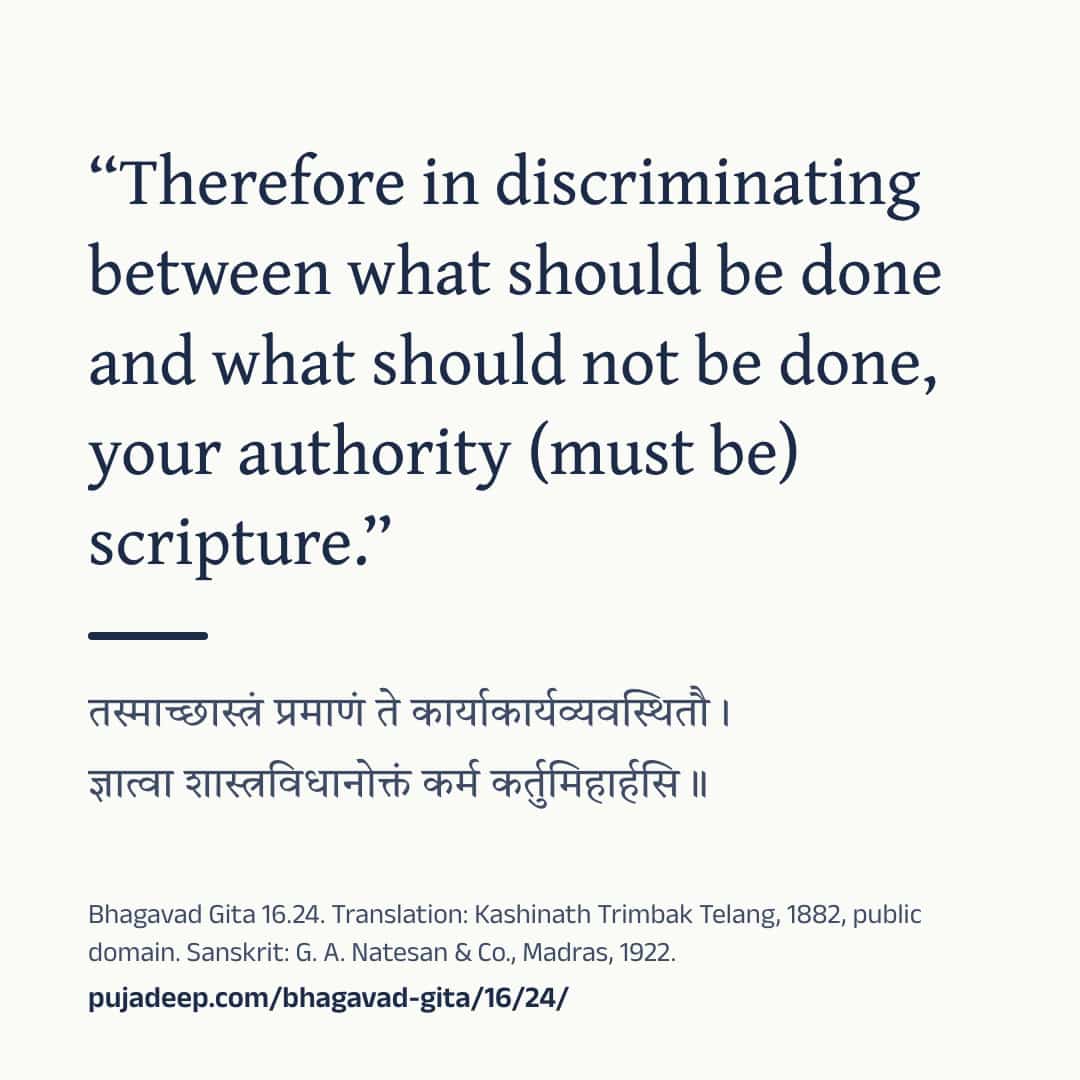
Drawing the picture
See the words
Bhagavad Gita 16.24

तस्माच्छास्त्रं प्रमाणं ते कार्याकार्यव्यवस्थितौ ।
ज्ञात्वा शास्त्रविधानोक्तं कर्म कर्तुमिहार्हसि ॥

“Therefore in discriminating between what should be done and what should not be done, your authority (must be) scripture. And knowing what is declared by the ordinances of scripture, you should perform action in this world.”
(K. T. Telang, The Bhagavadgîtâ (The Sacred Books of the East, vol. VIII, Oxford: Clarendon Press, 1882), p. 117, public domain)

“Therefore let the Shâstras be thy authority, in determining what ought to be done, or what ought not to be done. Having learned what hath been said by the scriptural texts, thou oughtest to work in this world.”
(Annie Besant, The Bhagavad Gîtâ, or The Lord's Song (London: Theosophical Publishing Society, 1895), p. 144, public domain)

“So let the Shâstra be thy authority in ascertaining what ought to be done and what ought not to be done. Having known what is said in the ordinances of the Shâstra, thou shouldst act here.”
(Swami Swarupananda, Srimad-Bhagavad-Gita (Mayavati: Prabuddha Bharata Press, 1909; first printed in Prabuddha Bharata, 1907–1909), p. 305, public domain)

Sanskrit: G. A. Natesan & Co., Madras, 1922.
https://pujadeep.com/bhagavad-gita/16/24/ Nothing is sent from this site. Your own app sends it, to the chat you choose. The picture quotes the translation you chose on this page, with its name and year.
Sanskrit text: The Bhagavad-Gita, or The Lord's Song, with the text in Devanagari and an English translation, 1922. Meanings: written for Pujadeep and checked against the cited edition. Source and changes
Questions families ask
Who speaks Bhagavad Gita 16.24?
Krishna speaks this verse, in chapter 16 (Daivasura Sampad Vibhaga Yoga).
Where does the Sanskrit text come from?
Sanskrit text: The Bhagavad-Gita, or The Lord's Song, with the text in Devanagari and an English translation, 1922. Meanings: written for Pujadeep and checked against the cited edition. See the source
Is the meaning on this page a translation?
Explanation written for this site from the sources listed here, and checked against the cited edition. It is not a translation and not the only way to read the text. Free to quote with credit.
Source and licence
- Sanskrit text
- The Bhagavad-Gita, or The Lord's Song, with the text in Devanagari and an English translation (Annie Besant, G. A. Natesan & Co., Madras, 1922). Public domain. The Sanskrit on these pages was read from this printing’s page images.
- Translation
- The Bhagavadgîtâ with the Sanatsugâtîya and the Anugîtâ, translated by Kâshinâth Trimbak Telang (The Sacred Books of the East, vol. VIII, ed. F. Max Müller) (Kashinath Trimbak Telang, F. Max Müller, Clarendon Press, Oxford, 1882). Public domain. Shown verbatim, as printed.
- Translation
- The Bhagavad Gîtâ, or The Lord's Song, translated by Annie Besant (Annie Besant, Theosophical Publishing Society, London, 1895). Public domain. Shown verbatim, as printed.
- Translation
- Srimad-Bhagavad-Gita, with Sanskrit Text; Paraphrase with Word-by-word Literal Translation; English Rendering and Comments, Index, &c., by the Swami Swarupananda (Himalayan Series, No. XX) (Swami Swarupananda, The Editors and Publishers, Advaita Ashrama, Mayavati, Prabuddha Bharata Press, Mayavati, Almora, Himalayas, 1909). Public domain. Shown verbatim, as printed.
- Commentary
- The Bhagavad-Gita, with the commentary of Sri Sankaracharya, translated by A. Mahadeva Sastri (2nd ed., Mysore: G. T. A. Printing Works, 1901) (Public-domain scan, University of California Libraries). Summarised in our own words; none of its text is reproduced.
- Commentary
- Sri Bhagavad-Gita with Sri Ramanujacharya's Visishtadvaita commentary, translated by A. Govindacharya (Madras, 1898) (Scan uploaded to archive.org (folkscanomy collection)). Summarised in our own words; none of its text is reproduced.
- Common wording
- In this text, 32 words follow today's common wording, checked against sanskritdocuments.org; Sanskrit Wikisource; Gita Press, Gorakhpur; GRETIL, Göttingen and Bhaktivedanta Book Trust.
- Our explanation
- Explanation written for this site from the sources listed here, and checked against the cited edition. It is not a translation and not the only way to read the text. Free to quote with credit.
- Checked
- Checked against the cited edition, October 14, 2026.
- Updated
- October 25, 2026