Bhagavad Gita 16.22: meaning and translation
Chapter 16: Daivasura Sampad Vibhaga Yoga. Krishna says
Krishna tells Arjuna (Kaunteya) that a person freed from these three gates of darkness (tamas) does what is good for the self, and then goes to the highest goal.
Click or tap a word for its meaning and its dictionary page.
Text and layers
Text and layers
These choices stay in this browser.
Bhagavad Gita 16.22
एतैर्विमुक्तः कौन्तेय तमोद्वारैस्त्रिभिर्नरः ।आचरत्यात्मनः श्रेयस्ततो याति परां गतिम् ॥
Etairvimuktah kaunteya tamodvaraistribhirnarahAcharatyatmanah shreyastato yati param gatim
etairvimuktaḥ kaunteya tamodvāraistribhirnaraḥ |ācaratyātmanaḥ śreyastato yāti parāṃ gatim ||
Our explanation Krishna tells Arjuna (Kaunteya) that a person freed from these three gates of darkness (tamas) does what is good for the self, and then goes to the highest goal.
हिंदी अर्थ कृष्ण अर्जुन (कौन्तेय) से कहते हैं कि अंधकार (तम) के इन तीन द्वारों से छूटा हुआ मनुष्य वह करता है जो आत्मा के लिए हितकर है, और फिर परम गति को पाता है।
Word by word
Every word, with its dictionary page
Word by word
- एतैः etaiḥ · from these (pronoun (neuter), instrumental plural) Dictionary: etad, Monier-Williams 1899, p. 231, col. 2 “this, this here, here”
- विमुक्तः vimuktaḥ · freed (past participle (masculine), nominative singular) Dictionary: vi-mukta, Monier-Williams 1899, p. 980, col. 2 “set free, liberated (esp. from mundane existence), freed”
- कौन्तेय kaunteya · O son of Kunti (noun (masculine), vocative singular) Dictionary: kaunteya, Monier-Williams 1899, p. 316, col. 2 “metron. fr. Kuntī”
- तमोद्वारैः tamodvāraiḥ · gates to darkness (compound (neuter), instrumental plural) Dictionary: tamas, Monier-Williams 1899, p. 438, col. 1 “darkness, gloom”; dvāra, Monier-Williams 1899, p. 504, col. 2 “door, gate, passage, entrance”
- त्रिभिः tribhiḥ · three (adjective (neuter), instrumental plural) Dictionary: tri, Monier-Williams 1899, p. 457, col. 3
- नरः naraḥ · a person (noun (masculine), nominative singular) Dictionary: nara, Monier-Williams 1899, p. 528, col. 3 “a man, a male, a person”
- आचरति ācarati · practises (present, 3rd person singular) Dictionary: ā-car, Monier-Williams 1899, p. 131, col. 3 “to act, undertake, do, exercise, practise, perform”
- आत्मनः ātmanaḥ · his own (noun (masculine), genitive singular) Dictionary: ātman, Monier-Williams 1899, p. 135, col. 1 “the individual soul, self”
- श्रेयः śreyaḥ · good, welfare (noun (neuter), accusative singular) Dictionary: śreyas, Monier-Williams 1899, p. 1102, col. 2 “good (as opp. to ‘evil’), welfare, bliss, fortune, happiness”
- ततः tataḥ · then (indeclinable) Dictionary: tatas, Monier-Williams 1899, p. 432, col. 2 “thereupon, then, after that, afterwards”
- याति yāti · goes (present, 3rd person singular) Dictionary: 1. yā, Monier-Williams 1899, p. 849, col. 1 “to go, proceed, move, walk, set out”
- पराम् parām · highest (adjective (feminine), accusative singular) Dictionary: 1. para, Monier-Williams 1899, p. 586, col. 1 “best or worst, highest, supreme, chief”
- गतिम् gatim · goal (noun (feminine), accusative singular) Dictionary: gati, Monier-Williams 1899, p. 347, col. 3 “path, way, course”
Old translations
Kashinath Trimbak Telang, 1882. Public domain. Page 117.
Released from these three ways to darkness, O son of Kuntî! a man works out his own welfare, and then proceeds to the highest goal.
Compare 3 translations
Kashinath Trimbak Telang, 1882. Public domain. Page 117.
Released from these three ways to darkness, O son of Kuntî! a man works out his own welfare, and then proceeds to the highest goal.
You are reading this one
Annie Besant, 1895. Public domain. Page 144.
A man liberated from these three gates of darkness, O son of Kuntî, accomplisheth his own welfare and thus reacheth the highest Path.
You are reading this one
Swami Swarupananda, 1909 (first printed 1907). Public domain. Page 304.
The man who has got beyond these three gates of darkness, O son of Kunti, practises what is good for himself, and thus goes to the Goal Supreme.
You are reading this one
Cite this verse
The translation: K. T. Telang, The Bhagavadgîtâ (The Sacred Books of the East, vol. VIII, Oxford: Clarendon Press, 1882), p. 117. Bhagavad Gita 16.22.
The translation: Annie Besant, The Bhagavad Gîtâ, or The Lord's Song (London: Theosophical Publishing Society, 1895), p. 144. Bhagavad Gita 16.22.
The translation: Swami Swarupananda, Srimad-Bhagavad-Gita (Mayavati: Prabuddha Bharata Press, 1909; first printed in Prabuddha Bharata, 1907–1909), p. 304. Bhagavad Gita 16.22.
Our explanation: “Bhagavad Gita 16.22: meaning and translation.” Pujadeep. Updated October 25, 2026. https://pujadeep.com/bhagavad-gita/16/22/
Pujadeep’s explanations are free to quote with credit: name Pujadeep and link to the page. How to credit
Classical readings, by school
No readings by school on this verse yet.
Share
Show the ways to share
Send one picture or the text to one chat. The picture names its source and the address of this page.
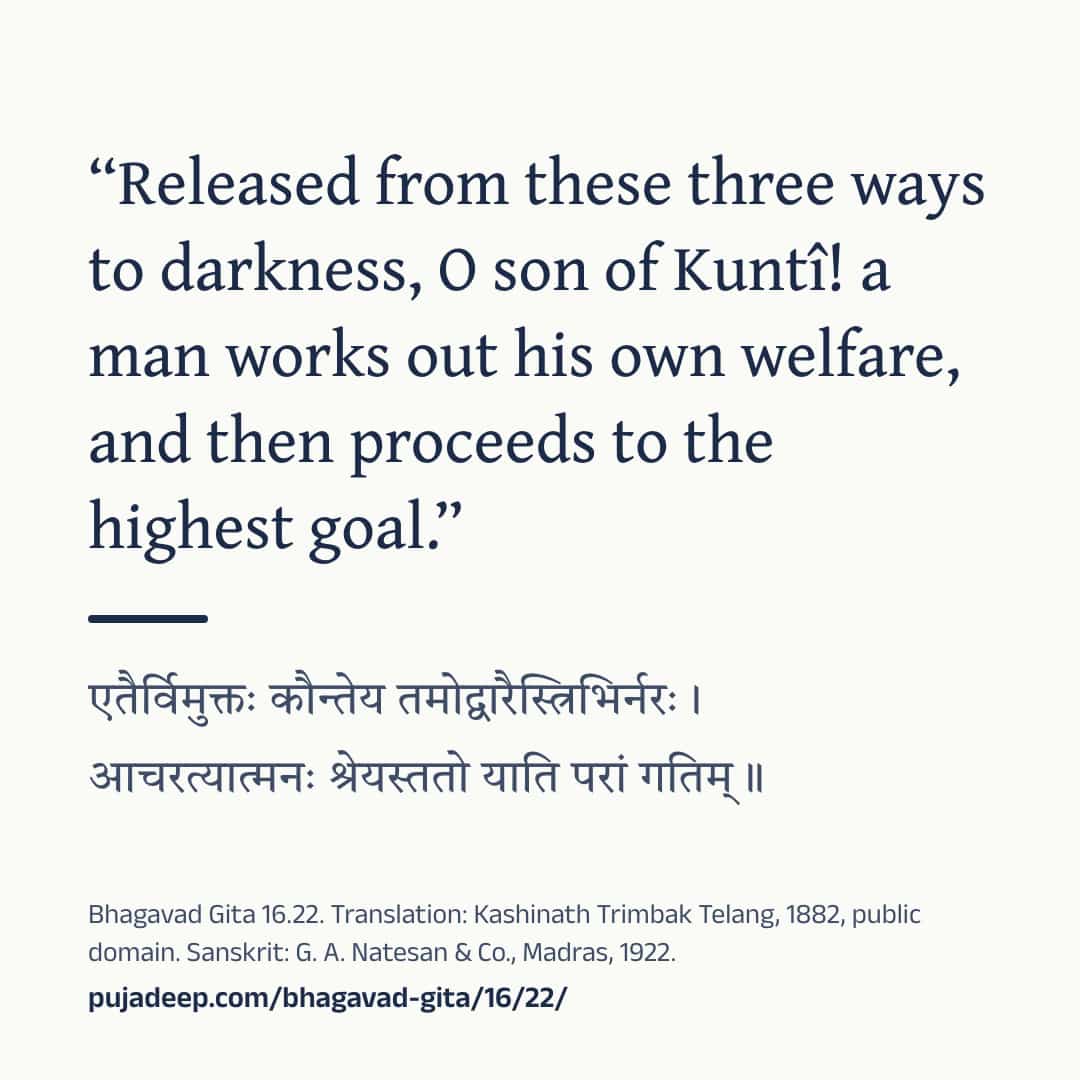
Drawing the picture
See the words
Bhagavad Gita 16.22

एतैर्विमुक्तः कौन्तेय तमोद्वारैस्त्रिभिर्नरः ।
आचरत्यात्मनः श्रेयस्ततो याति परां गतिम् ॥

“Released from these three ways to darkness, O son of Kuntî! a man works out his own welfare, and then proceeds to the highest goal.”
(K. T. Telang, The Bhagavadgîtâ (The Sacred Books of the East, vol. VIII, Oxford: Clarendon Press, 1882), p. 117, public domain)

“A man liberated from these three gates of darkness, O son of Kuntî, accomplisheth his own welfare and thus reacheth the highest Path.”
(Annie Besant, The Bhagavad Gîtâ, or The Lord's Song (London: Theosophical Publishing Society, 1895), p. 144, public domain)

“The man who has got beyond these three gates of darkness, O son of Kunti, practises what is good for himself, and thus goes to the Goal Supreme.”
(Swami Swarupananda, Srimad-Bhagavad-Gita (Mayavati: Prabuddha Bharata Press, 1909; first printed in Prabuddha Bharata, 1907–1909), p. 304, public domain)

Sanskrit: G. A. Natesan & Co., Madras, 1922.
https://pujadeep.com/bhagavad-gita/16/22/ Nothing is sent from this site. Your own app sends it, to the chat you choose. The picture quotes the translation you chose on this page, with its name and year.
Sanskrit text: The Bhagavad-Gita, or The Lord's Song, with the text in Devanagari and an English translation, 1922. Meanings: written for Pujadeep and checked against the cited edition. Source and changes
Questions families ask
Who speaks Bhagavad Gita 16.22?
Krishna speaks this verse, in chapter 16 (Daivasura Sampad Vibhaga Yoga).
Where does the Sanskrit text come from?
Sanskrit text: The Bhagavad-Gita, or The Lord's Song, with the text in Devanagari and an English translation, 1922. Meanings: written for Pujadeep and checked against the cited edition. See the source
Is the meaning on this page a translation?
Explanation written for this site from the sources listed here, and checked against the cited edition. It is not a translation and not the only way to read the text. Free to quote with credit.
Source and licence
- Sanskrit text
- The Bhagavad-Gita, or The Lord's Song, with the text in Devanagari and an English translation (Annie Besant, G. A. Natesan & Co., Madras, 1922). Public domain. The Sanskrit on these pages was read from this printing’s page images.
- Translation
- The Bhagavadgîtâ with the Sanatsugâtîya and the Anugîtâ, translated by Kâshinâth Trimbak Telang (The Sacred Books of the East, vol. VIII, ed. F. Max Müller) (Kashinath Trimbak Telang, F. Max Müller, Clarendon Press, Oxford, 1882). Public domain. Shown verbatim, as printed.
- Translation
- The Bhagavad Gîtâ, or The Lord's Song, translated by Annie Besant (Annie Besant, Theosophical Publishing Society, London, 1895). Public domain. Shown verbatim, as printed.
- Translation
- Srimad-Bhagavad-Gita, with Sanskrit Text; Paraphrase with Word-by-word Literal Translation; English Rendering and Comments, Index, &c., by the Swami Swarupananda (Himalayan Series, No. XX) (Swami Swarupananda, The Editors and Publishers, Advaita Ashrama, Mayavati, Prabuddha Bharata Press, Mayavati, Almora, Himalayas, 1909). Public domain. Shown verbatim, as printed.
- Common wording
- In this text, 32 words follow today's common wording, checked against sanskritdocuments.org; Sanskrit Wikisource; Gita Press, Gorakhpur; GRETIL, Göttingen and Bhaktivedanta Book Trust.
- Our explanation
- Explanation written for this site from the sources listed here, and checked against the cited edition. It is not a translation and not the only way to read the text. Free to quote with credit.
- Checked
- Checked against the cited edition, October 14, 2026.
- Updated
- October 25, 2026