Bhagavad Gita 16.14: meaning and translation
Chapter 16: Daivasura Sampad Vibhaga Yoga. Krishna says
Krishna: Their thoughts go on: "That enemy I have killed, and I shall kill others too.
Click or tap a word for its meaning and its dictionary page.
Text and layers
Text and layers
These choices stay in this browser.
Bhagavad Gita 16.14
असौ मया हतः शत्रुर्हनिष्ये चापरानपि ।ईश्वरोऽहमहं भोगी सिद्धोऽहं बलवान्सुखी ॥
Asau maya hatah shatrurhanishye chaparanapiIshvarohamaham bhogi siddhoham balavansukhi
asau mayā hataḥ śatrurhaniṣye cāparānapi |īśvaro’hamahaṃ bhogī siddho’haṃ balavānsukhī ||
Our explanation Their thoughts go on: "That enemy I have killed, and I shall kill others too. I am the lord, I am the enjoyer; I am successful, strong and happy."
हिंदी अर्थ उनके विचार आगे चलते हैं: “उस शत्रु को मैंने मार दिया, और दूसरों को भी मारूँगा। मैं ईश्वर (स्वामी) हूँ, मैं भोगने वाला हूँ; मैं सफल हूँ, बलवान हूँ और सुखी हूँ।”
Word by word
Every word, with its dictionary page
Word by word
- असौ asau · that (one) (pronoun (masculine), nominative singular) Dictionary: adas, Monier-Williams 1899, p. 18, col. 1 “that; a certain”
- मया mayā · by "me" (the boaster) (pronoun, instrumental singular) Dictionary: 1. mad, Monier-Williams 1899, p. 777, col. 2 “base of the first pers. pron. in the sg. number (esp. in comp.)”
- हतः hataḥ · slain (past participle (masculine), nominative singular) Dictionary: hata, Monier-Williams 1899, p. 1287, col. 2 “struck, beaten (also said of a drum), smitten, killed, slain”
- शत्रुः śatruḥ · enemy (noun (masculine), nominative singular) Dictionary: śatru, Monier-Williams 1899, p. 1051, col. 1 “‘overthrower,’ an enemy, foe, rival”
- हनिष्ये haniṣye · will slay (future, 1st person singular) Dictionary: 1. han, Monier-Williams 1899, p. 1287, col. 2 “to smite, slay, hit, kill, mar, destroy”
- च ca · and (indeclinable) Dictionary: 2. ca, Monier-Williams 1899, p. 380, col. 1 “and, both, also, moreover, as well as”
- अपरान् aparān · others (pronoun (masculine), accusative plural) Dictionary: 2. apara, Monier-Williams 1899, p. 50, col. 3 “other, another”
- अपि api · also (indeclinable) Dictionary: api, Monier-Williams 1899, p. 55, col. 1 “in the sense of even, also, very”
- ईश्वरः īśvaraḥ · lord, master (noun (masculine), nominative singular) Dictionary: īśvara, Monier-Williams 1899, p. 171, col. 1 “master, lord, prince, king”
- अहम् aham · "I" (the boaster) (pronoun, nominative singular) Dictionary: aham, Monier-Williams 1899, p. 124, col. 2 “nom. sg. ‘I,’”
- अहम् aham · "I" (pronoun, nominative singular) Dictionary: aham, Monier-Williams 1899, p. 124, col. 2 “nom. sg. ‘I,’”
- भोगी bhogī · enjoyer (noun (masculine), nominative singular) Dictionary: 2. bhogin, Monier-Williams 1899, p. 767, col. 3 “enjoying, eating”
- सिद्धः siddhaḥ · successful (past participle (masculine), nominative singular) Dictionary: 2. siddha, Monier-Williams 1899, p. 1215, col. 1 “accomplished, fulfilled, effected, gained, acquired”
- अहम् aham · "I" (pronoun, nominative singular) Dictionary: aham, Monier-Williams 1899, p. 124, col. 2 “nom. sg. ‘I,’”
- बलवान् balavān · strong (adjective (masculine), nominative singular) Dictionary: bala-vat, Monier-Williams 1899, p. 723, col. 1 “possessing power, powerful, mighty, strong”
- सुखी sukhī · happy (adjective (masculine), nominative singular) Dictionary: sukhin, Monier-Williams 1899, p. 1222, col. 1 “possessing or causing happiness or pleasure, happy, joyful”
Old translations
Kashinath Trimbak Telang, 1882. Public domain. Page 116.
this foe I have killed; others too I will destroy; I am lord, I am the enjoyer, I am perfect1, strong, happy;
This sentence begins in 16.13. This sentence goes on in 16.15.
Footnotes (the translator’s own) - Blessed with children, &c. Srîdhara takes it to mean, 'one who has done all he need do,' and Râmânuga 'sufficient in himself.' ↩
Compare 3 translations
Kashinath Trimbak Telang, 1882. Public domain. Page 116.
this foe I have killed; others too I will destroy; I am lord, I am the enjoyer, I am perfect1, strong, happy;
This sentence begins in 16.13. This sentence goes on in 16.15.
Footnotes (the translator’s own) - Blessed with children, &c. Srîdhara takes it to mean, 'one who has done all he need do,' and Râmânuga 'sufficient in himself.' ↩
You are reading this one
Annie Besant, 1895. Public domain. Page 142–143.
"I have slain this enemy, and others also I shall slay. I am a lord, I am the enjoyer, I am successful, I am powerful, happy;
This sentence goes on in 16.15.
You are reading this one
Swami Swarupananda, 1909 (first printed 1907). Public domain. Page 301.
"That enemy has been slain by me, and others also shall I slay. I am lord, I enjoy, I am successful, powerful and happy.
You are reading this one
Cite this verse
The translation: K. T. Telang, The Bhagavadgîtâ (The Sacred Books of the East, vol. VIII, Oxford: Clarendon Press, 1882), p. 116. Bhagavad Gita 16.14.
The translation: Annie Besant, The Bhagavad Gîtâ, or The Lord's Song (London: Theosophical Publishing Society, 1895), pp. 142–143. Bhagavad Gita 16.14.
The translation: Swami Swarupananda, Srimad-Bhagavad-Gita (Mayavati: Prabuddha Bharata Press, 1909; first printed in Prabuddha Bharata, 1907–1909), p. 301. Bhagavad Gita 16.14.
Our explanation: “Bhagavad Gita 16.14: meaning and translation.” Pujadeep. Updated October 25, 2026. https://pujadeep.com/bhagavad-gita/16/14/
Pujadeep’s explanations are free to quote with credit: name Pujadeep and link to the page. How to credit
Classical readings, by school
No readings by school on this verse yet.
Share
Show the ways to share
Send one picture or the text to one chat. The picture names its source and the address of this page.
Drawing the picture
See the words
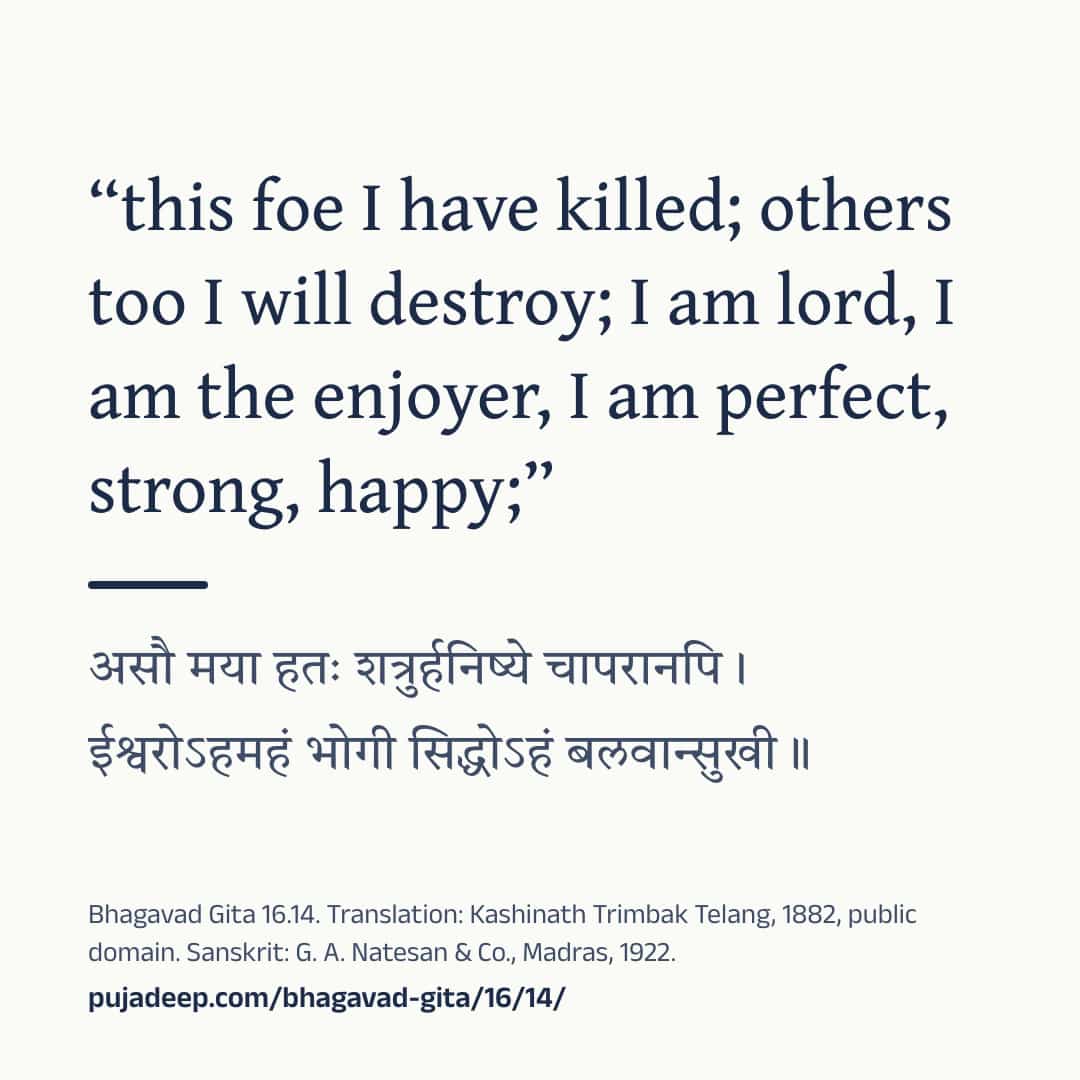
Bhagavad Gita 16.14

असौ मया हतः शत्रुर्हनिष्ये चापरानपि ।
ईश्वरोऽहमहं भोगी सिद्धोऽहं बलवान्सुखी ॥

“this foe I have killed; others too I will destroy; I am lord, I am the enjoyer, I am perfect, strong, happy;”
(K. T. Telang, The Bhagavadgîtâ (The Sacred Books of the East, vol. VIII, Oxford: Clarendon Press, 1882), p. 116, public domain)
This sentence begins in 16.13. This sentence goes on in 16.15.

“"I have slain this enemy, and others also I shall slay. I am a lord, I am the enjoyer, I am successful, I am powerful, happy;”
(Annie Besant, The Bhagavad Gîtâ, or The Lord's Song (London: Theosophical Publishing Society, 1895), pp. 142–143, public domain)
This sentence goes on in 16.15.

“"That enemy has been slain by me, and others also shall I slay. I am lord, I enjoy, I am successful, powerful and happy.”
(Swami Swarupananda, Srimad-Bhagavad-Gita (Mayavati: Prabuddha Bharata Press, 1909; first printed in Prabuddha Bharata, 1907–1909), p. 301, public domain)

Sanskrit: G. A. Natesan & Co., Madras, 1922.
https://pujadeep.com/bhagavad-gita/16/14/ Nothing is sent from this site. Your own app sends it, to the chat you choose. The picture quotes the translation you chose on this page, with its name and year.
Sanskrit text: The Bhagavad-Gita, or The Lord's Song, with the text in Devanagari and an English translation, 1922. Meanings: written for Pujadeep and checked against the cited edition. Source and changes
Questions families ask
Who speaks Bhagavad Gita 16.14?
Krishna speaks this verse, in chapter 16 (Daivasura Sampad Vibhaga Yoga).
Where does the Sanskrit text come from?
Sanskrit text: The Bhagavad-Gita, or The Lord's Song, with the text in Devanagari and an English translation, 1922. Meanings: written for Pujadeep and checked against the cited edition. See the source
Is the meaning on this page a translation?
Explanation written for this site from the sources listed here, and checked against the cited edition. It is not a translation and not the only way to read the text. Free to quote with credit.
Source and licence
- Sanskrit text
- The Bhagavad-Gita, or The Lord's Song, with the text in Devanagari and an English translation (Annie Besant, G. A. Natesan & Co., Madras, 1922). Public domain. The Sanskrit on these pages was read from this printing’s page images.
- Translation
- The Bhagavadgîtâ with the Sanatsugâtîya and the Anugîtâ, translated by Kâshinâth Trimbak Telang (The Sacred Books of the East, vol. VIII, ed. F. Max Müller) (Kashinath Trimbak Telang, F. Max Müller, Clarendon Press, Oxford, 1882). Public domain. Shown verbatim, as printed.
- Translation
- The Bhagavad Gîtâ, or The Lord's Song, translated by Annie Besant (Annie Besant, Theosophical Publishing Society, London, 1895). Public domain. Shown verbatim, as printed.
- Translation
- Srimad-Bhagavad-Gita, with Sanskrit Text; Paraphrase with Word-by-word Literal Translation; English Rendering and Comments, Index, &c., by the Swami Swarupananda (Himalayan Series, No. XX) (Swami Swarupananda, The Editors and Publishers, Advaita Ashrama, Mayavati, Prabuddha Bharata Press, Mayavati, Almora, Himalayas, 1909). Public domain. Shown verbatim, as printed.
- Common wording
- In this text, 32 words follow today's common wording, checked against sanskritdocuments.org; Sanskrit Wikisource; Gita Press, Gorakhpur; GRETIL, Göttingen and Bhaktivedanta Book Trust.
- Our explanation
- Explanation written for this site from the sources listed here, and checked against the cited edition. It is not a translation and not the only way to read the text. Free to quote with credit.
- Checked
- Checked against the cited edition, October 14, 2026.
- Updated
- October 25, 2026