Bhagavad Gita 16.17: meaning and translation
Chapter 16: Daivasura Sampad Vibhaga Yoga. Krishna says
Krishna says they think highly of themselves and are stubborn, full of the pride and intoxication of wealth.
Click or tap a word for its meaning and its dictionary page.
Text and layers
Text and layers
These choices stay in this browser.
Bhagavad Gita 16.17
आत्मसंभाविताः स्तब्धा धनमानमदान्विताः ।यजन्ते नामयज्ञैस्ते दम्भेनाविधिपूर्वकम् ॥
Atmasambhavitah stabdha dhanamanamadanvitahYajante namayajnaiste dambhenavidhipurvakam
ātmasaṃbhāvitāḥ stabdhā dhanamānamadānvitāḥ |yajante nāmayajñaiste dambhenāvidhipūrvakam ||
Our explanation Krishna says they think highly of themselves and are stubborn, full of the pride and intoxication of wealth. They perform sacrifices in name only, for show, without the rules the scriptures give.
हिंदी अर्थ कृष्ण कहते हैं कि वे अपने को ही बड़ा मानते हैं, अकड़े रहते हैं, और धन के मान और मद से भरे रहते हैं। वे केवल नाम के यज्ञ करते हैं, दिखावे के लिए, शास्त्र की विधि के बिना।
Word by word
Every word, with its dictionary page
Word by word
- आत्मसंभाविताः ātmasaṃbhāvitāḥ · self-admiring, conceited (compound (masculine), nominative plural) Dictionary: ātman, Monier-Williams 1899, p. 135, col. 1 “the individual soul, self”; sam-bhāvita, Monier-Williams 1899, p. 1179, col. 1 “thought highly of, esteemed, honoured, respected”
- स्तब्धाः stabdhāḥ · stubborn, haughty (past participle (masculine), nominative plural) Dictionary: stabdha, Monier-Williams 1899, p. 1258, col. 1 “puffed up, proud, arrogant”
- धनमानमदान्विताः dhanamānamadānvitāḥ · full of pride and intoxication of wealth (compound (masculine), nominative plural) Dictionary: dhana, Monier-Williams 1899, p. 508, col. 2 “wealth, riches, (movable) property, money, treasure”; 1. māna, Monier-Williams 1899, p. 809, col. 1 “self-conceit, arrogance, pride”; mada, Monier-Williams 1899, p. 777, col. 3 “pride, arrogance, presumption”; anv-ita, Monier-Williams 1899, p. 47, col. 2 “gone along with; joined, attended, accompanied by, connected with”
- यजन्ते yajante · perform sacrifice (present, 3rd person plural) Dictionary: 1. yaj, Monier-Williams 1899, p. 838, col. 3 “to worship, adore, honour (esp. with sacrifice or oblations)”
- नामयज्ञैः nāmayajñaiḥ · with sacrifices in name only (compound (masculine), instrumental plural) Dictionary: nāma-yajña, Monier-Williams 1899, p. 536, col. 2 “a sacrifice only in n°”; nāman, Monier-Williams 1899, p. 536, col. 2 “name, appellation”; yajña, Monier-Williams 1899, p. 839, col. 2 “worship, devotion, prayer, praise; act of worship or devotion, offering, oblation, sacrifice”
- ते te · they (pronoun (masculine), nominative plural) Dictionary: tad, Monier-Williams 1899, p. 434, col. 1 “m. he, f. she, n. it, that, this”
- दम्भेन dambhena · with show (noun (masculine), instrumental singular) Dictionary: dambha, Monier-Williams 1899, p. 469, col. 3 “deceit, fraud, feigning, hypocrisy”
- अविधिपूर्वकम् avidhipūrvakam · not by the set rule (compound, used as adverb) Dictionary: a-vidhi-pūrvakam, Monier-Williams 1899, p. 108, col. 3 “not according to rule”
1 printing differs
Edition differences. Another printing or text reads this place differently.
- Spelling A digital text reads Same word. The e-text writes the class nasal (आत्मसम्भाविताः); the 1922 edition writes anusvara (आत्मसंभाविताः).
Old translations
Kashinath Trimbak Telang, 1882. Public domain. Page 116.
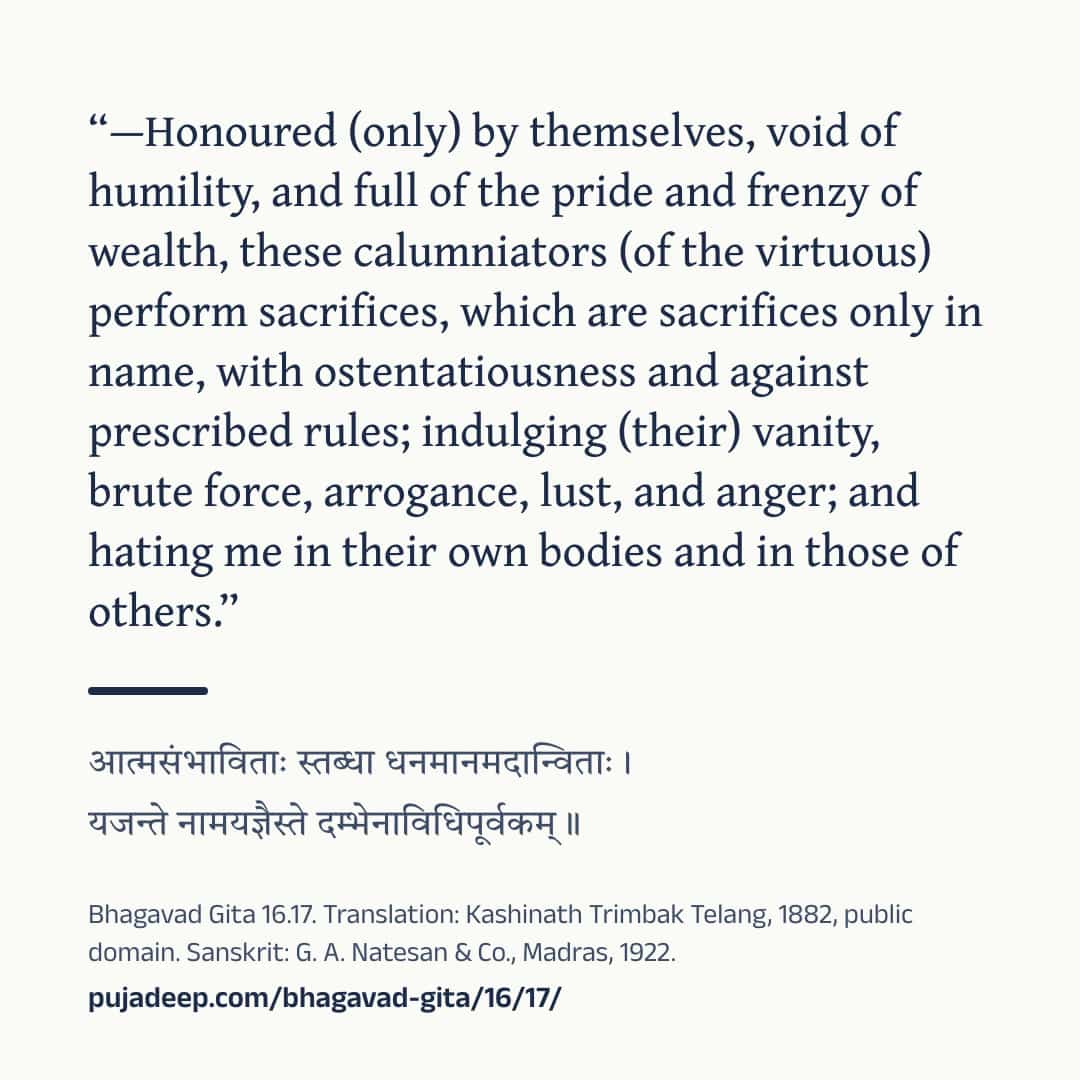
—Honoured (only) by themselves, void of humility, and full of the pride and frenzy of wealth, these calumniators (of the virtuous) perform sacrifices, which are sacrifices only in name, with ostentatiousness and against prescribed rules1; indulging (their) vanity, brute force, arrogance, lust, and anger; and hating me in their own bodies and in those of others2.
This sentence covers verses 16.17 to 16.18.
Footnotes (the translator’s own) Compare 3 translations
Kashinath Trimbak Telang, 1882. Public domain. Page 116.
—Honoured (only) by themselves, void of humility, and full of the pride and frenzy of wealth, these calumniators (of the virtuous) perform sacrifices, which are sacrifices only in name, with ostentatiousness and against prescribed rules1; indulging (their) vanity, brute force, arrogance, lust, and anger; and hating me in their own bodies and in those of others2.
This sentence covers verses 16.17 to 16.18.
Footnotes (the translator’s own) You are reading this one
Annie Besant, 1895. Public domain. Page 143.
Self-conceited, obstinate, filled with pride and the intoxication of wealth, they perform lip-sacrifices with hypocrisy, contrary to Scriptural ordinance.
You are reading this one
Swami Swarupananda, 1909 (first printed 1907). Public domain. Page 302.
Self-conceited, haughty, filled with the pride and intoxication of wealth, they perform sacrifices, in name, out of ostentation, disregarding ordinance;
This sentence goes on in 16.18.
You are reading this one
Cite this verse
The translation: K. T. Telang, The Bhagavadgîtâ (The Sacred Books of the East, vol. VIII, Oxford: Clarendon Press, 1882), p. 116. Bhagavad Gita 16.17–18.
The translation: Annie Besant, The Bhagavad Gîtâ, or The Lord's Song (London: Theosophical Publishing Society, 1895), p. 143. Bhagavad Gita 16.17.
The translation: Swami Swarupananda, Srimad-Bhagavad-Gita (Mayavati: Prabuddha Bharata Press, 1909; first printed in Prabuddha Bharata, 1907–1909), p. 302. Bhagavad Gita 16.17.
Our explanation: “Bhagavad Gita 16.17: meaning and translation.” Pujadeep. Updated October 25, 2026. https://pujadeep.com/bhagavad-gita/16/17/
Pujadeep’s explanations are free to quote with credit: name Pujadeep and link to the page. How to credit
Classical readings, by school
No readings by school on this verse yet.
Share
Show the ways to share
Send one picture or the text to one chat. The picture names its source and the address of this page.
Drawing the picture
See the words
Bhagavad Gita 16.17

आत्मसंभाविताः स्तब्धा धनमानमदान्विताः ।
यजन्ते नामयज्ञैस्ते दम्भेनाविधिपूर्वकम् ॥

“—Honoured (only) by themselves, void of humility, and full of the pride and frenzy of wealth, these calumniators (of the virtuous) perform sacrifices, which are sacrifices only in name, with ostentatiousness and against prescribed rules; indulging (their) vanity, brute force, arrogance, lust, and anger; and hating me in their own bodies and in those of others.”
(K. T. Telang, The Bhagavadgîtâ (The Sacred Books of the East, vol. VIII, Oxford: Clarendon Press, 1882), p. 116, public domain)
This sentence covers verses 16.17 to 16.18.

“Self-conceited, obstinate, filled with pride and the intoxication of wealth, they perform lip-sacrifices with hypocrisy, contrary to Scriptural ordinance.”
(Annie Besant, The Bhagavad Gîtâ, or The Lord's Song (London: Theosophical Publishing Society, 1895), p. 143, public domain)

“Self-conceited, haughty, filled with the pride and intoxication of wealth, they perform sacrifices, in name, out of ostentation, disregarding ordinance;”
(Swami Swarupananda, Srimad-Bhagavad-Gita (Mayavati: Prabuddha Bharata Press, 1909; first printed in Prabuddha Bharata, 1907–1909), p. 302, public domain)
This sentence goes on in 16.18.

Sanskrit: G. A. Natesan & Co., Madras, 1922.
https://pujadeep.com/bhagavad-gita/16/17/ Nothing is sent from this site. Your own app sends it, to the chat you choose. The picture quotes the translation you chose on this page, with its name and year.
Sanskrit text: The Bhagavad-Gita, or The Lord's Song, with the text in Devanagari and an English translation, 1922. Meanings: written for Pujadeep and checked against the cited edition. Source and changes
Questions families ask
Who speaks Bhagavad Gita 16.17?
Krishna speaks this verse, in chapter 16 (Daivasura Sampad Vibhaga Yoga).
Where does the Sanskrit text come from?
Sanskrit text: The Bhagavad-Gita, or The Lord's Song, with the text in Devanagari and an English translation, 1922. Meanings: written for Pujadeep and checked against the cited edition. See the source
Is the meaning on this page a translation?
Explanation written for this site from the sources listed here, and checked against the cited edition. It is not a translation and not the only way to read the text. Free to quote with credit.
Source and licence
- Sanskrit text
- The Bhagavad-Gita, or The Lord's Song, with the text in Devanagari and an English translation (Annie Besant, G. A. Natesan & Co., Madras, 1922). Public domain. The Sanskrit on these pages was read from this printing’s page images.
- Translation
- The Bhagavadgîtâ with the Sanatsugâtîya and the Anugîtâ, translated by Kâshinâth Trimbak Telang (The Sacred Books of the East, vol. VIII, ed. F. Max Müller) (Kashinath Trimbak Telang, F. Max Müller, Clarendon Press, Oxford, 1882). Public domain. Shown verbatim, as printed.
- Translation
- The Bhagavad Gîtâ, or The Lord's Song, translated by Annie Besant (Annie Besant, Theosophical Publishing Society, London, 1895). Public domain. Shown verbatim, as printed.
- Translation
- Srimad-Bhagavad-Gita, with Sanskrit Text; Paraphrase with Word-by-word Literal Translation; English Rendering and Comments, Index, &c., by the Swami Swarupananda (Himalayan Series, No. XX) (Swami Swarupananda, The Editors and Publishers, Advaita Ashrama, Mayavati, Prabuddha Bharata Press, Mayavati, Almora, Himalayas, 1909). Public domain. Shown verbatim, as printed.
- Common wording
- In this text, 32 words follow today's common wording, checked against sanskritdocuments.org; Sanskrit Wikisource; Gita Press, Gorakhpur; GRETIL, Göttingen and Bhaktivedanta Book Trust.
- Our explanation
- Explanation written for this site from the sources listed here, and checked against the cited edition. It is not a translation and not the only way to read the text. Free to quote with credit.
- Checked
- Checked against the cited edition, October 14, 2026.
- Updated
- October 25, 2026