Bhagavad Gita 16.12: meaning and translation
Chapter 16: Daivasura Sampad Vibhaga Yoga. Krishna says
Bound by hundreds of ropes of hope, given over to desire and anger, they try, Krishna says, to pile up wealth by unjust means, for the enjoyment of their desires.
Click or tap a word for its meaning and its dictionary page.
Text and layers
Text and layers
These choices stay in this browser.
Bhagavad Gita 16.12
आशापाशशतैर्बद्धाः कामक्रोधपरायणाः ।ईहन्ते कामभोगार्थमन्यायेनार्थसञ्चयान् ॥
Ashapashashatairbaddhah kamakrodhaparayanahIhante kamabhogarthamanyayenarthasanchayan
āśāpāśaśatairbaddhāḥ kāmakrodhaparāyaṇāḥ |īhante kāmabhogārthamanyāyenārthasañcayān ||
Our explanation Bound by hundreds of ropes of hope, given over to desire and anger, they try, Krishna says, to pile up wealth by unjust means, for the enjoyment of their desires.
हिंदी अर्थ कृष्ण कहते हैं कि आशा की सैकड़ों रस्सियों से बँधे, काम और क्रोध में डूबे, वे अपनी इच्छाओं के भोग के लिए अन्याय से धन जमा करने की कोशिश करते हैं।
Word by word
Every word, with its dictionary page
Word by word
- आशापाशशतैः āśāpāśaśataiḥ · by hundreds of ties of hope (compound (neuter), instrumental plural) Dictionary: 1. āśā, Monier-Williams 1899, p. 157, col. 1 “wish, desire, hope, expectation”; pāśa, Monier-Williams 1899, p. 623, col. 3 “a snare, trap, noose, tie, bond, cord, chain, fetter”; śata, Monier-Williams 1899, p. 1048, col. 3 “a hundred”
- बद्धाः baddhāḥ · bound (past participle (masculine), nominative plural) Dictionary: baddha, Monier-Williams 1899, p. 720, col. 2 “bound, tied, fixed, fastened, chained, fettered”
- कामक्रोधपरायणाः kāmakrodhaparāyaṇāḥ · given over to desire and anger (compound (masculine), nominative plural) Dictionary: kāma, Monier-Williams 1899, p. 271, col. 3 “wish, desire, longing”; krodha, Monier-Williams 1899, p. 322, col. 1 “anger, wrath, passion”; 1. parāyaṇa, Monier-Williams 1899, p. 587, col. 3 “wholly devoted or destined to, engaged in, intent upon”
- ईहन्ते īhante · strive for (present, 3rd person plural) Dictionary: īh, Monier-Williams 1899, p. 171, col. 2 “to endeavour to obtain; to aim at, attempt”
- कामभोगार्थम् kāmabhogārtham · for enjoying desires (compound, used as adverb) Dictionary: kāma, Monier-Williams 1899, p. 271, col. 3 “wish, desire, longing”; 2. bhoga, Monier-Williams 1899, p. 767, col. 2 “enjoyment, eating, feeding on”; artha, Monier-Williams 1899, p. 90, col. 3 “aim, purpose”
- अन्यायेन anyāyena · by unjust means (noun (masculine), instrumental singular) Dictionary: a-nyāya, Monier-Williams 1899, p. 46, col. 1 “unjust or unlawful action”
- अर्थसञ्चयान् arthasañcayān · heaps of wealth (compound (masculine), accusative plural) Dictionary: artha, Monier-Williams 1899, p. 90, col. 3 “substance, wealth, property, opulence, money”; saṃ-caya, Monier-Williams 1899, p. 1132, col. 1 “collection, gathering, accumulation, heap, hoard, store”
Old translations
Kashinath Trimbak Telang, 1882. Public domain. Page 115–116.
bound down by nets of hopes in hundreds, given up to anger and desire, they wish to obtain heaps of wealth unfairly for enjoying objects of desire.
This sentence begins in 16.11.
Compare 3 translations
Kashinath Trimbak Telang, 1882. Public domain. Page 115–116.
bound down by nets of hopes in hundreds, given up to anger and desire, they wish to obtain heaps of wealth unfairly for enjoying objects of desire.
This sentence begins in 16.11.
You are reading this one
Annie Besant, 1895. Public domain. Page 142.
Held in bondage by a hundred ties of expectation, given over to lust and anger, they strive to obtain by unlawful means hoards of wealth for sensual enjoyments.
This sentence begins in 16.11.
You are reading this one
Swami Swarupananda, 1909 (first printed 1907). Public domain. Page 300.
Bound by a hundred ties of hope, given over to lust and wrath, they strive to secure by unjust means hoards of wealth for sensual enjoyment.
This sentence begins in 16.11.
You are reading this one
Cite this verse
The translation: K. T. Telang, The Bhagavadgîtâ (The Sacred Books of the East, vol. VIII, Oxford: Clarendon Press, 1882), pp. 115–116. Bhagavad Gita 16.12.
The translation: Annie Besant, The Bhagavad Gîtâ, or The Lord's Song (London: Theosophical Publishing Society, 1895), p. 142. Bhagavad Gita 16.12.
The translation: Swami Swarupananda, Srimad-Bhagavad-Gita (Mayavati: Prabuddha Bharata Press, 1909; first printed in Prabuddha Bharata, 1907–1909), p. 300. Bhagavad Gita 16.12.
Our explanation: “Bhagavad Gita 16.12: meaning and translation.” Pujadeep. Updated October 25, 2026. https://pujadeep.com/bhagavad-gita/16/12/
Pujadeep’s explanations are free to quote with credit: name Pujadeep and link to the page. How to credit
Classical readings, by school
No readings by school on this verse yet.
Share
Show the ways to share
Send one picture or the text to one chat. The picture names its source and the address of this page.
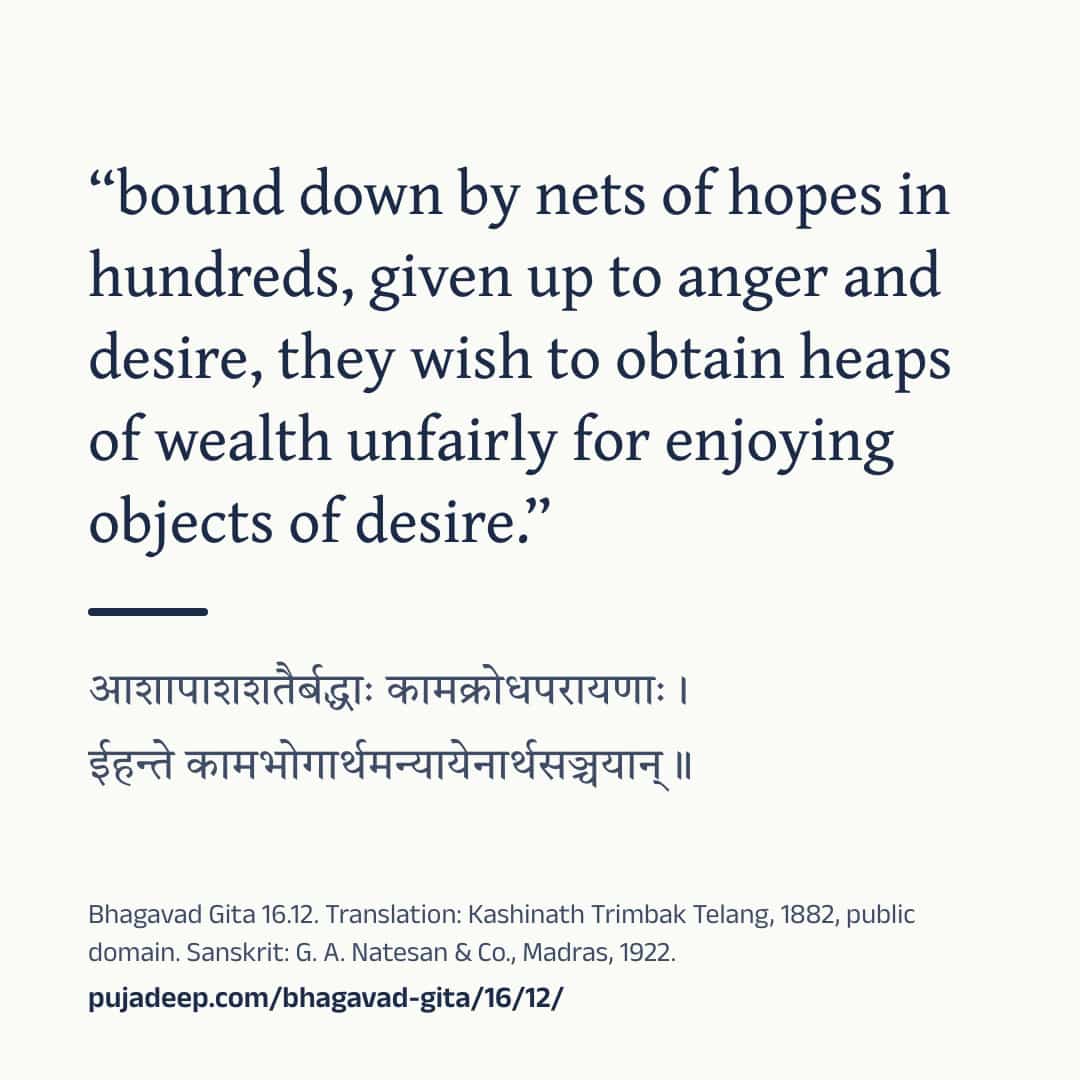
Drawing the picture
See the words
Bhagavad Gita 16.12

आशापाशशतैर्बद्धाः कामक्रोधपरायणाः ।
ईहन्ते कामभोगार्थमन्यायेनार्थसञ्चयान् ॥

“bound down by nets of hopes in hundreds, given up to anger and desire, they wish to obtain heaps of wealth unfairly for enjoying objects of desire.”
(K. T. Telang, The Bhagavadgîtâ (The Sacred Books of the East, vol. VIII, Oxford: Clarendon Press, 1882), pp. 115–116, public domain)
This sentence begins in 16.11.

“Held in bondage by a hundred ties of expectation, given over to lust and anger, they strive to obtain by unlawful means hoards of wealth for sensual enjoyments.”
(Annie Besant, The Bhagavad Gîtâ, or The Lord's Song (London: Theosophical Publishing Society, 1895), p. 142, public domain)
This sentence begins in 16.11.

“Bound by a hundred ties of hope, given over to lust and wrath, they strive to secure by unjust means hoards of wealth for sensual enjoyment.”
(Swami Swarupananda, Srimad-Bhagavad-Gita (Mayavati: Prabuddha Bharata Press, 1909; first printed in Prabuddha Bharata, 1907–1909), p. 300, public domain)
This sentence begins in 16.11.

Sanskrit: G. A. Natesan & Co., Madras, 1922.
https://pujadeep.com/bhagavad-gita/16/12/ Nothing is sent from this site. Your own app sends it, to the chat you choose. The picture quotes the translation you chose on this page, with its name and year.
Sanskrit text: The Bhagavad-Gita, or The Lord's Song, with the text in Devanagari and an English translation, 1922. Meanings: written for Pujadeep and checked against the cited edition. Source and changes
Questions families ask
Who speaks Bhagavad Gita 16.12?
Krishna speaks this verse, in chapter 16 (Daivasura Sampad Vibhaga Yoga).
Where does the Sanskrit text come from?
Sanskrit text: The Bhagavad-Gita, or The Lord's Song, with the text in Devanagari and an English translation, 1922. Meanings: written for Pujadeep and checked against the cited edition. See the source
Is the meaning on this page a translation?
Explanation written for this site from the sources listed here, and checked against the cited edition. It is not a translation and not the only way to read the text. Free to quote with credit.
Source and licence
- Sanskrit text
- The Bhagavad-Gita, or The Lord's Song, with the text in Devanagari and an English translation (Annie Besant, G. A. Natesan & Co., Madras, 1922). Public domain. The Sanskrit on these pages was read from this printing’s page images.
- Translation
- The Bhagavadgîtâ with the Sanatsugâtîya and the Anugîtâ, translated by Kâshinâth Trimbak Telang (The Sacred Books of the East, vol. VIII, ed. F. Max Müller) (Kashinath Trimbak Telang, F. Max Müller, Clarendon Press, Oxford, 1882). Public domain. Shown verbatim, as printed.
- Translation
- The Bhagavad Gîtâ, or The Lord's Song, translated by Annie Besant (Annie Besant, Theosophical Publishing Society, London, 1895). Public domain. Shown verbatim, as printed.
- Translation
- Srimad-Bhagavad-Gita, with Sanskrit Text; Paraphrase with Word-by-word Literal Translation; English Rendering and Comments, Index, &c., by the Swami Swarupananda (Himalayan Series, No. XX) (Swami Swarupananda, The Editors and Publishers, Advaita Ashrama, Mayavati, Prabuddha Bharata Press, Mayavati, Almora, Himalayas, 1909). Public domain. Shown verbatim, as printed.
- Common wording
- In this text, 32 words follow today's common wording, checked against sanskritdocuments.org; Sanskrit Wikisource; Gita Press, Gorakhpur; GRETIL, Göttingen and Bhaktivedanta Book Trust.
- Our explanation
- Explanation written for this site from the sources listed here, and checked against the cited edition. It is not a translation and not the only way to read the text. Free to quote with credit.
- Checked
- Checked against the cited edition, October 14, 2026.
- Updated
- October 25, 2026