Bhagavad Gita 16.6: meaning and translation
Chapter 16: Daivasura Sampad Vibhaga Yoga. Krishna says
Krishna says there are two kinds of created beings in this world, the divine (daiva) and the asura.
Click or tap a word for its meaning and its dictionary page.
Text and layers
Text and layers
These choices stay in this browser.
Bhagavad Gita 16.6
द्वौ भूतसर्गौ लोकेऽस्मिन्दैव आसुर एव च ।दैवो विस्तरशः प्रोक्त आसुरं पार्थ मे शृणु ॥
Dvau bhutasargau lokesmindaiva asura eva chaDaivo vistarashah prokta asuram partha me shrinu
dvau bhūtasargau loke’smindaiva āsura eva ca |daivo vistaraśaḥ prokta āsuraṃ pārtha me śṛṇu ||
Our explanation Krishna says there are two kinds of created beings in this world, the divine (daiva) and the asura. He has spoken of the divine at length; now he asks Arjuna (Partha) to hear about the asura. The commentators read what follows as a nature found in people, not as a people (see the views). Readings of these verses differ between schools and teachers, and the wording is the text's, not the view of this library.
हिंदी अर्थ कृष्ण कहते हैं कि इस संसार में दो प्रकार की सृष्टि है, दैवी और आसुरी। दैवी का वर्णन वे विस्तार से कर चुके हैं; अब वे अर्जुन (पार्थ) से आसुरी के बारे में सुनने को कहते हैं। टीकाकार आगे के वर्णन को मनुष्यों में मिलने वाला एक स्वभाव मानते हैं, कोई अलग जाति या समुदाय नहीं। इन श्लोकों को अलग-अलग परंपराएँ और आचार्य अलग ढंग से पढ़ते हैं, और ये शब्द पाठ के हैं, इस पुस्तकालय का मत नहीं।
Word by word
Every word, with its dictionary page
Word by word
- द्वौ dvau · two (adjective (masculine), nominative dual) Dictionary: dva, Monier-Williams 1899, p. 503, col. 2 “two”
- भूतसर्गौ bhūtasargau · kinds of created beings (compound (masculine), nominative dual) Dictionary: bhūta, Monier-Williams 1899, p. 761, col. 3 “that which is or exists, any living being”; sarga, Monier-Williams 1899, p. 1184, col. 1 “emission or creation of matter, primary creation”
- लोके loke · in the world (noun (masculine), locative singular) Dictionary: loka, Monier-Williams 1899, p. 906, col. 1 “the wide space or world”
- अस्मिन् asmin · in this (pronoun (masculine), locative singular) Dictionary: 1. idam, Monier-Williams 1899, p. 165, col. 2 “this, this here, referring to something near the speaker”
- दैवः daivaḥ · the divine (adjective (masculine), nominative singular) Dictionary: 1. daiva, Monier-Williams 1899, p. 497, col. 2 “belonging to or coming from the gods, divine, celestial”
- आसुरः āsuraḥ · the asura (adjective (masculine), nominative singular) Dictionary: 1. āsura, Monier-Williams 1899, p. 160, col. 3 “belonging or relating to the Asuras”
- एव eva · also (indeclinable) Dictionary: 1. eva, Monier-Williams 1899, p. 232, col. 2 “just, exactly, very, same, only, even, alone, merely”
- च ca · and (indeclinable) Dictionary: 2. ca, Monier-Williams 1899, p. 380, col. 1 “and, both, also, moreover, as well as”
- दैवः daivaḥ · the divine (kind) (adjective (masculine), nominative singular) Dictionary: 1. daiva, Monier-Williams 1899, p. 497, col. 2 “belonging to or coming from the gods, divine, celestial”
- विस्तरशः vistaraśaḥ · at length (indeclinable) Dictionary: vi-stara-śas, Monier-Williams 1899, p. 1001, col. 3; vi-stara-tas, Monier-Williams 1899, p. 1001, col. 3 “diffusely, at length”
- प्रोक्तः proktaḥ · has been told (past participle (masculine), nominative singular) Dictionary: prokta, Monier-Williams 1899, p. 690, col. 2 “announced, told, taught, mentioned”
- आसुरम् āsuram · the asura (kind) (adjective (masculine), accusative singular) Dictionary: 1. āsura, Monier-Williams 1899, p. 160, col. 3 “belonging or relating to the Asuras”
- पार्थ pārtha · O son of Pritha (Arjuna) (noun (masculine), vocative singular) Dictionary: 2. pārtha, Monier-Williams 1899, p. 621, col. 3 “metron. of Yudhi-shṭhira or Bhīma-sena or Arjuna”
- मे me · from "me" (Krishna) (pronoun, genitive singular) Dictionary: 1. mad, Monier-Williams 1899, p. 777, col. 2 “base of the first pers. pron. in the sg. number (esp. in comp.)”
- शृणु śṛṇu · hear (imperative, 2nd person singular) Dictionary: 1. śru, Monier-Williams 1899, p. 1100, col. 3 “to hear, listen or attend to anything”
Old translations
Kashinath Trimbak Telang, 1882. Public domain. Page 115.
(There are) two classes of created beings in this world, the godlike and the demoniac; the godlike (class) has been described at length; now hear from me, O son of Prithâ! about the demoniac.
Compare 3 translations
Kashinath Trimbak Telang, 1882. Public domain. Page 115.
(There are) two classes of created beings in this world, the godlike and the demoniac; the godlike (class) has been described at length; now hear from me, O son of Prithâ! about the demoniac.
You are reading this one
Annie Besant, 1895. Public domain. Page 141.
There are two streams of beings in this world, the divine and also the âsuric; the divine hath been described at length; hear from Me, O Pârtha, the âsuric.
You are reading this one
Swami Swarupananda, 1909 (first printed 1907). Public domain. Page 297.
There are two manifestations of beings in this world, the divine and the Asuric. The divine has been described at length; hear from Me, O Pârtha, of the Asuric.
You are reading this one
Cite this verse
The translation: K. T. Telang, The Bhagavadgîtâ (The Sacred Books of the East, vol. VIII, Oxford: Clarendon Press, 1882), p. 115. Bhagavad Gita 16.6.
The translation: Annie Besant, The Bhagavad Gîtâ, or The Lord's Song (London: Theosophical Publishing Society, 1895), p. 141. Bhagavad Gita 16.6.
The translation: Swami Swarupananda, Srimad-Bhagavad-Gita (Mayavati: Prabuddha Bharata Press, 1909; first printed in Prabuddha Bharata, 1907–1909), p. 297. Bhagavad Gita 16.6.
Our explanation: “Bhagavad Gita 16.6: meaning and translation.” Pujadeep. Updated October 25, 2026. https://pujadeep.com/bhagavad-gita/16/6/
Pujadeep’s explanations are free to quote with credit: name Pujadeep and link to the page. How to credit
Classical readings, by school
Each reading is named by its school. None is presented as the only meaning.
What Advaita, Vishishtadvaita and Dvaita teach, in short
Shankara Advaita
Shankara says every being in this world belongs to one of the two creations, and cites the Bṛhadāraṇyaka Upaniṣad: Prajāpati's offspring are of two kinds, devas and asuras. The asura nature is described in detail, to the end of the chapter, as a trait found in some living people, because only what is recognised can be avoided; Arjuna is to hear it in order to avoid it.
Source: The Bhagavad-Gita, with the commentary of Sri Sankaracharya, translated by A. Mahadeva Sastri (2nd ed., Mysore: G. T. A. Printing Works, 1901), commentary on 16.6, pp. 375–376. Summarised in our own words; none of its text is reproduced.
Ramanuja Vishishtadvaita
Ramanuja says beings are born either to follow the Lord's commands or to rebel against them, as the merit and fault of their past lives decide. The divine kind, already described at length, walks by the Lord's will in karma-yoga, jñāna-yoga and bhakti-yoga; Krishna now describes the other kind, what they are born for and how they act.
Source: Sri Bhagavad-Gita with Sri Ramanujacharya's Visishtadvaita commentary, translated by A. Govindacharya (Madras, 1898), commentary on 16.6, pp. 488–489. Summarised in our own words; none of its text is reproduced.
Share
Show the ways to share
Send one picture or the text to one chat. The picture names its source and the address of this page.
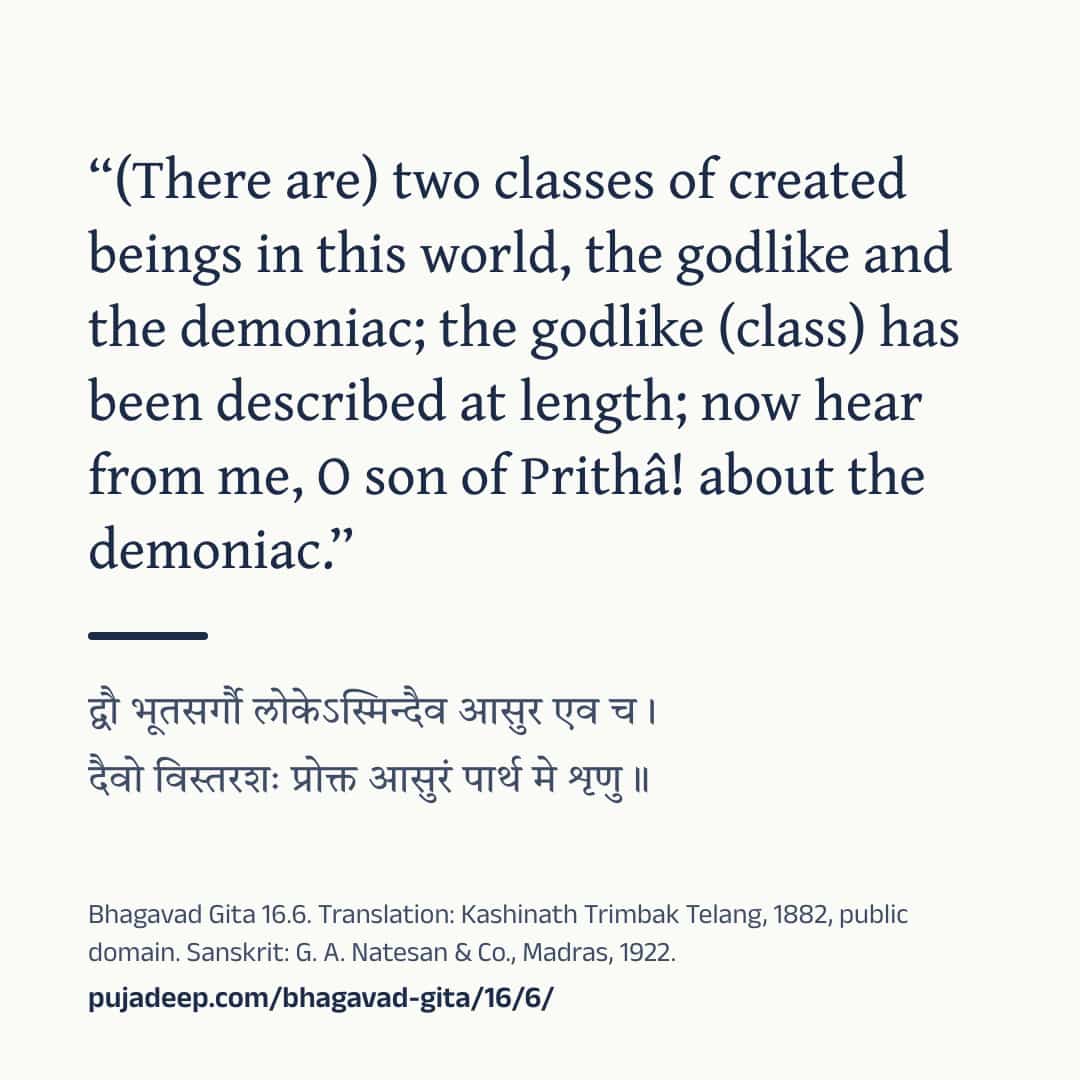
Drawing the picture
See the words
Bhagavad Gita 16.6

द्वौ भूतसर्गौ लोकेऽस्मिन्दैव आसुर एव च ।
दैवो विस्तरशः प्रोक्त आसुरं पार्थ मे शृणु ॥

“(There are) two classes of created beings in this world, the godlike and the demoniac; the godlike (class) has been described at length; now hear from me, O son of Prithâ! about the demoniac.”
(K. T. Telang, The Bhagavadgîtâ (The Sacred Books of the East, vol. VIII, Oxford: Clarendon Press, 1882), p. 115, public domain)

“There are two streams of beings in this world, the divine and also the âsuric; the divine hath been described at length; hear from Me, O Pârtha, the âsuric.”
(Annie Besant, The Bhagavad Gîtâ, or The Lord's Song (London: Theosophical Publishing Society, 1895), p. 141, public domain)

“There are two manifestations of beings in this world, the divine and the Asuric. The divine has been described at length; hear from Me, O Pârtha, of the Asuric.”
(Swami Swarupananda, Srimad-Bhagavad-Gita (Mayavati: Prabuddha Bharata Press, 1909; first printed in Prabuddha Bharata, 1907–1909), p. 297, public domain)

Sanskrit: G. A. Natesan & Co., Madras, 1922.
https://pujadeep.com/bhagavad-gita/16/6/ Nothing is sent from this site. Your own app sends it, to the chat you choose. The picture quotes the translation you chose on this page, with its name and year.
Sanskrit text: The Bhagavad-Gita, or The Lord's Song, with the text in Devanagari and an English translation, 1922. Meanings: written for Pujadeep and checked against the cited edition. Source and changes
Questions families ask
Who speaks Bhagavad Gita 16.6?
Krishna speaks this verse, in chapter 16 (Daivasura Sampad Vibhaga Yoga).
Where does the Sanskrit text come from?
Sanskrit text: The Bhagavad-Gita, or The Lord's Song, with the text in Devanagari and an English translation, 1922. Meanings: written for Pujadeep and checked against the cited edition. See the source
Is the meaning on this page a translation?
Explanation written for this site from the sources listed here, and checked against the cited edition. It is not a translation and not the only way to read the text. Free to quote with credit.
Source and licence
- Sanskrit text
- The Bhagavad-Gita, or The Lord's Song, with the text in Devanagari and an English translation (Annie Besant, G. A. Natesan & Co., Madras, 1922). Public domain. The Sanskrit on these pages was read from this printing’s page images.
- Translation
- The Bhagavadgîtâ with the Sanatsugâtîya and the Anugîtâ, translated by Kâshinâth Trimbak Telang (The Sacred Books of the East, vol. VIII, ed. F. Max Müller) (Kashinath Trimbak Telang, F. Max Müller, Clarendon Press, Oxford, 1882). Public domain. Shown verbatim, as printed.
- Translation
- The Bhagavad Gîtâ, or The Lord's Song, translated by Annie Besant (Annie Besant, Theosophical Publishing Society, London, 1895). Public domain. Shown verbatim, as printed.
- Translation
- Srimad-Bhagavad-Gita, with Sanskrit Text; Paraphrase with Word-by-word Literal Translation; English Rendering and Comments, Index, &c., by the Swami Swarupananda (Himalayan Series, No. XX) (Swami Swarupananda, The Editors and Publishers, Advaita Ashrama, Mayavati, Prabuddha Bharata Press, Mayavati, Almora, Himalayas, 1909). Public domain. Shown verbatim, as printed.
- Commentary
- The Bhagavad-Gita, with the commentary of Sri Sankaracharya, translated by A. Mahadeva Sastri (2nd ed., Mysore: G. T. A. Printing Works, 1901) (Public-domain scan, University of California Libraries). Summarised in our own words; none of its text is reproduced.
- Commentary
- Sri Bhagavad-Gita with Sri Ramanujacharya's Visishtadvaita commentary, translated by A. Govindacharya (Madras, 1898) (Scan uploaded to archive.org (folkscanomy collection)). Summarised in our own words; none of its text is reproduced.
- Common wording
- In this text, 32 words follow today's common wording, checked against sanskritdocuments.org; Sanskrit Wikisource; Gita Press, Gorakhpur; GRETIL, Göttingen and Bhaktivedanta Book Trust.
- Our explanation
- Explanation written for this site from the sources listed here, and checked against the cited edition. It is not a translation and not the only way to read the text. Free to quote with credit.
- Checked
- Checked against the cited edition, October 14, 2026.
- Updated
- October 25, 2026