Bhagavad Gita 16.1: meaning and translation
Chapter 16: Daivasura Sampad Vibhaga Yoga. Krishna says
Krishna speaks.
Click or tap a word for its meaning and its dictionary page.
Text and layers
Text and layers
These choices stay in this browser.
Bhagavad Gita 16.1
श्रीभगवानुवाच ।
अभयं सत्त्वसंशुद्धिर्ज्ञानयोगव्यवस्थितिः ।दानं दमश्च यज्ञश्च स्वाध्यायस्तप आर्जवम् ॥
Abhayam sattvasanshuddhirjnanayogavyavasthitihDanam damashcha yajnashcha svadhyayastapa arjavam
abhayaṃ sattvasaṃśuddhirjñānayogavyavasthitiḥ |dānaṃ damaśca yajñaśca svādhyāyastapa ārjavam ||
Our explanation Krishna speaks. He begins a list of the qualities of one born to the divine endowment (daivī sampad), which runs to verse 3: fearlessness, purity of mind (sattva-saṃśuddhi), steadiness in the path of knowledge (jñāna-yoga), giving, self-control, sacrifice (yajña), study of the scriptures (svādhyāya), austerity (tapas) and straightness.
हिंदी अर्थ कृष्ण बोलते हैं। वे दैवी संपदा के साथ जन्मे व्यक्ति के गुणों की सूची शुरू करते हैं, जो श्लोक 3 तक चलती है: अभय (निडरता), मन की शुद्धि, ज्ञानयोग में स्थिरता, दान, इंद्रियों पर संयम, यज्ञ, स्वाध्याय (शास्त्रों का अध्ययन), तप और सरलता (आर्जव)।
Word by word
Every word, with its dictionary page
Word by word
- अभयम् abhayam · fearlessness (noun (neuter), nominative singular) Dictionary: a-bhaya, Monier-Williams 1899, p. 60, col. 3 “absence or removal of fear, peace, safety, security”
- सत्त्वसंशुद्धिः sattvasaṃśuddhiḥ · purity of one's inner being (compound (feminine), nominative singular) Dictionary: sat-tva, Monier-Williams 1899, p. 1135, col. 2 “true essence, nature, disposition of mind, character”; saṃ-śuddhi, Monier-Williams 1899, p. 1117, col. 3 “perfect purification or purity”
- ज्ञानयोगव्यवस्थितिः jñānayogavyavasthitiḥ · steadfastness in knowledge and yoga (compound (feminine), nominative singular) Dictionary: jñāna, Monier-Williams 1899, p. 426, col. 1 “knowing, becoming acquainted with, knowledge”; yoga, Monier-Williams 1899, p. 856, col. 3 “application or concentration of the thoughts, abstract contemplation, meditation”; vy-avasthiti, Monier-Williams 1899, p. 1034, col. 1 “constancy, steadfastness”
- दानम् dānam · giving, charity (noun (neuter), nominative singular) Dictionary: 1. dāna, Monier-Williams 1899, p. 474, col. 1 “the act of giving”
- दमः damaḥ · self-restraint (noun (masculine), nominative singular) Dictionary: dama, Monier-Williams 1899, p. 469, col. 2 “self-command, self-restraint, self-control”
- च ca · and (indeclinable) Dictionary: 2. ca, Monier-Williams 1899, p. 380, col. 1 “and, both, also, moreover, as well as”
- यज्ञः yajñaḥ · sacrifice, worship (noun (masculine), nominative singular) Dictionary: yajña, Monier-Williams 1899, p. 839, col. 2 “worship, devotion, prayer, praise; act of worship or devotion, offering, oblation, sacrifice”
- च ca · and (indeclinable) Dictionary: 2. ca, Monier-Williams 1899, p. 380, col. 1 “and, both, also, moreover, as well as”
- स्वाध्यायः svādhyāyaḥ · study of scripture (noun (masculine), nominative singular) Dictionary: 1. svā-dhyāya, Monier-Williams 1899, p. 1277, col. 2 “recitation or perusal of any sacred texts”
- तपः tapaḥ · austerity (noun (neuter), nominative singular) Dictionary: tapas, Monier-Williams 1899, p. 437, col. 1 “religious austerity, bodily mortification, penance, severe meditation”
- आर्जवम् ārjavam · straightforwardness (noun (neuter), nominative singular) Dictionary: ārjava, Monier-Williams 1899, p. 151, col. 3 “honesty, frankness, sincerity”
Old translations
Kashinath Trimbak Telang, 1882. Public domain. Page 114.
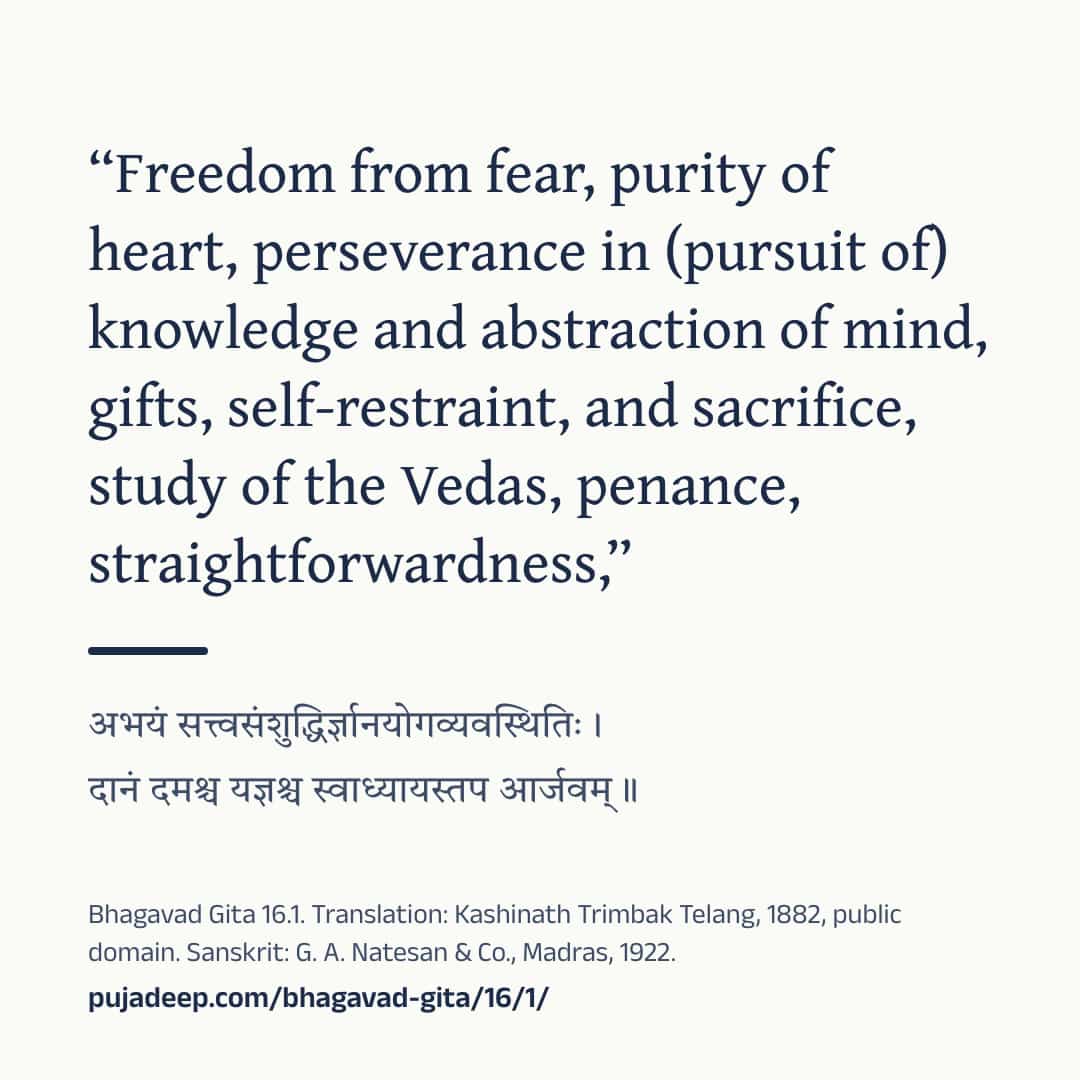
Freedom from fear, purity of heart, perseverance in (pursuit of) knowledge and abstraction of mind, gifts1, self-restraint2, and sacrifice, study of the Vedas, penance, straightforwardness,
This sentence goes on in 16.2.
Footnotes (the translator’s own) Compare 3 translations
Kashinath Trimbak Telang, 1882. Public domain. Page 114.
Freedom from fear, purity of heart, perseverance in (pursuit of) knowledge and abstraction of mind, gifts1, self-restraint2, and sacrifice, study of the Vedas, penance, straightforwardness,
This sentence goes on in 16.2.
Footnotes (the translator’s own) You are reading this one
Annie Besant, 1895. Public domain. Page 140.
Fearlessness, purity of heart, steadfastness in the Yoga of wisdom, almsgiving, self-restraint and sacrifice and study of the Shâstras, austerity and straightforwardness,
This sentence goes on in 16.2.
You are reading this one
Swami Swarupananda, 1909 (first printed 1907). Public domain. Page 295.
The Blessed Lord said:
Fearlessness, purity of heart, steadfastness in knowledge and Yoga, giving away as charity, control of the senses, Yajna, reading of the Shástras, austerity, uprightness;
This sentence goes on in 16.2.
You are reading this one
Cite this verse
The translation: K. T. Telang, The Bhagavadgîtâ (The Sacred Books of the East, vol. VIII, Oxford: Clarendon Press, 1882), p. 114. Bhagavad Gita 16.1.
The translation: Annie Besant, The Bhagavad Gîtâ, or The Lord's Song (London: Theosophical Publishing Society, 1895), p. 140. Bhagavad Gita 16.1.
The translation: Swami Swarupananda, Srimad-Bhagavad-Gita (Mayavati: Prabuddha Bharata Press, 1909; first printed in Prabuddha Bharata, 1907–1909), p. 295. Bhagavad Gita 16.1.
Our explanation: “Bhagavad Gita 16.1: meaning and translation.” Pujadeep. Updated October 25, 2026. https://pujadeep.com/bhagavad-gita/16/1/
Pujadeep’s explanations are free to quote with credit: name Pujadeep and link to the page. How to credit
Classical readings, by school
No readings by school on this verse yet.
Share
Show the ways to share
Send one picture or the text to one chat. The picture names its source and the address of this page.
Drawing the picture
See the words
Bhagavad Gita 16.1

अभयं सत्त्वसंशुद्धिर्ज्ञानयोगव्यवस्थितिः ।
दानं दमश्च यज्ञश्च स्वाध्यायस्तप आर्जवम् ॥

“Freedom from fear, purity of heart, perseverance in (pursuit of) knowledge and abstraction of mind, gifts, self-restraint, and sacrifice, study of the Vedas, penance, straightforwardness,”
(K. T. Telang, The Bhagavadgîtâ (The Sacred Books of the East, vol. VIII, Oxford: Clarendon Press, 1882), p. 114, public domain)
This sentence goes on in 16.2.

“Fearlessness, purity of heart, steadfastness in the Yoga of wisdom, almsgiving, self-restraint and sacrifice and study of the Shâstras, austerity and straightforwardness,”
(Annie Besant, The Bhagavad Gîtâ, or The Lord's Song (London: Theosophical Publishing Society, 1895), p. 140, public domain)
This sentence goes on in 16.2.

“Fearlessness, purity of heart, steadfastness in knowledge and Yoga, giving away as charity, control of the senses, Yajna, reading of the Shástras, austerity, uprightness;”
(Swami Swarupananda, Srimad-Bhagavad-Gita (Mayavati: Prabuddha Bharata Press, 1909; first printed in Prabuddha Bharata, 1907–1909), p. 295, public domain)
This sentence goes on in 16.2.

Sanskrit: G. A. Natesan & Co., Madras, 1922.
https://pujadeep.com/bhagavad-gita/16/1/ Nothing is sent from this site. Your own app sends it, to the chat you choose. The picture quotes the translation you chose on this page, with its name and year.
Sanskrit text: The Bhagavad-Gita, or The Lord's Song, with the text in Devanagari and an English translation, 1922. Meanings: written for Pujadeep and checked against the cited edition. Source and changes
Questions families ask
Who speaks Bhagavad Gita 16.1?
Krishna speaks this verse, in chapter 16 (Daivasura Sampad Vibhaga Yoga).
Where does the Sanskrit text come from?
Sanskrit text: The Bhagavad-Gita, or The Lord's Song, with the text in Devanagari and an English translation, 1922. Meanings: written for Pujadeep and checked against the cited edition. See the source
Is the meaning on this page a translation?
Explanation written for this site from the sources listed here, and checked against the cited edition. It is not a translation and not the only way to read the text. Free to quote with credit.
Source and licence
- Sanskrit text
- The Bhagavad-Gita, or The Lord's Song, with the text in Devanagari and an English translation (Annie Besant, G. A. Natesan & Co., Madras, 1922). Public domain. The Sanskrit on these pages was read from this printing’s page images.
- Translation
- The Bhagavadgîtâ with the Sanatsugâtîya and the Anugîtâ, translated by Kâshinâth Trimbak Telang (The Sacred Books of the East, vol. VIII, ed. F. Max Müller) (Kashinath Trimbak Telang, F. Max Müller, Clarendon Press, Oxford, 1882). Public domain. Shown verbatim, as printed.
- Translation
- The Bhagavad Gîtâ, or The Lord's Song, translated by Annie Besant (Annie Besant, Theosophical Publishing Society, London, 1895). Public domain. Shown verbatim, as printed.
- Translation
- Srimad-Bhagavad-Gita, with Sanskrit Text; Paraphrase with Word-by-word Literal Translation; English Rendering and Comments, Index, &c., by the Swami Swarupananda (Himalayan Series, No. XX) (Swami Swarupananda, The Editors and Publishers, Advaita Ashrama, Mayavati, Prabuddha Bharata Press, Mayavati, Almora, Himalayas, 1909). Public domain. Shown verbatim, as printed.
- Common wording
- In this text, 32 words follow today's common wording, checked against sanskritdocuments.org; Sanskrit Wikisource; Gita Press, Gorakhpur; GRETIL, Göttingen and Bhaktivedanta Book Trust.
- Our explanation
- Explanation written for this site from the sources listed here, and checked against the cited edition. It is not a translation and not the only way to read the text. Free to quote with credit.
- Checked
- Checked against the cited edition, October 14, 2026.
- Updated
- October 25, 2026