Bhagavad Gita 16.2: meaning and translation
Chapter 16: Daivasura Sampad Vibhaga Yoga. Krishna says
Krishna: The list goes on: non-harming (ahiṃsā), truthfulness, freedom from anger, renunciation, calm, not speaking ill of others, kindness to all beings, freedom from greed, gentleness, a sense of shame at wrong (hrī) and freedom from restless, pointless action.
Click or tap a word for its meaning and its dictionary page.
Text and layers
Text and layers
These choices stay in this browser.
Bhagavad Gita 16.2
अहिंसा सत्यमक्रोधस्त्यागः शान्तिरपैशुनम् ।दया भूतेष्वलोलुप्त्वं मार्दवं ह्रीरचापलम् ॥
Ahinsa satyamakrodhastyagah shantirapaishunamDaya bhuteshvaloluptvam mardavam hrirachapalam
ahiṃsā satyamakrodhastyāgaḥ śāntirapaiśunam |dayā bhūteṣvaloluptvaṃ mārdavaṃ hrīracāpalam ||
Our explanation The list goes on: non-harming (ahiṃsā), truthfulness, freedom from anger, renunciation, calm, not speaking ill of others, kindness to all beings, freedom from greed, gentleness, a sense of shame at wrong (hrī) and freedom from restless, pointless action.
हिंदी अर्थ सूची आगे चलती है: अहिंसा, सत्य, क्रोध न करना, त्याग, शांति, किसी की चुगली या निंदा न करना, सब प्राणियों पर दया, लोभ न होना, कोमलता, गलत काम से लज्जा (ह्री) और चंचलता न होना।
Word by word
Every word, with its dictionary page
Word by word
- अहिंसा ahiṃsā · not harming (noun (feminine), nominative singular) Dictionary: a-hiṃsā, Monier-Williams 1899, p. 125, col. 2 “not injuring anything, harmlessness”
- सत्यम् satyam · truthfulness (noun (neuter), nominative singular) Dictionary: satya, Monier-Williams 1899, p. 1135, col. 3 “true, real, actual, genuine, sincere, honest, truthful”
- अक्रोधः akrodhaḥ · freedom from anger (noun (masculine), nominative singular) Dictionary: a-krodha, Monier-Williams 1899, p. 3, col. 1 “suppression of anger”
- त्यागः tyāgaḥ · renunciation (noun (masculine), nominative singular) Dictionary: tyāga, Monier-Williams 1899, p. 456, col. 3 “leaving, abandoning, forsaking”
- शान्तिः śāntiḥ · calm, peace (noun (feminine), nominative singular) Dictionary: śānti, Monier-Williams 1899, p. 1064, col. 3 “tranquillity, peace, quiet, peace or calmness of mind”
- अपैशुनम् apaiśunam · not slandering (noun (neuter), nominative singular) Dictionary: a-paiśuna, Monier-Williams 1899, p. 56, col. 3 “non-calumny”
- दया dayā · compassion (noun (feminine), nominative singular) Dictionary: dayā, Monier-Williams 1899, p. 469, col. 3 “sympathy, compassion, pity”
- भूतेषु bhūteṣu · for living beings (noun (neuter), locative plural) Dictionary: bhūta, Monier-Williams 1899, p. 761, col. 3 “that which is or exists, any living being”
- अलोलुप्त्वम् aloluptvam · freedom from greed (noun (neuter), nominative singular) Dictionary: a-lolupa-tva, Monier-Williams 1899, p. 95, col. 2 “freedom from any desire”
- मार्दवम् mārdavam · gentleness (noun (neuter), nominative singular) Dictionary: mārdava, Monier-Williams 1899, p. 813, col. 2 “softness (lit. and fig.), pliancy, weakness, gentleness, kindness”
- ह्रीः hrīḥ · modesty (noun (feminine), nominative singular) Dictionary: 2. hrī, Monier-Williams 1899, p. 1307, col. 2 “shame, modesty, shyness, timidity”
- अचापलम् acāpalam · steadiness, no fickleness (noun (neuter), nominative singular) Dictionary: cāpala, Monier-Williams 1899, p. 393, col. 1 “agitation, unsteadiness, fickleness”
1 printing differs
Edition differences. Another printing or text reads this place differently.
- The printed edition reads: अहिंसा सत्यमक्रोधस्त्यागः शान्तिरपैशुनम् ।
दया भूतेष्वलोलुप्त्व मार्दवं ह्रीरचापलम् ॥ The print has no anusvara on त्व (भूतेष्वलोलुप्त्व, leaf n227); read as a dropped sort and restored to अलोलुप्त्वं ('freedom from greed', a neuter noun in the nominative like the other nouns of the list), as both proofreading references read.
Old translations
Kashinath Trimbak Telang, 1882. Public domain. Page 114.
harmlessness, truth1, freedom from anger, renunciation2, tranquillity, freedom from the habit of backbiting3, compassion for (all) beings, freedom from avarice, gentleness, modesty, absence of vain activity,
This sentence begins in 16.1. This sentence goes on in 16.3.
Footnotes (the translator’s own) Compare 3 translations
Kashinath Trimbak Telang, 1882. Public domain. Page 114.
harmlessness, truth1, freedom from anger, renunciation2, tranquillity, freedom from the habit of backbiting3, compassion for (all) beings, freedom from avarice, gentleness, modesty, absence of vain activity,
This sentence begins in 16.1. This sentence goes on in 16.3.
Footnotes (the translator’s own) You are reading this one
Annie Besant, 1895. Public domain. Page 140.
Harmlessness, truth, absence of wrath, renunciation, peacefulness, absence of calumny, compassion to living beings, uncovetousness, mildness, modesty, absence of fickleness,
This sentence begins in 16.1. This sentence goes on in 16.3.
You are reading this one
Swami Swarupananda, 1909 (first printed 1907). Public domain. Page 296.
Non-injuriousness, truth, absence of anger, renunciation, tranquility, absence of calumny, compassion to beings, non-covetousness, gentleness, modesty, absence of fickleness;
This sentence begins in 16.1. This sentence goes on in 16.3.
You are reading this one
Cite this verse
The translation: K. T. Telang, The Bhagavadgîtâ (The Sacred Books of the East, vol. VIII, Oxford: Clarendon Press, 1882), p. 114. Bhagavad Gita 16.2.
The translation: Annie Besant, The Bhagavad Gîtâ, or The Lord's Song (London: Theosophical Publishing Society, 1895), p. 140. Bhagavad Gita 16.2.
The translation: Swami Swarupananda, Srimad-Bhagavad-Gita (Mayavati: Prabuddha Bharata Press, 1909; first printed in Prabuddha Bharata, 1907–1909), p. 296. Bhagavad Gita 16.2.
Our explanation: “Bhagavad Gita 16.2: meaning and translation.” Pujadeep. Updated October 25, 2026. https://pujadeep.com/bhagavad-gita/16/2/
Pujadeep’s explanations are free to quote with credit: name Pujadeep and link to the page. How to credit
Classical readings, by school
No readings by school on this verse yet.
Share
Show the ways to share
Send one picture or the text to one chat. The picture names its source and the address of this page.
Drawing the picture
See the words
Bhagavad Gita 16.2

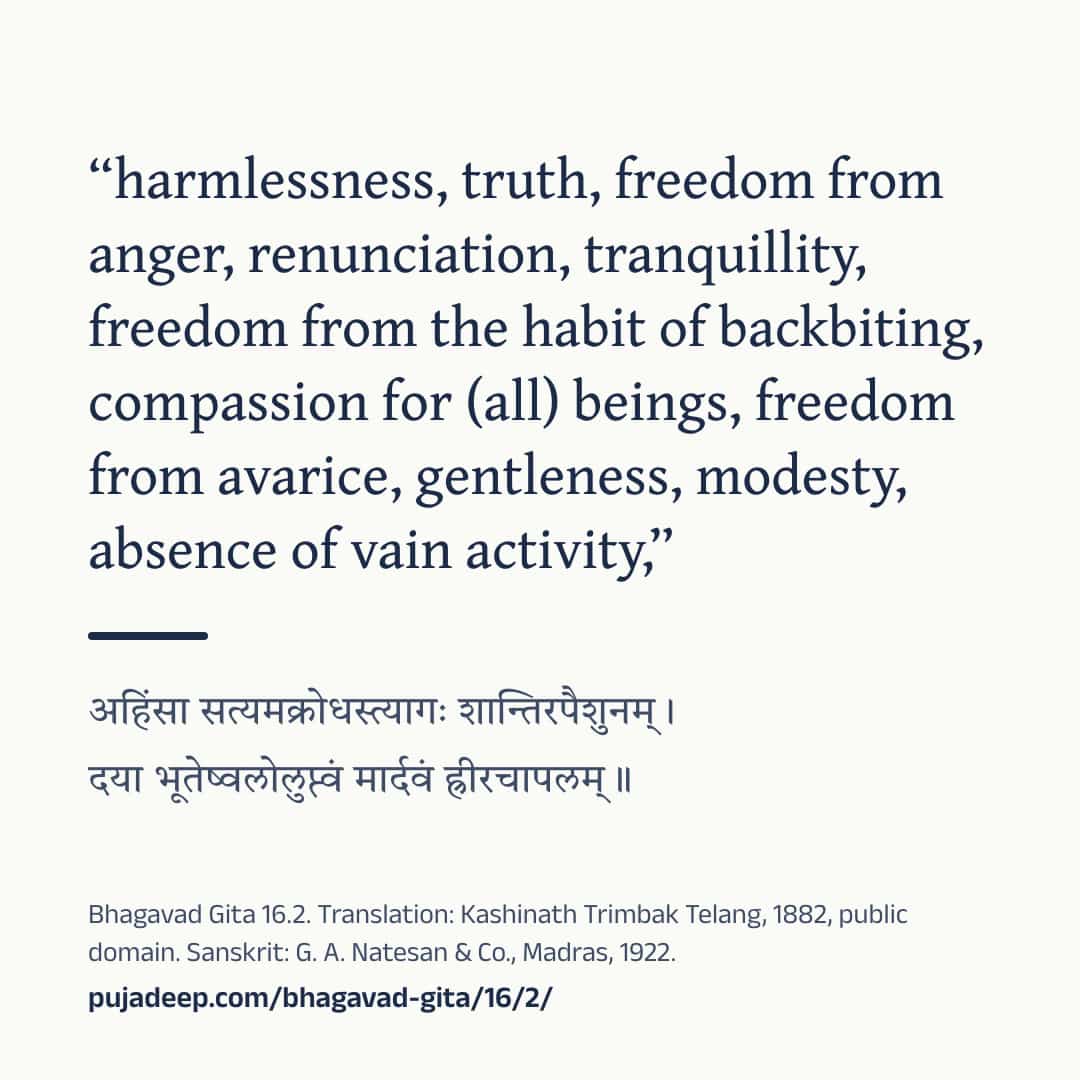
अहिंसा सत्यमक्रोधस्त्यागः शान्तिरपैशुनम् ।
दया भूतेष्वलोलुप्त्वं मार्दवं ह्रीरचापलम् ॥

“harmlessness, truth, freedom from anger, renunciation, tranquillity, freedom from the habit of backbiting, compassion for (all) beings, freedom from avarice, gentleness, modesty, absence of vain activity,”
(K. T. Telang, The Bhagavadgîtâ (The Sacred Books of the East, vol. VIII, Oxford: Clarendon Press, 1882), p. 114, public domain)
This sentence begins in 16.1. This sentence goes on in 16.3.

“Harmlessness, truth, absence of wrath, renunciation, peacefulness, absence of calumny, compassion to living beings, uncovetousness, mildness, modesty, absence of fickleness,”
(Annie Besant, The Bhagavad Gîtâ, or The Lord's Song (London: Theosophical Publishing Society, 1895), p. 140, public domain)
This sentence begins in 16.1. This sentence goes on in 16.3.

“Non-injuriousness, truth, absence of anger, renunciation, tranquility, absence of calumny, compassion to beings, non-covetousness, gentleness, modesty, absence of fickleness;”
(Swami Swarupananda, Srimad-Bhagavad-Gita (Mayavati: Prabuddha Bharata Press, 1909; first printed in Prabuddha Bharata, 1907–1909), p. 296, public domain)
This sentence begins in 16.1. This sentence goes on in 16.3.

Sanskrit: G. A. Natesan & Co., Madras, 1922.
https://pujadeep.com/bhagavad-gita/16/2/ Nothing is sent from this site. Your own app sends it, to the chat you choose. The picture quotes the translation you chose on this page, with its name and year.
Sanskrit text: The Bhagavad-Gita, or The Lord's Song, with the text in Devanagari and an English translation, 1922. Meanings: written for Pujadeep and checked against the cited edition. Source and changes
Questions families ask
Who speaks Bhagavad Gita 16.2?
Krishna speaks this verse, in chapter 16 (Daivasura Sampad Vibhaga Yoga).
Where does the Sanskrit text come from?
Sanskrit text: The Bhagavad-Gita, or The Lord's Song, with the text in Devanagari and an English translation, 1922. Meanings: written for Pujadeep and checked against the cited edition. See the source
Is the meaning on this page a translation?
Explanation written for this site from the sources listed here, and checked against the cited edition. It is not a translation and not the only way to read the text. Free to quote with credit.
Source and licence
- Sanskrit text
- The Bhagavad-Gita, or The Lord's Song, with the text in Devanagari and an English translation (Annie Besant, G. A. Natesan & Co., Madras, 1922). Public domain. The Sanskrit on these pages was read from this printing’s page images.
- Translation
- The Bhagavadgîtâ with the Sanatsugâtîya and the Anugîtâ, translated by Kâshinâth Trimbak Telang (The Sacred Books of the East, vol. VIII, ed. F. Max Müller) (Kashinath Trimbak Telang, F. Max Müller, Clarendon Press, Oxford, 1882). Public domain. Shown verbatim, as printed.
- Translation
- The Bhagavad Gîtâ, or The Lord's Song, translated by Annie Besant (Annie Besant, Theosophical Publishing Society, London, 1895). Public domain. Shown verbatim, as printed.
- Translation
- Srimad-Bhagavad-Gita, with Sanskrit Text; Paraphrase with Word-by-word Literal Translation; English Rendering and Comments, Index, &c., by the Swami Swarupananda (Himalayan Series, No. XX) (Swami Swarupananda, The Editors and Publishers, Advaita Ashrama, Mayavati, Prabuddha Bharata Press, Mayavati, Almora, Himalayas, 1909). Public domain. Shown verbatim, as printed.
- Common wording
- In this text, 32 words follow today's common wording, checked against sanskritdocuments.org; Sanskrit Wikisource; Gita Press, Gorakhpur; GRETIL, Göttingen and Bhaktivedanta Book Trust.
- Our explanation
- Explanation written for this site from the sources listed here, and checked against the cited edition. It is not a translation and not the only way to read the text. Free to quote with credit.
- Checked
- Checked against the cited edition, October 14, 2026.
- Updated
- October 25, 2026