Bhagavad Gita 16.9: meaning and translation
Chapter 16: Daivasura Sampad Vibhaga Yoga. Krishna says
Krishna says that, holding to this view, these people, whose selves are ruined (naṣṭātman) and whose understanding is small, do fierce deeds; they rise as enemies of the world, for its ruin.
Click or tap a word for its meaning and its dictionary page.
Text and layers
Text and layers
These choices stay in this browser.
Bhagavad Gita 16.9
एतां दृष्टिमवष्टभ्य नष्टात्मानोऽल्पबुद्धयः ।प्रभवन्त्युग्रकर्माणः क्षयाय जगतोऽहिताः ॥
Etam drishtimavashtabhya nashtatmanolpabuddhayahPrabhavantyugrakarmanah kshayaya jagatohitah
etāṃ dṛṣṭimavaṣṭabhya naṣṭātmāno’lpabuddhayaḥ |prabhavantyugrakarmāṇaḥ kṣayāya jagato’hitāḥ ||
Our explanation Krishna says that, holding to this view, these people, whose selves are ruined (naṣṭātman) and whose understanding is small, do fierce deeds; they rise as enemies of the world, for its ruin.
हिंदी अर्थ कृष्ण कहते हैं कि इस दृष्टि को पकड़कर ये लोग, जिनकी आत्मा नष्ट हो चुकी है (नष्टात्मा) और जिनकी बुद्धि थोड़ी है, उग्र कर्म करते हैं; वे जगत के शत्रु बनकर उसके नाश के लिए उठ खड़े होते हैं।
Word by word
Every word, with its dictionary page
Word by word
- एताम् etām · this (pronoun (feminine), accusative singular) Dictionary: etad, Monier-Williams 1899, p. 231, col. 2 “this, this here, here”
- दृष्टिम् dṛṣṭim · view (noun (feminine), accusative singular) Dictionary: dṛṣṭi, Monier-Williams 1899, p. 492, col. 1 “view, notion”
- अवष्टभ्य avaṣṭabhya · holding to (absolutive (having done)) Dictionary: ava-ṣṭambh, Monier-Williams 1899, p. 104, col. 2 “to lean or rest upon”
- नष्टात्मानः naṣṭātmānaḥ · of ruined self (compound (masculine), nominative plural) Dictionary: naṣṭa, Monier-Williams 1899, p. 532, col. 1 “lost, disappeared, perished, destroyed”; ātman, Monier-Williams 1899, p. 135, col. 1 “the individual soul, self”
- अल्पबुद्धयः alpabuddhayaḥ · of little understanding (compound (masculine), nominative plural) Dictionary: alpa, Monier-Williams 1899, p. 95, col. 2 “small, minute, trifling, little”; buddhi, Monier-Williams 1899, p. 733, col. 3 “intelligence, reason, intellect, mind, discernment, judgment”
- प्रभवन्ति prabhavanti · come forth (present, 3rd person plural) Dictionary: pra-bhū, Monier-Williams 1899, p. 684, col. 2 “to come forth, spring up, arise or originate from (abl.), appear”
- उग्रकर्माणः ugrakarmāṇaḥ · of fierce deeds (compound (masculine), nominative plural) Dictionary: ugra, Monier-Williams 1899, p. 172, col. 2 “cruel, fierce, ferocious, savage”; karman, Monier-Williams 1899, p. 258, col. 2 “act, action, performance, business”
- क्षयाय kṣayāya · for the ruin (noun (masculine), dative singular) Dictionary: 3. kṣaya, Monier-Williams 1899, p. 328, col. 1 “loss, waste, wane, diminution, destruction, decay”
- जगतः jagataḥ · of the world (noun (neuter), genitive singular) Dictionary: jagat, Monier-Williams 1899, p. 408, col. 1 “the world, esp. this world, earth”
- अहिताः ahitāḥ · hostile, harmful (adjective (masculine), nominative plural) Dictionary: a-hita, Monier-Williams 1899, p. 125, col. 2 “noxious, hostile”
1 printing differs
Edition differences. Another printing or text reads this place differently.
- The printed edition reads: एतवां दृष्टिमवष्टभ्य नष्टात्मानोऽल्पबुद्धयः ।
प्रभवन्त्युग्रकर्माणः क्षयाय जगतोऽहिताः ॥ The print reads एतव with the sort for ā and anusvara (ां) standing raised out of the line after it (leaf n229); read as a wrong sort (व) and a displaced sort, and shown as एतां ('this', with दृष्टिम्), as both proofreading references read.
Old translations
Kashinath Trimbak Telang, 1882. Public domain. Page 115.
Holding this view, (these) enemies of the world, of ruined1 selfs, of little knowledge, and of ferocious actions, are born for the destruction (of the world).
Footnotes (the translator’s own) - I. e. who have none of the means of reaching the next world. ↩
Compare 3 translations
Kashinath Trimbak Telang, 1882. Public domain. Page 115.
Holding this view, (these) enemies of the world, of ruined1 selfs, of little knowledge, and of ferocious actions, are born for the destruction (of the world).
Footnotes (the translator’s own) - I. e. who have none of the means of reaching the next world. ↩
You are reading this one
Annie Besant, 1895. Public domain. Page 141–142.
Seeing thus, these uncurbed ruined men, of small intelligence1, of fierce deeds, come forth as enemies for the destruction of the world.
Footnotes (the translator’s own) - Buddhi. ↩
You are reading this one
Swami Swarupananda, 1909 (first printed 1907). Public domain. Page 299.
Holding this view, these ruined souls of small intellect, of fierce deeds, rise as the enemies of the world for its destruction.
You are reading this one
Cite this verse
The translation: K. T. Telang, The Bhagavadgîtâ (The Sacred Books of the East, vol. VIII, Oxford: Clarendon Press, 1882), p. 115. Bhagavad Gita 16.9.
The translation: Annie Besant, The Bhagavad Gîtâ, or The Lord's Song (London: Theosophical Publishing Society, 1895), pp. 141–142. Bhagavad Gita 16.9.
The translation: Swami Swarupananda, Srimad-Bhagavad-Gita (Mayavati: Prabuddha Bharata Press, 1909; first printed in Prabuddha Bharata, 1907–1909), p. 299. Bhagavad Gita 16.9.
Our explanation: “Bhagavad Gita 16.9: meaning and translation.” Pujadeep. Updated October 25, 2026. https://pujadeep.com/bhagavad-gita/16/9/
Pujadeep’s explanations are free to quote with credit: name Pujadeep and link to the page. How to credit
Classical readings, by school
No readings by school on this verse yet.
Share
Show the ways to share
Send one picture or the text to one chat. The picture names its source and the address of this page.
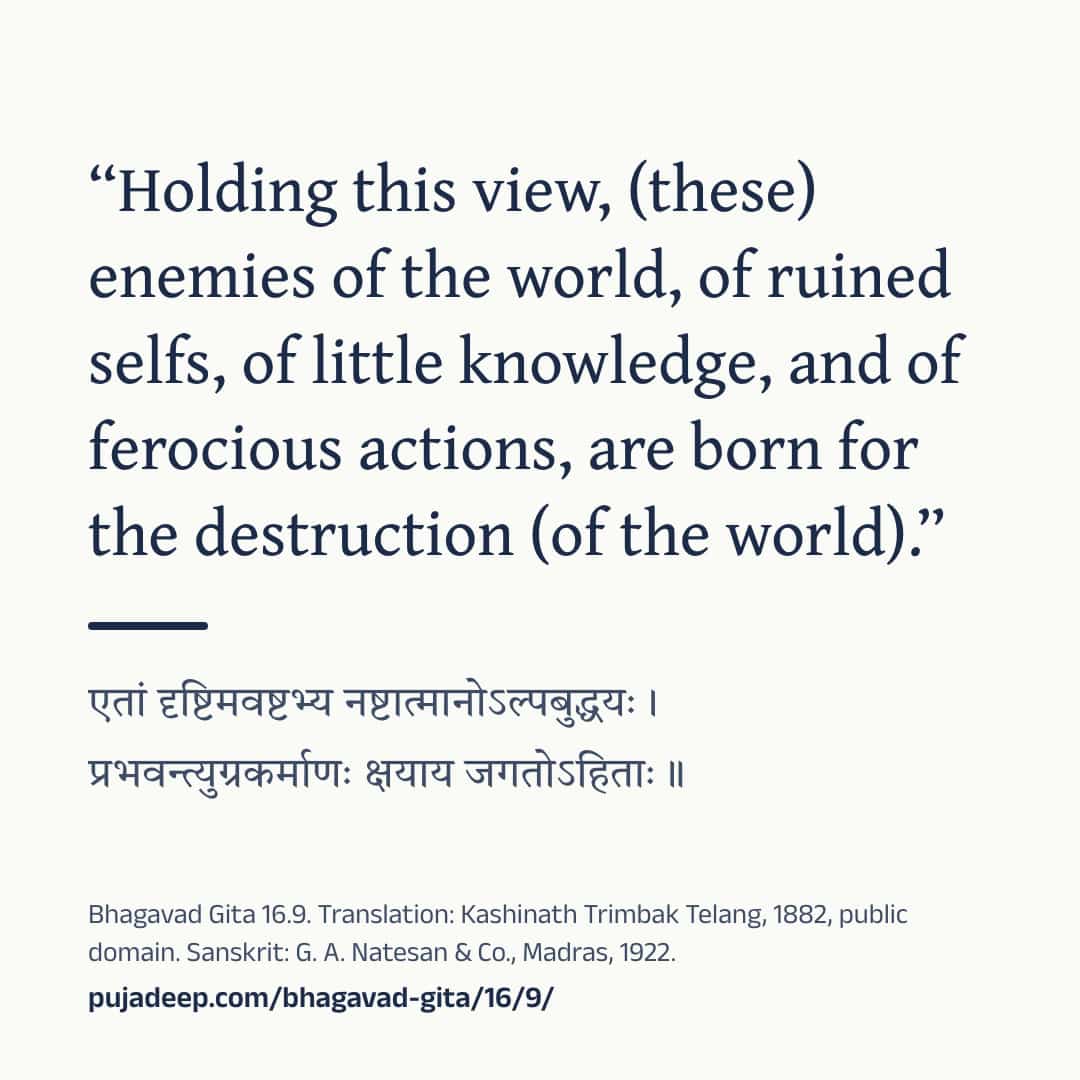
Drawing the picture
See the words
Bhagavad Gita 16.9

एतां दृष्टिमवष्टभ्य नष्टात्मानोऽल्पबुद्धयः ।
प्रभवन्त्युग्रकर्माणः क्षयाय जगतोऽहिताः ॥

“Holding this view, (these) enemies of the world, of ruined selfs, of little knowledge, and of ferocious actions, are born for the destruction (of the world).”
(K. T. Telang, The Bhagavadgîtâ (The Sacred Books of the East, vol. VIII, Oxford: Clarendon Press, 1882), p. 115, public domain)

“Seeing thus, these uncurbed ruined men, of small intelligence, of fierce deeds, come forth as enemies for the destruction of the world.”
(Annie Besant, The Bhagavad Gîtâ, or The Lord's Song (London: Theosophical Publishing Society, 1895), pp. 141–142, public domain)

“Holding this view, these ruined souls of small intellect, of fierce deeds, rise as the enemies of the world for its destruction.”
(Swami Swarupananda, Srimad-Bhagavad-Gita (Mayavati: Prabuddha Bharata Press, 1909; first printed in Prabuddha Bharata, 1907–1909), p. 299, public domain)

Sanskrit: G. A. Natesan & Co., Madras, 1922.
https://pujadeep.com/bhagavad-gita/16/9/ Nothing is sent from this site. Your own app sends it, to the chat you choose. The picture quotes the translation you chose on this page, with its name and year.
Sanskrit text: The Bhagavad-Gita, or The Lord's Song, with the text in Devanagari and an English translation, 1922. Meanings: written for Pujadeep and checked against the cited edition. Source and changes
Questions families ask
Who speaks Bhagavad Gita 16.9?
Krishna speaks this verse, in chapter 16 (Daivasura Sampad Vibhaga Yoga).
Where does the Sanskrit text come from?
Sanskrit text: The Bhagavad-Gita, or The Lord's Song, with the text in Devanagari and an English translation, 1922. Meanings: written for Pujadeep and checked against the cited edition. See the source
Is the meaning on this page a translation?
Explanation written for this site from the sources listed here, and checked against the cited edition. It is not a translation and not the only way to read the text. Free to quote with credit.
Source and licence
- Sanskrit text
- The Bhagavad-Gita, or The Lord's Song, with the text in Devanagari and an English translation (Annie Besant, G. A. Natesan & Co., Madras, 1922). Public domain. The Sanskrit on these pages was read from this printing’s page images.
- Translation
- The Bhagavadgîtâ with the Sanatsugâtîya and the Anugîtâ, translated by Kâshinâth Trimbak Telang (The Sacred Books of the East, vol. VIII, ed. F. Max Müller) (Kashinath Trimbak Telang, F. Max Müller, Clarendon Press, Oxford, 1882). Public domain. Shown verbatim, as printed.
- Translation
- The Bhagavad Gîtâ, or The Lord's Song, translated by Annie Besant (Annie Besant, Theosophical Publishing Society, London, 1895). Public domain. Shown verbatim, as printed.
- Translation
- Srimad-Bhagavad-Gita, with Sanskrit Text; Paraphrase with Word-by-word Literal Translation; English Rendering and Comments, Index, &c., by the Swami Swarupananda (Himalayan Series, No. XX) (Swami Swarupananda, The Editors and Publishers, Advaita Ashrama, Mayavati, Prabuddha Bharata Press, Mayavati, Almora, Himalayas, 1909). Public domain. Shown verbatim, as printed.
- Common wording
- In this text, 32 words follow today's common wording, checked against sanskritdocuments.org; Sanskrit Wikisource; Gita Press, Gorakhpur; GRETIL, Göttingen and Bhaktivedanta Book Trust.
- Our explanation
- Explanation written for this site from the sources listed here, and checked against the cited edition. It is not a translation and not the only way to read the text. Free to quote with credit.
- Checked
- Checked against the cited edition, October 14, 2026.
- Updated
- October 25, 2026