Bhagavad Gita 16.20: meaning and translation
Chapter 16: Daivasura Sampad Vibhaga Yoga. Krishna says
Krishna says that, having come into asura births, deluded birth after birth and never reaching him, they go, Kaunteya, to a still lower state.
Click or tap a word for its meaning and its dictionary page.
Text and layers
Text and layers
These choices stay in this browser.
Bhagavad Gita 16.20
आसुरीं योनिमापन्ना मूढा जन्मनि जन्मनि ।मामप्राप्यैव कौन्तेय ततो यान्त्यधमां गतिम् ॥
Asurim yonimapanna mudha janmani janmaniMamaprapyaiva kaunteya tato yantyadhamam gatim
āsurīṃ yonimāpannā mūḍhā janmani janmani |māmaprāpyaiva kaunteya tato yāntyadhamāṃ gatim ||
Our explanation Krishna says that, having come into asura births, deluded birth after birth and never reaching him, they go, Kaunteya, to a still lower state. The schools explain 'never reaching him' differently (see the views). Readings of these verses differ between schools and teachers, and the wording is the text's, not the view of this library.
हिंदी अर्थ कृष्ण कहते हैं कि आसुरी योनियों में आकर, जन्म-जन्म में मोहित, उन्हें (कृष्ण को) पाए बिना, हे कौन्तेय, वे उससे भी नीची गति को जाते हैं। “उन्हें पाए बिना” को परंपराएँ अलग-अलग ढंग से समझाती हैं। इन श्लोकों को अलग-अलग परंपराएँ और आचार्य अलग ढंग से पढ़ते हैं, और ये शब्द पाठ के हैं, इस पुस्तकालय का मत नहीं।
Word by word
Every word, with its dictionary page
Word by word
- आसुरीम् āsurīm · asura (adjective (feminine), accusative singular) Dictionary: 1. āsura, Monier-Williams 1899, p. 160, col. 3 “belonging or relating to the Asuras”
- योनिम् yonim · womb, birth (noun (feminine), accusative singular) Dictionary: yoni, Monier-Williams 1899, p. 858, col. 2 “the womb, uterus”
- आपन्नाः āpannāḥ · having entered (past participle (masculine), nominative plural) Dictionary: ā-panna, Monier-Williams 1899, p. 143, col. 1 “entered, got in”
- मूढाः mūḍhāḥ · deluded (past participle (masculine), nominative plural) Dictionary: mūḍha, Monier-Williams 1899, p. 825, col. 2 “stupefied, bewildered, perplexed, confused”
- जन्मनि janmani · in birth (noun (neuter), locative singular) Dictionary: janman, Monier-Williams 1899, p. 411, col. 3 “birth, production”
- जन्मनि janmani · (after) birth (noun (neuter), locative singular) Dictionary: janman, Monier-Williams 1899, p. 411, col. 3 “birth, production”
- माम् mām · "me" (Krishna) (pronoun, accusative singular) Dictionary: 1. mad, Monier-Williams 1899, p. 777, col. 2 “base of the first pers. pron. in the sg. number (esp. in comp.)”
- अप्राप्य aprāpya · not reaching (absolutive (having done)) Dictionary: 2. a-prāpya, Monier-Williams 1899, p. 59, col. 2 “not having obtained; not reaching”
- एव eva · at all, ever (indeclinable) Dictionary: 1. eva, Monier-Williams 1899, p. 232, col. 2 “just, exactly, very, same, only, even, alone, merely”
- कौन्तेय kaunteya · O son of Kunti (noun (masculine), vocative singular) Dictionary: kaunteya, Monier-Williams 1899, p. 316, col. 2 “metron. fr. Kuntī”
- ततः tataḥ · then, from there (indeclinable) Dictionary: tatas, Monier-Williams 1899, p. 432, col. 2 “thereupon, then, after that, afterwards”
- यान्ति yānti · go (present, 3rd person plural) Dictionary: 1. yā, Monier-Williams 1899, p. 849, col. 1 “to go, proceed, move, walk, set out”
- अधमाम् adhamām · lowest (adjective (feminine), accusative singular) Dictionary: adhama, Monier-Williams 1899, p. 19, col. 3 “lowest, vilest, worst; very low or vile or bad”
- गतिम् gatim · state, path (noun (feminine), accusative singular) Dictionary: gati, Monier-Williams 1899, p. 347, col. 3 “path, way, course”
Old translations
Kashinath Trimbak Telang, 1882. Public domain. Page 116.
Coming into demoniac wombs, deluded in every birth, they go down to the vilest state, O son of Kuntî! without ever coming to me.
Compare 3 translations
Kashinath Trimbak Telang, 1882. Public domain. Page 116.
Coming into demoniac wombs, deluded in every birth, they go down to the vilest state, O son of Kuntî! without ever coming to me.
You are reading this one
Annie Besant, 1895. Public domain. Page 144.
Obtaining an âsuric womb, deluded birth after birth, attaining not to Me, O Kaunteya, thus they tread the lowest path.
You are reading this one
Swami Swarupananda, 1909 (first printed 1907). Public domain. Page 303.
Obtaining the Asuric wombs, and deluded birth after birth, not attaining Me, they thus fall, O son of Kunti, into a still lower condition.
You are reading this one
Cite this verse
The translation: K. T. Telang, The Bhagavadgîtâ (The Sacred Books of the East, vol. VIII, Oxford: Clarendon Press, 1882), p. 116. Bhagavad Gita 16.20.
The translation: Annie Besant, The Bhagavad Gîtâ, or The Lord's Song (London: Theosophical Publishing Society, 1895), p. 144. Bhagavad Gita 16.20.
The translation: Swami Swarupananda, Srimad-Bhagavad-Gita (Mayavati: Prabuddha Bharata Press, 1909; first printed in Prabuddha Bharata, 1907–1909), p. 303. Bhagavad Gita 16.20.
Our explanation: “Bhagavad Gita 16.20: meaning and translation.” Pujadeep. Updated October 25, 2026. https://pujadeep.com/bhagavad-gita/16/20/
Pujadeep’s explanations are free to quote with credit: name Pujadeep and link to the page. How to credit
Classical readings, by school
Each reading is named by its school. None is presented as the only meaning.
What Advaita, Vishishtadvaita and Dvaita teach, in short
Shankara Advaita
Shankara says they are born again and again in tāmasa wombs and pass into lower and lower states. He reads 'without reaching Me' as 'without ever reaching the right path that the Lord teaches', since there was never any thought that they would reach the Lord himself.
Source: The Bhagavad-Gita, with the commentary of Sri Sankaracharya, translated by A. Mahadeva Sastri (2nd ed., Mysore: G. T. A. Printing Works, 1901), commentary on 16.20, p. 381. Summarised in our own words; none of its text is reproduced.
Ramanuja Vishishtadvaita
Ramanuja says the asura wombs are births opposed to harmony with the Lord, in which their error grows. 'Never find Me' means never coming to know that the Lord, Vāsudeva, truly exists; from such births they slip further down.
Source: Sri Bhagavad-Gita with Sri Ramanujacharya's Visishtadvaita commentary, translated by A. Govindacharya (Madras, 1898), commentary on 16.20, p. 495. Summarised in our own words; none of its text is reproduced.
Share
Show the ways to share
Send one picture or the text to one chat. The picture names its source and the address of this page.
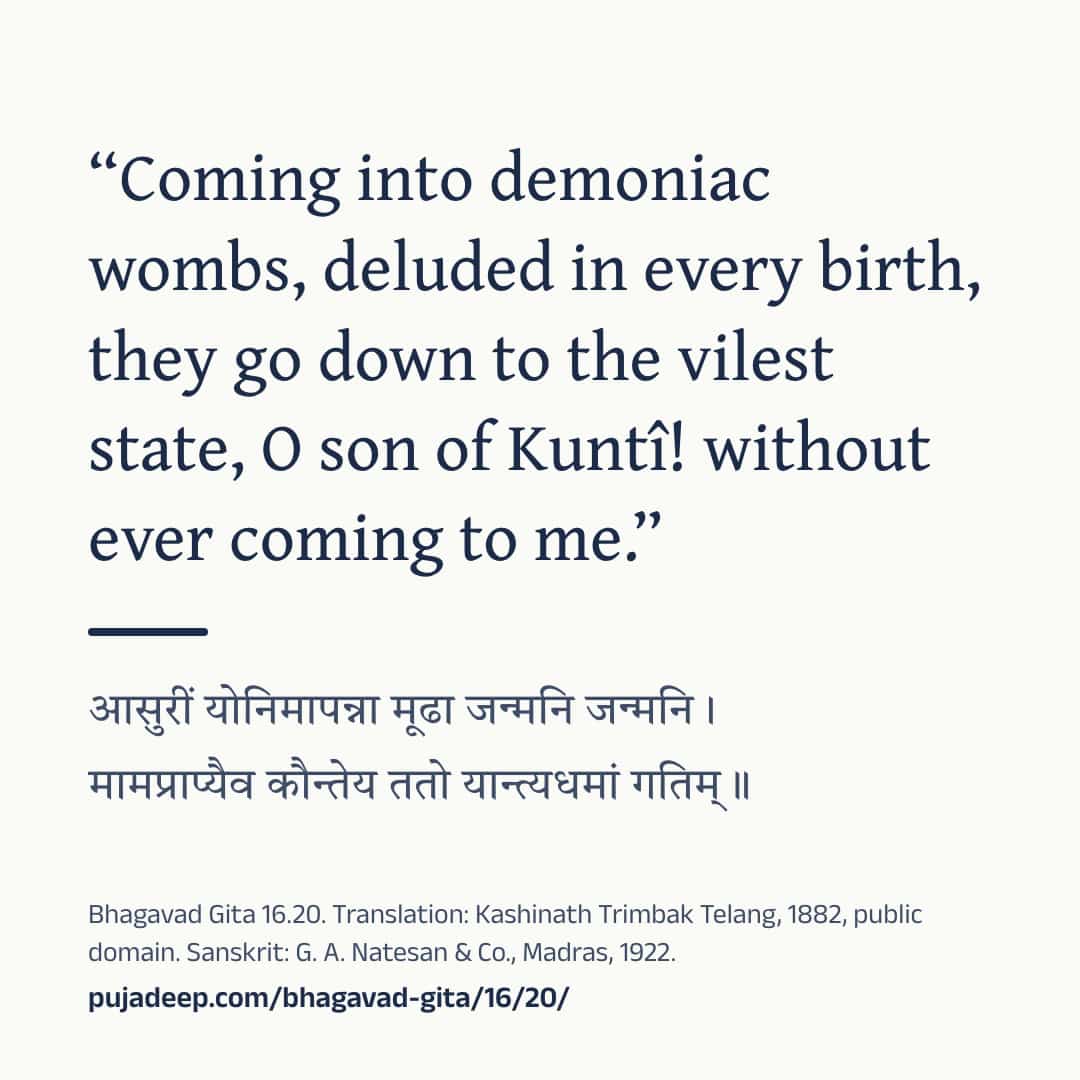
Drawing the picture
See the words
Bhagavad Gita 16.20

आसुरीं योनिमापन्ना मूढा जन्मनि जन्मनि ।
मामप्राप्यैव कौन्तेय ततो यान्त्यधमां गतिम् ॥

“Coming into demoniac wombs, deluded in every birth, they go down to the vilest state, O son of Kuntî! without ever coming to me.”
(K. T. Telang, The Bhagavadgîtâ (The Sacred Books of the East, vol. VIII, Oxford: Clarendon Press, 1882), p. 116, public domain)

“Obtaining an âsuric womb, deluded birth after birth, attaining not to Me, O Kaunteya, thus they tread the lowest path.”
(Annie Besant, The Bhagavad Gîtâ, or The Lord's Song (London: Theosophical Publishing Society, 1895), p. 144, public domain)

“Obtaining the Asuric wombs, and deluded birth after birth, not attaining Me, they thus fall, O son of Kunti, into a still lower condition.”
(Swami Swarupananda, Srimad-Bhagavad-Gita (Mayavati: Prabuddha Bharata Press, 1909; first printed in Prabuddha Bharata, 1907–1909), p. 303, public domain)

Sanskrit: G. A. Natesan & Co., Madras, 1922.
https://pujadeep.com/bhagavad-gita/16/20/ Nothing is sent from this site. Your own app sends it, to the chat you choose. The picture quotes the translation you chose on this page, with its name and year.
Sanskrit text: The Bhagavad-Gita, or The Lord's Song, with the text in Devanagari and an English translation, 1922. Meanings: written for Pujadeep and checked against the cited edition. Source and changes
Questions families ask
Who speaks Bhagavad Gita 16.20?
Krishna speaks this verse, in chapter 16 (Daivasura Sampad Vibhaga Yoga).
Where does the Sanskrit text come from?
Sanskrit text: The Bhagavad-Gita, or The Lord's Song, with the text in Devanagari and an English translation, 1922. Meanings: written for Pujadeep and checked against the cited edition. See the source
Is the meaning on this page a translation?
Explanation written for this site from the sources listed here, and checked against the cited edition. It is not a translation and not the only way to read the text. Free to quote with credit.
Source and licence
- Sanskrit text
- The Bhagavad-Gita, or The Lord's Song, with the text in Devanagari and an English translation (Annie Besant, G. A. Natesan & Co., Madras, 1922). Public domain. The Sanskrit on these pages was read from this printing’s page images.
- Translation
- The Bhagavadgîtâ with the Sanatsugâtîya and the Anugîtâ, translated by Kâshinâth Trimbak Telang (The Sacred Books of the East, vol. VIII, ed. F. Max Müller) (Kashinath Trimbak Telang, F. Max Müller, Clarendon Press, Oxford, 1882). Public domain. Shown verbatim, as printed.
- Translation
- The Bhagavad Gîtâ, or The Lord's Song, translated by Annie Besant (Annie Besant, Theosophical Publishing Society, London, 1895). Public domain. Shown verbatim, as printed.
- Translation
- Srimad-Bhagavad-Gita, with Sanskrit Text; Paraphrase with Word-by-word Literal Translation; English Rendering and Comments, Index, &c., by the Swami Swarupananda (Himalayan Series, No. XX) (Swami Swarupananda, The Editors and Publishers, Advaita Ashrama, Mayavati, Prabuddha Bharata Press, Mayavati, Almora, Himalayas, 1909). Public domain. Shown verbatim, as printed.
- Commentary
- The Bhagavad-Gita, with the commentary of Sri Sankaracharya, translated by A. Mahadeva Sastri (2nd ed., Mysore: G. T. A. Printing Works, 1901) (Public-domain scan, University of California Libraries). Summarised in our own words; none of its text is reproduced.
- Commentary
- Sri Bhagavad-Gita with Sri Ramanujacharya's Visishtadvaita commentary, translated by A. Govindacharya (Madras, 1898) (Scan uploaded to archive.org (folkscanomy collection)). Summarised in our own words; none of its text is reproduced.
- Common wording
- In this text, 32 words follow today's common wording, checked against sanskritdocuments.org; Sanskrit Wikisource; Gita Press, Gorakhpur; GRETIL, Göttingen and Bhaktivedanta Book Trust.
- Our explanation
- Explanation written for this site from the sources listed here, and checked against the cited edition. It is not a translation and not the only way to read the text. Free to quote with credit.
- Checked
- Checked against the cited edition, October 14, 2026.
- Updated
- October 25, 2026