Bhagavad Gita 16.11: meaning and translation
Chapter 16: Daivasura Sampad Vibhaga Yoga. Krishna says
Krishna says they take on endless cares that end only at death.
Click or tap a word for its meaning and its dictionary page.
Text and layers
Text and layers
These choices stay in this browser.
Bhagavad Gita 16.11
चिन्तामपरिमेयां च प्रलयान्तामुपाश्रिताः ।कामोपभोगपरमा एतावदिति निश्चिताः ॥
Chintamaparimeyam cha pralayantamupashritahKamopabhogaparama etavaditi nishchitah
cintāmaparimeyāṃ ca pralayāntāmupāśritāḥ |kāmopabhogaparamā etāvaditi niścitāḥ ||
Our explanation Krishna says they take on endless cares that end only at death. They hold the enjoyment of desires as the highest aim, sure that this is all there is. The sentence goes on into verse 12.
हिंदी अर्थ कृष्ण कहते हैं कि वे अनगिनत चिंताओं में लगे रहते हैं, जो मृत्यु पर ही खत्म होती हैं। वे इच्छाओं के भोग को सबसे ऊँचा लक्ष्य मानते हैं और पक्का मानते हैं कि बस इतना ही है। यह वाक्य श्लोक 12 में आगे चलता है।
Word by word
Every word, with its dictionary page
Word by word
- चिन्ताम् cintām · cares, anxiety (noun (feminine), accusative singular) Dictionary: cintā, Monier-Williams 1899, p. 398, col. 1 “thought, care, anxiety”
- अपरिमेयाम् aparimeyām · boundless (adjective (feminine), accusative singular) Dictionary: a-parimeya, Monier-Williams 1899, p. 51, col. 2 “immeasurable, illimitable”
- च ca · and (indeclinable) Dictionary: 2. ca, Monier-Williams 1899, p. 380, col. 1 “and, both, also, moreover, as well as”
- प्रलयान्ताम् pralayāntām · ending only with death (compound (feminine), accusative singular) Dictionary: pra-laya, Monier-Williams 1899, p. 689, col. 3 “dissolution, reabsorption, destruction, annihilation; death”; anta, Monier-Williams 1899, p. 42, col. 3 “end, limit, boundary, term”
- उपाश्रिताः upāśritāḥ · given over to (past participle (masculine), nominative plural) Dictionary: upā-śri, Monier-Williams 1899, p. 214, col. 3 “to take refuge or have recourse to”
- कामोपभोगपरमाः kāmopabhogaparamāḥ · holding enjoyment of desires as highest (compound (masculine), nominative plural) Dictionary: kāma, Monier-Williams 1899, p. 271, col. 3 “wish, desire, longing”; upa-bhoga, Monier-Williams 1899, p. 203, col. 1 “enjoyment, eating, consuming”; parama, Monier-Williams 1899, p. 588, col. 1 “chief, highest, primary, most prominent or conspicuous”
- एतावत् etāvat · this much (is all) (adjective (neuter), nominative singular) Dictionary: etāvat, Monier-Williams 1899, p. 231, col. 3 “so great, so much, so many”
- इति iti · thus (indeclinable) Dictionary: 2. iti, Monier-Williams 1899, p. 165, col. 1 “in this manner, thus”
- निश्चिताः niścitāḥ · sure, convinced (past participle (masculine), nominative plural) Dictionary: niś-cita, Monier-Williams 1899, p. 561, col. 2 “ascertained, determined, settled, decided”
Old translations
Kashinath Trimbak Telang, 1882. Public domain. Page 115.
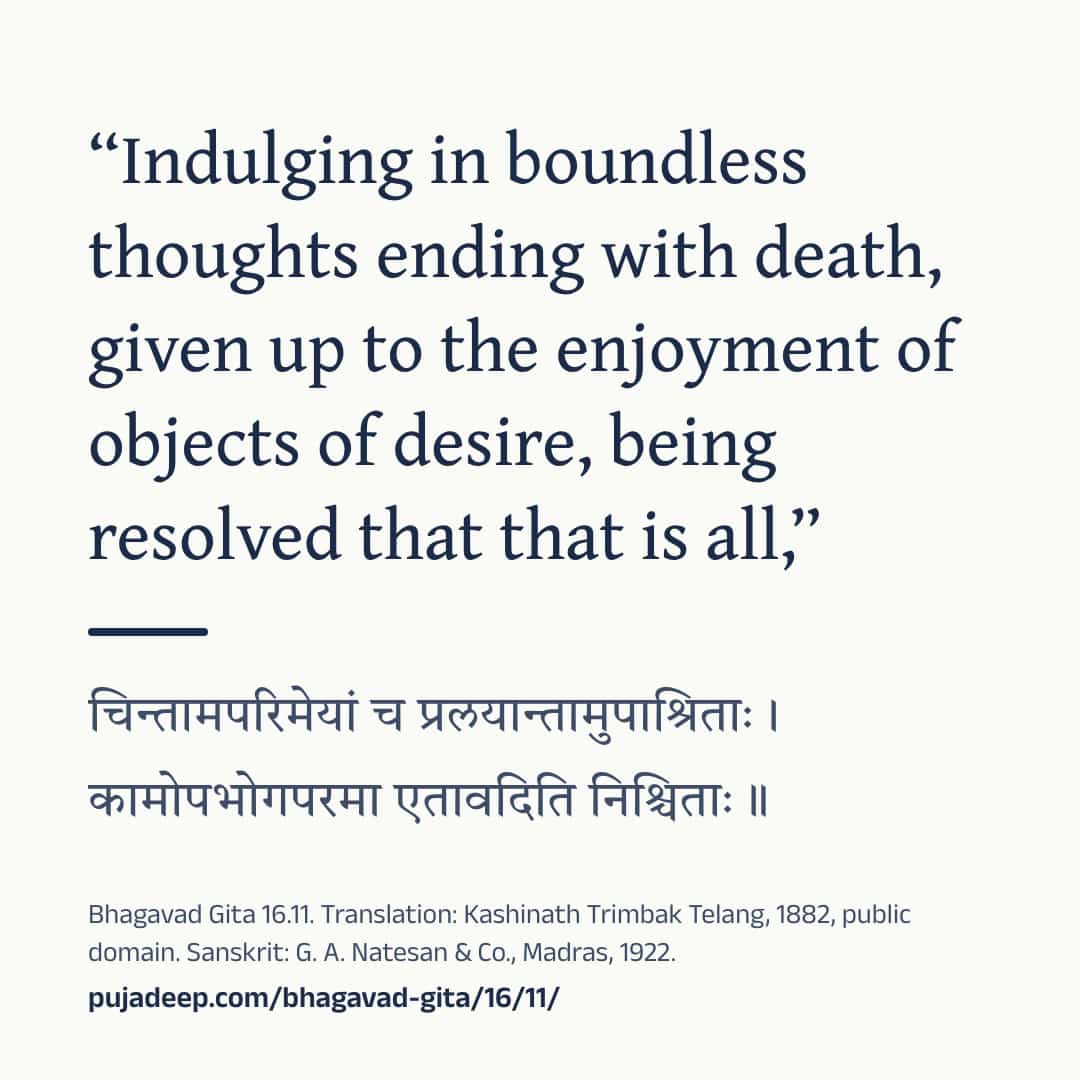
Indulging in boundless thoughts ending with death1, given up to the enjoyment of objects of desire, being resolved that that is all,
This sentence goes on in 16.12.
Footnotes (the translator’s own) - Till their last moments, thinking of making new acquisitions and preserving old ones. ↩
Compare 3 translations
Kashinath Trimbak Telang, 1882. Public domain. Page 115.
Indulging in boundless thoughts ending with death1, given up to the enjoyment of objects of desire, being resolved that that is all,
This sentence goes on in 16.12.
Footnotes (the translator’s own) - Till their last moments, thinking of making new acquisitions and preserving old ones. ↩
You are reading this one
Annie Besant, 1895. Public domain. Page 142.
Giving themselves over to numberless plans, whose end is death, regarding as the highest the gratification of lusts, feeling sure that that is all,
This sentence goes on in 16.12.
You are reading this one
Swami Swarupananda, 1909 (first printed 1907). Public domain. Page 300.
Beset with immense cares ending only with death, regarding gratification of lusts as the highest, and feeling sure that that is all;
This sentence goes on in 16.12.
You are reading this one
Cite this verse
The translation: K. T. Telang, The Bhagavadgîtâ (The Sacred Books of the East, vol. VIII, Oxford: Clarendon Press, 1882), p. 115. Bhagavad Gita 16.11.
The translation: Annie Besant, The Bhagavad Gîtâ, or The Lord's Song (London: Theosophical Publishing Society, 1895), p. 142. Bhagavad Gita 16.11.
The translation: Swami Swarupananda, Srimad-Bhagavad-Gita (Mayavati: Prabuddha Bharata Press, 1909; first printed in Prabuddha Bharata, 1907–1909), p. 300. Bhagavad Gita 16.11.
Our explanation: “Bhagavad Gita 16.11: meaning and translation.” Pujadeep. Updated October 25, 2026. https://pujadeep.com/bhagavad-gita/16/11/
Pujadeep’s explanations are free to quote with credit: name Pujadeep and link to the page. How to credit
Classical readings, by school
No readings by school on this verse yet.
Share
Show the ways to share
Send one picture or the text to one chat. The picture names its source and the address of this page.
Drawing the picture
See the words
Bhagavad Gita 16.11

चिन्तामपरिमेयां च प्रलयान्तामुपाश्रिताः ।
कामोपभोगपरमा एतावदिति निश्चिताः ॥

“Indulging in boundless thoughts ending with death, given up to the enjoyment of objects of desire, being resolved that that is all,”
(K. T. Telang, The Bhagavadgîtâ (The Sacred Books of the East, vol. VIII, Oxford: Clarendon Press, 1882), p. 115, public domain)
This sentence goes on in 16.12.

“Giving themselves over to numberless plans, whose end is death, regarding as the highest the gratification of lusts, feeling sure that that is all,”
(Annie Besant, The Bhagavad Gîtâ, or The Lord's Song (London: Theosophical Publishing Society, 1895), p. 142, public domain)
This sentence goes on in 16.12.

“Beset with immense cares ending only with death, regarding gratification of lusts as the highest, and feeling sure that that is all;”
(Swami Swarupananda, Srimad-Bhagavad-Gita (Mayavati: Prabuddha Bharata Press, 1909; first printed in Prabuddha Bharata, 1907–1909), p. 300, public domain)
This sentence goes on in 16.12.

Sanskrit: G. A. Natesan & Co., Madras, 1922.
https://pujadeep.com/bhagavad-gita/16/11/ Nothing is sent from this site. Your own app sends it, to the chat you choose. The picture quotes the translation you chose on this page, with its name and year.
Sanskrit text: The Bhagavad-Gita, or The Lord's Song, with the text in Devanagari and an English translation, 1922. Meanings: written for Pujadeep and checked against the cited edition. Source and changes
Questions families ask
Who speaks Bhagavad Gita 16.11?
Krishna speaks this verse, in chapter 16 (Daivasura Sampad Vibhaga Yoga).
Where does the Sanskrit text come from?
Sanskrit text: The Bhagavad-Gita, or The Lord's Song, with the text in Devanagari and an English translation, 1922. Meanings: written for Pujadeep and checked against the cited edition. See the source
Is the meaning on this page a translation?
Explanation written for this site from the sources listed here, and checked against the cited edition. It is not a translation and not the only way to read the text. Free to quote with credit.
Source and licence
- Sanskrit text
- The Bhagavad-Gita, or The Lord's Song, with the text in Devanagari and an English translation (Annie Besant, G. A. Natesan & Co., Madras, 1922). Public domain. The Sanskrit on these pages was read from this printing’s page images.
- Translation
- The Bhagavadgîtâ with the Sanatsugâtîya and the Anugîtâ, translated by Kâshinâth Trimbak Telang (The Sacred Books of the East, vol. VIII, ed. F. Max Müller) (Kashinath Trimbak Telang, F. Max Müller, Clarendon Press, Oxford, 1882). Public domain. Shown verbatim, as printed.
- Translation
- The Bhagavad Gîtâ, or The Lord's Song, translated by Annie Besant (Annie Besant, Theosophical Publishing Society, London, 1895). Public domain. Shown verbatim, as printed.
- Translation
- Srimad-Bhagavad-Gita, with Sanskrit Text; Paraphrase with Word-by-word Literal Translation; English Rendering and Comments, Index, &c., by the Swami Swarupananda (Himalayan Series, No. XX) (Swami Swarupananda, The Editors and Publishers, Advaita Ashrama, Mayavati, Prabuddha Bharata Press, Mayavati, Almora, Himalayas, 1909). Public domain. Shown verbatim, as printed.
- Common wording
- In this text, 32 words follow today's common wording, checked against sanskritdocuments.org; Sanskrit Wikisource; Gita Press, Gorakhpur; GRETIL, Göttingen and Bhaktivedanta Book Trust.
- Our explanation
- Explanation written for this site from the sources listed here, and checked against the cited edition. It is not a translation and not the only way to read the text. Free to quote with credit.
- Checked
- Checked against the cited edition, October 14, 2026.
- Updated
- October 25, 2026