Bhagavad Gita 16.4: meaning and translation
Chapter 16: Daivasura Sampad Vibhaga Yoga. Krishna says
Krishna now names the asura endowment (āsurī sampad).
Click or tap a word for its meaning and its dictionary page.
Text and layers
Text and layers
These choices stay in this browser.
Bhagavad Gita 16.4
दम्भो दर्पोऽभिमानश्च क्रोधः पारुष्यमेव च ।अज्ञानं चाभिजातस्य पार्थ सम्पदमासुरीम् ॥
Dambho darpobhimanashcha krodhah parushyameva chaAjnanam chabhijatasya partha sampadamasurim
dambho darpo’bhimānaśca krodhaḥ pāruṣyameva ca |ajñānaṃ cābhijātasya pārtha sampadamāsurīm ||
Our explanation Krishna now names the asura endowment (āsurī sampad). In the old stories the asuras are the opponents of the devas, and Besant's note explains the word so. Hypocrisy, arrogance, excess of pride, anger, harshness and ignorance, he tells Arjuna (Partha), belong to one born to this endowment.
हिंदी अर्थ अब कृष्ण आसुरी संपदा बताते हैं। पुरानी कथाओं में असुर देवताओं के विरोधी हैं; बेसेंट की टिप्पणी भी यही बताती है। वे अर्जुन (पार्थ) से कहते हैं कि दंभ (दिखावा), घमंड, अभिमान, क्रोध, कठोरता और अज्ञान उस व्यक्ति के होते हैं जो आसुरी संपदा लेकर जन्मा है।
Word by word
Every word, with its dictionary page
Word by word
- दम्भः dambhaḥ · hypocrisy, show (noun (masculine), nominative singular) Dictionary: dambha, Monier-Williams 1899, p. 469, col. 3 “deceit, fraud, feigning, hypocrisy”
- दर्पः darpaḥ · arrogance (noun (masculine), nominative singular) Dictionary: darpa, Monier-Williams 1899, p. 470, col. 2 “pride, arrogance”
- अभिमानः abhimānaḥ · conceit (noun (masculine), nominative singular) Dictionary: abhi-māna, Monier-Williams 1899, p. 67, col. 1 “high opinion of one's self, self-conceit, pride, haughtiness”
- च ca · and (indeclinable) Dictionary: 2. ca, Monier-Williams 1899, p. 380, col. 1 “and, both, also, moreover, as well as”
- क्रोधः krodhaḥ · anger (noun (masculine), nominative singular) Dictionary: krodha, Monier-Williams 1899, p. 322, col. 1 “anger, wrath, passion”
- पारुष्यम् pāruṣyam · harshness (noun (neuter), nominative singular) Dictionary: pāruṣya, Monier-Williams 1899, p. 621, col. 2 “harshness (esp. of language)”
- एव eva · also (indeclinable) Dictionary: 1. eva, Monier-Williams 1899, p. 232, col. 2 “just, exactly, very, same, only, even, alone, merely”
- च ca · and (indeclinable) Dictionary: 2. ca, Monier-Williams 1899, p. 380, col. 1 “and, both, also, moreover, as well as”
- अज्ञानम् ajñānam · ignorance (noun (neuter), nominative singular) Dictionary: a-jñāna, Monier-Williams 1899, p. 10, col. 3 “non-cognizance; ignorance”
- च ca · and (indeclinable) Dictionary: 2. ca, Monier-Williams 1899, p. 380, col. 1 “and, both, also, moreover, as well as”
- अभिजातस्य abhijātasya · of one born (to) (past participle (masculine), genitive singular) Dictionary: abhi-jāta, Monier-Williams 1899, p. 62, col. 2 “born, produced”
- पार्थ pārtha · O son of Pritha (Arjuna) (noun (masculine), vocative singular) Dictionary: 2. pārtha, Monier-Williams 1899, p. 621, col. 3 “metron. of Yudhi-shṭhira or Bhīma-sena or Arjuna”
- सम्पदम् sampadam · endowment, inheritance (noun (feminine), accusative singular) Dictionary: sampad, Monier-Williams 1899, p. 1172, col. 1 “fate, destiny”
- आसुरीम् āsurīm · asura, ungodly (adjective (feminine), accusative singular) Dictionary: 1. āsura, Monier-Williams 1899, p. 160, col. 3 “belonging or relating to the Asuras”
Old translations
Kashinath Trimbak Telang, 1882. Public domain. Page 114.
Ostentatiousness, pride, vanity1, anger, and also harshness and ignorance (are) his, O son of Prithâ! who is born to demoniac2 endowments.
Footnotes (the translator’s own) Compare 3 translations
Kashinath Trimbak Telang, 1882. Public domain. Page 114.
Ostentatiousness, pride, vanity1, anger, and also harshness and ignorance (are) his, O son of Prithâ! who is born to demoniac2 endowments.
Footnotes (the translator’s own) You are reading this one
Annie Besant, 1895. Public domain. Page 140–141.
Hypocrisy, arrogance and conceit, wrath and also harshness and unwisdom are his who is born, O Pârtha, with âsuric1 properties.
Footnotes (the translator’s own) - The Asuras were the enemies of the Suras, or Gods; "demoniac properties" might be said. ↩
You are reading this one
Swami Swarupananda, 1909 (first printed 1907). Public domain. Page 297.
Ostentation, arrogance and self-conceit, anger as also harshness and ignorance, belong to one who is born, O Pártha, for an Asuric state.
You are reading this one
Cite this verse
The translation: K. T. Telang, The Bhagavadgîtâ (The Sacred Books of the East, vol. VIII, Oxford: Clarendon Press, 1882), p. 114. Bhagavad Gita 16.4.
The translation: Annie Besant, The Bhagavad Gîtâ, or The Lord's Song (London: Theosophical Publishing Society, 1895), pp. 140–141. Bhagavad Gita 16.4.
The translation: Swami Swarupananda, Srimad-Bhagavad-Gita (Mayavati: Prabuddha Bharata Press, 1909; first printed in Prabuddha Bharata, 1907–1909), p. 297. Bhagavad Gita 16.4.
Our explanation: “Bhagavad Gita 16.4: meaning and translation.” Pujadeep. Updated October 25, 2026. https://pujadeep.com/bhagavad-gita/16/4/
Pujadeep’s explanations are free to quote with credit: name Pujadeep and link to the page. How to credit
Classical readings, by school
No readings by school on this verse yet.
Share
Show the ways to share
Send one picture or the text to one chat. The picture names its source and the address of this page.
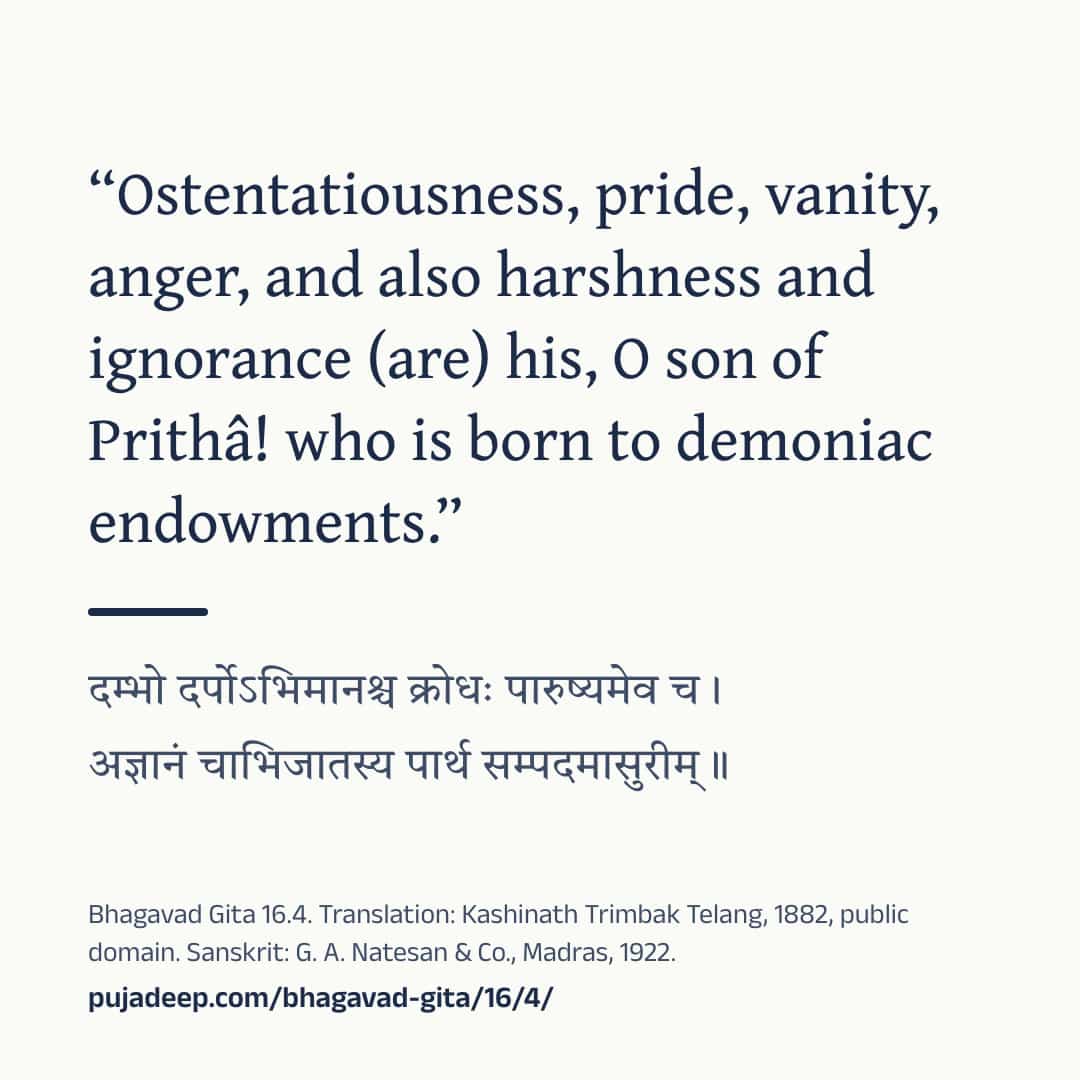
Drawing the picture
See the words
Bhagavad Gita 16.4

दम्भो दर्पोऽभिमानश्च क्रोधः पारुष्यमेव च ।
अज्ञानं चाभिजातस्य पार्थ सम्पदमासुरीम् ॥

“Ostentatiousness, pride, vanity, anger, and also harshness and ignorance (are) his, O son of Prithâ! who is born to demoniac endowments.”
(K. T. Telang, The Bhagavadgîtâ (The Sacred Books of the East, vol. VIII, Oxford: Clarendon Press, 1882), p. 114, public domain)

“Hypocrisy, arrogance and conceit, wrath and also harshness and unwisdom are his who is born, O Pârtha, with âsuric properties.”
(Annie Besant, The Bhagavad Gîtâ, or The Lord's Song (London: Theosophical Publishing Society, 1895), pp. 140–141, public domain)

“Ostentation, arrogance and self-conceit, anger as also harshness and ignorance, belong to one who is born, O Pártha, for an Asuric state.”
(Swami Swarupananda, Srimad-Bhagavad-Gita (Mayavati: Prabuddha Bharata Press, 1909; first printed in Prabuddha Bharata, 1907–1909), p. 297, public domain)

Sanskrit: G. A. Natesan & Co., Madras, 1922.
https://pujadeep.com/bhagavad-gita/16/4/ Nothing is sent from this site. Your own app sends it, to the chat you choose. The picture quotes the translation you chose on this page, with its name and year.
Sanskrit text: The Bhagavad-Gita, or The Lord's Song, with the text in Devanagari and an English translation, 1922. Meanings: written for Pujadeep and checked against the cited edition. Source and changes
Questions families ask
Who speaks Bhagavad Gita 16.4?
Krishna speaks this verse, in chapter 16 (Daivasura Sampad Vibhaga Yoga).
Where does the Sanskrit text come from?
Sanskrit text: The Bhagavad-Gita, or The Lord's Song, with the text in Devanagari and an English translation, 1922. Meanings: written for Pujadeep and checked against the cited edition. See the source
Is the meaning on this page a translation?
Explanation written for this site from the sources listed here, and checked against the cited edition. It is not a translation and not the only way to read the text. Free to quote with credit.
Source and licence
- Sanskrit text
- The Bhagavad-Gita, or The Lord's Song, with the text in Devanagari and an English translation (Annie Besant, G. A. Natesan & Co., Madras, 1922). Public domain. The Sanskrit on these pages was read from this printing’s page images.
- Translation
- The Bhagavadgîtâ with the Sanatsugâtîya and the Anugîtâ, translated by Kâshinâth Trimbak Telang (The Sacred Books of the East, vol. VIII, ed. F. Max Müller) (Kashinath Trimbak Telang, F. Max Müller, Clarendon Press, Oxford, 1882). Public domain. Shown verbatim, as printed.
- Translation
- The Bhagavad Gîtâ, or The Lord's Song, translated by Annie Besant (Annie Besant, Theosophical Publishing Society, London, 1895). Public domain. Shown verbatim, as printed.
- Translation
- Srimad-Bhagavad-Gita, with Sanskrit Text; Paraphrase with Word-by-word Literal Translation; English Rendering and Comments, Index, &c., by the Swami Swarupananda (Himalayan Series, No. XX) (Swami Swarupananda, The Editors and Publishers, Advaita Ashrama, Mayavati, Prabuddha Bharata Press, Mayavati, Almora, Himalayas, 1909). Public domain. Shown verbatim, as printed.
- Common wording
- In this text, 32 words follow today's common wording, checked against sanskritdocuments.org; Sanskrit Wikisource; Gita Press, Gorakhpur; GRETIL, Göttingen and Bhaktivedanta Book Trust.
- Our explanation
- Explanation written for this site from the sources listed here, and checked against the cited edition. It is not a translation and not the only way to read the text. Free to quote with credit.
- Checked
- Checked against the cited edition, October 14, 2026.
- Updated
- October 25, 2026