Bhagavad Gita 16.5: meaning and translation
Chapter 16: Daivasura Sampad Vibhaga Yoga. Krishna says
Krishna says the divine endowment is held to lead to freedom (vimokṣa), and the asura endowment to bondage.
Click or tap a word for its meaning and its dictionary page.
Text and layers
Text and layers
These choices stay in this browser.
Bhagavad Gita 16.5
दैवी सम्पद्विमोक्षाय निबन्धायासुरी मता ।मा शुचः सम्पदं दैवीमभिजातोऽसि पाण्डव ॥
Daivi sampadvimokshaya nibandhayasuri mataMa shuchah sampadam daivimabhijatosi pandava
daivī sampadvimokṣāya nibandhāyāsurī matā |mā śucaḥ sampadaṃ daivīmabhijāto’si pāṇḍava ||
Our explanation Krishna says the divine endowment is held to lead to freedom (vimokṣa), and the asura endowment to bondage. Then he tells Arjuna (Pandava) not to grieve: Arjuna, he says, is born to the divine endowment. The schools explain why Krishna adds this (see the views).
हिंदी अर्थ कृष्ण कहते हैं कि दैवी संपदा मुक्ति की ओर ले जाने वाली मानी गई है और आसुरी संपदा बंधन की ओर। फिर वे अर्जुन (पांडव) से शोक न करने को कहते हैं, और कहते हैं कि अर्जुन दैवी संपदा लेकर जन्मे हैं। कृष्ण यह बात क्यों जोड़ते हैं, इसे टीकाकार अपने-अपने ढंग से बताते हैं।
Word by word
Every word, with its dictionary page
Word by word
- दैवी daivī · divine (adjective (feminine), nominative singular) Dictionary: 1. daiva, Monier-Williams 1899, p. 497, col. 2 “belonging to or coming from the gods, divine, celestial”
- सम्पत् sampat · endowment (noun (feminine), nominative singular) Dictionary: sampad, Monier-Williams 1899, p. 1172, col. 1 “fate, destiny”
- विमोक्षाय vimokṣāya · for liberation (noun (masculine), dative singular) Dictionary: vi-mokṣa, Monier-Williams 1899, p. 981, col. 2 “liberation of the soul, i.e. final emancipation”
- निबन्धाय nibandhāya · for bondage (noun (masculine), dative singular) Dictionary: ni-bandha, Monier-Williams 1899, p. 550, col. 1 “chain, fetter, bondage”
- आसुरी āsurī · the asura (endowment) (adjective (feminine), nominative singular) Dictionary: 1. āsura, Monier-Williams 1899, p. 160, col. 3 “belonging or relating to the Asuras”
- मता matā · is held (past participle (feminine), nominative singular) Dictionary: mata, Monier-Williams 1899, p. 783, col. 1 “regarded or considered as, taken or passing for”
- मा mā · do not (indeclinable) Dictionary: 1. mā, Monier-Williams 1899, p. 804, col. 1 “not, that not, lest, would that not; a particle of prohibition or negation”
- शुचः śucaḥ · grieve (aorist (with mā: do not), 2nd person singular) Dictionary: 1. śuc, Monier-Williams 1899, p. 1081, col. 1 “be sorrowful or afflicted, grieve, mourn at or for”
- सम्पदम् sampadam · endowment (noun (feminine), accusative singular) Dictionary: sampad, Monier-Williams 1899, p. 1172, col. 1 “fate, destiny”
- दैवीम् daivīm · divine (adjective (feminine), accusative singular) Dictionary: 1. daiva, Monier-Williams 1899, p. 497, col. 2 “belonging to or coming from the gods, divine, celestial”
- अभिजातः abhijātaḥ · born (to) (past participle (masculine), nominative singular) Dictionary: abhi-jāta, Monier-Williams 1899, p. 62, col. 2 “born, produced”
- असि asi · (you) are (present, 2nd person singular) Dictionary: 1. as, Monier-Williams 1899, p. 117, col. 2 “to be, live, exist, be present”
- पाण्डव pāṇḍava · O son of Pandu (Arjuna) (noun (masculine), vocative singular) Dictionary: pāṇḍava, Monier-Williams 1899, p. 616, col. 2 “a son or descendant of Pāṇḍu”
1 printing differs
Edition differences. Another printing or text reads this place differently.
- The printed edition reads: दैवी सम्पद्विमोक्षाय निबन्धायासुरी मता ।
मा शुवः सम्पदं दैवीमभिजातोऽसि पाण्डव ॥ The print reads शुवः, with the closed bowl of व where च is needed (compare the open च of चाभिजातस्य on the same page, leaf n228); read as a wrong sort and corrected to शुचः (mā śucaḥ, 'do not grieve'), as both proofreading references read.
Old translations
Kashinath Trimbak Telang, 1882. Public domain. Page 114–115.
Godlike endowments are deemed to be (means) for final emancipation, demoniac for bondage1. Grieve not, O descendant of Bharata! you are born to godlike endowments.
Footnotes (the translator’s own) - Scil. to birth and death in this world. ↩
Compare 3 translations
Kashinath Trimbak Telang, 1882. Public domain. Page 114–115.
Godlike endowments are deemed to be (means) for final emancipation, demoniac for bondage1. Grieve not, O descendant of Bharata! you are born to godlike endowments.
Footnotes (the translator’s own) - Scil. to birth and death in this world. ↩
You are reading this one
Annie Besant, 1895. Public domain. Page 141.
The divine properties are deemed (to be) for liberation, the âsuric for bondage. Grieve not, thou art born with divine properties, O Pândava.
You are reading this one
Swami Swarupananda, 1909 (first printed 1907). Public domain. Page 297.
The divine state is deemed (as mature) for liberation, the Asuric for bondage; grieve not, O Pándava, thou art born for a divine state.
You are reading this one
Cite this verse
The translation: K. T. Telang, The Bhagavadgîtâ (The Sacred Books of the East, vol. VIII, Oxford: Clarendon Press, 1882), pp. 114–115. Bhagavad Gita 16.5.
The translation: Annie Besant, The Bhagavad Gîtâ, or The Lord's Song (London: Theosophical Publishing Society, 1895), p. 141. Bhagavad Gita 16.5.
The translation: Swami Swarupananda, Srimad-Bhagavad-Gita (Mayavati: Prabuddha Bharata Press, 1909; first printed in Prabuddha Bharata, 1907–1909), p. 297. Bhagavad Gita 16.5.
Our explanation: “Bhagavad Gita 16.5: meaning and translation.” Pujadeep. Updated October 25, 2026. https://pujadeep.com/bhagavad-gita/16/5/
Pujadeep’s explanations are free to quote with credit: name Pujadeep and link to the page. How to credit
Classical readings, by school
Each reading is named by its school. None is presented as the only meaning.
What Advaita, Vishishtadvaita and Dvaita teach, in short
Shankara Advaita
Shankara says the divine nature leads to freedom from the bondage of saṃsāra, while the asura nature, and the rākṣasa nature too, lead to sure bondage. Krishna adds 'grieve not' because he sees Arjuna wondering which nature he has; born to the divine lot, Arjuna has happiness ahead of him.
Source: The Bhagavad-Gita, with the commentary of Sri Sankaracharya, translated by A. Mahadeva Sastri (2nd ed., Mysore: G. T. A. Printing Works, 1901), commentary on 16.5, p. 375. Summarised in our own words; none of its text is reproduced.
Ramanuja Vishishtadvaita
Ramanuja says the divine endowment is obedience to the Lord's will, which in time brings release from bondage; the asura endowment is refusal to obey his commands, which leads to bondage. Seeing Arjuna in doubt and fear about his own nature, Krishna reassures him: as the son of Pandu, a most righteous man, he belongs to the divine lot.
Source: Sri Bhagavad-Gita with Sri Ramanujacharya's Visishtadvaita commentary, translated by A. Govindacharya (Madras, 1898), commentary on 16.5, pp. 487–488. Summarised in our own words; none of its text is reproduced.
Share
Show the ways to share
Send one picture or the text to one chat. The picture names its source and the address of this page.
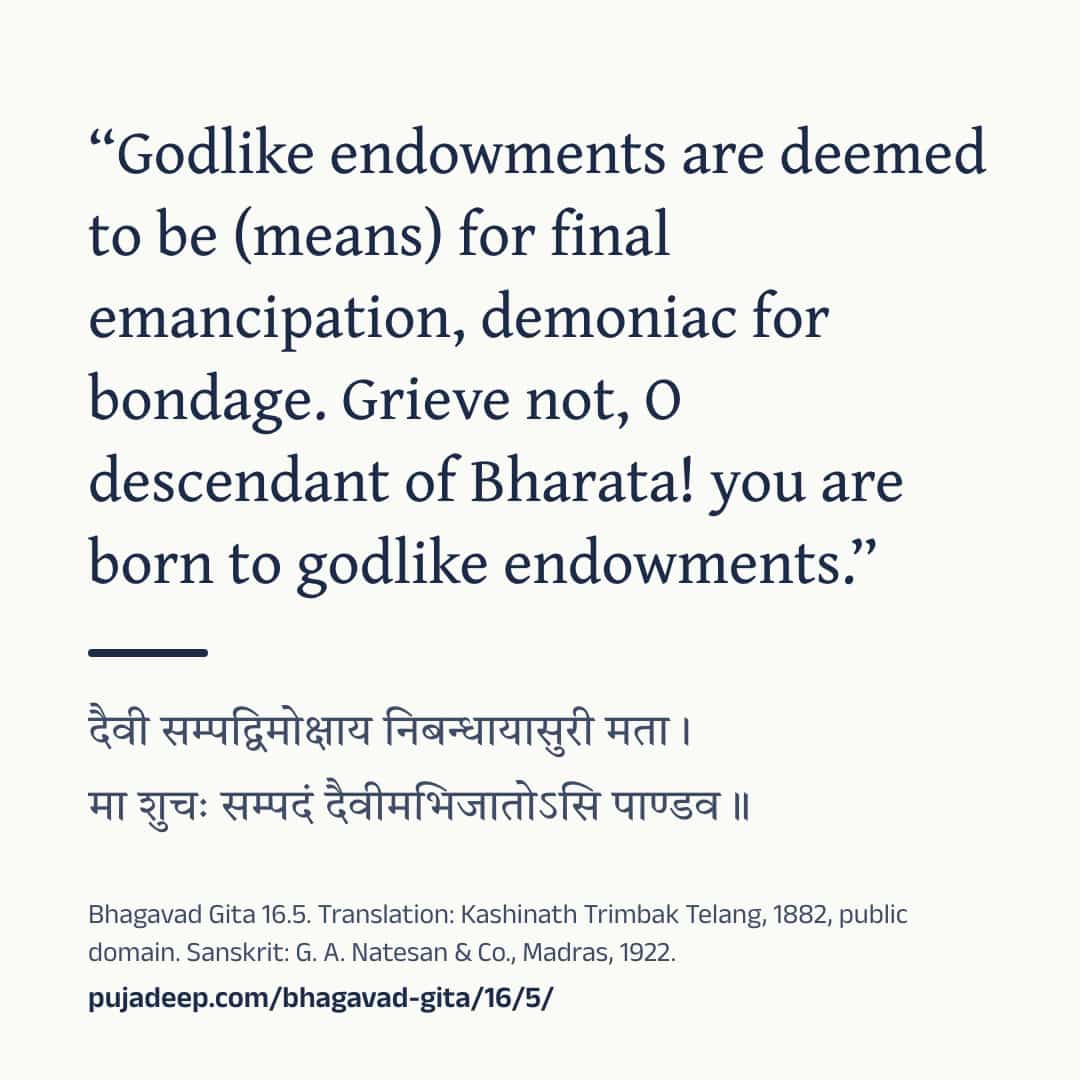
Drawing the picture
See the words
Bhagavad Gita 16.5

दैवी सम्पद्विमोक्षाय निबन्धायासुरी मता ।
मा शुचः सम्पदं दैवीमभिजातोऽसि पाण्डव ॥

“Godlike endowments are deemed to be (means) for final emancipation, demoniac for bondage. Grieve not, O descendant of Bharata! you are born to godlike endowments.”
(K. T. Telang, The Bhagavadgîtâ (The Sacred Books of the East, vol. VIII, Oxford: Clarendon Press, 1882), pp. 114–115, public domain)

“The divine properties are deemed (to be) for liberation, the âsuric for bondage. Grieve not, thou art born with divine properties, O Pândava.”
(Annie Besant, The Bhagavad Gîtâ, or The Lord's Song (London: Theosophical Publishing Society, 1895), p. 141, public domain)

“The divine state is deemed (as mature) for liberation, the Asuric for bondage; grieve not, O Pándava, thou art born for a divine state.”
(Swami Swarupananda, Srimad-Bhagavad-Gita (Mayavati: Prabuddha Bharata Press, 1909; first printed in Prabuddha Bharata, 1907–1909), p. 297, public domain)

Sanskrit: G. A. Natesan & Co., Madras, 1922.
https://pujadeep.com/bhagavad-gita/16/5/ Nothing is sent from this site. Your own app sends it, to the chat you choose. The picture quotes the translation you chose on this page, with its name and year.
Sanskrit text: The Bhagavad-Gita, or The Lord's Song, with the text in Devanagari and an English translation, 1922. Meanings: written for Pujadeep and checked against the cited edition. Source and changes
Questions families ask
Who speaks Bhagavad Gita 16.5?
Krishna speaks this verse, in chapter 16 (Daivasura Sampad Vibhaga Yoga).
Where does the Sanskrit text come from?
Sanskrit text: The Bhagavad-Gita, or The Lord's Song, with the text in Devanagari and an English translation, 1922. Meanings: written for Pujadeep and checked against the cited edition. See the source
Is the meaning on this page a translation?
Explanation written for this site from the sources listed here, and checked against the cited edition. It is not a translation and not the only way to read the text. Free to quote with credit.
Source and licence
- Sanskrit text
- The Bhagavad-Gita, or The Lord's Song, with the text in Devanagari and an English translation (Annie Besant, G. A. Natesan & Co., Madras, 1922). Public domain. The Sanskrit on these pages was read from this printing’s page images.
- Translation
- The Bhagavadgîtâ with the Sanatsugâtîya and the Anugîtâ, translated by Kâshinâth Trimbak Telang (The Sacred Books of the East, vol. VIII, ed. F. Max Müller) (Kashinath Trimbak Telang, F. Max Müller, Clarendon Press, Oxford, 1882). Public domain. Shown verbatim, as printed.
- Translation
- The Bhagavad Gîtâ, or The Lord's Song, translated by Annie Besant (Annie Besant, Theosophical Publishing Society, London, 1895). Public domain. Shown verbatim, as printed.
- Translation
- Srimad-Bhagavad-Gita, with Sanskrit Text; Paraphrase with Word-by-word Literal Translation; English Rendering and Comments, Index, &c., by the Swami Swarupananda (Himalayan Series, No. XX) (Swami Swarupananda, The Editors and Publishers, Advaita Ashrama, Mayavati, Prabuddha Bharata Press, Mayavati, Almora, Himalayas, 1909). Public domain. Shown verbatim, as printed.
- Commentary
- The Bhagavad-Gita, with the commentary of Sri Sankaracharya, translated by A. Mahadeva Sastri (2nd ed., Mysore: G. T. A. Printing Works, 1901) (Public-domain scan, University of California Libraries). Summarised in our own words; none of its text is reproduced.
- Commentary
- Sri Bhagavad-Gita with Sri Ramanujacharya's Visishtadvaita commentary, translated by A. Govindacharya (Madras, 1898) (Scan uploaded to archive.org (folkscanomy collection)). Summarised in our own words; none of its text is reproduced.
- Common wording
- In this text, 32 words follow today's common wording, checked against sanskritdocuments.org; Sanskrit Wikisource; Gita Press, Gorakhpur; GRETIL, Göttingen and Bhaktivedanta Book Trust.
- Our explanation
- Explanation written for this site from the sources listed here, and checked against the cited edition. It is not a translation and not the only way to read the text. Free to quote with credit.
- Checked
- Checked against the cited edition, October 14, 2026.
- Updated
- October 25, 2026