Bhagavad Gita 16.19: meaning and translation
Chapter 16: Daivasura Sampad Vibhaga Yoga. Krishna says
Krishna says that these people, hating and cruel, the lowest among humans, unholy (aśubha), he casts again and again into asura births (āsurī yoni) in the round of birth and death (saṃsāra).
Click or tap a word for its meaning and its dictionary page.
Text and layers
Text and layers
These choices stay in this browser.
Bhagavad Gita 16.19
तानहं द्विषतः क्रूरान्संसारेषु नराधमान् ।क्षिपाम्यजस्रमशुभानासुरीष्वेव योनिषु ॥
Tanaham dvishatah kruransansareshu naradhamanKshipamyajasramashubhanasurishveva yonishu
tānahaṃ dviṣataḥ krūrānsaṃsāreṣu narādhamān |kṣipāmyajasramaśubhānāsurīṣveva yoniṣu ||
Our explanation Krishna says that these people, hating and cruel, the lowest among humans, unholy (aśubha), he casts again and again into asura births (āsurī yoni) in the round of birth and death (saṃsāra). The verse speaks of qualities, those listed in verses 4 and 7–18, and names no group of people. The schools explain 'asura births' differently (see the views). Readings of these verses differ between schools and teachers, and the wording is the text's, not the view of this library.
हिंदी अर्थ कृष्ण कहते हैं कि द्वेष करने वाले, क्रूर, मनुष्यों में सबसे नीचे और अशुभ ऐसे लोगों को वे संसार (जन्म और मृत्यु के चक्र) में बार-बार आसुरी योनियों में डालते हैं। यह श्लोक गुणों की बात करता है, जो श्लोक 4 और 7–18 में गिनाए गए हैं; यह किसी समुदाय का नाम नहीं लेता। “आसुरी योनि” को परंपराएँ अलग-अलग ढंग से समझाती हैं। इन श्लोकों को अलग-अलग परंपराएँ और आचार्य अलग ढंग से पढ़ते हैं, और ये शब्द पाठ के हैं, इस पुस्तकालय का मत नहीं।
Word by word
Every word, with its dictionary page
Word by word
- तान् tān · them (pronoun (masculine), accusative plural) Dictionary: tad, Monier-Williams 1899, p. 434, col. 1 “m. he, f. she, n. it, that, this”
- अहम् aham · "I" (Krishna) (pronoun, nominative singular) Dictionary: aham, Monier-Williams 1899, p. 124, col. 2 “nom. sg. ‘I,’”
- द्विषतः dviṣataḥ · hating (present participle (masculine), accusative plural) Dictionary: 2. dviṣ, Monier-Williams 1899, p. 506, col. 3 “to hate, show hatred against”
- क्रूरान् krūrān · cruel (adjective (masculine), accusative plural) Dictionary: krūra, Monier-Williams 1899, p. 322, col. 3 “cruel, fierce, ferocious, pitiless”
- संसारेषु saṃsāreṣu · in the rounds of birth (noun (masculine), locative plural) Dictionary: saṃ-sāra, Monier-Williams 1899, p. 1119, col. 3 “transmigration, metempsychosis, the world, secular life, worldly illusion”
- नराधमान् narādhamān · lowest of men (compound (masculine), accusative plural) Dictionary: nara, Monier-Williams 1899, p. 528, col. 3 “a man, a male, a person”; adhama, Monier-Williams 1899, p. 19, col. 3 “lowest, vilest, worst; very low or vile or bad”
- क्षिपामि kṣipāmi · cast (present, 1st person singular) Dictionary: 1. kṣip, Monier-Williams 1899, p. 328, col. 3 “to throw, cast, send, despatch”
- अजस्रम् ajasram · ever, without end (indeclinable) Dictionary: a-jasra, Monier-Williams 1899, p. 10, col. 1 “not to be obstructed, perpetual”
- अशुभान् aśubhān · impure (adjective (masculine), accusative plural) Dictionary: a-śubha, Monier-Williams 1899, p. 113, col. 3 “not beautiful or agreeable, disagreeable; inauspicious”
- आसुरीषु āsurīṣu · asura (adjective (feminine), locative plural) Dictionary: 1. āsura, Monier-Williams 1899, p. 160, col. 3 “belonging or relating to the Asuras”
- एव eva · only (indeclinable) Dictionary: 1. eva, Monier-Williams 1899, p. 232, col. 2 “just, exactly, very, same, only, even, alone, merely”
- योनिषु yoniṣu · into wombs (births) (noun (feminine), locative plural) Dictionary: yoni, Monier-Williams 1899, p. 858, col. 2 “the womb, uterus”
Old translations
Kashinath Trimbak Telang, 1882. Public domain. Page 116.
These enemies1, ferocious, meanest of men, and unholy, I continually hurl down to these worlds2, only into demoniac wombs.
Footnotes (the translator’s own) Compare 3 translations
Kashinath Trimbak Telang, 1882. Public domain. Page 116.
These enemies1, ferocious, meanest of men, and unholy, I continually hurl down to these worlds2, only into demoniac wombs.
Footnotes (the translator’s own) You are reading this one
Annie Besant, 1895. Public domain. Page 143.
These haters, pitiless, vilest among men, impure, I ever throw down in the worlds into âsuric wombs.
You are reading this one
Swami Swarupananda, 1909 (first printed 1907). Public domain. Page 303.
These malicious and cruel evil-doers, most degraded of men, I hurl perpetually into the wombs of Asuras only, in these worlds.
You are reading this one
Cite this verse
The translation: K. T. Telang, The Bhagavadgîtâ (The Sacred Books of the East, vol. VIII, Oxford: Clarendon Press, 1882), p. 116. Bhagavad Gita 16.19.
The translation: Annie Besant, The Bhagavad Gîtâ, or The Lord's Song (London: Theosophical Publishing Society, 1895), p. 143. Bhagavad Gita 16.19.
The translation: Swami Swarupananda, Srimad-Bhagavad-Gita (Mayavati: Prabuddha Bharata Press, 1909; first printed in Prabuddha Bharata, 1907–1909), p. 303. Bhagavad Gita 16.19.
Our explanation: “Bhagavad Gita 16.19: meaning and translation.” Pujadeep. Updated October 25, 2026. https://pujadeep.com/bhagavad-gita/16/19/
Pujadeep’s explanations are free to quote with credit: name Pujadeep and link to the page. How to credit
Classical readings, by school
Each reading is named by its school. None is presented as the only meaning.
What Advaita, Vishishtadvaita and Dvaita teach, in short
Shankara Advaita
Shankara explains 'these' as the enemies of the right path who hate the righteous, and 'lowest' as doing what is against dharma. The 'worlds' are the paths of saṃsāra that pass through many hells, and the asura wombs are births as the most cruel creatures, such as tigers and lions.
Source: The Bhagavad-Gita, with the commentary of Sri Sankaracharya, translated by A. Mahadeva Sastri (2nd ed., Mysore: G. T. A. Printing Works, 1901), commentary on 16.19, pp. 380–381. Summarised in our own words; none of its text is reproduced.
Ramanuja Vishishtadvaita
Ramanuja says the Lord casts those who oppose him into the stream of birth, old age and death, and there into births that increase their aversion to him; he gives them a cruel understanding that suits the births they are born into.
Source: Sri Bhagavad-Gita with Sri Ramanujacharya's Visishtadvaita commentary, translated by A. Govindacharya (Madras, 1898), commentary on 16.19, p. 495. Summarised in our own words; none of its text is reproduced.
Share
Show the ways to share
Send one picture or the text to one chat. The picture names its source and the address of this page.
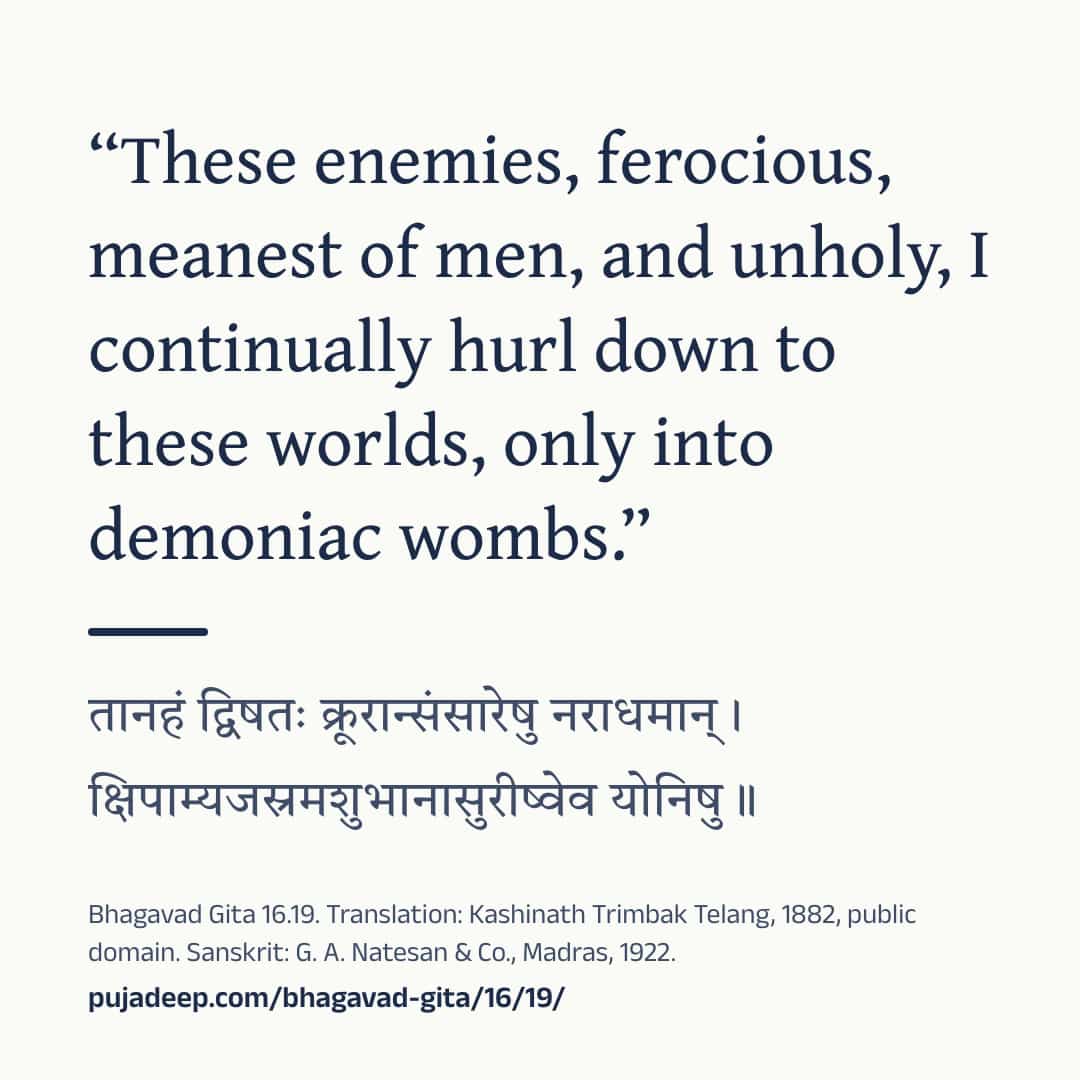
Drawing the picture
See the words
Bhagavad Gita 16.19

तानहं द्विषतः क्रूरान्संसारेषु नराधमान् ।
क्षिपाम्यजस्रमशुभानासुरीष्वेव योनिषु ॥

“These enemies, ferocious, meanest of men, and unholy, I continually hurl down to these worlds, only into demoniac wombs.”
(K. T. Telang, The Bhagavadgîtâ (The Sacred Books of the East, vol. VIII, Oxford: Clarendon Press, 1882), p. 116, public domain)

“These haters, pitiless, vilest among men, impure, I ever throw down in the worlds into âsuric wombs.”
(Annie Besant, The Bhagavad Gîtâ, or The Lord's Song (London: Theosophical Publishing Society, 1895), p. 143, public domain)

“These malicious and cruel evil-doers, most degraded of men, I hurl perpetually into the wombs of Asuras only, in these worlds.”
(Swami Swarupananda, Srimad-Bhagavad-Gita (Mayavati: Prabuddha Bharata Press, 1909; first printed in Prabuddha Bharata, 1907–1909), p. 303, public domain)

Sanskrit: G. A. Natesan & Co., Madras, 1922.
https://pujadeep.com/bhagavad-gita/16/19/ Nothing is sent from this site. Your own app sends it, to the chat you choose. The picture quotes the translation you chose on this page, with its name and year.
Sanskrit text: The Bhagavad-Gita, or The Lord's Song, with the text in Devanagari and an English translation, 1922. Meanings: written for Pujadeep and checked against the cited edition. Source and changes
Questions families ask
Who speaks Bhagavad Gita 16.19?
Krishna speaks this verse, in chapter 16 (Daivasura Sampad Vibhaga Yoga).
Where does the Sanskrit text come from?
Sanskrit text: The Bhagavad-Gita, or The Lord's Song, with the text in Devanagari and an English translation, 1922. Meanings: written for Pujadeep and checked against the cited edition. See the source
Is the meaning on this page a translation?
Explanation written for this site from the sources listed here, and checked against the cited edition. It is not a translation and not the only way to read the text. Free to quote with credit.
Source and licence
- Sanskrit text
- The Bhagavad-Gita, or The Lord's Song, with the text in Devanagari and an English translation (Annie Besant, G. A. Natesan & Co., Madras, 1922). Public domain. The Sanskrit on these pages was read from this printing’s page images.
- Translation
- The Bhagavadgîtâ with the Sanatsugâtîya and the Anugîtâ, translated by Kâshinâth Trimbak Telang (The Sacred Books of the East, vol. VIII, ed. F. Max Müller) (Kashinath Trimbak Telang, F. Max Müller, Clarendon Press, Oxford, 1882). Public domain. Shown verbatim, as printed.
- Translation
- The Bhagavad Gîtâ, or The Lord's Song, translated by Annie Besant (Annie Besant, Theosophical Publishing Society, London, 1895). Public domain. Shown verbatim, as printed.
- Translation
- Srimad-Bhagavad-Gita, with Sanskrit Text; Paraphrase with Word-by-word Literal Translation; English Rendering and Comments, Index, &c., by the Swami Swarupananda (Himalayan Series, No. XX) (Swami Swarupananda, The Editors and Publishers, Advaita Ashrama, Mayavati, Prabuddha Bharata Press, Mayavati, Almora, Himalayas, 1909). Public domain. Shown verbatim, as printed.
- Commentary
- The Bhagavad-Gita, with the commentary of Sri Sankaracharya, translated by A. Mahadeva Sastri (2nd ed., Mysore: G. T. A. Printing Works, 1901) (Public-domain scan, University of California Libraries). Summarised in our own words; none of its text is reproduced.
- Commentary
- Sri Bhagavad-Gita with Sri Ramanujacharya's Visishtadvaita commentary, translated by A. Govindacharya (Madras, 1898) (Scan uploaded to archive.org (folkscanomy collection)). Summarised in our own words; none of its text is reproduced.
- Common wording
- In this text, 32 words follow today's common wording, checked against sanskritdocuments.org; Sanskrit Wikisource; Gita Press, Gorakhpur; GRETIL, Göttingen and Bhaktivedanta Book Trust.
- Our explanation
- Explanation written for this site from the sources listed here, and checked against the cited edition. It is not a translation and not the only way to read the text. Free to quote with credit.
- Checked
- Checked against the cited edition, October 14, 2026.
- Updated
- October 25, 2026