Bhagavad Gita 16.21: meaning and translation
Chapter 16: Daivasura Sampad Vibhaga Yoga. Krishna says
Krishna names three gates to hell (naraka) that ruin the self: desire (kāma), anger (krodha) and greed (lobha).
Click or tap a word for its meaning and its dictionary page.
Text and layers
Text and layers
These choices stay in this browser.
Bhagavad Gita 16.21
त्रिविधं नरकस्येदं द्वारं नाशनमात्मनः ।कामः क्रोधस्तथा लोभस्तस्मादेतत्त्रयं त्यजेत् ॥
Trividham narakasyedam dvaram nashanamatmanahKamah krodhastatha lobhastasmadetattrayam tyajet
trividhaṃ narakasyedaṃ dvāraṃ nāśanamātmanaḥ |kāmaḥ krodhastathā lobhastasmādetattrayaṃ tyajet ||
Our explanation Krishna names three gates to hell (naraka) that ruin the self: desire (kāma), anger (krodha) and greed (lobha). So, he says, one should give up these three.
हिंदी अर्थ कृष्ण नरक के तीन द्वार बताते हैं, जो आत्मा का नाश करते हैं: काम, क्रोध और लोभ। इसलिए, वे कहते हैं, इन तीनों को छोड़ देना चाहिए।
Word by word
Every word, with its dictionary page
Word by word
- त्रिविधम् trividham · threefold (adjective (neuter), nominative singular) Dictionary: tri-vidha, Monier-Williams 1899, p. 460, col. 2 “of 3 kinds, triple, threefold”
- नरकस्य narakasya · of hell (naraka) (noun (masculine), genitive singular) Dictionary: naraka, Monier-Williams 1899, p. 529, col. 3 “hell, place of torment”
- इदम् idam · this (pronoun (neuter), nominative singular) Dictionary: 1. idam, Monier-Williams 1899, p. 165, col. 2 “this, this here, referring to something near the speaker”
- द्वारम् dvāram · gate (noun (neuter), nominative singular) Dictionary: dvāra, Monier-Williams 1899, p. 504, col. 2 “door, gate, passage, entrance”
- नाशनम् nāśanam · ruinous (adjective (neuter), nominative singular) Dictionary: nāśana, Monier-Williams 1899, p. 538, col. 1 “destroying &c.”
- आत्मनः ātmanaḥ · of the self (noun (masculine), genitive singular) Dictionary: ātman, Monier-Williams 1899, p. 135, col. 1 “the individual soul, self”
- कामः kāmaḥ · desire (noun (masculine), nominative singular) Dictionary: kāma, Monier-Williams 1899, p. 271, col. 3 “wish, desire, longing”
- क्रोधः krodhaḥ · anger (noun (masculine), nominative singular) Dictionary: krodha, Monier-Williams 1899, p. 322, col. 1 “anger, wrath, passion”
- तथा tathā · and also (indeclinable) Dictionary: tathā, Monier-Williams 1899, p. 433, col. 3 “in that manner, so, thus”
- लोभः lobhaḥ · greed (noun (masculine), nominative singular) Dictionary: lobha, Monier-Williams 1899, p. 905, col. 1 “covetousness, cupidity, avarice”
- तस्मात् tasmāt · therefore (indeclinable) Dictionary: tasmāt, Monier-Williams 1899, p. 441, col. 2 “from that, on that account, therefore”
- एतत् etat · this (pronoun (neuter), accusative singular) Dictionary: etad, Monier-Williams 1899, p. 231, col. 2 “this, this here, here”
- त्रयम् trayam · set of three (noun (neuter), accusative singular) Dictionary: traya, Monier-Williams 1899, p. 457, col. 2 “a triad”
- त्यजेत् tyajet · one should give up (optative, 3rd person singular) Dictionary: 1. tyaj, Monier-Williams 1899, p. 456, col. 3 “to leave, abandon, quit”
Old translations
Kashinath Trimbak Telang, 1882. Public domain. Page 116–117.
Threefold is this way to hell,—ruinous to the self1,—lust,anger, and likewise avarice; therefore one should abandon this triad.
Footnotes (the translator’s own) - I.e. rendering the self unfit for any of the highest ends of man. ↩
Compare 3 translations
Kashinath Trimbak Telang, 1882. Public domain. Page 116–117.
Threefold is this way to hell,—ruinous to the self1,—lust,anger, and likewise avarice; therefore one should abandon this triad.
Footnotes (the translator’s own) - I.e. rendering the self unfit for any of the highest ends of man. ↩
You are reading this one
Annie Besant, 1895. Public domain. Page 144.
Triple is this gate of hell, destructive of the self—lust, wrath and greed: therefore let man renounce these three.
You are reading this one
Swami Swarupananda, 1909 (first printed 1907). Public domain. Page 304.
Triple is this gate of hell, destructive of the self,—lust, anger and greed; therefore one should forsake these three.
You are reading this one
Cite this verse
The translation: K. T. Telang, The Bhagavadgîtâ (The Sacred Books of the East, vol. VIII, Oxford: Clarendon Press, 1882), pp. 116–117. Bhagavad Gita 16.21.
The translation: Annie Besant, The Bhagavad Gîtâ, or The Lord's Song (London: Theosophical Publishing Society, 1895), p. 144. Bhagavad Gita 16.21.
The translation: Swami Swarupananda, Srimad-Bhagavad-Gita (Mayavati: Prabuddha Bharata Press, 1909; first printed in Prabuddha Bharata, 1907–1909), p. 304. Bhagavad Gita 16.21.
Our explanation: “Bhagavad Gita 16.21: meaning and translation.” Pujadeep. Updated October 25, 2026. https://pujadeep.com/bhagavad-gita/16/21/
Pujadeep’s explanations are free to quote with credit: name Pujadeep and link to the page. How to credit
Classical readings, by school
Each reading is named by its school. None is presented as the only meaning.
What Advaita, Vishishtadvaita and Dvaita teach, in short
Shankara Advaita
Shankara says these three sum up the whole asura nature, endless in its forms, so that giving them up gives up all of it. 'Gate to hell' is the entrance that leads to naraka; by merely entering it the self is ruined, that is, made unfit for any human end.
Source: The Bhagavad-Gita, with the commentary of Sri Sankaracharya, translated by A. Mahadeva Sastri (2nd ed., Mysore: G. T. A. Printing Works, 1901), commentary on 16.21, pp. 381–382. Summarised in our own words; none of its text is reproduced.
Ramanuja Vishishtadvaita
Ramanuja says the asura nature is itself naraka, and these three are the door, that is, the cause, that leads into it. Desire, anger and greed are to be thrown far away.
Source: Sri Bhagavad-Gita with Sri Ramanujacharya's Visishtadvaita commentary, translated by A. Govindacharya (Madras, 1898), commentary on 16.21, pp. 495–496. Summarised in our own words; none of its text is reproduced.
Share
Show the ways to share
Send one picture or the text to one chat. The picture names its source and the address of this page.
Drawing the picture
See the words
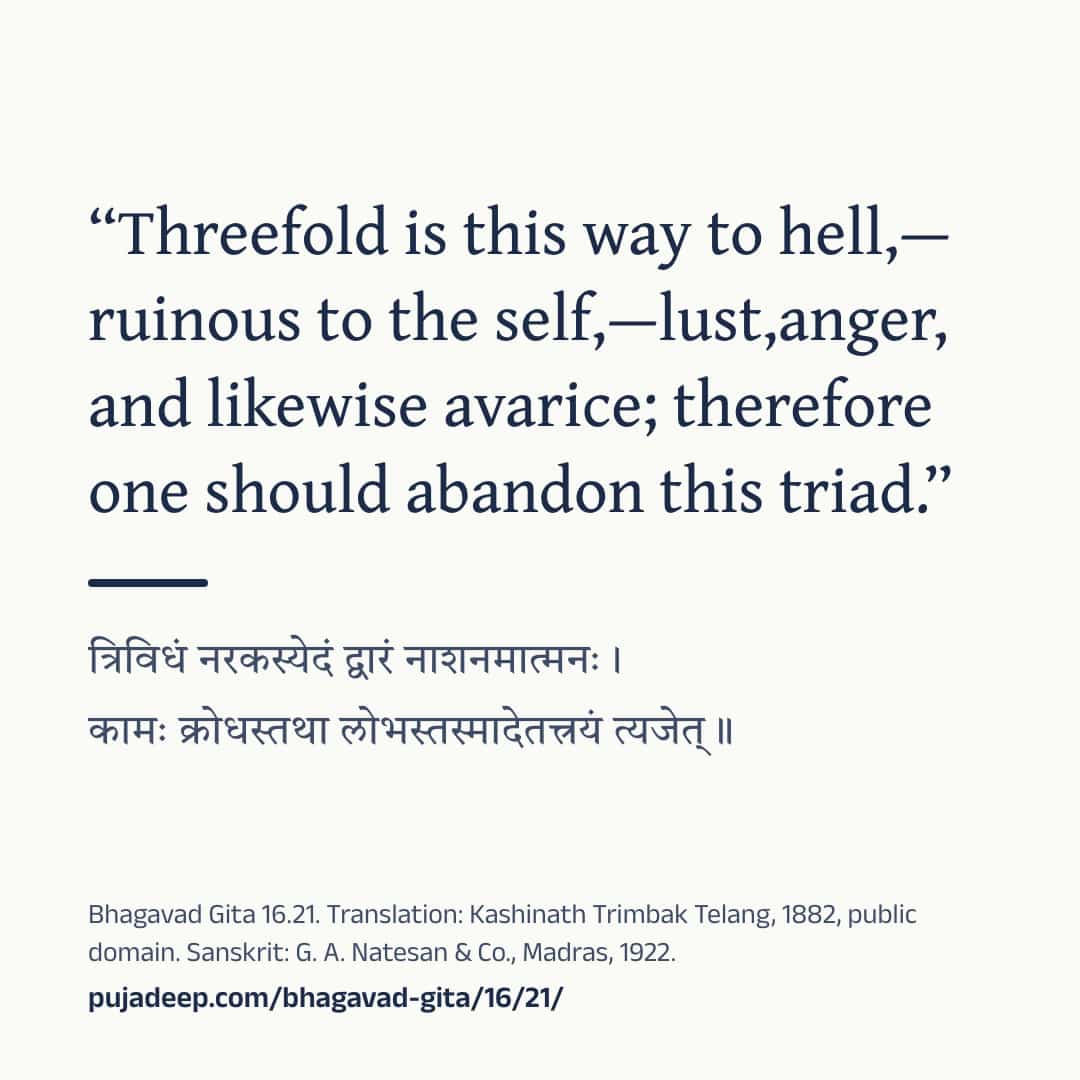
Bhagavad Gita 16.21

त्रिविधं नरकस्येदं द्वारं नाशनमात्मनः ।
कामः क्रोधस्तथा लोभस्तस्मादेतत्त्रयं त्यजेत् ॥

“Threefold is this way to hell,—ruinous to the self,—lust,anger, and likewise avarice; therefore one should abandon this triad.”
(K. T. Telang, The Bhagavadgîtâ (The Sacred Books of the East, vol. VIII, Oxford: Clarendon Press, 1882), pp. 116–117, public domain)

“Triple is this gate of hell, destructive of the self—lust, wrath and greed: therefore let man renounce these three.”
(Annie Besant, The Bhagavad Gîtâ, or The Lord's Song (London: Theosophical Publishing Society, 1895), p. 144, public domain)

“Triple is this gate of hell, destructive of the self,—lust, anger and greed; therefore one should forsake these three.”
(Swami Swarupananda, Srimad-Bhagavad-Gita (Mayavati: Prabuddha Bharata Press, 1909; first printed in Prabuddha Bharata, 1907–1909), p. 304, public domain)

Sanskrit: G. A. Natesan & Co., Madras, 1922.
https://pujadeep.com/bhagavad-gita/16/21/ Nothing is sent from this site. Your own app sends it, to the chat you choose. The picture quotes the translation you chose on this page, with its name and year.
Sanskrit text: The Bhagavad-Gita, or The Lord's Song, with the text in Devanagari and an English translation, 1922. Meanings: written for Pujadeep and checked against the cited edition. Source and changes
Questions families ask
Who speaks Bhagavad Gita 16.21?
Krishna speaks this verse, in chapter 16 (Daivasura Sampad Vibhaga Yoga).
Where does the Sanskrit text come from?
Sanskrit text: The Bhagavad-Gita, or The Lord's Song, with the text in Devanagari and an English translation, 1922. Meanings: written for Pujadeep and checked against the cited edition. See the source
Is the meaning on this page a translation?
Explanation written for this site from the sources listed here, and checked against the cited edition. It is not a translation and not the only way to read the text. Free to quote with credit.
Source and licence
- Sanskrit text
- The Bhagavad-Gita, or The Lord's Song, with the text in Devanagari and an English translation (Annie Besant, G. A. Natesan & Co., Madras, 1922). Public domain. The Sanskrit on these pages was read from this printing’s page images.
- Translation
- The Bhagavadgîtâ with the Sanatsugâtîya and the Anugîtâ, translated by Kâshinâth Trimbak Telang (The Sacred Books of the East, vol. VIII, ed. F. Max Müller) (Kashinath Trimbak Telang, F. Max Müller, Clarendon Press, Oxford, 1882). Public domain. Shown verbatim, as printed.
- Translation
- The Bhagavad Gîtâ, or The Lord's Song, translated by Annie Besant (Annie Besant, Theosophical Publishing Society, London, 1895). Public domain. Shown verbatim, as printed.
- Translation
- Srimad-Bhagavad-Gita, with Sanskrit Text; Paraphrase with Word-by-word Literal Translation; English Rendering and Comments, Index, &c., by the Swami Swarupananda (Himalayan Series, No. XX) (Swami Swarupananda, The Editors and Publishers, Advaita Ashrama, Mayavati, Prabuddha Bharata Press, Mayavati, Almora, Himalayas, 1909). Public domain. Shown verbatim, as printed.
- Commentary
- The Bhagavad-Gita, with the commentary of Sri Sankaracharya, translated by A. Mahadeva Sastri (2nd ed., Mysore: G. T. A. Printing Works, 1901) (Public-domain scan, University of California Libraries). Summarised in our own words; none of its text is reproduced.
- Commentary
- Sri Bhagavad-Gita with Sri Ramanujacharya's Visishtadvaita commentary, translated by A. Govindacharya (Madras, 1898) (Scan uploaded to archive.org (folkscanomy collection)). Summarised in our own words; none of its text is reproduced.
- Common wording
- In this text, 32 words follow today's common wording, checked against sanskritdocuments.org; Sanskrit Wikisource; Gita Press, Gorakhpur; GRETIL, Göttingen and Bhaktivedanta Book Trust.
- Our explanation
- Explanation written for this site from the sources listed here, and checked against the cited edition. It is not a translation and not the only way to read the text. Free to quote with credit.
- Checked
- Checked against the cited edition, October 14, 2026.
- Updated
- October 25, 2026