Bhagavad Gita 16.10: meaning and translation
Chapter 16: Daivasura Sampad Vibhaga Yoga. Krishna says
Krishna goes on.
Click or tap a word for its meaning and its dictionary page.
Text and layers
Text and layers
These choices stay in this browser.
Bhagavad Gita 16.10
काममाश्रित्य दुष्पूरं दम्भमानमदान्विताः ।मोहाद्गृहीत्वाऽसद्ग्राहान्प्रवर्तन्तेऽशुचिव्रताः ॥
Kamamashritya dushpuram dambhamanamadanvitahMohadgrihitvasadgrahanpravartanteshuchivratah
kāmamāśritya duṣpūraṃ dambhamānamadānvitāḥ |mohādgṛhītvā’sadgrāhānpravartante’śucivratāḥ ||
Our explanation Krishna goes on. Such people give themselves to desire that can never be filled. They are full of hypocrisy, pride and arrogance. Out of delusion they take up false ideas, and they act with impure vows (aśuci-vrata).
हिंदी अर्थ कृष्ण आगे कहते हैं। ऐसे लोग उस इच्छा का सहारा लेते हैं जो कभी पूरी नहीं होती। वे दंभ, मान और मद से भरे रहते हैं। मोह के कारण वे गलत विचार पकड़ लेते हैं और अपवित्र व्रतों (अशुचिव्रत) के साथ कर्म में लगे रहते हैं।
Word by word
Every word, with its dictionary page
Word by word
- कामम् kāmam · desire (noun (masculine), accusative singular) Dictionary: kāma, Monier-Williams 1899, p. 271, col. 3 “wish, desire, longing”
- आश्रित्य āśritya · holding to (absolutive (having done)) Dictionary: 1. ā-śri, Monier-Williams 1899, p. 158, col. 2 “to betake one's self to, resort to”
- दुष्पूरम् duṣpūram · hard to fill (adjective (masculine), accusative singular) Dictionary: duṣ-pūra, Monier-Williams 1899, p. 488, col. 1 “difficult to be filled or satisfied”
- दम्भमानमदान्विताः dambhamānamadānvitāḥ · full of show, pride and arrogance (compound (masculine), nominative plural) Dictionary: dambha, Monier-Williams 1899, p. 469, col. 3 “deceit, fraud, feigning, hypocrisy”; 1. māna, Monier-Williams 1899, p. 809, col. 1 “self-conceit, arrogance, pride”; mada, Monier-Williams 1899, p. 777, col. 3 “pride, arrogance, presumption”; anv-ita, Monier-Williams 1899, p. 47, col. 2 “gone along with; joined, attended, accompanied by, connected with”
- मोहात् mohāt · through delusion (noun (masculine), ablative singular) Dictionary: moha, Monier-Williams 1899, p. 836, col. 1 “loss of consciousness, bewilderment, perplexity, distraction, infatuation, delusion”
- गृहीत्वा gṛhītvā · having taken up (absolutive (having done)) Dictionary: grah, Monier-Williams 1899, p. 371, col. 3 “to seize, take”
- असद्ग्राहान् asadgrāhān · false notions (compound (masculine), accusative plural) Dictionary: asad-grāha, Monier-Williams 1899, p. 118, col. 3; asad-graha, Monier-Williams 1899, p. 118, col. 3 “caprice, idle or childish desire”
- प्रवर्तन्ते pravartante · set to work (present, 3rd person plural) Dictionary: pra-vṛt, Monier-Williams 1899, p. 693, col. 2 “to commence, begin to (inf.), set about, engage in”
- अशुचिव्रताः aśucivratāḥ · with impure resolves (compound (masculine), nominative plural) Dictionary: a-śuci, Monier-Williams 1899, p. 113, col. 2 “impure, foul”; vrata, Monier-Williams 1899, p. 1042, col. 2 “any vow or firm purpose, resolve”
1 printing differs
Edition differences. Another printing or text reads this place differently.
- Spelling A digital text reads Same words. The 1922 edition marks the merged vowel with an avagraha (गृहीत्वाऽसद्ग्राहान्, leaf n230); the e-text writes गृहीत्वासद्ग्राहान्, as another digital text does.
Old translations
Kashinath Trimbak Telang, 1882. Public domain. Page 115.
Entertaining insatiable desire, full of vanity, ostentatiousness, and frenzy, they adopt false notions1 through delusion, and engage in unholy observances.
Footnotes (the translator’s own) - Such as that by propitiating a certain divinity by a certain rite they may obtain treasure and so forth. ↩
Compare 3 translations
Kashinath Trimbak Telang, 1882. Public domain. Page 115.
Entertaining insatiable desire, full of vanity, ostentatiousness, and frenzy, they adopt false notions1 through delusion, and engage in unholy observances.
Footnotes (the translator’s own) - Such as that by propitiating a certain divinity by a certain rite they may obtain treasure and so forth. ↩
You are reading this one
Annie Besant, 1895. Public domain. Page 142.
Surrendering themselves to insatiable desires, possessed with hypocrisy, conceit and arrogance, holding evil ideas through delusion, (they) engage in action with impure resolves.
You are reading this one
Swami Swarupananda, 1909 (first printed 1907). Public domain. Page 299.
Filled with insatiable desires, possessed with ostentation, pride and arrogance, holding evil ideas through delusion, they work with impure resolve.
You are reading this one
Cite this verse
The translation: K. T. Telang, The Bhagavadgîtâ (The Sacred Books of the East, vol. VIII, Oxford: Clarendon Press, 1882), p. 115. Bhagavad Gita 16.10.
The translation: Annie Besant, The Bhagavad Gîtâ, or The Lord's Song (London: Theosophical Publishing Society, 1895), p. 142. Bhagavad Gita 16.10.
The translation: Swami Swarupananda, Srimad-Bhagavad-Gita (Mayavati: Prabuddha Bharata Press, 1909; first printed in Prabuddha Bharata, 1907–1909), p. 299. Bhagavad Gita 16.10.
Our explanation: “Bhagavad Gita 16.10: meaning and translation.” Pujadeep. Updated October 25, 2026. https://pujadeep.com/bhagavad-gita/16/10/
Pujadeep’s explanations are free to quote with credit: name Pujadeep and link to the page. How to credit
Classical readings, by school
No readings by school on this verse yet.
Share
Show the ways to share
Send one picture or the text to one chat. The picture names its source and the address of this page.
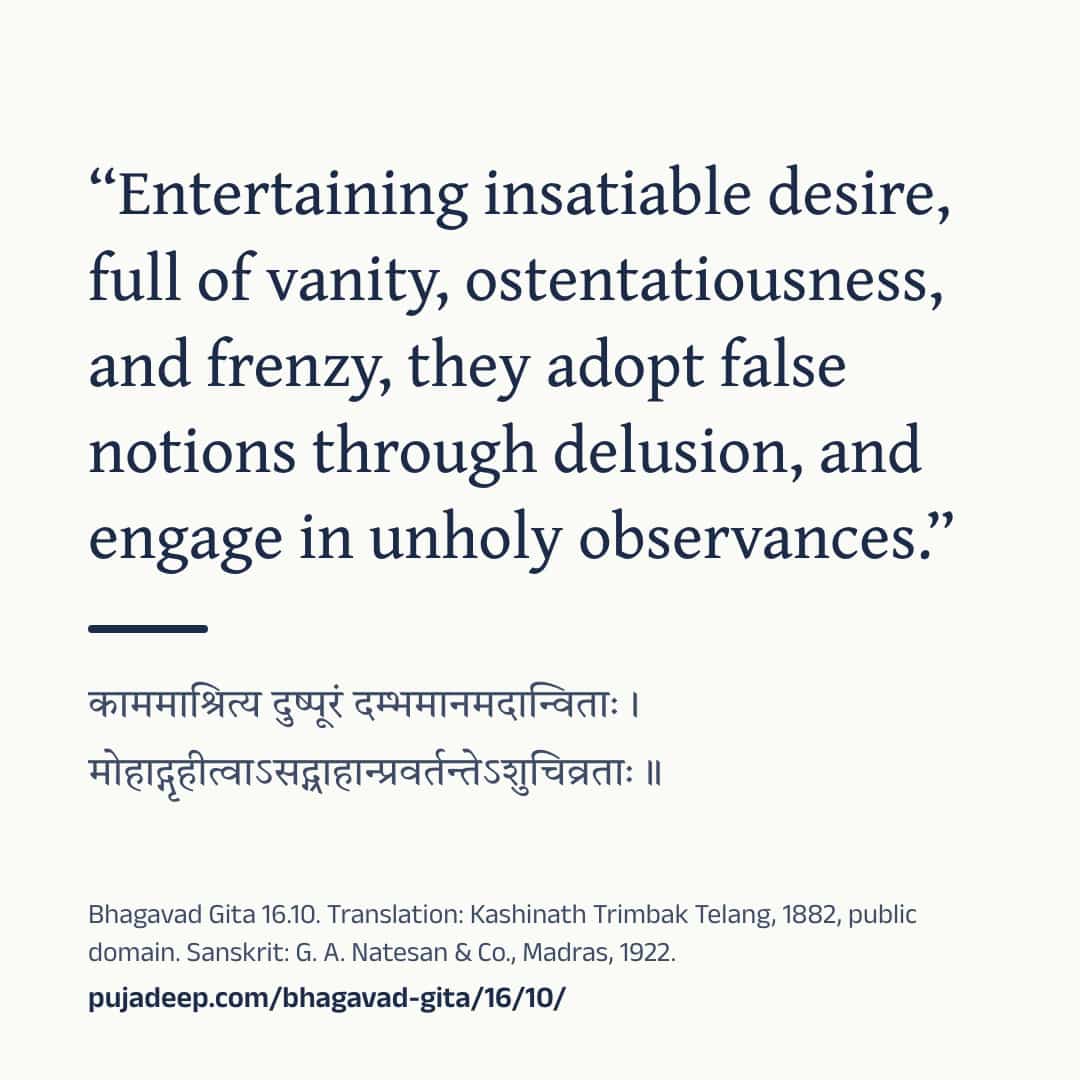
Drawing the picture
See the words
Bhagavad Gita 16.10

काममाश्रित्य दुष्पूरं दम्भमानमदान्विताः ।
मोहाद्गृहीत्वाऽसद्ग्राहान्प्रवर्तन्तेऽशुचिव्रताः ॥

“Entertaining insatiable desire, full of vanity, ostentatiousness, and frenzy, they adopt false notions through delusion, and engage in unholy observances.”
(K. T. Telang, The Bhagavadgîtâ (The Sacred Books of the East, vol. VIII, Oxford: Clarendon Press, 1882), p. 115, public domain)

“Surrendering themselves to insatiable desires, possessed with hypocrisy, conceit and arrogance, holding evil ideas through delusion, (they) engage in action with impure resolves.”
(Annie Besant, The Bhagavad Gîtâ, or The Lord's Song (London: Theosophical Publishing Society, 1895), p. 142, public domain)

“Filled with insatiable desires, possessed with ostentation, pride and arrogance, holding evil ideas through delusion, they work with impure resolve.”
(Swami Swarupananda, Srimad-Bhagavad-Gita (Mayavati: Prabuddha Bharata Press, 1909; first printed in Prabuddha Bharata, 1907–1909), p. 299, public domain)

Sanskrit: G. A. Natesan & Co., Madras, 1922.
https://pujadeep.com/bhagavad-gita/16/10/ Nothing is sent from this site. Your own app sends it, to the chat you choose. The picture quotes the translation you chose on this page, with its name and year.
Sanskrit text: The Bhagavad-Gita, or The Lord's Song, with the text in Devanagari and an English translation, 1922. Meanings: written for Pujadeep and checked against the cited edition. Source and changes
Questions families ask
Who speaks Bhagavad Gita 16.10?
Krishna speaks this verse, in chapter 16 (Daivasura Sampad Vibhaga Yoga).
Where does the Sanskrit text come from?
Sanskrit text: The Bhagavad-Gita, or The Lord's Song, with the text in Devanagari and an English translation, 1922. Meanings: written for Pujadeep and checked against the cited edition. See the source
Is the meaning on this page a translation?
Explanation written for this site from the sources listed here, and checked against the cited edition. It is not a translation and not the only way to read the text. Free to quote with credit.
Source and licence
- Sanskrit text
- The Bhagavad-Gita, or The Lord's Song, with the text in Devanagari and an English translation (Annie Besant, G. A. Natesan & Co., Madras, 1922). Public domain. The Sanskrit on these pages was read from this printing’s page images.
- Translation
- The Bhagavadgîtâ with the Sanatsugâtîya and the Anugîtâ, translated by Kâshinâth Trimbak Telang (The Sacred Books of the East, vol. VIII, ed. F. Max Müller) (Kashinath Trimbak Telang, F. Max Müller, Clarendon Press, Oxford, 1882). Public domain. Shown verbatim, as printed.
- Translation
- The Bhagavad Gîtâ, or The Lord's Song, translated by Annie Besant (Annie Besant, Theosophical Publishing Society, London, 1895). Public domain. Shown verbatim, as printed.
- Translation
- Srimad-Bhagavad-Gita, with Sanskrit Text; Paraphrase with Word-by-word Literal Translation; English Rendering and Comments, Index, &c., by the Swami Swarupananda (Himalayan Series, No. XX) (Swami Swarupananda, The Editors and Publishers, Advaita Ashrama, Mayavati, Prabuddha Bharata Press, Mayavati, Almora, Himalayas, 1909). Public domain. Shown verbatim, as printed.
- Common wording
- In this text, 32 words follow today's common wording, checked against sanskritdocuments.org; Sanskrit Wikisource; Gita Press, Gorakhpur; GRETIL, Göttingen and Bhaktivedanta Book Trust.
- Our explanation
- Explanation written for this site from the sources listed here, and checked against the cited edition. It is not a translation and not the only way to read the text. Free to quote with credit.
- Checked
- Checked against the cited edition, October 14, 2026.
- Updated
- October 25, 2026