Bhagavad Gita 16.8: meaning and translation
Chapter 16: Daivasura Sampad Vibhaga Yoga. Krishna says
Krishna tells what such people say of the world: that it is "without truth, without a foundation, without a Lord (anīśvara)", that it comes from union, one with another, and that desire alone is its cause.
Click or tap a word for its meaning and its dictionary page.
Text and layers
Text and layers
These choices stay in this browser.
Bhagavad Gita 16.8
असत्यमप्रतिष्ठं ते जगदाहुरनीश्वरम् ।अपरस्परसंभूतं किमन्यत्कामहैतुकम् ॥
Asatyamapratishtham te jagadahuranishvaramAparasparasambhutam kimanyatkamahaitukam
asatyamapratiṣṭhaṃ te jagadāhuranīśvaram |aparasparasaṃbhūtaṃ kimanyatkāmahaitukam ||
Our explanation Krishna tells what such people say of the world: that it is "without truth, without a foundation, without a Lord (anīśvara)", that it comes from union, one with another, and that desire alone is its cause. The schools read this verse differently (see the views).
हिंदी अर्थ कृष्ण बताते हैं कि ऐसे लोग संसार के बारे में क्या कहते हैं: कि जगत “असत्य है, बिना आधार के है, बिना ईश्वर के है”, कि यह आपसी मेल से बना है, और काम (इच्छा) ही इसका एकमात्र कारण है। इस श्लोक को परंपराएँ अलग-अलग ढंग से पढ़ती हैं।
Word by word
Every word, with its dictionary page
Word by word
- असत्यम् asatyam · without truth (adjective (neuter), accusative singular) Dictionary: a-satya, Monier-Williams 1899, p. 118, col. 2 “untrue, false, lying”
- अप्रतिष्ठम् apratiṣṭham · without a basis (adjective (neuter), accusative singular) Dictionary: a-pratiṣṭha, Monier-Williams 1899, p. 58, col. 1 “having no solid ground, no value, fluctuating, unsafe”
- ते te · they (pronoun (masculine), nominative plural) Dictionary: tad, Monier-Williams 1899, p. 434, col. 1 “m. he, f. she, n. it, that, this”
- जगत् jagat · the world (noun (neuter), accusative singular) Dictionary: jagat, Monier-Williams 1899, p. 408, col. 1 “the world, esp. this world, earth”
- आहुः āhuḥ · say (perfect form, present sense, 3rd person plural) Dictionary: 1. ah, Monier-Williams 1899, p. 124, col. 1 “to say, speak”
- अनीश्वरम् anīśvaram · without a Lord (adjective (neuter), accusative singular) Dictionary: an-īśvara, Monier-Williams 1899, p. 30, col. 3 “not belonging to the Deity; atheistical”
- अपरस्परसंभूतम् aparasparasaṃbhūtam · born of union, one with another (compound (neuter), accusative singular) Dictionary: 1. a-para, Monier-Williams 1899, p. 50, col. 2 “not produced one by the other”; sam-bhūta, Monier-Williams 1899, p. 1179, col. 2 “become, born, produced or arisen or proceeding from”
- किम् kim · what (pronoun (neuter), nominative singular) Dictionary: kim, Monier-Williams 1899, p. 282, col. 2 “what? how? whence? wherefore? why?”
- अन्यत् anyat · else (pronoun (neuter), nominative singular) Dictionary: 2. anya, Monier-Williams 1899, p. 45, col. 2 “other, different”
- कामहैतुकम् kāmahaitukam · caused by desire (compound (neuter), accusative singular) Dictionary: kāma, Monier-Williams 1899, p. 271, col. 3 “wish, desire, longing”; haituka, Monier-Williams 1899, p. 1304, col. 1 “caused by, dependent on”
1 printing differs
Edition differences. Another printing or text reads this place differently.
- Spelling A digital text reads Same word. The e-text writes the class nasal (सम्भूतं); the 1922 edition writes anusvara (संभूतं).
Old translations
Kashinath Trimbak Telang, 1882. Public domain. Page 115.
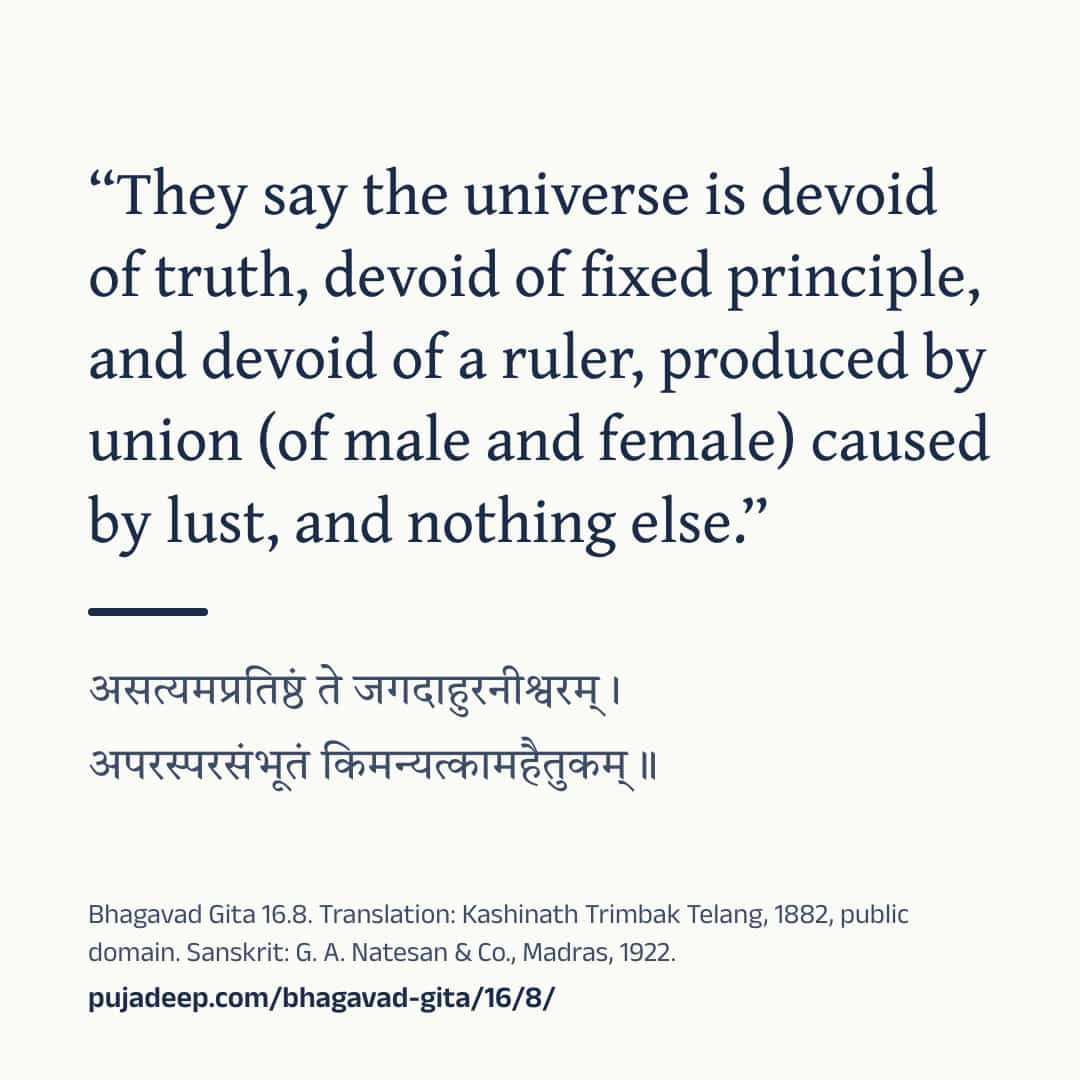
They say the universe is devoid of truth1, devoid of fixed principle2, and devoid of a ruler, produced by union (of male and female) caused by lust3, and nothing else.
Footnotes (the translator’s own) Compare 3 translations
Kashinath Trimbak Telang, 1882. Public domain. Page 115.
They say the universe is devoid of truth1, devoid of fixed principle2, and devoid of a ruler, produced by union (of male and female) caused by lust3, and nothing else.
Footnotes (the translator’s own) You are reading this one
Annie Besant, 1895. Public domain. Page 141.
"The universe is without truth, without (moral) basis," they say, "without a God1, brought about by mutual union and caused by lust and nothing else."
Footnotes (the translator’s own) - Îshvara, the Ruler of a Universe, ↩
You are reading this one
Swami Swarupananda, 1909 (first printed 1907). Public domain. Page 298.
They say, "The universe is without truth, without (moral) basis, without a God, brought about by mutual union, with lust for its cause; what else?"
You are reading this one
Cite this verse
The translation: K. T. Telang, The Bhagavadgîtâ (The Sacred Books of the East, vol. VIII, Oxford: Clarendon Press, 1882), p. 115. Bhagavad Gita 16.8.
The translation: Annie Besant, The Bhagavad Gîtâ, or The Lord's Song (London: Theosophical Publishing Society, 1895), p. 141. Bhagavad Gita 16.8.
The translation: Swami Swarupananda, Srimad-Bhagavad-Gita (Mayavati: Prabuddha Bharata Press, 1909; first printed in Prabuddha Bharata, 1907–1909), p. 298. Bhagavad Gita 16.8.
Our explanation: “Bhagavad Gita 16.8: meaning and translation.” Pujadeep. Updated October 25, 2026. https://pujadeep.com/bhagavad-gita/16/8/
Pujadeep’s explanations are free to quote with credit: name Pujadeep and link to the page. How to credit
Classical readings, by school
Each reading is named by its school. None is presented as the only meaning.
What Advaita, Vishishtadvaita and Dvaita teach, in short
Shankara Advaita
Shankara gives the words as these people's own claim: the world is unreal, as they are; dharma and adharma are not its basis; no Lord rules it; and the union of man and woman under desire is its only cause, with no unseen cause and no karma. In Shankara's reading this is the view of an old school of thought, the Lokāyatikas; Sastri renders his words 'This is the view of the materialists (Lokáyatikas), that sexual passion is the sole cause of all living creatures.' The identification is Shankara's: the verse names no school, and Ramanuja's comment names none.
Source: The Bhagavad-Gita, with the commentary of Sri Sankaracharya, translated by A. Mahadeva Sastri (2nd ed., Mysore: G. T. A. Printing Works, 1901), commentary on 16.8, pp. 376–377. Summarised in our own words; none of its text is reproduced.
Ramanuja Vishishtadvaita
Ramanuja reads asatya as 'not an effect of Brahman, who is the Truth', apratiṣṭha as 'not resting on Brahman', and anīśvara as 'not ruled by the Lord, whose will is never thwarted'. On this view, he says, the world is held to be nothing more than the offspring of male and female, with desire as its only cause.
Source: Sri Bhagavad-Gita with Sri Ramanujacharya's Visishtadvaita commentary, translated by A. Govindacharya (Madras, 1898), commentary on 16.8, p. 490. Summarised in our own words; none of its text is reproduced.
Share
Show the ways to share
Send one picture or the text to one chat. The picture names its source and the address of this page.
Drawing the picture
See the words
Bhagavad Gita 16.8

असत्यमप्रतिष्ठं ते जगदाहुरनीश्वरम् ।
अपरस्परसंभूतं किमन्यत्कामहैतुकम् ॥

“They say the universe is devoid of truth, devoid of fixed principle, and devoid of a ruler, produced by union (of male and female) caused by lust, and nothing else.”
(K. T. Telang, The Bhagavadgîtâ (The Sacred Books of the East, vol. VIII, Oxford: Clarendon Press, 1882), p. 115, public domain)

“"The universe is without truth, without (moral) basis," they say, "without a God, brought about by mutual union and caused by lust and nothing else."”
(Annie Besant, The Bhagavad Gîtâ, or The Lord's Song (London: Theosophical Publishing Society, 1895), p. 141, public domain)

“They say, "The universe is without truth, without (moral) basis, without a God, brought about by mutual union, with lust for its cause; what else?"”
(Swami Swarupananda, Srimad-Bhagavad-Gita (Mayavati: Prabuddha Bharata Press, 1909; first printed in Prabuddha Bharata, 1907–1909), p. 298, public domain)

Sanskrit: G. A. Natesan & Co., Madras, 1922.
https://pujadeep.com/bhagavad-gita/16/8/ Nothing is sent from this site. Your own app sends it, to the chat you choose. The picture quotes the translation you chose on this page, with its name and year.
Sanskrit text: The Bhagavad-Gita, or The Lord's Song, with the text in Devanagari and an English translation, 1922. Meanings: written for Pujadeep and checked against the cited edition. Source and changes
Questions families ask
Who speaks Bhagavad Gita 16.8?
Krishna speaks this verse, in chapter 16 (Daivasura Sampad Vibhaga Yoga).
Where does the Sanskrit text come from?
Sanskrit text: The Bhagavad-Gita, or The Lord's Song, with the text in Devanagari and an English translation, 1922. Meanings: written for Pujadeep and checked against the cited edition. See the source
Is the meaning on this page a translation?
Explanation written for this site from the sources listed here, and checked against the cited edition. It is not a translation and not the only way to read the text. Free to quote with credit.
Source and licence
- Sanskrit text
- The Bhagavad-Gita, or The Lord's Song, with the text in Devanagari and an English translation (Annie Besant, G. A. Natesan & Co., Madras, 1922). Public domain. The Sanskrit on these pages was read from this printing’s page images.
- Translation
- The Bhagavadgîtâ with the Sanatsugâtîya and the Anugîtâ, translated by Kâshinâth Trimbak Telang (The Sacred Books of the East, vol. VIII, ed. F. Max Müller) (Kashinath Trimbak Telang, F. Max Müller, Clarendon Press, Oxford, 1882). Public domain. Shown verbatim, as printed.
- Translation
- The Bhagavad Gîtâ, or The Lord's Song, translated by Annie Besant (Annie Besant, Theosophical Publishing Society, London, 1895). Public domain. Shown verbatim, as printed.
- Translation
- Srimad-Bhagavad-Gita, with Sanskrit Text; Paraphrase with Word-by-word Literal Translation; English Rendering and Comments, Index, &c., by the Swami Swarupananda (Himalayan Series, No. XX) (Swami Swarupananda, The Editors and Publishers, Advaita Ashrama, Mayavati, Prabuddha Bharata Press, Mayavati, Almora, Himalayas, 1909). Public domain. Shown verbatim, as printed.
- Commentary
- The Bhagavad-Gita, with the commentary of Sri Sankaracharya, translated by A. Mahadeva Sastri (2nd ed., Mysore: G. T. A. Printing Works, 1901) (Public-domain scan, University of California Libraries). Summarised in our own words; none of its text is reproduced.
- Commentary
- Sri Bhagavad-Gita with Sri Ramanujacharya's Visishtadvaita commentary, translated by A. Govindacharya (Madras, 1898) (Scan uploaded to archive.org (folkscanomy collection)). Summarised in our own words; none of its text is reproduced.
- Common wording
- In this text, 32 words follow today's common wording, checked against sanskritdocuments.org; Sanskrit Wikisource; Gita Press, Gorakhpur; GRETIL, Göttingen and Bhaktivedanta Book Trust.
- Our explanation
- Explanation written for this site from the sources listed here, and checked against the cited edition. It is not a translation and not the only way to read the text. Free to quote with credit.
- Checked
- Checked against the cited edition, October 14, 2026.
- Updated
- October 25, 2026