Bhagavad Gita 16.7: meaning and translation
Chapter 16: Daivasura Sampad Vibhaga Yoga. Krishna says
Krishna says that people of the asura nature do not know pravṛtti and nivṛtti: what to take up and what to turn away from.
Click or tap a word for its meaning and its dictionary page.
Text and layers
Text and layers
These choices stay in this browser.
Bhagavad Gita 16.7
प्रवृत्तिं च निवृत्तिं च जना न विदुरासुराः ।न शौचं नापि चाचारो न सत्यं तेषु विद्यते ॥
Pravrittim cha nivrittim cha jana na vidurasurahNa shaucham napi chacharo na satyam teshu vidyate
pravṛttiṃ ca nivṛttiṃ ca janā na vidurāsurāḥ |na śaucaṃ nāpi cācāro na satyaṃ teṣu vidyate ||
Our explanation Krishna says that people of the asura nature do not know pravṛtti and nivṛtti: what to take up and what to turn away from. In them there is no cleanness, no right conduct and no truth. The commentators explain the two words differently (see the views).
हिंदी अर्थ कृष्ण कहते हैं कि आसुरी स्वभाव वाले लोग प्रवृत्ति और निवृत्ति को नहीं जानते, यानी क्या करना है और किससे हटना है। उनमें न शौच (पवित्रता) है, न सदाचार, न सत्य। टीकाकार इन दो शब्दों को अलग-अलग ढंग से समझाते हैं।
Word by word
Every word, with its dictionary page
Word by word
- प्रवृत्तिम् pravṛttim · what to do, action (noun (feminine), accusative singular) Dictionary: pra-vṛtti, Monier-Williams 1899, p. 694, col. 1 “activity, exertion, efficacy, function”
- च ca · and (indeclinable) Dictionary: 2. ca, Monier-Williams 1899, p. 380, col. 1 “and, both, also, moreover, as well as”
- निवृत्तिम् nivṛttim · what to refrain from (noun (feminine), accusative singular) Dictionary: ni-vṛtti, Monier-Williams 1899, p. 560, col. 2 “ceasing from worldly acts, inactivity, rest, repose (opp. to pra-vṛtti)”
- च ca · and (indeclinable) Dictionary: 2. ca, Monier-Williams 1899, p. 380, col. 1 “and, both, also, moreover, as well as”
- जनाः janāḥ · people (noun (masculine), nominative plural) Dictionary: jana, Monier-Williams 1899, p. 410, col. 1 “creature, living being, man, person, race”
- न na · not (indeclinable) Dictionary: 2. na, Monier-Williams 1899, p. 523, col. 1 “not, no, nor, neither”
- विदुः viduḥ · know (perfect with present sense, 3rd person plural) Dictionary: 1. vid, Monier-Williams 1899, p. 963, col. 2 “to know, understand, perceive, learn”
- आसुराः āsurāḥ · of asura nature (adjective (masculine), nominative plural) Dictionary: 1. āsura, Monier-Williams 1899, p. 160, col. 3 “belonging or relating to the Asuras”
- न na · not (indeclinable) Dictionary: 2. na, Monier-Williams 1899, p. 523, col. 1 “not, no, nor, neither”
- शौचम् śaucam · purity (noun (neuter), nominative singular) Dictionary: śauca, Monier-Williams 1899, p. 1092, col. 3 “cleanness, purity, purification”
- न na · not (indeclinable) Dictionary: 2. na, Monier-Williams 1899, p. 523, col. 1 “not, no, nor, neither”
- अपि api · even (indeclinable) Dictionary: api, Monier-Williams 1899, p. 55, col. 1 “in the sense of even, also, very”
- च ca · and (indeclinable) Dictionary: 2. ca, Monier-Williams 1899, p. 380, col. 1 “and, both, also, moreover, as well as”
- आचारः ācāraḥ · good conduct (noun (masculine), nominative singular) Dictionary: ā-cāra, Monier-Williams 1899, p. 131, col. 3 “conduct, manner of action, behaviour, good behaviour, good conduct”
- न na · not (indeclinable) Dictionary: 2. na, Monier-Williams 1899, p. 523, col. 1 “not, no, nor, neither”
- सत्यम् satyam · truth (noun (neuter), nominative singular) Dictionary: satya, Monier-Williams 1899, p. 1135, col. 3 “true, real, actual, genuine, sincere, honest, truthful”
- तेषु teṣu · in them (pronoun (masculine), locative plural) Dictionary: tad, Monier-Williams 1899, p. 434, col. 1 “m. he, f. she, n. it, that, this”
- विद्यते vidyate · is found (present passive, 3rd person singular) Dictionary: 3. vid, Monier-Williams 1899, p. 965, col. 1 “to be found, exist, be”
Old translations
Kashinath Trimbak Telang, 1882. Public domain. Page 115.
Demoniac persons know not action or inaction1, neither purity nor yet (correct) conduct nor veracity are in them.
Footnotes (the translator’s own) - What should be done for the attainment of real good, and what should not be done as productive of mischief. See too p. 125. ↩
Compare 3 translations
Kashinath Trimbak Telang, 1882. Public domain. Page 115.
Demoniac persons know not action or inaction1, neither purity nor yet (correct) conduct nor veracity are in them.
Footnotes (the translator’s own) - What should be done for the attainment of real good, and what should not be done as productive of mischief. See too p. 125. ↩
You are reading this one
Annie Besant, 1895. Public domain. Page 141.
Âsuric men know not either action or inaction;1 nor purity (of body), nor even purity of conduct, nor truth is in them.
Footnotes (the translator’s own) - Religious action or inaction. ↩
You are reading this one
Swami Swarupananda, 1909 (first printed 1907). Public domain. Page 298.
The persons of Asuric nature know not what to do and what to refrain from; neither purity, nor conduct, nor truth is in them.
You are reading this one
Cite this verse
The translation: K. T. Telang, The Bhagavadgîtâ (The Sacred Books of the East, vol. VIII, Oxford: Clarendon Press, 1882), p. 115. Bhagavad Gita 16.7.
The translation: Annie Besant, The Bhagavad Gîtâ, or The Lord's Song (London: Theosophical Publishing Society, 1895), p. 141. Bhagavad Gita 16.7.
The translation: Swami Swarupananda, Srimad-Bhagavad-Gita (Mayavati: Prabuddha Bharata Press, 1909; first printed in Prabuddha Bharata, 1907–1909), p. 298. Bhagavad Gita 16.7.
Our explanation: “Bhagavad Gita 16.7: meaning and translation.” Pujadeep. Updated October 25, 2026. https://pujadeep.com/bhagavad-gita/16/7/
Pujadeep’s explanations are free to quote with credit: name Pujadeep and link to the page. How to credit
Classical readings, by school
Each reading is named by its school. None is presented as the only meaning.
What Advaita, Vishishtadvaita and Dvaita teach, in short
Shankara Advaita
Shankara reads pravṛtti and nivṛtti as the acts one should do to reach the human end and the acts one should keep from to avoid harm. Such people know neither, and they also lack purity, good conduct and truth.
Source: The Bhagavad-Gita, with the commentary of Sri Sankaracharya, translated by A. Mahadeva Sastri (2nd ed., Mysore: G. T. A. Printing Works, 1901), commentary on 16.7, p. 376. Summarised in our own words; none of its text is reproduced.
Ramanuja Vishishtadvaita
Ramanuja reads pravṛtti as the dharma the Veda enjoins for worldly prosperity and heaven, and nivṛtti as the dharma it enjoins for mokṣa. Cleanness is fitness for the work the Veda enjoins, and good conduct means practices such as the twilight prayers (sandhyā-vandana).
Source: Sri Bhagavad-Gita with Sri Ramanujacharya's Visishtadvaita commentary, translated by A. Govindacharya (Madras, 1898), commentary on 16.7, p. 489. Summarised in our own words; none of its text is reproduced.
Share
Show the ways to share
Send one picture or the text to one chat. The picture names its source and the address of this page.
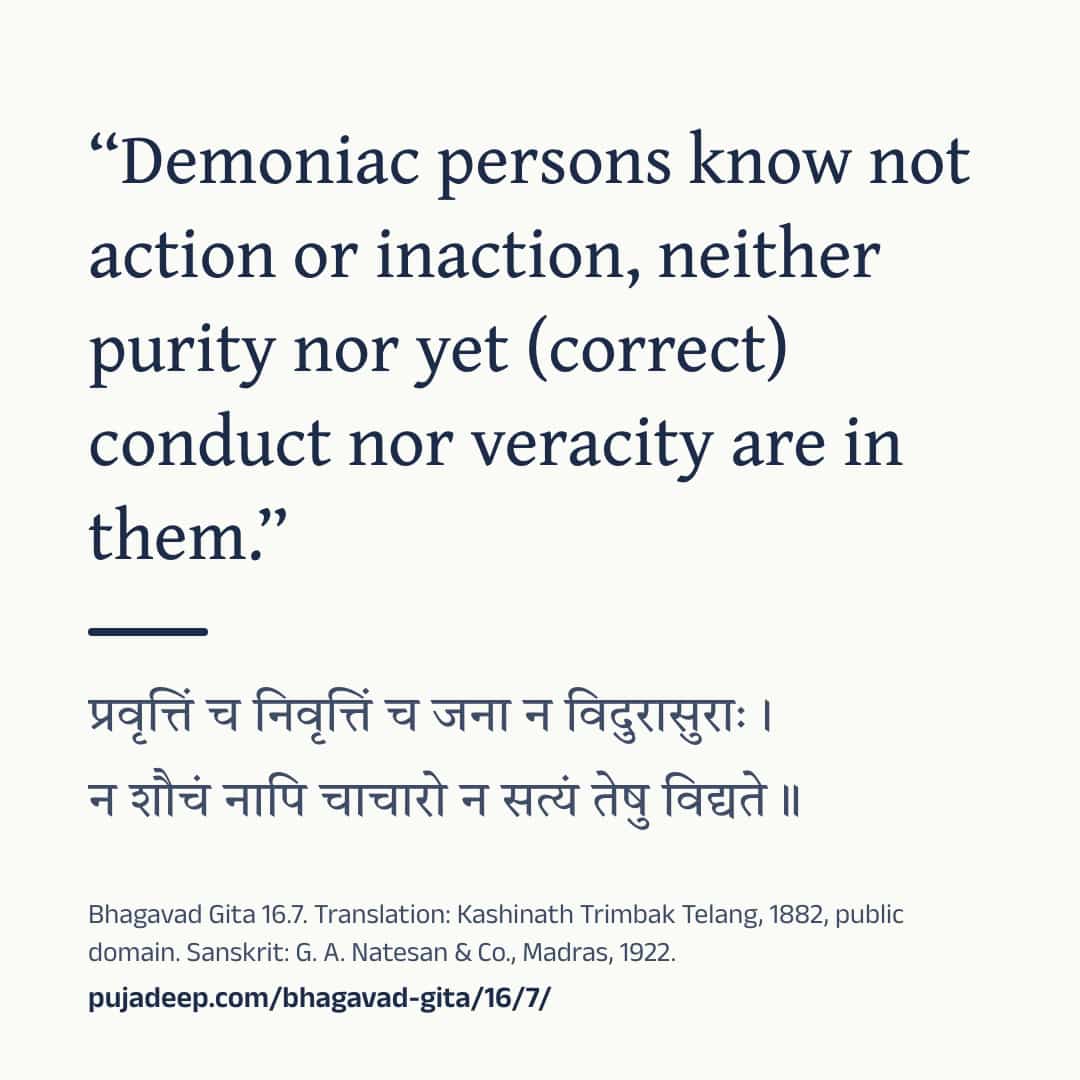
Drawing the picture
See the words
Bhagavad Gita 16.7

प्रवृत्तिं च निवृत्तिं च जना न विदुरासुराः ।
न शौचं नापि चाचारो न सत्यं तेषु विद्यते ॥

“Demoniac persons know not action or inaction, neither purity nor yet (correct) conduct nor veracity are in them.”
(K. T. Telang, The Bhagavadgîtâ (The Sacred Books of the East, vol. VIII, Oxford: Clarendon Press, 1882), p. 115, public domain)

“Âsuric men know not either action or inaction; nor purity (of body), nor even purity of conduct, nor truth is in them.”
(Annie Besant, The Bhagavad Gîtâ, or The Lord's Song (London: Theosophical Publishing Society, 1895), p. 141, public domain)

“The persons of Asuric nature know not what to do and what to refrain from; neither purity, nor conduct, nor truth is in them.”
(Swami Swarupananda, Srimad-Bhagavad-Gita (Mayavati: Prabuddha Bharata Press, 1909; first printed in Prabuddha Bharata, 1907–1909), p. 298, public domain)

Sanskrit: G. A. Natesan & Co., Madras, 1922.
https://pujadeep.com/bhagavad-gita/16/7/ Nothing is sent from this site. Your own app sends it, to the chat you choose. The picture quotes the translation you chose on this page, with its name and year.
Sanskrit text: The Bhagavad-Gita, or The Lord's Song, with the text in Devanagari and an English translation, 1922. Meanings: written for Pujadeep and checked against the cited edition. Source and changes
Questions families ask
Who speaks Bhagavad Gita 16.7?
Krishna speaks this verse, in chapter 16 (Daivasura Sampad Vibhaga Yoga).
Where does the Sanskrit text come from?
Sanskrit text: The Bhagavad-Gita, or The Lord's Song, with the text in Devanagari and an English translation, 1922. Meanings: written for Pujadeep and checked against the cited edition. See the source
Is the meaning on this page a translation?
Explanation written for this site from the sources listed here, and checked against the cited edition. It is not a translation and not the only way to read the text. Free to quote with credit.
Source and licence
- Sanskrit text
- The Bhagavad-Gita, or The Lord's Song, with the text in Devanagari and an English translation (Annie Besant, G. A. Natesan & Co., Madras, 1922). Public domain. The Sanskrit on these pages was read from this printing’s page images.
- Translation
- The Bhagavadgîtâ with the Sanatsugâtîya and the Anugîtâ, translated by Kâshinâth Trimbak Telang (The Sacred Books of the East, vol. VIII, ed. F. Max Müller) (Kashinath Trimbak Telang, F. Max Müller, Clarendon Press, Oxford, 1882). Public domain. Shown verbatim, as printed.
- Translation
- The Bhagavad Gîtâ, or The Lord's Song, translated by Annie Besant (Annie Besant, Theosophical Publishing Society, London, 1895). Public domain. Shown verbatim, as printed.
- Translation
- Srimad-Bhagavad-Gita, with Sanskrit Text; Paraphrase with Word-by-word Literal Translation; English Rendering and Comments, Index, &c., by the Swami Swarupananda (Himalayan Series, No. XX) (Swami Swarupananda, The Editors and Publishers, Advaita Ashrama, Mayavati, Prabuddha Bharata Press, Mayavati, Almora, Himalayas, 1909). Public domain. Shown verbatim, as printed.
- Commentary
- The Bhagavad-Gita, with the commentary of Sri Sankaracharya, translated by A. Mahadeva Sastri (2nd ed., Mysore: G. T. A. Printing Works, 1901) (Public-domain scan, University of California Libraries). Summarised in our own words; none of its text is reproduced.
- Commentary
- Sri Bhagavad-Gita with Sri Ramanujacharya's Visishtadvaita commentary, translated by A. Govindacharya (Madras, 1898) (Scan uploaded to archive.org (folkscanomy collection)). Summarised in our own words; none of its text is reproduced.
- Common wording
- In this text, 32 words follow today's common wording, checked against sanskritdocuments.org; Sanskrit Wikisource; Gita Press, Gorakhpur; GRETIL, Göttingen and Bhaktivedanta Book Trust.
- Our explanation
- Explanation written for this site from the sources listed here, and checked against the cited edition. It is not a translation and not the only way to read the text. Free to quote with credit.
- Checked
- Checked against the cited edition, October 14, 2026.
- Updated
- October 25, 2026